Bob Schwartz

Category: War

Veterans Day and Busby Berkeley

Gold Diggers of 1933
Gold Diggers of 1933 may be the strangest of all classic movies—and the one that has the most to say about Veterans Day 2013.

It is classic because it is still entertaining: snappy, cynical dialogue; singing and dancing that may be a little out of style, but Busby Berkeley production numbers that are still wonders of the world, in part because they were actually performed and filmed on sound stages—no special effects or shortcuts. Your jaw will drop in astonishment and delight.

The strangeness is that framing this jollity is a movie about the Depression—not as a backdrop but about it, head on. Nowhere is this incongruity more obvious than the close of the movie. There is a penultimate mega-happy ending, where the three down-on-their-luck showgirls marry the three rich Boston bluebloods. But just then, there is one last song and production number: Remember My Forgotten Man.

In 1932, most veterans of World War I were out of work, as were so many others. In 1924 the government had authorized a longstanding practice of offering bonuses to those who served in war. This took the form of Certificates of Service, which matured over 20 years, and were to be paid in annual installments. But in the midst of the Depression, the veterans didn’t need that money down the road—they needed it right now. A movement for immediate redemption of the certificates gained momentum (the amount was tens of billions of dollars in today’s money). So in 1932, 43,000 marchers—veterans, their families and their supporters—gathered in Washington in what came to be called the Bonus Army, to demand cash payment. This was rebuffed. President Hoover and Republicans in Congress believed that this would require a tax increase, and that a tax increase would delay the recovery of the economy.

These were the Forgotten Men. As the tragic climax of a musical comedy, we watch a sordid street scene, narrated in song by Gingers Rogers. She is now surviving as a prostitute, married to a war veteran abandoned by the government and the nation. On stage we see the troops marching off in glory to cheers and flag-waving, only to return broken and injured, with no one to greet or comfort them—or even to remember them.

Remember My Forgotten Man

I don’t know if he deserves a bit of sympathy,
Forget your sympathy, that’s all right with me.
I was satisfied to drift along from day to day,
Till they came and took my man away.

Remember my forgotten man,
You put a rifle in his hand;
You sent him far away,
You shouted, “Hip, hooray!”
But look at him today!

Remember my forgotten man,
You had him cultivate the land;
He walked behind the plow,
The sweat fell from his brow,
But look at him right now!

And once, he used to love me,
I was happy then;
He used to take care of me,
Won’t you bring him back again?
‘Cause ever since the world began,
A woman’s got to have a man;
Forgetting him, you see,
Means you’re forgetting me
Like my forgotten man.

Maybe the musicals of the 1930s are old-fashioned and for a lot of people unwatchable. Maybe Busby Berkeley is just some campy choreographer whose over-the-top numbers are funny but incomparable to today’s digital masterpieces. Then again, maybe ending a popular entertainment with a bleak and uncompromising plea to our national conscience isn’t a bad idea—and never goes out of style. Remember Our Forgotten People, circa 2013.

There Is Still a War in Syria

Paris Hilton As Miley Cyrus
When there was less to people’s news and info lives—a newspaper or two a day, a half-hour network news show, a couple of news magazines a week—there were stories that rose to the top and stayed there, depending on importance. This didn’t mean that second-tier or frivolous stories didn’t get coverage or traction. People always loved celebrities, always loved hearing gossip, and when man bites dog, that’s always news. The down side was a certain provincialism that came with a narrow channel and less worldly attitudes: if millions were suffering in a place nobody heard of, with people unlike us, most readers and viewers might have no idea.

Now we can know anything, though we don’t know everything, or care about everything. This has left news leaders in a delicate position. There are going to be stories that appeal to a journalist sense and a humanist sense, that deserve at least regular mention, if not coverage that might only say, “And in the misery of this place or that war, it’s still happening, with no end in sight.” The dual problem is that people can find and figure that out for themselves, without a multi-billion dollar media enterprise telling them, and those media consumers might just as well pay attention to something else.

Which is why, unlike its predecessors World War II, Korean War and Vietnam War, the Iraq War was not the top story every day of its ten years. Which is why the current violence in Iraq is barely covered, a turning away that in part must come from some profound but unspoken embarrassment.

For a few moments a few months ago, Syria was a bright shiny object. Red lines, chemical warfare, threats of military action, etc. After some erratic movement, slight progress is being made. But that progress does not include ending the civil war.

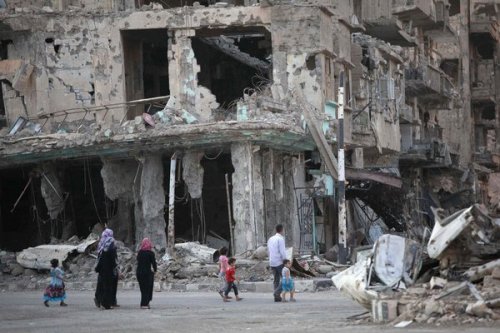
The New York Times, still possibly the world’s greatest news enterprise, has an ongoing section devoted to the Crisis in Syria. The increasing numbers stupefy: 6.5 million Syrians displaced from their homes, more than 2 million of them seeking refuge in other countries. Now we hear about a cluster of polio cases among Syrian children.

We have plenty of our own problems, individually and as a country. Some of those are not small at all. But there is no polio. And the entire population of the state of Tennessee or Indiana has not had to leave their homes behind, dodging mayhem, unsure if they will ever return, or if there will be anything to return to.

We shouldn’t expect ourselves to be exhausted or crushed by the miseries of the world; that’s what keeping track of all the problems all the time would do. So yes, you can argue that it is important to learn from the news today that Paris Hilton has spent $5,000 on Halloween costumes so that she can dress up as Miley Cyrus. But for a change of pace, a regular, maybe daily, reminder that there is still a war in Syria might be of value.

Which Comes First: Evolution or Revolution?

Tea Party
The 20th century gave us two world wars and an atomic bomb, but the most interesting of the Big Events of the century may be the Russian Revolution. An inequitable and unbalanced way of life gave bloody way to abstract enlightened visions of a better world. The particular inequities ended, Russia moved into modern times, but competition for the “right” vision and ineradicable baser human natures seeking power and control led to decades of national and global troubles. “Meet the new boss, same as the old boss,” the Who said.

The Russian Revolution was grounded in a Marxist vision, which was in turn a Christian vision: a community on earth as it is in heaven, a brotherhood of people in which suffering and want would be softened, if not alleviated, by those who have a surplus of comfort and resource. It was Lennon, not Marx, who said, “You can say I’m a dreamer, but I’m not the only one. I hope someday you’ll join us, and the world will live as one.”

What went wrong?

What almost always goes wrong is that evolution and revolution are out of sync. It is easy to say that people and society should first evolve for a while, and then at some critical moment, all that’s needed is that next faster-than-evolution event to take it to the next level.

That turns out rarely to be the case.

Evolution is slow, erratic, and always engenders resistance and reaction. The cliché is that people and society fear change, but that is too easy. They fear the unknown. The expression “better the devil you know than the one you don’t” sums it up. It takes a substantial leap—you might say a leap of faith—the walk into a vision rather than remain in a lesser but familiar reality.

Revolution is both an attempt to make evolution more real and to create conditions where that evolution can continue more broadly and forcefully. But, as pointed out with the Russian experience, it doesn’t always work that way. Revolution is conflict, and conflict creates its own set of conditions sometimes antithetical to evolution. “Fighting for peace” is oxymoronic (some would say just plain moronic), but we have had to live through that. (Note the moment in Stanley Kubrick’s brilliant film Dr. Strangelove where the President scolds his arguing advisers, “Stop it. There’s no fighting in the War Room.”)

One of the exceptional examples of evolution and revolution working together is the American Revolution. It is one of the reasons it worked so well. The founders may have been the fathers of our country, but they were the children of the Enlightenment. That multi-faceted evolution—philosophical, political, economic, spiritual—had gone as far as it could go when it hit a wall. They believed that if they could break through, which did mean war, they could establish an enlightened nation. And, to an extent greater or lesser than some might like or expect, they did.

Evolution, or lack of it, is at the heart of some current American problems.

America is heir to two great evolutions, sometimes unrecognized, often distorted. Some of those obstructionists who fight today hark back to the patriots who were mad as hell and wouldn’t take it any more, and so upended a cargo of British tea. Others who claim this is a Christian nation have the idea that if alive today, Jesus would certainly choose to be an American.

Every American in these dynamic times is free to pick the evolution they aspire to. There are plenty to choose from. We do have two very big ones on the menu. If a rabid revolutionary patriot, you might choose to follow the path of a 21st century version of Enlightenment; you might even study the work of those founding Enlightenists—Jefferson, Madison, Monroe, et al.—for guidance. If a committed Christian it’s even easier. No slogging through the Federalist Papers, or even the whole Bible. Just read and read again the words of Jesus—the ones in red type—and consider just how much evolution he was asking for and expecting. Then again, maybe it’s not evolution he was talking about at all.

Syria: So This Was the Plan All Along

The Sting
The Syria strategy may have looked improvised or haphazard. It turns out that all along it was a master plan. A sting. A long con. Aimed at having Assad turn over his chemical weapons.

It began with President Obama’s mention of a chemical weapons red line two years ago. Even after there was evidence that chemical weapons were being used a year ago, it was too soon to make a play. And then it was time.

Everybody knew their part. The President beat the limited and unbelievably small war drums. The international community and Congress demurred, feigning reluctance. Most of all, John Kerry’s penchant for overtalking was the most valuable tool. One loose remark after another, and then the trap was sprung. He mentioned the “impossible” possibility that Assad would turn over his chemical weapons in a week. The State Department would pretend that this offhanded remark was not administration policy. Assad and his Russian handler took the bait. Very soon—maybe not a week but soon—Syrian chemical weapons would be in the hands of the international community, ready to be destroyed.

Back in the real world, here is another possible behind the scenes scenario.

John Kerry continued to say stuff, lots of stuff. Asked if there was any way for Assad to avoid a strike, Kerry did indeed mention turning over the chemical weapons in a week. It was an accident.

Vladimir Putin and Bashar al-Assad are power hungry political survivors, one more venal and voracious than the other. One or both of them sensed an opening.

It was Putin who may have said: This chemical weapons business is bad for all of us. The world knows you are our client state, and while I don’t mind defending you most of the time, this isn’t in either of our best interests. You can do whatever you want to hold on to power by conventional means; we will continue to help. The chemical weapons can be our trump card and it is time to play it. Once we come to the table, we can keep this negotiation going for months. As long as there is the appearance or the slightest possibility of progress, there will be no military action. Meanwhile, you can continue to pursue your war with no interference. I get to look a little bit like a hero and statesman—I don’t expect miracles—and you get to look like someone who isn’t averse to being part of civilized humanity. We both win.

The American scenario is already unfolding. While the administration is cautious about this latest development, it does claim that whatever good comes out of it will be due to their willingness to respond militarily. For the moment, it is hard to say who is more relieved, the President or Congress. The President may avoid having his request for authorization turned down. In Congress, those who continued to sit on the fence may be gloating, as a vote may be delayed or never taken.

And John Kerry? With all due respect, when you are smart and articulate, if you keep talking long enough, something good is bound to happen.

John Kerry: A Teeny, Tiny, Unbelievably Small Strike

Cruise Missile
Secretary of State John Kerry says the strike against Syria would be “unbelievably small” (“teeny, tiny” is inferred).

The job of Secretary of State is unbelievably big. More than just the nation’s chief diplomat, the secretary is in the line of presidential succession, following the Vice President, Speaker of the House and President Pro Tem of the Senate. Six American Presidents have served in the office, along with two of the most famous Chief Justices—John Jay and John Marshall—and an army of legendary figures, including Daniel Webster twice.

Throughout the Syria crisis so far, John Kerry has had some trouble when he speaks. His appearance before Congressional committees has been widely viewed as underwhelming. His comparing Assad to Hitler, talking about a “Munich moment,” was mostly ignored. And now he is trying to minimize attacking targets in Syria as “unbelievably small.” It isn’t clear that this is a diplomatic term of art. Hopefully, it is not a military term of art. If it is artful anywhere, it might find its place in a casual conversation between friends.

John Kerry has already been getting a pass from the media on past statements, no doubt out of respect for his no longer being a politician. So what he might have said as a Senator and presidential candidate may be out of bounds. Such as

“If you don’t believe…Saddam Hussein is a threat with nuclear weapons, then you shouldn’t vote for me.” February 11, 2003

The real dilemma is how to downplay the nature of the strike while maximizing its claimed ability to achieve either the stated aim to deter further chemical warfare or, as some would like it, to change the balance of power in the civil war. This is less like squaring the circle and more like rounding the tesseract (a four-dimensional cube).

Whatever the rhetorical trick that is being tried, it is not working. Or at least talking about a teeny, tiny, unbelievably small strike isn’t.

Syria Videos and the ASPCA

ASPCA Ad
Almost everyone knows the Sarah McLachlan television ad for the ASPCA, her haunting song Angel playing as background for heart-tugging scenes of cats and dogs. It is widely reviled and sometimes mocked: some viewers can’t lunge quickly enough for the remote. It is also one of the most successful fundraising ads ever, considered by some a game changer.

This weekend, supporters of a military strike against Syria are using a similar approach. Horrific videos of victims, especially children, in the throes of chemical warfare in Syria are now circulating.

Emotional rather than rational appeals have to be carefully calibrated. There may be a sense that the emotional appeal is a last resort, because your rational argument is weak or failing. Viewers may also feel unduly manipulated, even insulted, by the premise that they are too stupid or uncaring to get the point otherwise. Finally, disgust may take over, nearly making further appreciation of whatever good arguments there are impossible to hear.

The ASPCA ad worked not because people were entirely guiltily coerced into giving. Those who did manage to stay and were not turned off had an aha moment: you know, I thought about it some more, and I get the point. Animals are mistreated and homeless, something I care about, and I can help.

This is where the Syria horror show falls down. Even when those who aren’t disgusted to the point of numbness think about it, they have trouble getting the point because, even if there is or once was a focused point in Syria, it keeps shifting, as do the rationales, as do the discussions of outcomes.

If you give to the ASPCA, there is reasonable certainty that your donation will go to programs reasonably designed to help mistreated and homeless animals. If you give your approval and support to an attack on Syria, what exactly are you getting for that donation?

Extreme emotional appeals are not necessarily illegitimate; in some cases, as with the Holocaust, they are necessary. But care is the keynote, knowing exactly what you are saying in support of what you are showing. Right now, the Syria videos are being shown in the context of a bunch of different explanations. The audience is left not only with uncertainty about where it all leads or should lead, but with a diminished regard for the presenter. These are serious times, and when the presenter is the President of the United States, none of us can afford that.

“Pentagon Is Ordered to Expand Potential Targets in Syria With a Focus on Forces”

Syria

This headline— Pentagon Is Ordered to Expand Potential Targets in Syria With a Focus on Forces—is from a New York Times story yesterday. It has not been as widely reported as it should. And it should, because it might make some people more uneasy than they already are.

The story begins:

President Obama has directed the Pentagon to develop an expanded list of potential targets in Syria in response to intelligence suggesting that the government of President Bashar al-Assad has been moving troops and equipment used to employ chemical weapons while Congress debates whether to authorize military action.

Mr. Obama, officials said, is now determined to put more emphasis on the “degrade” part of what the administration has said is the goal of a military strike against Syria — to “deter and degrade” Mr. Assad’s ability to use chemical weapons. That means expanding beyond the 50 or so major sites that were part of the original target list developed with French forces before Mr. Obama delayed action on Saturday to seek Congressional approval of his plan.

For the first time, the administration is talking about using American and French aircraft to conduct strikes on specific targets, in addition to ship-launched Tomahawk cruise missiles. There is a renewed push to get other NATO forces involved.

The strikes would be aimed not at the chemical stockpiles themselves — risking a potential catastrophe — but rather the military units that have stored and prepared the chemical weapons and carried the attacks against Syrian rebels, as well as the headquarters overseeing the effort, and the rockets and artillery that have launched the attacks, military officials said Thursday….

Obviously we are not going to blow up stockpiles of chemical weapons, even assuming we know where they are. But this news puts the question in starker relief. If our goal is to both punish Assad and to reduce the possibility of his using chemical weapons again, we are not going to do that by taking them out of his hands. But if not that way, then how? And the answer from this report is that we intend to weaken his ability to make war more generally—because the people and equipment that make chemical warfare possible are the same ones that make the overall bloody war on his people possible. And at that point, intentionally or incidentally, we have generally intervened in the conflict, no matter how limited the basis.

And that, as this news report helps clarify, is what is bothering members of Congress, members of the military and a lot of Americans.

Yellowcake and Red Line: The Colors of Casus Belli

Yellowcake
You may not remember yellowcake. Not the kind you eat. The kind that is uranium, the stuff of nuclear fission, the stuff of weapons of mass destruction, the stuff that was supposed to be in Iraq but was never found there.

Colors seem to be troublesome in talking about reasons for going to war. So maybe President Obama should have picked a different metaphor than red line. Line in the sand comes to mind. Of course, lines in the sand have a different quality. They are harder to see, and are subject to being erased by wind or water, or by a quick brush of the foot.

Maybe better to stay away from colors and lines altogether, and instead do the much harder, painful and less appealing work, leaders and citizens, of talking honestly about our strengths and limitations, the world we have and the one we want to have, and how to practically and ideally get from here to there. That would be a nice grownup change from childish colors and macho ultimata.

What Would Truman Do?

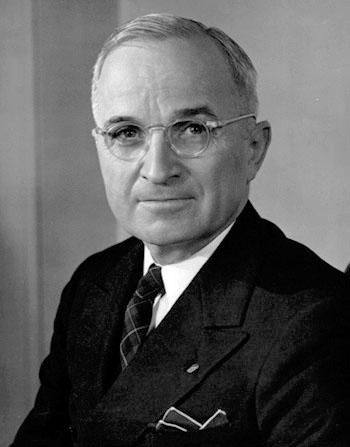
Harry Truman
Harry Truman is maybe the most interesting American President of the twentieth century, and maybe the most significant.

He held a power that no one had held in human history and he took the decision to use it. He had no precedent to guide him—except maybe God in the Bible. He dropped atomic bombs on Hiroshima and Nagasaki. From that point forward, everyone who uses nuclear weapons will be the second or third to do it.

He is also the only President in the twentieth century without a college degree, and one of the relatively few in American history. Grover Cleveland was the last before him. But there are some before that who did manage to stand out without college, such as George Washington and Abraham Lincoln.

Obama shares some things with Truman, and on other scores couldn’t be more unlike. Truman was an unabashed though pragmatic reformer: he used executive power to desegregate the military, but his Fair Deal liberal agenda failed in the face of a recalcitrant Republican Congress. Truman’s second term was the model for all other second term disasters, marked by a war that was both unpopular and unsuccessful and by a President whose effectiveness was a constant question.

Unlike Obama, Truman was not a spell-binding orator or a scholar. He had come up through politics and to the Senate the old back room way, and his ascension to the 1944 presidential ticket was a matter of political manipulation and happenstance. The legendary 1948 election pitted him against the dapper, smooth talking, hard-nosed, well-educated federal prosecutor and New York Governor. It was considered no contest for Thomas E. Dewey. Truman won.

The reasons that Truman has risen to the top ten on nearly all lists of great American Presidents (he is number 5 on a few) are many. This puts him in the range of both Roosevelts, TR and FDR, both of whom went to Harvard, both of them charismatic patricians with colorful histories and silver tongues. Among Truman’s gifts, the one most associated with him was a plain-spoken decisiveness in word and deed, even if the decision turned out troublesome or wrong.

There were reasons to like Truman at the time of his presidency, and a number of reasons not to. But there was a sense—even those who were his enemies at the time acknowledge it and historians have come to treasure it—that underneath it all was a man who had fought in a world war (only a few Presidents have), a man who had lived a modest life, a man who knew how to practice politics, a man who could surprise by analyzing deeply, a man who faced with the prospect of killing hundreds of thousands of people in a moment gave the order to do it.

Plain speaking. Decisive action. Truman was not the ideal President because there is no such thing. But at every critical juncture, it can’t hurt to ask: what would Truman do?

Syria Indecision: Give Them A (Small) Break

Decision Tree
Hard cases make bad law.

This is a maxim of the legal process. Roughly, it means that cases with lots of moving parts, with lots of collateral considerations, with no clear and straight path to resolution, produce rulings that are unsettling and unsatisfactory and, worse, have limited or counterproductive effect down the road.

Maybe the corollary is that hard foreign cases make bad foreign policy.

The indecision of Congressfolk is usually vexing, as so many of them claim to be weighing the factors, all the while putting their finger in the air to feel which way the wind blows.

This decision on attacking Syria seems to be different. There are certainly plenty of politicians who are trying to look thoughtful as they assess potential electoral damage. But this situation is so complex that for the moment, despite the usual frustration as a voter and citizen, a number of the Senators and Representatives deserve a little bit of a break. A lot of them are understandably having real trouble figuring out what to do—as are many of us.

The complexity isn’t just the result of a force of nature, and isn’t even due entirely to Assad. President Obama may have handled Syria with some degree of insight, intelligence and integrity, but he has made a difficult situation much harder. It is now widely agreed that announcing a chemical weapon “red line” long ago without a clear plan—public or at least private—to respond if and when it was crossed was a mistake. This contingency plan did not have to be tactically certain: how much evidence to need, which particular sites would be targeted. But the much bigger strategic issues—objectives and the dizzying range of possible consequences, good and bad—should have been vetted in all sorts of venues, including Congress.

That didn’t happen. So in short order, we are discussing the international conventions on chemical warfare, the forensics of discovering the use of chemical weapons, our ability to execute a limited strike, all the more or less likely impacts of a limited strike, the interpretation of the history of all our recent wars, comparison of our current situation to all those wars, and even the question of what exactly war is. So we have the Chairman of the Joint Chiefs of Staff telling a House committee this week that an air strike such as the one contemplated would be an act of war, while Secretary of State John Kerry, sitting right beside him, begged to differ: “We don’t believe we are going to war, in the classic sense of taking American troops and America to war.”

Americans are also being asked to learn more about a country and civil conflict that was often regarded as a video clip, sound bite or talking point—including discovering the shocking news that two million people are currently refugees from Syria (including one million children), leaving their country at a rate of one million people every six months.

Among those more or less likely impacts, there is a possibility that even this small action could precipitate wider and deeper crises, ones that might make our previous (mis)adventures look relatively small. We can’t be sure, of course, of this or just about anything else right now.

That’s a lot to discuss and digest. But we only have a few weeks, or so we are told. So, while Congress may be the most disliked institution in the country, seemingly stuffed with people who are uncertain about the proper ratio of self-interest to national interest, on this they are going to get a brief pass while they really do contemplate a genuinely serious and complicated situation. But after that break, when confusion is no longer an option, because deciding is the reason they get the honor and the big bucks, we expect them to vote conscientiously and to explain their vote clearly and unequivocally.

One more small matter: If any of them do vote “Present” in the final roll call on this, they should be expected to fall on their sword and offer their resignation forthwith. With only an 11% approval rate (and dropping), Congress doesn’t have room for any more of that sort of mushy politics.