Bob Schwartz

Category: Uncategorized

Barbara Jordan’s speech to the House Judiciary Committee on the impeachment of President Nixon, July 24, 1974
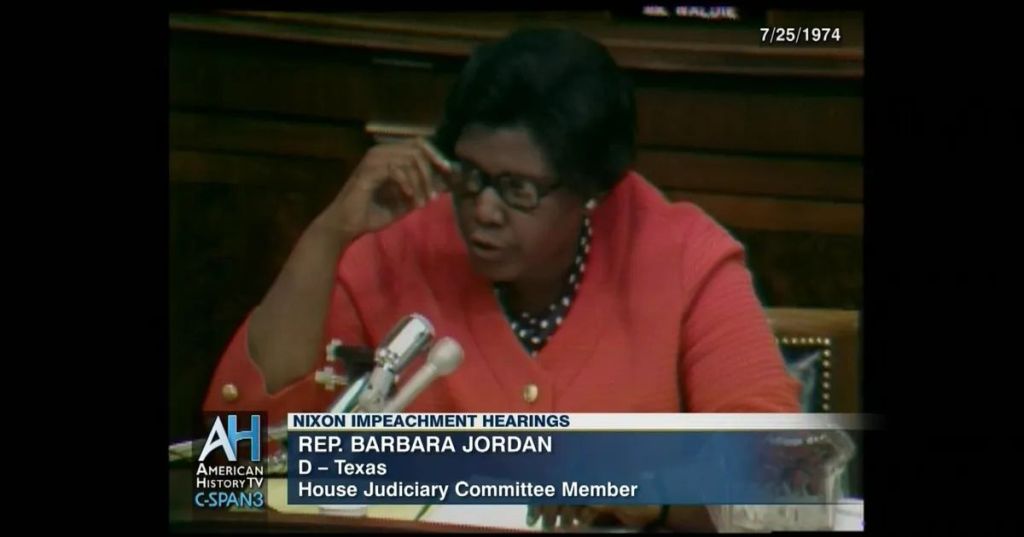
If you know little or nothing about American history, government and Constitution, little or nothing about Congresswoman Barbara Jordan , read and listen to this speech.

It is regarded as one of the great speeches in American history. According to one list, Barbara Jordan gave two of the greatest speeches: Number 5 (keynote address to the Democratic National Convention in 1976) and Number 13 (this speech).

This is not to suggest that Trump, whose conduct has far exceeded Nixon’s, should be impeached. On the contrary, efforts to impeach Trump during his first term failed, and would pointlessly fail now. Unless possibly a current member of Congress equal to Barbara Jordan could deliver an equivalent speech, which might make it worth it. With all due respect, that is not going to happen.


Congresswoman Barbara Jordan’s July 24, 1974 speech to the House Judiciary Committee

Mr. Chairman, I join my colleague Mr. Rangel in thanking you for giving the junior members of this committee the glorious opportunity of sharing the pain of this inquiry. Mr. Chairman, you are a strong man, and it has not been easy, but we have tried as best we can to give you as much assistance as possible.

Earlier today, we heard the beginning of the Preamble to the Constitution of the United States: “We, the people.” It’s a very eloquent beginning. But when that document was completed, on the seventeenth of September in 1787, I was not included in that “We, the people.” I felt somehow, for many years, that George Washington and Alexander Hamilton just left me out by mistake. But through the process of amendment, interpretation, and court decision, I have finally been included in “We, the people.”

Today I am an inquisitor. An hyperbole would not be fictional and would not overstate the solemness that I feel right now. My faith in the Constitution is whole; it is complete; it is total. And I am not going to sit here and be an idle spectator to the diminution, the subversion, the destruction of the Constitution.

“Who can so properly be the inquisitors for the nation as the representatives of the nation themselves?” “The subjects of its jurisdiction are those offenses which proceed from the misconduct of public men.” And that’s what we’re talking about. In other words, from the abuse or violation of some public trust.

It is wrong, I suggest, it is a misreading of the Constitution for any member here to assert that for a member to vote for an article of impeachment means that that member must be convinced that the President should be removed from office. The Constitution doesn’t say that. The powers relating to impeachment are an essential check in the hands of the body of the Legislature against and upon the encroachments of the Executive. The division between the two branches of the Legislature, the House and the Senate, assigning to the one the right to accuse and to the other the right to judge, the Framers of this Constitution were very astute. They did not make the accusers and the judgers—and the judges the same person.

We know the nature of impeachment. We’ve been talking about it awhile now. It is chiefly designed for the President and his high ministers to somehow be called into account. It is designed to “bridle” the Executive if he engages in excesses. “It is designed as a method of national inquest into the conduct of public men.” The Framers confided in the Congress the power, if need be, to remove the President in order to strike a delicate balance between a President swollen with power and grown tyrannical, and preservation of the independence of the Executive.

The nature of impeachment: a narrowly channeled exception to the separation-of-powers maxim; the Federal Convention of 1787 said that. It limited impeachment to high crimes and misdemeanors and discounted and opposed the term “maladministration.” “It is to be used only for great misdemeanors,” so it was said in the North Carolina ratification convention. And in the Virginia ratification convention, “We do not trust our liberty to a particular branch. We need one branch to check the other.” “No one need be afraid,”—the North Carolina ratification convention—“No one need be afraid that officers who commit oppression will pass with immunity.” “Prosecutions of impeachments will seldom fail to agitate the passions of the whole community,” said Hamilton in the Federalist Papers, number 65. “We divide into parties, more or less friendly or inimical to the accused.” I do not mean political parties in that sense.

The drawing of political lines goes to the motivation behind impeachment, but impeachment must proceed within the confines of the constitutional term “high crime and misdemeanors.”

Of the impeachment process, it was Woodrow Wilson who said that “Nothing short of the grossest offenses against the plain law of the land will suffice to give them speed and effectiveness. Indignation so great as to overgrow party interest may secure a conviction, but nothing else can.”

Common sense would be revolted if we engaged upon this process for petty reasons. Congress has a lot to do: appropriations, tax reform, health insurance, campaign finance reform, housing, environmental protection, energy sufficiency, mass transportation. Pettiness cannot be allowed to stand in the face of such overwhelming problems. So today we are not being petty. We are trying to be big because the task we have before us is a big one.

This morning in a discussion of the evidence, we were told that the evidence which purports to support the allegations of misuse of the CIA by the President is thin. We’re told that that evidence is insufficient. What that recital of the evidence this morning did not include is what the President did know on June the 23rd, 1972. The President did know that it was Republican money, that it was money from the Committee for the Re-Election of the President, which was found in the possession of one of the burglars arrested on June the 17th.

What the President did know on the 23rd of June was the prior activities of E. Howard Hunt, which included his participation in the break-in of Daniel Ellsberg’s psychiatrist, which included Howard Hunt’s participation in the Dita Beard ITT affair, which included Howard Hunt’s fabrication of cables designed to discredit the Kennedy Administration.

We were further cautioned today that perhaps these proceedings ought to be delayed because certainly there would be new evidence forthcoming from the President of the United States. There has not even been an obfuscated indication that this committee would receive any additional materials from the President. The committee subpoena is outstanding, and if the President wants to supply that material, the committee sits here.

The fact is that on yesterday, the American people waited with great anxiety for eight hours, not knowing whether their President would obey an order of the Supreme Court of the United States.

At this point, I would like to juxtapose a few of the impeachment criteria with some of the actions the President has engaged in.

Impeachment criteria: James Madison, from the Virginia ratification convention: “If the President be connected in any suspicious manner with any person and there be grounds to believe that he will shelter him, he may be impeached.”

We have heard time and time again that the evidence reflects the payment to defendants’ money. The President had knowledge that these funds were being paid and these were funds collected for the 1972 presidential campaign.

We know that the President met with Mr. Henry Petersen twenty-seven times to discuss matters related to Watergate and immediately thereafter met with the very persons who were implicated in the information Mr. Petersen was receiving. The words are: “If the President is connected in any suspicious manner with any person and there be grounds to believe that he will shelter that person, he may be impeached.”

Justice Story: “Impeachment” is attended—“is intended for occasional and extraordinary cases where a superior power acting for the whole people is put into operation to protect their rights and rescue their liberties from violations.”

We know about the Huston Plan. We know about the break-in of the psychiatrist’s office. We know that there was absolute, complete direction on September 3rd, when the President indicated that a surreptitious entry had been made in Dr. Fielding’s office, after having met with Mr. Ehrlichman and Mr. Young.

“Protect their rights.” “Rescue their liberties from violation.”

The Carolina ratification convention impeachment criteria: those are impeachable “who behave amiss or betray their public trust.”

Beginning shortly after the Watergate break-in and continuing to the present time, the President has engaged in a series of public statements and actions designed to thwart the lawful investigation by government prosecutors. Moreover, the President has made public announcements and assertions bearing on the Watergate case, which the evidence will show he knew to be false.

These assertions, false assertions, impeachable, those who misbehave. Those who “behave amiss or betray the public trust.”

James Madison, again, at the Constitutional Convention: “A President is impeachable if he attempts to subvert the Constitution.”

The Constitution charges the President with the task of taking care that the laws be faithfully executed. And yet the President has counseled his aides to commit perjury, willfully disregard the secrecy of grand jury proceedings, conceal surreptitious entry, attempt to compromise a federal judge while publicly displaying his cooperation with the processes of criminal justice.

“A President is impeachable if he attempts to subvert the Constitution.”

If the impeachment provision in the Constitution of the United States will not reach the offenses charged here, then perhaps that eighteenth-century Constitution should be abandoned to a twentieth-century paper shredder. Has the President committed offenses, and planned, and directed, and acquiesced in a course of conduct which the Constitution will not tolerate? That’s the question. We know that. We know the question. We should now forthwith proceed to answer the question. It is reason, and not passion, which must guide our deliberations, guide our debate, and guide our decision.

Up with music and people: You Get What You Give by New Radicals and Tubthumping by Chumbawamba

Do you listen regularly/occasionally to these songs? You should.


Wake up, kids
We got the dreamers disease
Age fourteen, they got you down on your knees
So polite, we’re busy still saying please

But when the night is falling
You cannot find the light
You feel your dreams are dying
Hold tight

You’ve got the music in you
Don’t let go
You’ve got the music in you
One dance left
This world is gonna pull through
Don’t give up
You’ve got a reason to live
Can’t forget
We only get what we give

You Get What You Give by New Radicals (1998)


Truth is, I thought it mattered, I thought that music mattered
But does it bollocks; not compared to how people matter

We’ll be singin’
When we’re winnin’
We’ll be singin’

I get knocked down, but I get up again
You’re never gonna keep me down
I get knocked down, but I get up again
You’re never gonna keep me down

Tubthumping by Chumbawamba (1997)


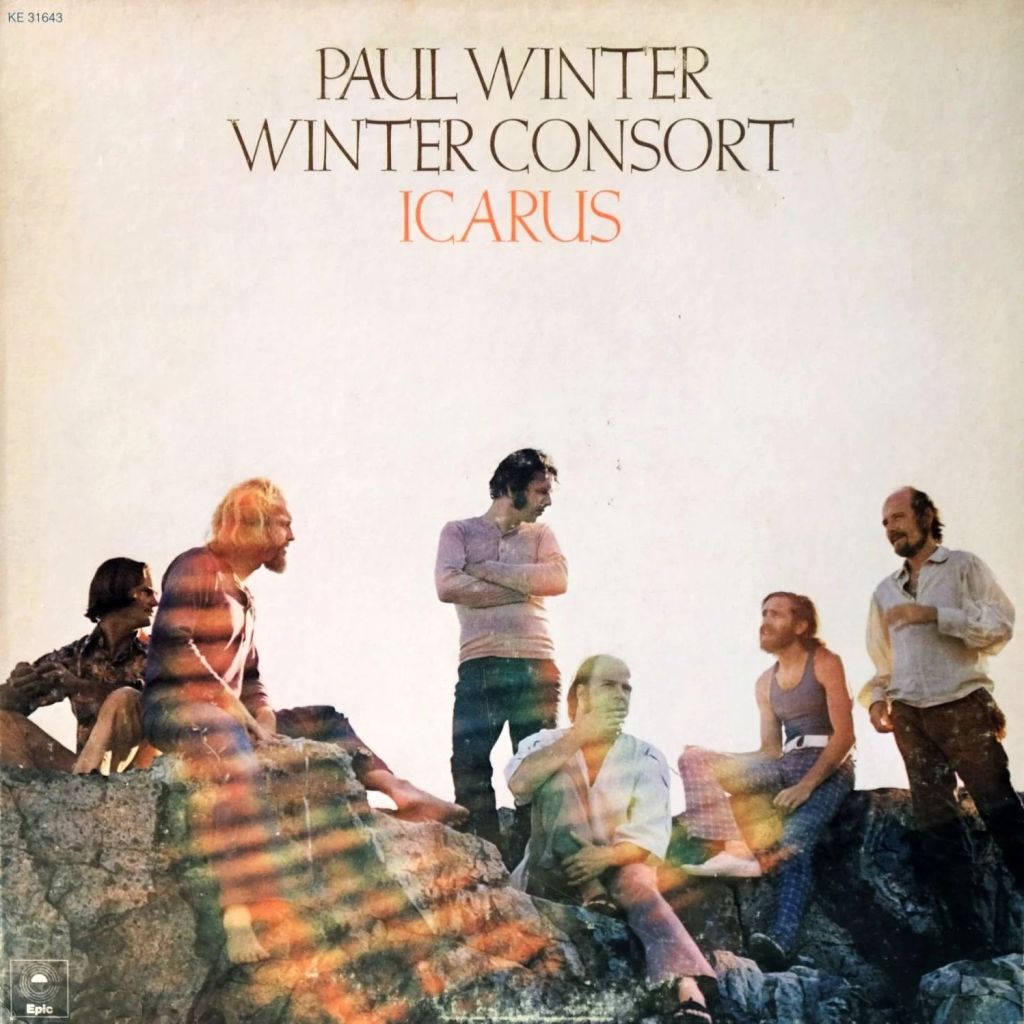
Icarus (1972) by Paul Winter Consort

“The finest album I ever made.”
George Martin, producer of The Beatles albums

Think about that. George Martin, who produced The Beatles albums, says “Icarus” is the finest album he ever made.

Reviewers have tried to pigeonhole this masterpiece by saxophonist Paul Winter and this group of equally talented musicians. Some have called it “chamber jazz”. Some have pegged it as early New Age music.

Below are the first and last tracks, but please discover it all.

Like a vacation in a sonic paradise. Exactly the kind of music to truly help us through this moment.

“If the only prayer you say in your entire life is ‘Thank-you’, that would suffice.”

Meister Eckhart

“If the only prayer you say in your entire life is ‘Thank-you’, that would suffice.”
Meister Eckhart (1260 – 1328), Catholic priest, theologian, philosopher and mystic

I read a column complaining that too many people say “thank you” too much. The writer’s point was that much of the time this is perfunctory and reflexive, and people often don’t mean it.

The above quote from Meister Eckhart is a fitting response.

“Thank you”, whether deeply felt or not, is an express acknowledgment that something has been given to you or done on your behalf. Even if the thanks are grudging—maybe even sarcastic—you may hear a message inside.

In some enlightened traditions, we are advised to offer thanks not just to those on our side but to those actively against us:


When I see beings of unpleasant character
Oppressed by strong negativity and suffering,
May I hold them dear – for they are rare to find –
As if I have discovered a jewel treasure!
Eight Verses on Transforming the Mind


Thank you.

“No stranger shall you oppress, for you know the stranger’s heart, having yourselves been strangers in the land of Egypt.”

גֵ֖ר לֹ֣א תִלְחָ֑ץ וְאַתֶּ֗ם יְדַעְתֶּם֙ אֶת־נֶ֣פֶשׁ הַגֵּ֔ר כִּֽי־גֵרִ֥ים הֱיִיתֶ֖ם בְּאֶ֥רֶץ מִצְרָֽיִם׃
Exodus 23:9


Speaker of the House Mike Johnson is taking on Pope Leo regarding a matter of biblical interpretation. Johnson says that government oppressing strangers is the biblical thing to do. Pope Leo disagrees.

One line from the Book of Exodus crystallizes the issue.

As with all biblical Hebrew, the translation is challenging and varied.

Exodus 23:9:
You shall not oppress a stranger, for you know the feelings of the stranger, having yourselves been strangers in the land of Egypt. (NJPS)
You shall not oppress a resident alien; you know the heart of an alien, for you were aliens in the land of Egypt. (NRSV)
No sojourner shall you oppress, for you know the sojourner’s heart, since you were sojourners in the land of Egypt. (Robert Alter)

Robert Alter addresses one of the translation challenges, the Hebrew word nefesh/נֶ֣פֶשׁ:
“The Hebrew is nefesh, “heart”, “life,” “inner nature,” “essential being,” “breath.””

Another word needing expansion is the Hebrew ger/גֵּ֔ר. Scholars Mark Allen Powell and Dennis R. Bratcher explain in the HarperCollins Bible Dictionary:


alien (ger): In the Bible, one who is not a member of a particular social group. Accordingly, Abraham was an alien (NRSV: “stranger”) among the Hittites at Hebron (Gen. 23:4), as were Moses in Midian (Exod. 2:22) and the Israelites in Egypt (Deut. 23:7; cf. Ruth 1:1). The Hebrew word is ger, and it has often been translated “sojourner” in English Bibles. The NRSV is inconsistent, translating it “alien” in some instances and “stranger” in others. After the settlement in Canaan, the term not only designated a temporary guest but also acquired the more specialized meaning of “resident alien,” one who lived permanently within Israel (Exod. 22:21; 23:9). No doubt because the Israelites were keenly aware of their own heritage as aliens without rights in a foreign land, they developed specific laws governing the treatment of aliens. Strangers or aliens were to be treated with kindness and generosity (Lev. 19:10, 33–34; 23:22; Deut. 14:29). The basic principle was, “You shall also love the stranger, for you were strangers in the land of Egypt” (Deut. 10:19). And, again, “You shall love the alien as yourself, for you were aliens in the land of Egypt” (Lev. 19:34)….

“Alien” or “stranger” also appears in a figurative sense, usually in appealing to the generosity and mercy of God in dealing with undeserving people (Pss. 39:12; 119:19; 1 Chron. 29:15). The idea of dwelling in a land owned by someone else is also applied theologically to the relationship of the Israelites to the land; it belonged to God and they were the strangers in it (Lev. 25:23). (emphasis added)


Pope Leo has given lots of thought to the nefesh—heart, life, inner nature, essential being, breath—of the ger—stranger, sojourner, resident alien.

Has Mike Johnson given much thought to the nefesh of the ger? Have we?

Along with the Book of Exodus, we can sing along with Randy Newman in his song have You Seen My Baby?:

I say, “Please don’t talk to strangers, baby”
But she always do
She say, “I’ll talk to strangers if I want to
‘Cause I’m a stranger, too”

Real spring (not false spring) has arrived in early February

February 8, 2026

I have lived in a variety of places with hard winters, where occasionally in February it seemed like spring but was actually false spring, followed by more, sometimes much more, hard winter.

Here is not one of those places.

The Winter Olympics are happening now. Some places share Winter Olympics-type weather, some people prefer that, some people tolerate it, with the promise of spring arriving soon or eventually. Just not yet.

Some places, like this one, rarely have anything like hard winter, though on the other hand we know that hard summer will arrive eventually, just not yet.

The birds and the plants know. So do I.

If you are somewhere in the Northern Hemisphere where winter has more than a month to go, spring is coming. If you’ve never believed anything I’ve said, believe that.

Have we become uncomfortably numb? Trump posts video of the Obamas as apes.


Trump shares video with racist imagery of Barack and Michelle Obama in late-night posting spree
In clip amplifying false claim that Trump won 2020 election, the Obamas’ faces are superimposed on bodies of apes

Richard Luscombe, The Guardian
Fri 6 Feb 2026

Fury erupted early on Friday after Donald Trump posted a racist video that depicts Barack and Michelle Obama as apes.

The clip appeared during one of the 79-year-old US president’s increasingly frequent late-night posting sprees to his Truth Social account, and shows the laughing faces of the former president and first lady superimposed on the bodies of primates in a jungle setting, bobbing to the song The Lion Sleeps Tonight.


There have been American moments when your reaction is “this is not happening.” Sometimes it is the sudden shock of an assassination or of towers under attack and collapsing. Sometimes it is an extended situation, like the Covid pandemic.

The Trump presidency is both. There are particular moments that shock. There is a cumulative extended experience. Defenders may say again and again that it is just “Trump being Trump.” The rest of us wonder when we will wake up from the seeming interminable nightmare.

Have we “normalized” the aberrant, hateful, inhumane and frankly demented? Have we become uncomfortably numb, knowing what is wrong but just wanting to pull the covers over our heads and get on with our lives, compromised as they may be?

Let us wake up, not from the nightmare, but to the heart of the nightmare to actualize a better dream right now.

Mean-ing

For those who wonder whether meanness is a sin or vice, you can start with Summa Theologica by St. Thomas Aquinas, where Question 135 addresses the issue. Or you could ask your parents or your elementary school teachers or your spouse or your children: It’s not nice to be mean.

Which should make us think about why rampant meanness is not only acceptable, but encouraged, entertaining, and profitable. Cheaters may never prosper (though they often do), but meaners are doing very well these days.

Saying that all things virtuous seem to be dying and on life support is an overstatement that doesn’t get us far. Instead, four possible explanations of how what was once a private disturbance has become such a pandemic, a public poison:

Meanness by proxy: All art and performance is based on the ability and willingness of creators to express what we can’t or won’t. It would be nice to think that we only long to be the one who can move people to tears or laughter, inspire people to reach higher, and if we can’t be those creators, at least they are doing that for us. The same thing unfortunately applies to darker messaging, though. We may not be able to attack quite so sharply and eloquently, but we appreciate that someone can. “Yeah, what he said!”

Meanness as superiority: This is a subset of meanness by proxy. There’s perversity in enjoying the meanness of others, but at the same time taking pride in being one who would never say something like that because…we are better than that and would never be so mean. (Whatever the theological status of meanness, by the way, pride is definitely on all the lists of sins.)

Meanness as incompetent and faulty criticism: This is the explanation of meanness as sub-juvenile behavior. When little children aren’t sure why they hate somebody or something, or can’t articulate it, they revert to name-calling and indiscriminate meanness: “You’re a poo-poo head!” It’s a fantastic dream that one day, thanks to some spell, the most gratuitously mean would be magically forced to speak only such childish epithets.

Meanness unconditioned by a thought/speech barrier: The thought/speech barrier, the wall that should keep many thoughts from ever being spoken, is dissolving. Whether phenomena such as social media are causal, enabling, or merely symptomatic is beside the point. Thought moves from brain to mouth (or phone or keyboard) at the speed of synapse. Mean heart becomes mean words in a literal instant.

There is a genuine critical function, which can be exercised with thoughtfulness, care, and respect. That simple sentence, a foundation of a free, enlightened society, is looking particularly quaint, and seems for many to have lost its meaning.

“Federal Agents Left Behind “Death Cards” After Capturing Immigrants”

“The horror! The horror!”


Federal Agents Left Behind “Death Cards” After Capturing Immigrants
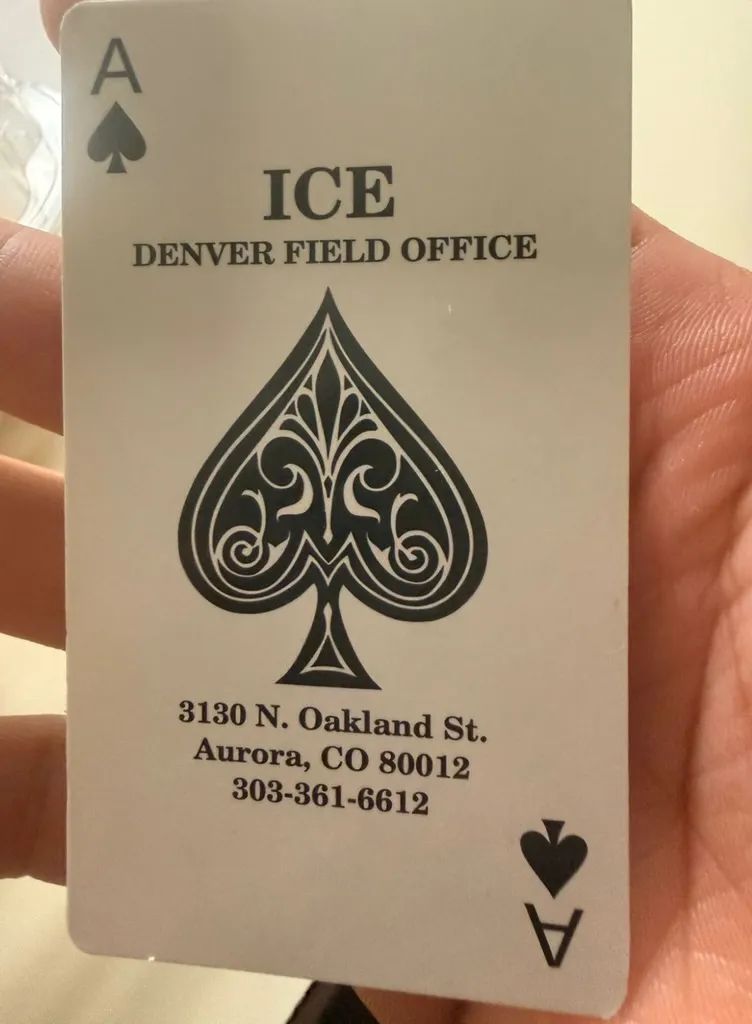
ICE agents dropped customized ace of spades playing cards, recalling a practice by U.S. soldiers during the Vietnam War.

Nick Turse
The Intercept
February 3 2026

The cars sat abandoned at the side of the road. Their engines idling, with hazard lights flashing, according to a witness who captured video of the incident on his phone. The occupants of the vehicles had been taken away by Immigration and Customs Enforcement officers late last month in what a local immigrant rights group calls “fake traffic stops.” During these encounters, ICE vehicles reportedly employ red and blue flashing lights to mimic those of local law enforcement agencies, duping people into pulling over.

When family members arrived on the scene in Eagle County, Colorado, their loved ones had already been disappeared by federal agents. But what they found inside the vehicles was disturbing: a customized ace of spades playing card — popularly known as a “death card” — that read “ICE Denver Field Office.”

“We are disgusted by ICE’s actions in Eagle County,” Alex Sánchez, president and CEO of that immigrant rights group, Voces Unidas, told The Intercept. “Leaving a racist death card behind after targeting Latino workers is an act of intimidation. This is not about public safety. It is about fear and control. It’s rooted in a very long history of racial violence.”

During the Vietnam War, U.S. troops regularly adorned Vietnamese corpses with “death cards” — either an ace of spades or a custom-printed business card claiming credit for their kills. A 1966 entry in the Congressional Record noted that due to supposed Vietnamese superstitions regarding the ace of spades, “the U.S. Playing Card Co. had been furnishing thousands of these cards free to U.S. servicemen in Vietnam who requested them.”…

The ace card has a long and macabre history. A British tax on playing cards, which specifically required purchasing aces of spades from the stamp office, resulted in the hanging of a serial forger of the “death card” in 1805. Legend has it that “Wild Bill” Hickok held the Dead Man’s Hand — aces and eights, including the ace of spades — when he was gunned down in Deadwood in Dakota Territory in 1876. In 1931, murdered Mafia boss Giuseppe Masseria was photographed with the ace of spades clutched in his hand. By that time, it was firmly entrenched in culture as the “death card.”

The U.S. use of death cards in Vietnam was immortalized in the 1979 film “Apocalypse Now” in a scene in which Lt. Col. Bill Kilgore, played by Robert Duvall, places unit-branded playing cards, reading “DEATH FROM ABOVE,” on the bodies of dead Vietnamese people. During the 2003 invasion of Iraq, the U.S. Defense Intelligence Agency developed a set of playing cards to help troops identify the most-wanted members of the Iraqi government. President Saddam Hussein, who was eventually captured and executed, was the ace of spades.


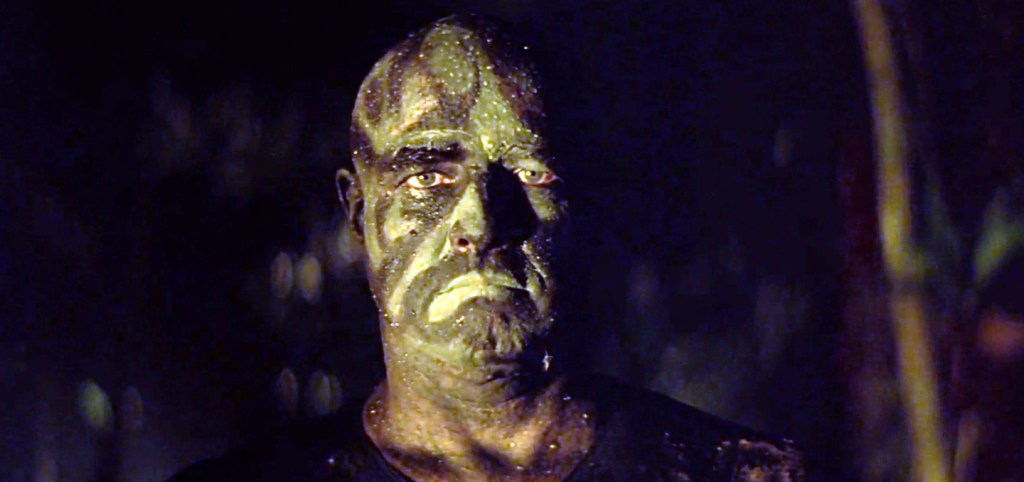
Besides the horrible conduct of ICE, mention of Apocalypse Now (1979) inspires some thoughts. If you have seen the movie, see it again, and if not, see it now. It is not only a great movie and insight into the Vietnam War, but an insight into America.

The villain of the story is Colonel Kurtz, based on Kurtz in Josef Conrad’s novella Heart of Darkness. Colonel Kurtz has gone rogue and fled from the Vietnam War to Cambodia. There he leads natives who worship him almost as a god. The U.S. military command has sent Captain Willard to find him and eliminate him with extreme prejudice. Willard’s journey through the war and his encounter with Kurtz is the story of Apocalypse Now.

Kurtz’s dying words are the same in Heart of Darkness and Apocalypse Now, words that echo today: “The horror! The horror!”

Poems by Cold Mountain/Han Shan (c. 9th century CE)


Han Shan (寒山, meaning “Cold Mountain”) was a legendary Tang Dynasty Chinese poet who lived sometime between the 7th-9th centuries CE. He’s one of the most beloved figures in Chinese Buddhist literature.

His historical existence is debated. He may have been a recluse living on Cold Mountain (Hanyan) near Tiantai in Zhejiang province, or a literary persona created by one or more Chan (Zen) Buddhist poets.

About 300 poems survive, written in colloquial language rather than formal literary Chinese. They blend Chan Buddhism, Daoism, and nature imagery with humor, social criticism, and spiritual insight.

Themes include mountain solitude, the foolishness of worldly pursuits, enlightenment, and the beauty of simple living. His work often ridicules conventional society and religious formalism. He embodies the archetype of the wandering, enlightened madman.

He is traditionally paired with his sidekick Shide (拾得, “Foundling”), another hermit-poet. They are depicted as eccentric, laughing sages.

He remains hugely popular in East Asia. He was brought to Western audiences by Gary Snyder’s translations.


Please read some poems by Cold Mountain. Following are three translations, all worthy, with those of Red Pine (Bill Porter) especially recommended.

The Collected Songs of Cold Mountain by Red Pine

Cold Mountain Poems: Zen Poems of Han Shan, Shih Te, and Wang Fan-chih by J. P. Seaton

The Complete Cold Mountain: Poems of the Legendary Hermit Hanshan by Kazuaki Tanahashi and Peter Levitt


The new year ends a year of sorrow
spring finds everything fresh
mountain flowers laugh with green water
cliff trees dance with blue mist
bees and butterflies seem so happy
birds and fishes look lovelier still
the joy of companionship never ends
who can sleep past dawn

Cold Mountain (Hanshan), c. 9th century
Translated by Red Pine (Bill Porter)