Bob Schwartz

Category: Spirituality

Thusness

Soul Nebula

Thusness, suchness, tathata in Sanskrit, the ultimate and unconditioned nature of things.
Things as they are. Things as it is.

It is thought of as a Buddhist concept, or an Eastern concept. But it is basic to every faith and wisdom tradition, once you peel away many layers of sometimes self-righteous or overly fussy codification and interpretation. The Christian gospels, unconditioned by unnecessary accretions, are just one example. It would appear that Jesus could speak for himself, plainly articulating thusness as well as any other realized teacher.

Talking about thusness is challenging for some of the wisest people ever. Which puts me at a humble and stupid disadvantage. But fools, like me, rush in.

Is thusness seemingly separate from you?

Yes.

Are you within it?

Yes.

Is it within you?

Yes.

What does it contain?

Among other things, it contains all the attributes we usually consider good and admirable: love, compassion, justice, healing, and on and on.

Does thusness define those attributes?

No. People define those attributes, sometimes in long and complex detail. These definitions seem to help people act on these attributes. This act is loving, this act is not. This act is just, this act is not. It is a practical matter.

Is there a problem with defining the attributes?

No, except that people, often people of good will, confuse the definitions with the attributes themselves. That is, by doing this defined thing, they believe they are acting lovingly or justly. They may be wrong.

Is this a problem?

No, unless people forget to look back to the source of those attributes in thusness. If they identify their particular definition with the essence of the attribute, saying that compassion or justice means exactly what I say it means, they are grounded in themselves.

Is there a solution?

Every faith and wisdom tradition offers the same solution, though the terms may be different. The solution is eliminating the seeming separation from thusness, which leads to realizing that thusness is in you and you are in it. That way, when you hear or consider the attributes of love, justice, and so on, you don’t stop at someone else’s definition or at your own. You look deeper, to an ultimate source, that at once makes the attribute less certain and more complicated, and yet more real and simpler.
Why We Should Not Give Up on Global Nuclear Disarmament

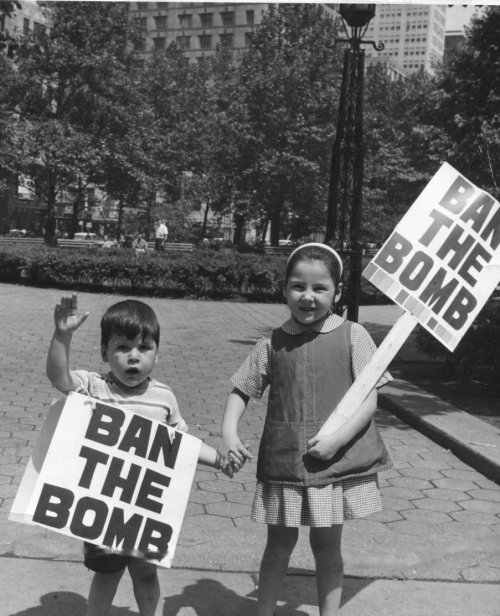
Ban the Bomb

It is picture as quaint as someone dialing a telephone: protestors in the 1950s and 1960s marching around with signs that say “Ban the Bomb.”

Quaint because so many countries now have nuclear weapons that getting rid of them all borders on the ridiculous. And it’s not just major powers; smaller nations who have developed nuclear weapons consider themselves “major” for having done so. (It sure beats the trouble of developing a sustainable, healthy economy and democracy.) Speaking of democracy, nuclear armament is all so complex that one of the bright lights of a hyperdangerous region refuses to acknowledge even having a nuclear stockpile, pretending to maintain the worst kept geopolitical secret in the world.

And yet: Blessed are the peacemakers. According to someone or other, they will be called children of God. This doesn’t mean that warmakers and hoarders of nuclear weapons aren’t children of God. It just means that the billions who live in the shadows of those bombs and missile warheads might not feel particularly blessed. That’s why we, and our children and our generations, shouldn’t give up on global nuclear disarmament, no matter how naïve or impossible it seems.

Pope Francis’ Encyclical Laudato Si’

Laudato Si'

The Pope’s new encyclical, Laudato Si’, has been much in the news. Whatever you’ve heard about it, if you haven’t seen it, you really don’t know the whole story.

You’ve heard it is about the environment and climate change, which is in small part true. You’ve heard Catholic presidential hopefuls such as Jeb Bush and Bobby Jindal admonish the Pope, their spiritual father, telling him to stick to religion and stay out of politics.

The encyclical is much bigger than climate change, the environment, and certainly bigger than Bush or Jindal or dozens of politicians. It is a big statement about the moral and religious shortcomings of this modern world and us modern people. You don’t have to be Catholic or Christian or faithful or religious to read and appreciate it. You just have to read it.

It is full of inconvenient and uncomfortable truths. Which is probably why the coverage has focused on the environmental exhortations, rather than on the broader cultural, media, technological and social ones. In essence, it is nothing less than a call for radical evolution, in the spirit of the radical evolutionary upon whom the church is built. There are plenty of established institutions and powerful interests and individuals, including the media, who could be forced to change if such radical evolution came to pass. And many of them don’t want to change, and don’t even want us to listen to the Pope talking about it.

The encyclical is a long and deep but very readable work. Download it, sample it. You don’t have to read it all, or all at once. It is naturally grounded in theology, and in some particular theology, but be assured that the observations and conclusions don’t require you to hold any sectarian beliefs. It only requires that we believe that things are far from perfect, and that after we take a close look at ourselves and others, we believe that we have the power and obligation to make things better.

It is filled with so much quotable inspired thought and inspiration. Here is just one brief excerpt:

114. All of this shows the urgent need for us to move forward in a bold cultural revolution. Science and technology are not neutral; from the beginning to the end of a process, various intentions and possibilities are in play and can take on distinct shapes. Nobody is suggesting a return to the Stone Age, but we do need to slow down and look at reality in a different way, to appropriate the positive and sustainable progress which has been made, but also to recover the values and the great goals swept away by our unrestrained delusions of grandeur.

Laudato Si’ PDF

Laudato Si’ epub and Kindle

Compassion

A primary act of compassion is to lift the load and not add to the load of others.

Easy to say, not easy to do. Can you smile if unjoyful? Can you sing a happy song when you feel like a dirge?

Being true to your little self, no matter how dark it is, might seem like a good idea—if there is a little self, separate from the rest. We may be encouraged to let it all out, whether as a shout or a sulk. The complication is that if you think you are the center of the universe, privileged to make its own weather, you are right. You are the center of the universe, but so is everyone else. If they are to live subject to your clouds and storms, so you do to theirs.

Compassion, of which joy is an instrument, is at the top of the list for two reasons. It is the most powerful. And it is the hardest. So when next you wrap yourself in a blanket of seemingly private sadness, consider that you are most probably not alone. And that the smallest bit of light might be a big gift.

Mountains Walking

Jesus, Dogen and Donovan each have something to say about mountains. In some ways the same thing.

Jesus says that faith can move mountains, by which he may mean that understanding the nature of things, including mountains, will allow us to see that mountains are always moving, if we will see it. Jesus is all about what we don’t see that is right in front of us.

Dogen says that mountains are mountains and mountains are walking. If you can walk, mountains can walk. Those without eyes to see mountains cannot notice, understand, see, or hear this reality.

Donovan sings about this reality of mountains appearing, disappearing, appearing.

Jesus

He answered, ‘Because you have so little faith. In truth I tell you, if your faith is the size of a mustard seed you will say to this mountain, “Move from here to there,” and it will move; nothing will be impossible for you.’ (Matthew 17:20, New Jerusalem Bible)

Dogen Zenji

Priest Daokai of Mount Furong said to the assembly, “The green mountains are always walking; a stone woman gives birth to a child at night.”

Mountains do not lack the characteristics of mountains. Therefore, they always abide in ease and always walk. Examine in detail the characteristic of the mountains’ walking.

Mountains’ walking is just like human walking. Accordingly, do not doubt mountains’ walking even though it does not look the same as human walking. The buddha ancestor’s words point to walking. This is fundamental understanding. Penetrate these words.

Because green mountains walk, they are permanent. Although they walk more swiftly than the wind, someone in the mountains does not notice or understand it. “In the mountains” means the blossoming of the entire world. People outside the mountains do not notice or understand the mountains’ walking. Those without eyes to see mountains cannot notice, understand, see, or hear this reality.

If you doubt mountains’ walking, you do not know your own walking; it is not that you do not walk, but that you do not know or understand your own walking. Since you do know your own walking, you should fully know the green mountains’ walking.

Green mountains are neither sentient nor insentient. You are neither sentient nor insentient. At this moment, you cannot doubt the green mountains’ walking.

From Mountains and Waters Sutra, Shobo Genzo, Fascicle 15 (1240)

Donovan

The caterpillar sheds his skin to find a butterfly within
Caterpillar sheds his skin to find a butterfly within
First there is a mountain, then there is no mountain, then there is

From There Is a Mountain

Educating Prophets

If we view prophets in a broad sense, in a big sense, not something necessarily biblical or spiritual, not as fortune tellers, but as witnesses, critics, analysts, teachers, and guides, it is something we have always had and needed.

That kind of prophecy may be viewed as a gift, but it is something that can be cultivated and encouraged. That isn’t always to the liking of many. Prophets can point in a constructive direction, but in their role as critics they can also be harsh, and stand in the way of those who benefit and profit from the status quo. So some prophets are more acceptable than others, and some are treated as enemies.

Education, in and out of institutional settings, is a part of cultivating and encouraging prophets and prophecy. That isn’t often, or ever, on the list of what education is for or about. So maybe, if we are intent on viewing education as a path to employment and the jobs of the future, we should make sure to include prophet among those jobs. And should include the sorts of subjects and fields in which prophets and prophecy of all kinds grow.

Admonishing Others

Teachings of the Buddha

I found this tiny advice in the small and excellent collection Teachings of the Buddha from Shambhala Publications. These words are now required reading for me every day:

ONE who is about to admonish another must realize within herself or himself five qualities before doing so. [He or she must intend] thus:

“In due season will I speak, not out of season. In truth will I speak, not in falsehood. Gently will I speak, not harshly. To one’s profit will I speak, not to one’s loss. With kindly intent will I speak, not in anger.”

Adapted from the VINAYA PITAKA,
Translated by F. L. Woodward

New Year Non-Resolution: Less Nonsense

Maxfield Parrish - Winter Twilight

No New Year resolutions for me, for many reasons. Here is a related thought from Shunryu Suzuki Roshi:

When we reflect on what we are doing in our everyday life, we are always ashamed of ourselves. One of my students wrote to me saying, “You sent me a calendar, and I am trying to follow the good mottoes which appear on each page. But the year has hardly begun, and already I have failed!” Dogen-zenji said, “Shoshaku jushaku.” Shaku generally means “mistake” or “wrong.” Shoshaku jushaku means “to succeed wrong with wrong,” or one continuous mistake. According to Dogen, one continuous mistake can also be Zen. A Zen master’s life could be said to be so many years of shoshaku jushaku. This means so many years of one single-minded effort.

It is hard to talk about what is and isn’t nonsense. Waiting with anticipation for the new season of your favorite TV series or playing games is not necessarily more nonsense than discussing political affairs. And don’t even get started on food and sex, which can be critically important, nonsense, or both at the same time.

It is a matter of attention, depth, and priority appropriate for you at the time. A way to determine this is discernment, keeping just quiet enough to hear the voices coming from above, below, outside, and especially inside, that suggest just how much of what might be good for you.

Examples abound. More than ever, there is the theoretical possibility of paying attention to just about everything, and no possibility—even with multi-sensing capabilities we are equipped with—of actually doing it. Even when you do limit and choose, you may find that the coverage or talk is just repeating versions of the same stuff—nonsense—over and over, without its going much of anywhere except around in circles.

So for me—call it a wish or a perspective or a direction but not a resolution—I will try to discern who and what matters, pay better attention to those, and avoid some of the rest. This is not necessarily a matter of serious or world-changing: the new seasons of Downtown Abbey and Mad Men will have my attention. But as things come along, I will try to listen to just which way they might be moving me. Just a little less nonsense.

The Eight Ways of Hanukkah

happy-hanukkah

Hanukkah, which begins at sunset with the lighting of the first candle, may be the most interesting, confusing, and confused of Jewish holidays. Let me count the ways.

1. It is the most historic of the traditional Jewish holidays. The historicity of more important holidays is somewhat shrouded in antiquity, bible stories, and faith. We have a pretty good chronicle of the events commemorated by Hanukkah: the Jewish rebellion of around 163 BCE led by the Maccabee family against the Seleucid/Syrian occupiers of Israel.

2. The best chronicle of Hanukkah is found in the Books of Maccabees. Maccabees is found in the bible, but because of textual happenstance, not in the Jewish Bible. Books of Maccabees are part of the Roman Catholic and Eastern Orthodox bibles, and are apocryphal books of the Protestant bible. But the Jewish biblical canon (the books officially included) was closed before these books were available. So if Jews want to read this particular biblical story, they have to turn to Christian bibles. Not that there’s anything wrong with that.

3. Hanukkah is probably not just about the Maccabees. As with other holidays, including Christmas, it is likely a melding of other seasonal celebrations at that time of year.

4. Because Hanukkah is extra-biblical, it did not achieve the stature of other holidays. You will often see it referred to as a “minor” holiday. In baseball terms, though, Hanukkah is at least AAA minor league, that is, completely ready to play in the majors. Which, as it turned out, it kind of does.

5. How Hanukkah became a much more important holiday than ever is covered by the wonderful book Hanukkah in America. For one thing, the original story of the Maccabees is about fighting not just the occupiers but the tendency of Jews in that situation toward assimilation and Hellenization. This obviously resonated in America, where secular culture and particularly Christmas became a juggernaut.

6. The candelabra used on Hanukkah for the eight nights of lights is usually referred to, by Jews and non-Jews alike, as a menorah. This is not exactly right. A menorah is a lamp, more particularly the seven-armed lamp that is an abiding symbol of Judaism and Israel. The lamp lit at Hanukkah is more properly called a hanukkiah. But hardly ever is.

7. The spelling of the word Hanukkah in English remains an unsettled mess. “Hanukkah” is now prevalent, but there is still plenty of the older “Chanukah” or, less likely, “Chanukkah” or other variations. The problem stems from trying to transliterate a Hebrew word into English—especially a word that has the guttural “ch” sound not heard in English (that is, not “ch” as in China). But as the saying goes: You can spell it Hanukkah or Chanukah, just don’t call me late for latkes. (No, that’s not an actual saying.)

8. This is from a little book that is a century old. The Hanukkah Festival: Outline of Lessons for Teachers (1914) was published by The Teachers’ Institute of the Hebrew Union College in Cincinnati and written by Rabbi Louis Grossmann, its principal. One of the benedictions for lighting the candles goes well beyond Judaism, history, or faith. It should work for just about anyone, tonight and every night.

Eight days long the Lights burned in the homes of our Fathers, and eight days long they rejoiced. One little flask of sacred oil was enough to illumine the Temple and to keep it bright. So each one of us may gladden those with whom we are, and the Light within our heart may make bright all who are about us.

Happy Hanukkah.

The Day the Buddha Woke Up

Buddha Comic Bodhi

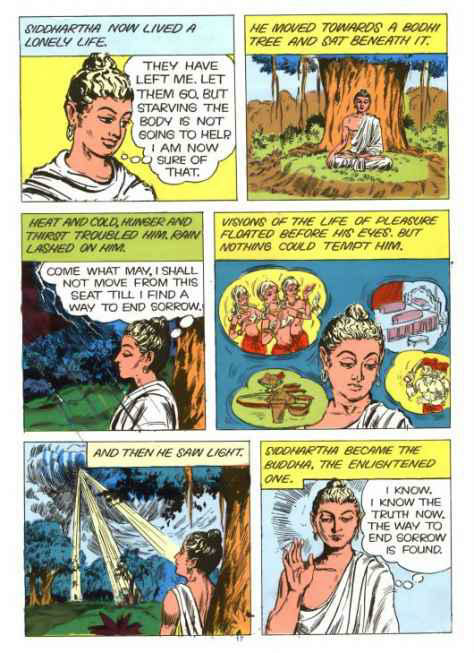
December 8 is Bodhi Day, the day on which the Buddha’s enlightenment is traditionally celebrated.

The English word “enlightenment” is so packed with meaning that it might be better to just go back to what the Buddha is reported to have said: I am awake.

This is useful because it leads to the two questions: woke up from what and woke up to what?

The Buddha, sitting there under the Bodhi tree, woke up from a journey. Born a royal son, he had fled a life of accidental privilege to answer ultimate questions about suffering and death—the very same questions that consume religious lives of all kinds. He believed that if he tried a, b, and c (such as extreme asceticism), he would discover some secret x, y, and z. There was some kind of magic formula, and all he had to do was learn it. That sort of magic is still at the heart of much of our religion.

He woke up to discover that there was no magic, not in such an instrumental sense. Nothing was different. Suffering and death would not go away, no matter what efforts we make. The best and worst aspects of life would go on, with and without us. Great fortunes would be made and lost. Great structures would be built and then destroyed, by cataclysms natural and human. Love would be here and gone.

But this: He could see something in all of that that made sense of all of that. There is no big plan in which we are players, active or passive, though we could and do make and execute our own little plans. There are just things, relationships between those things, and change, and of all those of a singular piece. We can and do overlay that with all of our very complicated details and distinctions, which is after all a definition of the life we live. But if we discover that underlying existence, we just might choose to live differently. And in that living differently, make change and wake others up. And on and on.

None of that eliminated suffering and death for the Buddha, as it won’t for anyone. He grew old and tired and, legend has it, died from being given spoiled food. He had told his followers what he had discovered, none of which involved magic. It was all about the infinite depth of the ordinary. For him, there was no more a kingdom in the clouds than the kingdom he had left behind when he started his journey. There was just what is. Strive on with diligence, he told those followers at the last.