Bob Schwartz

Category: Philosophy

Life Lessons from the End of the Regular Baseball Season

MLB Standings
The 162 games of the regular Major League Baseball season are over. Now the League Championship Series begin. For those who don’t care about baseball—or who think it a stupid waste of time—some generalized random thoughts about life lessons we can learn.

Cleveland Indians: The Indians closed the season with a ten-game winning streak. 10-0. That itself is a big deal. A bigger deal is that it came at the end of the season and kept them in the running for a spot in the playoffs.

Life Lesson: Winning streaks are good, well-timed winning streaks are better.

Boston Red Sox: Up until 2004, the Red Sox were one of the two legendary non-winners of World Series (Chicago Cubs are the other). Some attributed this to their selling Babe Ruth to the Yankees in 1919. Prior to that, the Red Sox were one of baseball’s great teams. After, the so-called Curse of the Bambino took over. They did get their mojo back, winning the World Series in 2004 and 2007, and having another great season this time around, with a 97-65 record—the best in baseball.

Life Lesson 1: Hang in there.

Life Lesson 2: There is no Curse of the Bambino.

Miami Marlins: The Marlins have the strangest history of any modern expansion team, maybe of any major league team at all. A rich guy owned them when they began in 1993. He bought a lot of talent, which led to their winning a World Series in 1997. He got rid of all the high-priced players before the next season, and so the World Champions had a record of 54-78. He sold the team to another rich guy, who would later own the Boston Red Sox. Before leaving, that rich guy set the stage for another World Series win in 2003. The current rich guy, who had previously owned a team that is now defunct, bought the Marlins just before that championship. He has subsequently changed his approach to baseball every year in a style that can be described as either whimsical or self-serving. To entice the leaders of South Florida to spend hundreds of millions on a new ballpark, he beefed up the team with lots of expensive talent for the 2012 season. He got the park, but the talent fizzled there, with a record of 69-93. He got rid of the talent, went for cheap and mostly untried young players, and the Marlins finished this season at 62-100. The most infamous upshot of his profitable penny-pinching was trading Miguel Cabrera to the Detroit Tigers in 2007, because he knew he could never pay what Cabrera might one day be worth. Cabrera is now almost certainly the greatest hitter of his generation, so it may not be the Curse of the Miguelito, but it’s close.

Life Lesson 1: When Eve complained to her nemesis in the Garden of Eden, the legless one who convinced her to break bad, the reply was simple: What are you complaining about? You knew all along that I was a snake.

Life Lesson 2: It’s all fun and games, but business is business. Not being cynical, just realistic. Whether you’re a fan of politics or music or baseball or whatever, enjoy the show, but don’t forget that.

Laptop Overheating and the State of the World

Laptop Overheating
Overheating is the single greatest source of problems with laptop computers. And before you run away from unwanted geek talk, be aware that it is also a lesson on the state of the world.

If you don’t know about overheating, that probably means that when things go wrong with your laptop, you leave it up to somebody else to make it better, maybe even having an IT department to take care of it, or you replace your laptops once a year, or you chalk up terrible performance and failure to bad luck, or you just throw the damn thing out.

Those of us working on our nth generation of laptops know better: they are frequently baking, and that can’t be good.

To understand overheating, we go back to the prehistoric days of computing, with cavemen searching for wall plugs. Before there were minicomputers or microcomputers (PCs), there was big iron. Giant rooms filled with big boxes, that compared to your smartphone had pretty tiny brains. But it was a wonder at the time. One of the upshots was that these big computers generated a lot of heat; processing is a hot business. So the rooms were equipped with powerful air conditioning to keep the machines cool and healthy.

As computers shrank, new solutions to heating were devised. They had to be. Even as microprocessors got smaller, the heat problems didn’t go away. The more powerful the processor, the hotter it got. Desktop computers solved this with space around the processors—the heat sink—and a fan to blow that heat out of the box. Desktops were usually placed in a space with some air around it, and for the most part (except, for example, with ultra-powerful gaming computers), this worked pretty well.

Laptops changed all this. The laptops didn’t offer much space around the processors. There was a fan, but the vent from it was frequently blocked by the way laptops were used and placed. The final compounding element was the development of very powerful laptop processors. If you had shown a 3rd generation Intel i7 processor to a computer engineer fifty years ago and told them the specs, when they picked themselves off the floor, the first thing they would say is “yeah, but I bet it gets plenty hot!” And they would be right.

This level of heat destroys components, especially processors themselves. An entire cooling pad industry has grown up around the problem, though that is far from a complete solution—even if you stick your pad in the freezer. When you search for suggestions on which laptops are the least likely to overheat, you find that the simple answer is: none of them.

(Funny personal anecdote about overheating—and all true. A very powerful laptop was showing increasing signs of overheating; besides getting blisteringly hot, crashes were more and more frequent, and cool down periods were getting less effective. One morning it simply refused to start up. Putting the whole laptop in the freezer was not an option. Fortunately, it was below freezing outdoors, where it was placed on the deck for an hour and then started there. The damaged components were soon replaced.)

So what, as promised, does this have to do with the state of the world? Technology—maybe progress in general—can take us down some very beneficial roads. But some chronic endemic problems come along for the ride. Our confidence that we can “solve anything” is misplaced. We can create situations with built-in disabilities that leave us helpless, just as we can build millions of genius laptops that can do anything but stay cool.

Relying on Ourselves and Not Rolling Stone

Rolling Stone - Tsarnaev

This is what upsets us? This magazine cover is our biggest problem?

As of today, some retailers—of those retailers who actually sell paper magazines any more—are refusing to the carry the new issue of Rolling Stone with a cover showing a youthful and attractive photo of Boston bomber Dzhokhar Tsarnaev. They, along with maybe millions in the socialsphere, are making a statement.

But what exactly is that statement, and why are they making it?

If it’s about not giving any more publicity to him, along with any coverage of the Boston bombing and the upcoming trial, you can make a case that that might be healthy for all of us. But since there’s been no call for less coverage, that can’t be it.

If it’s about continuing the coverage, but making sure the coverage only reflects one particular approach, what approach would that be, exactly? And if it’s about not “glamorizing” him, where is the directorate that is going to make sure that all photos, cover and otherwise, of the most despicable people look suitably evil and ugly?

We have reached a point, not unique in history but maybe more now than ever, where reaction to everything is often overtaking thought about everything. The theory of “the wisdom of crowds”—that individuals can be wrongheaded, but heads put together are self-correcting and frequently right—needs to be reconsidered, if not thrown out the window.

If this Rolling Stone cover is a threat to anything, we have a problem. If we think that this cover makes mass murder look “cool” and is a contributor to our social difficulties, we really don’t know what those difficulties are. If we think that we shouldn’t have magazine covers with social and political miscreants, the Magazine Cover Authority will have to make a much broader review of all publications, before they pass them on to the Magazine Content Authority.

We have to start relying on our own thoughts, and when that careful thinking leads to conclusions, on our own abilities to directly address what we find. If a Rolling Stone cover with Tsarnaev is emblematic of anything, it is that Tsarnaev is here, he did what he did, and we should be working on that, and not on choices that magazines make.

For more on self-reliance, you might read Ralph Waldo Emerson’s classic essay of the same name. There was a time when Emerson’s essays were widely taught in schools—back in the Stone Age, before America got so smart and well-connected, before we realized that science and technology were the key to the future, and that the musty, fusty words of some old fart from Boston really had nothing to offer us.

Whoso would be a man must be a nonconformist. He who would gather immortal palms must not be hindered by the name of goodness, but must explore if it be goodness. Nothing is at last sacred but the integrity of your own mind. Absolve you to yourself, and you shall have the suffrage of the world.
Ralph Waldo Emerson
Self-Reliance (1841)

George Zimmerman: Not Guilty. Responsible? Sorry?

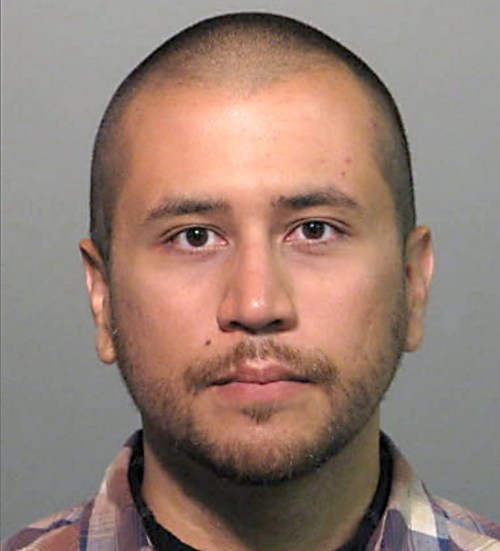
George Zimmerman
It’s easy to see how we’ve come to confuse the legal and the moral. Here and everywhere, laws are put in place that offend a general or specific sense of what is right, so we tend to connect the two. We’re also so used to seeing the legal system in media that it occupies a lot of our thinking. Even though those movies and shows try to include moral dilemmas for lawyers and clients, it’s the law that intrigues and entertains us. We have not yet had a hit television show featuring a team of super-attractive philosophers hammering out the fine points of moral right and wrong.

George Zimmerman is not guilty, at least of the crimes charged in Florida. We are awaiting possible federal civil rights charges or a wrongful death civil lawsuit. But we have no official moral court, and so we can consider where he might stand before that bench.

Every minute, people around the world, people you know, maybe even you, cross some pretty bright moral lines, and we don’t put them in jail. Not that they don’t deserve to somehow be punished, but the legal system doesn’t fit the deed, and anyway, our prison overcrowding would be exponentially more critical.

There are lots of killings we allow or sanction, including self-defense, war and capital punishment. (It would be disingenuous and dishonest not to include abortion—not because it is or isn’t killing, but because from the moral perspective of some, it is killing that we legally allow, and we can’t have the already underserved moral discussion without at least mentioning it.)

George Zimmerman killed Trayvon Martin. It is an unrefuted, admitted fact. The legal system, in its first but maybe not last swipe at the situation, has found him not guilty of a particular crime. For the record, for those who think the justice system failed, be aware that it was never enough for the jury to believe that Zimmerman was a liar and that his version of the scenario made no sense at all. The jury could only convict on the basis of another, more damning scenario—a scenario many of us could easily imagine, but a scenario the prosecution could never paint from the evidence they had to work with. The jury is allowed to draw inferences but can’t just use their imagination the way we can.

George Zimmerman killed Trayvon Martin, and many of us have come to the reasonable, non-legal conclusion about how it happened. People who reach that conclusion want him to be punished, not just for retribution, but to prevent something like this every happening again. Even if further legal proceedings don’t end up punishing him, many have the clear sense that he crossed a moral line and he was very wrong. That’s something that gets lost in all the fascinating legal discussion. You don’t have to be guilty to be wrong. And ever if there isn’t some sort of moral jail, that is still a big deal.

Which brings us to the apology. Even giving credit to the Zimmerman account, the killing happened, he did it, and all the legal exoneration can’t take it back or make it better. Apologies have gotten an increasingly bad name; just look at how the Republicans used it as pejorative in describing President Obama’s early “apology tour” of the world. (It does make you wonder what home life is like for some of those politicians, who in the face of expected apology refuse, not wanting to seem weak or ineffectual. Marriage counseling alert.)

George Zimmerman should apologize to Trayvon Martin’s family. Fully and sincerely. In legal terms, he can’t, of course, since there are still proceedings possible or likely. In moral terms, though, experts say that the need to confess is the best friend of police and prosecutors, because truth is a heavy weight that needs lifting. He is actually half-way to a confession anyway, since we know he shot Trayvon Martin. He doesn’t even have to detail the circumstances in any way different than he has, even if it’s not true.

All he has to say is this: I shot him I killed him. Whatever the law says, I was wrong. I’m sorry.

Moral Mondays

Moral Mondays

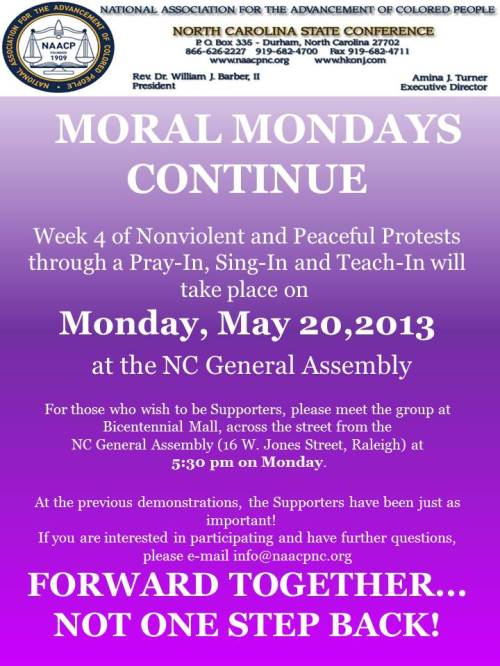
Today, Monday, June 3, is another Moral Monday in North Carolina. A Mega Moral Monday. Small and local right now, Moral Mondays have the potential to be the kind of broad movement that in recent years progressives have wanted but so far been unable to achieve.

In May, the North Carolina NAACP began peaceful protests each Monday at the General Assembly. The civil disobedience is meant to bring attention to legislative curbs on Medicaid expansion, workers’ rights and voting rights, and to the lack of legislative progress on gun control and public education funding. There have been an increasing number of arrests of activists, 153 so far. This week, the protests are expanding across the state.

All movements are more likely to fall flat than catch fire. The Occupy movement reflected real dissatisfaction and outrage, but never sufficiently articulated the underlying principles that would galvanize people to commit and to connect with each other in big numbers.

Moral Monday is built on a foundation that is at the heart of what bothers so many Americans. As is apparent from many of our political controversies, some of those who claim the moral high ground sometimes seem to ignore possible moral shortcomings in their policies, e.g., a Christian imperative to lift the poor and heal the damaged may be at odds with extreme cuts in government support and programs. (In this regard, see questions about Ayn Rand that arose in the most recent election.)

Moral Monday simplifies what is admittedly a set of very complex issues to a very basic baseline: If you claim, by the light of faith or by a sense of enlightened humanity, to believe in moral action, then your idea of morality must be your primary guide. You are free to choose that morality; no constitution, no set of laws, nothing can or should move it. But once you have chosen, and especially after you say it loudly every Friday, Saturday, or Sunday, or on whatever days you proclaim your core beliefs, your duty is to act on it. If you don’t act morally, or if you try to rationalize around that morality for some supposed greater cause, you are only human, but should investigate and consider your action, and even your possible hypocrisy.

Moral Mondays may not make it beyond North Carolina. But it is possible that in a little while, all around the country, more and more people will start the week by taking a stand and, if necessary, getting arrested for it. There is a global and historic tradition for this sort of action, and great change has been made.

Thank you North Carolina NAACP. Mondays will never be the same.

Publius Speaks to Congress

Federalist Papers
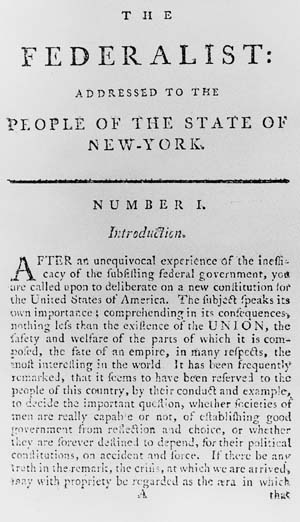
Publius Valerius Publicola (“friend of the people”) was a Roman consul who helped found the Roman Republic circa 509 BCE. When James Madison, Alexander Hamilton and John Jay began publishing The Federalist Papers in 1787, they attached his name to their arguments for adoption of the Constitution.

We don’t know how many current members of Congress have read the Federalist Papers—not even all 85 papers, maybe just a few. We also don’t know how many senior members of the executive branch have done so. We can assume that all nine Supreme Court Justices have; these are, after all, an essential part of the legislative history of the Constitution.

Every time you see politicians brandishing the Constitution as a weapon, well-meaningly or just plain meanly; every time you hear a half-baked political argument or analysis that makes absolutely no sense, but is based mostly or entirely on emotion or ambition; every time you wonder whether a particular politician is taking the best interests of the country to heart or is just interested I getting ahead, the Federalist Papers are your talisman.

The Federalist Papers are a brilliant combination of careful philosophy and political realities—a balance between aspiration and actuality, between the way we want to be and the way we are.

When we hear today about “grand bargains” being struck in Congress—or often not being reached at all—you have to laugh. The very same founders who are treated as saints or even gods had to make the grandest of all bargains so that this nation could exist and endure. And in the Federalist Papers, we find the philosophical intelligence, the political courage and the candid self-awareness to expose how narrow interest and pettiness can stand in the way of solutions. If anything has changed in more than two centuries, it’s that we seem to have fewer Madisons, Hamiltons and Jays front and center in our national discourse:

A torrent of angry and malignant passions will be let loose. To judge from the conduct of the opposite parties, we shall be led to conclude that they will mutually hope to evince the justness of their opinions, and to increase the number of their converts by the loudness of their declamations and the bitterness of their invectives.

An enlightened zeal for the energy and efficiency of government will be stigmatized as the offspring of a temper fond of despotic power and hostile to the principles of liberty. An over-scrupulous jealousy of danger to the rights of the people, which is more commonly the fault of the head than of the heart, will be represented as mere pretense and artifice, the stale bait for popularity at the expense of the public good.

It will be forgotten, on the one hand, that jealousy is the usual concomitant of love, and that the noble enthusiasm of liberty is apt to be infected with a spirit of narrow and illiberal distrust. On the other hand, it will be equally forgotten that the vigor of government is essential to the security of liberty; that, in the contemplation of a sound and well-informed judgment, their interest can never be separated; and that a dangerous ambition more often lurks behind the specious mask of zeal for the rights of the people than under the forbidden appearance of zeal for the firmness and efficiency of government.

Federalist No. 1

Rabindranath Tagore

Rabindranath Tagore
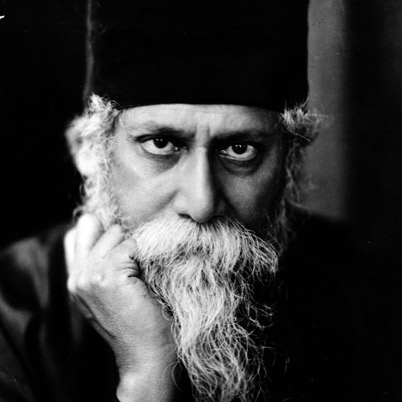
Take a break with Rabindranath Tagore (1861-1941).

He was a Bengali poet, essayist, dramatist, composer and philosopher, and is the most esteemed creative artist of modern India. He was the first non-European to win the Nobel Prize in Literature in 1913.

A brief introduction is Stray Birds (1916), which consists of 326 very short verses—each one usually one or two sentences. Below is a selection of them. Among the many online items by and about Tagore there is a 1961 documentary about Tagore by Satyajit Ray, India’s most celebrated film director. Here is a PDF of Stray Birds as originally published, with a translation from Bengali to English by Tagore himself.

These literary stray birds may seem at first glance to be mere poetic aphorisms. Taken together, though, this is a worldview of inspired simplicity.

From Stray Birds by Rabindranath Tagore

1
Stray birds of summer come to my window to sing and fly away.
And yellow leaves of autumn, which have no songs, flutter and fall there with a sigh.

2
O troupe of little vagrants of the world, leave your footprints in my words.

6
If you shed tears when you miss the sun, you also miss the stars.

28
O Beauty, find thyself in love, not in the flattery of thy mirror.

35
The bird wishes it were a cloud. The cloud wishes it were a bird.

36
The waterfall sings, “I find my song, when I find my freedom.”

40
Do not blame your food because you have no appetite.

43
The fish in the water is silent, the animal on the earth is noisy, the bird in the air is singing,
But Man has in him the silence of the sea, the noise of the earth and the music of the air.

45
He has made his weapons his gods. When his weapons win he is defeated himself.

48
The stars are not afraid to appear like fireflies.

52
Man does not reveal himself in his history, he struggles up through it.

58
The sparrow is sorry for the peacock at the burden of its tail.

62
The Perfect decks itself in beauty for the love of the Imperfect.

75
We read the world wrong and say that it deceives us.

88
He who wants to do good knocks at the gate; he who loves finds the gate open.

121
I carry in my world that flourishes the worlds that have failed.

123
The bird thinks it is an act of kindness to give the fish a lift in the air.

128
To be outspoken is easy when you do not wait to speak the complete truth.

130
If you shut your door to all errors truth will be shut out.

141
When I travelled to here and to there, I was tired of thee, O Road, but now when thou leadest me to everywhere I am wedded to thee in love.

146
I have my stars in the sky,
But oh for my little lamp unlit in my house.

156
The Great walks with the Small without fear.
The Middling keeps aloof.

158
Power takes as ingratitude the writhings of its victims.

161
The cobweb pretends to catch dew-drops and catches flies.

166
The canal loves to think that rivers exist solely to supply it with water.

169
Thought feeds itself with its own words and grows.

178
It is the little things that I leave behind for my loved ones, –great things are for everyone.

184
He who is too busy doing good finds no time to be good.

193
A mind all logic is like a knife all blade.
It makes the hand bleed that uses it.

207
Praise shames me, for I secretly beg for it.

208
Let my doing nothing when I have nothing to do become untroubled in its depth of peace like the evening in the seashore when the water is silent.

210
The best does not come alone. It comes with the company of the all.

235
Do not say, “It is morning,” and dismiss it with a name of yesterday. See it for the first time as a new-born child that has no name.

243
The stream of truth flows through its channels of mistakes.

248
Man is worse than an animal when he is an animal.

258
The false can never grow into truth by growing in power.

280
Let the dead have the immortality of fame, but the living the immortality of love.

296
Blessed is he whose fame does not outshine his truth.

317
Man’s history is waiting in patience for the triumph of the insulted man.

319
I long for the Island of Songs across this heaving Sea of Shouts.

323
I have suffered and despaired and known death and I am glad that I am in this great world.

198 Ways to Make Change

Gene Sharp
The Albert Einstein Institution may be the most important organization you’ve never heard of, and Gene Sharp may be the most important person. Since 1983, he has dedicated himself to advancing the study and use of strategic nonviolent action in conflicts throughout the world.

These are just a few of the headlines he has garnered in the past year or so:

The New Statesman – Gene Sharp: The Machiavelli of non-violence.
The Progressive – Nonviolence Strategist Gets Deserved Recognition.
Deutsche Welle – Alternative Nobel Winner says non-violence works.
The New York Times – The Quiet American.
CNN – Gene Sharp: A dictator’s worst nightmare.
The Nation – Gene Sharp, Nonviolent Warrior.
The Boston Globe – Sharp: The man who changed the world.

His book From Dictatorship to Democracy is an introduction to the use of nonviolent action to change regimes. It has been translated into seventeen languages and has served as a pro-democracy guide for movements around the world. This and other books are available free for download on the website.

Even if you are not living in a dictatorship and are not planning to topple a government, you will find a very small and very valuable item at AEI. Think of it as a jewel of social action. It is a two-page list of 198 Methods of Nonviolent Action. You will find the list below.

For those who want to make change, big or small, the keys are commitment and creativity. We’ve seen some inspired actions take hold. We’ve also seen some well-meaning initiatives pop-up and die almost as quickly. There is no blame in this. Sometimes all that’s needed is a fresh spring wind to revive the spirit of change.

This list is that spring wind. Look it over. This may go without saying, but be well aware that a number of these actions are obviously aimed at a serious lack of or breach of democracy, and are appropriately serious for those situations. All of them necessarily involve social, economic, legal, moral and ethical issues that must be considered. Maybe you will find something to do. Maybe you won’t do anything, but will be uplifted by knowing that such things can be done, have been done, and have moved communities and whole nations—today, in this very world—a little way along a path to freedom and justice.

198 Methods of Nonviolent Action
Albert Einstein Institution

The Methods of Nonviolent Protest and Persuasion

Formal Statements
1. Public Speeches
2. Letters of opposition or support
3. Declarations by organizations and institutions
4. Signed public statements
5. Declarations of indictment and intention
6. Group or mass petitions

Communications with a Wider Audience
7. Slogans, caricatures, and symbols
8. Banners, posters, displayed communications
9. Leaflets, pamphlets, and books
10. Newspapers and journals
11. Records, radio, and television
12. Skywriting and earthwriting

Group Representations
13. Deputations
14. Mock awards
15. Group lobbying
16. Picketing
17. Mock elections

Symbolic Public Acts
18. Displays of flags and symbolic colors
19. Wearing of symbols
20. Prayer and worship
21. Delivering symbolic objects
22. Protest disrobings
23. Destruction of own property
24. Symbolic lights
25. Displays of portraits
26. Paint as protest
27. New signs and names
28. Symbolic sounds
29. Symbolic reclamations
30. Rude gestures

Pressures on Individuals
31. “Haunting” officials
32. Taunting officials
33. Fraternization
34. Vigils

Drama and Music
35. Humorous skits and pranks
36. Performances of plays and music
37. Singing

Processions
38. Marches
39. Parades
40. Religious processions
41. Pilgrimages
42. Motorcades

Honoring the Dead
43. Political mourning
44. Mock funerals
45. Demonstrative funerals
46. Homage at burial places

Public Assemblies
47. Assemblies of protest or support
48. Protest meetings
49. Camouflaged meetings of protest
50. Teach-ins

Withdrawal and Renunciation
51. Walk-outs
52. Silence
53. Renouncing honors
54. Turning one’s back

The Methods Of Social Noncooperation

Ostracism of Persons
55. Social boycott
56. Selective social boycott
57. Lysistratic nonaction
58. Excommunication
59. Interdict

Noncooperation with Social Events, Customs, and Institutions
60. Suspension of social and sports activities
61. Boycott of social affairs
62. Student strike
63. Social disobedience
64. Withdrawal from social institutions

Withdrawal from the Social System
65. Stay-at-home
66. Total personal noncooperation
67. “Flight” of workers
68. Sanctuary
69. Collective disappearance
70. Protest emigration (hijrat)

The Methods of Economic Noncooperation: Economic Boycotts

Actions by Consumers
71. Consumers’ boycott
72. Nonconsumption of boycotted goods
73. Policy of austerity
74. Rent withholding
75. Refusal to rent
76. National consumers’ boycott
77. International consumers’ boycott

Action by Workers and Producers
78. Workmen’s boycott
79. Producers’ boycott

Action by Middlemen
80. Suppliers’ and handlers’ boycott

Action by Owners and Management
81. Traders’ boycott
82. Refusal to let or sell property
83. Lockout
84. Refusal of industrial assistance
85. Merchants’ “general strike”

Action by Holders of Financial Resources
86. Withdrawal of bank deposits
87. Refusal to pay fees, dues, and assessments
88. Refusal to pay debts or interest
89. Severance of funds and credit
90. Revenue refusal
91. Refusal of a government’s money

Action by Governments
92. Domestic embargo
93. Blacklisting of traders
94. International sellers’ embargo
95. International buyers’ embargo
96. International trade embargo

The Methods Of Economic Noncooperation: The Strike

Symbolic Strikes
97. Protest strike
98. Quickie walkout (lightning strike)

Agricultural Strikes
99. Peasant strike
100. Farm Workers’ strike

Strikes by Special Groups
101. Refusal of impressed labor
102. Prisoners’ strike
103. Craft strike
104. Professional strike

Ordinary Industrial Strikes
105. Establishment strike
106. Industry strike
107. Sympathetic strike

Restricted Strikes
108. Detailed strike
109. Bumper strike
110. Slowdown strike
111. Working-to-rule strike
112. Reporting “sick” (sick-in)
113. Strike by resignation
114. Limited strike
115. Selective strike

Multi-Industry Strikes
116. Generalized strike
117. General strike

Combination of Strikes and Economic Closures
118. Hartal
119. Economic shutdown

The Methods Of Political Noncooperation

Rejection of Authority
120. Withholding or withdrawal of allegiance
121. Refusal of public support
122. Literature and speeches advocating resistance

Citizens’ Noncooperation with Government
123. Boycott of legislative bodies
124. Boycott of elections
125. Boycott of government employment and positions
126. Boycott of government depts., agencies, and other bodies
127. Withdrawal from government educational institutions
128. Boycott of government-supported organizations
129. Refusal of assistance to enforcement agents
130. Removal of own signs and placemarks
131. Refusal to accept appointed officials
132. Refusal to dissolve existing institutions

Citizens’ Alternatives to Obedience
133. Reluctant and slow compliance
134. Nonobedience in absence of direct supervision
135. Popular nonobedience
136. Disguised disobedience
137. Refusal of an assemblage or meeting to disperse
138. Sitdown
139. Noncooperation with conscription and deportation
140. Hiding, escape, and false identities
141. Civil disobedience of “illegitimate” laws

Action by Government Personnel
142. Selective refusal of assistance by government aides
143. Blocking of lines of command and information
144. Stalling and obstruction
145. General administrative noncooperation
146. Judicial noncooperation
147. Deliberate inefficiency and selective noncooperation by enforcement agents
148. Mutiny

Domestic Governmental Action
149. Quasi-legal evasions and delays
150. Noncooperation by constituent governmental units

International Governmental Action
151. Changes in diplomatic and other representations
152. Delay and cancellation of diplomatic events
153. Withholding of diplomatic recognition
154. Severance of diplomatic relations
155. Withdrawal from international organizations
156. Refusal of membership in international bodies
157. Expulsion from international organizations

The Methods Of Nonviolent Intervention

Psychological Intervention
158. Self-exposure to the elements
159. The fast
a) Fast of moral pressure
b) Hunger strike
c) Satyagrahic fast
160. Reverse trial
161. Nonviolent harassment

Physical Intervention
162. Sit-in
163. Stand-in
164. Ride-in
165. Wade-in
166. Mill-in
167. Pray-in
168. Nonviolent raids
169. Nonviolent air raids
170. Nonviolent invasion
171. Nonviolent interjection
172. Nonviolent obstruction
173. Nonviolent occupation

Social Intervention
174. Establishing new social patterns
175. Overloading of facilities
176. Stall-in
177. Speak-in
178. Guerrilla theater
179. Alternative social institutions
180. Alternative communication system

Economic Intervention
181. Reverse strike
182. Stay-in strike
183. Nonviolent land seizure
184. Defiance of blockades
185. Politically motivated counterfeiting
186. Preclusive purchasing
187. Seizure of assets
188. Dumping
189. Selective patronage
190. Alternative markets
191. Alternative transportation systems
192. Alternative economic institutions

Political Intervention
193. Overloading of administrative systems
194. Disclosing identities of secret agents
195. Seeking imprisonment
196. Civil disobedience of “neutral” laws
197. Work-on without collaboration
198. Dual sovereignty and parallel government

Moses on Krypton, Superman in Egypt

Mose & Superman
The story of the Exodus and Passover is a story of freedom, faith and return from exile. It is also a story about the universal question of identity: who am I?

According to the story told in the Book of Exodus, Moses is born a lowly Hebrew, a child of slaves. Set afloat by his mother to avoid Pharaoh’s slaying of the first born, he is found and given the Egyptian name Moses. He is raised as Egyptian royalty, though as a baby he is fed at the breast of his Hebrew mother.

It is never clear in the text when or how he first finds out about his heritage. We only know that he does discover that he is a Jew. He flees to Midian and marries Zipporah, who bears him a son. The name chosen for their son tells a story, the story of Moses and of the Jewish people. The name is Gershom, meaning “I have been a stranger in a foreign land.” (Exodus 2:22)

This famous phrase leads to a question: exactly which land is Moses a stranger in? Is he a Hebrew who has been a stranger in Egypt, despite living his entire adult life as a great Egyptian? Or is he an Egyptian suddenly identified with a people he never knew as his own?

A clue is found in the stories about Moses as a speaker. Twice Moses tries to tell God that he is speech challenged. When directed to address the Jews, Moses claims to be “slow of tongue” and “heavy of mouth.” When told to speak to Pharaoh, Moses describes himself cryptically as having “uncircumcised lips.” Some interpreters attribute this to an actual speech impediment, perhaps stuttering. But a different view is that Moses is trying to tell God something sensible: Moses does not speak Hebrew very well. And why should he speak Hebrew, when he has spent his life as an Egyptian?

At this point, we leave Egypt for a trip to Cleveland in the 1930s. Jerry Siegel and Joe Shuster are a couple of nerdy Jewish teenagers with a love of science fiction and a talent for comic book art. They had grown up with the stories of the Bible, including the tales of Moses. Consciously or not, they mixed these together into a comic book creation that would become a modern cultural icon: Superman.

In the Siegel and Shuster version, there is no infant floated off in a basket to avoid his death, and no Egyptian princess to find and adopt him. Instead, the Kryptonian infant Kal-el (a version of the Hebrew phrase Kol El, “the voice of God” or “all of God”) is rocketed off in a space capsule to avoid the planet’s destruction. The capsule crashes on Earth, and he is found and adopted by the Midwestern couple, Ma and Pa Kent.

The biblical infant is raised as an Egyptian and given the Egyptian name Moses; Kal-el is raised as an earthling and given the Midwestern name Clark Kent. The time will come for both of them, Moses and Clark Kent, to reclaim their true identities in order to tap into great power, to become super-men.

But this reclaiming of identity is not without difficulties. The man born Kal-el struggles with his disguises: Is he Superman pretending to be Clark Kent, or is he Clark Kent who has a second identity as Superman?

These particular stories of exile and identity are only two of many such stories in history and in popular culture. It is a story that repeats itself again and again, not only among the Jewish people in ancient and modern times, but among all people in all times and circumstances.

Think of the Jews in the midst of their Exodus, chronically uncertain about who they were and where they belonged. As much as they wanted to follow their faith and their leader to a promised place, their adopted home for generations—even if not by choice, even under the oppressor’s thumb—had been Egypt.

Think of Moses, caught between two worlds. Yet the struggle for identity turns out to be a source of strength for him. All that he accomplished could never have happened if he had been only an Egyptian or only a Hebrew. It was through his being both, and through his trying to resolve that seeming contradiction, that the events of the Exodus transpired.

Think of ourselves. We may believe that by staying in one place and simply holding tight to an unchanging way, we can maintain an identity free of questions, and we can avoid being strangers in a foreign land. But that is impossible. Those around us are constantly changing and the world around us is constantly changing. The land we think of as familiar becomes foreign to us, and we find ourselves strangers in it.

Being a stranger is unavoidable, and it can be a good thing. Like Moses, we discover who we are only when we question who we are in the particular place and time we inhabit. Along with the divine direction that he heard, it is this burning question of identity that drove Moses to do great things. It is a valuable lesson for all of us as we retell the story of the Exodus this Passover.

Reductio Ad Scalia

Justice Antonin Scalia
Supreme Court Justice Antonin Scalia was asked yesterday why his writings compare homosexuality to bestiality and murder. Answering a Princeton freshman, Justice Scalia said:

“It’s a form of argument that I thought you would have known, which is called the ‘reduction to the absurd’. If we cannot have moral feelings against homosexuality, can we have it against murder? Can we have it against other things?”

(“I thought you would have known” seems a bit of a put down. This may have something to do with Justice Scalia having attended Georgetown undergrad, as opposed to Justices Samuel Alito, Sonia Sotomayor and Elena Kagan, all of whom attended Princeton.)

This is a common theme in the logical argument against cultural and moral relativism, particularly when it comes to homosexuality. And it is a provocative argument, as far as it goes. If we are to make no moral judgments about sexuality, then each and every type and instance of behavior is a matter of choice—polygamy, bestiality, you name it. Once we admit morality, we are broadly entitled to hold to it and the distinctions we make, even in the face of popular disagreement.

This is something worth thinking about as we make private and public policy, but it is far from dispositive. Some think we are at our best and doing our best when we hold strictly—including the “strict” construction of the Constitution, or for that matter of the Ten Commandments. But the real world has a funny way of demanding flexibility and fluidity from our philosophers, lawmakers, law interpreters and enforcers.

So Justice Scalia is not entirely wrong. He and all of us are, to avoid the absurd, allowed to attach particular values to homosexuality, bestiality, polygamy, divorce, whatever. There are probably still some out there who believe that slavery is moral; we know at least that it still thrives in the world. As for killing, morals differ for different circumstances; if not we would have outlawed killing entirely, or would admit that we don’t make a clear enough distinction when we seem to be legislating hypocritically.

But the story doesn’t end when we prove logically that different morals are legitimate. In the real world, people suffer at the hands of our “moral feelings” as Justice Scalia calls them. In some ways, it’s always about the suffering. In the face of “moral feelings” among some that there was nothing wrong with slavery, much of America agreed to its greatest national conflict to relieve an equally great suffering. Those who have legitimate “moral feelings” about homosexuality and marriage might want to be weighing their profound discomfort against the suffering of millions, not to mention against the arc of history.