Bob Schwartz

Category: Peace

Four Freedoms Passover

Four Freedoms - Norman Rockwell

Passover is coming. The first seder meal will be held on the evening of Friday, April 22. Even for non-observant Jews, this holiday is frequently a time for participation. One estimate says that 80% of Jews attend some sort of seder.

This year I suggest we go way back for a Passover theme. Back to FDR’s Four Freedoms from 1941.

The overall order of the seder (“seder” actually means order) has been standardized for centuries—the blessings, the rituals, the symbolic food and drink, the songs, and most of all, the recitation of the events of the exodus from Egypt. But the text and the form and the meaning have been subject to remixing, some of it pretty adventurous.

In the modern era, the freedom embedded in Passover has been extended to all sorts of concerns. During the time of the civil rights movement, the obvious connection was made between ancient and modern oppression, and the struggle to end that oppression.

In 1969 Rabbi Arthur Waskow created a Freedom Seder, making this connection more direct. He explains:

One of my earliest and warmest memories is that of my father reciting the Dayenu, the chant of rebellion, liberation, travail, and the creation of a new law that is the story of Passover. One of my latest and warmest memories is that of working with my wife and children to make of our own Passover Seder something that would speak to our deep concerns about our selves and our world.

Our efforts became sharper and more urgent in 1968, when the Passover came one bare week after the murder of Martin Luther King, the April uprising of black Washington against the blank-eyed pyramid-builders of our own time, and the military occupation of our city. Who in
those days could forget that the prophet King had remembered Moses?– had spoken of how he had been to the mountain-top, had seen the promised land, but might never enter. … And then we realized that in 1969, the third night of Passover, April 4, would be the first anniversary of King’s death.

Since then, Passover has become the platform for seders centered around all kinds of affliction, oppression, aspiration and freedom. Women. LGBT. Poverty. Peace. The Earth. And so on.

One example of this concerns a new tradition that is widely practiced. The seder plate contains a number of foods symbolizing the story of the Egyptian captivity and the fight for freedom. Susannah Heschel conceived of one more thing to add:

So how was it that the orange found its place on the seder plate as a Passover symbol of feminism and women’s rights?

Susannah Heschel, daughter of Abraham Joshua Heschel and a scholar in her own right, says that at the height of the Jewish feminist movement of the 1980s, she was inspired by the abundant new customs expressing women’s viewpoints and experiences and started placing an orange on the seder plate.

At an early point in the seder, she asked each person to take a segment of the orange, make the blessing over fruit and eat the segment in recognition of gay and lesbian Jews and of widows, orphans, Jews who are adopted and all others who sometimes feel marginalized in the Jewish community. She encouraged each guest to spit out the seeds in their orange segment to reject homophobia and hatred. The orange suggests the fruitfulness for all Jews when everyone in our community is a contributing and active member of Jewish life. (From The Wandering Is Over Haggadah, JewishBoston.com)

On January 6, 1941 President Franklin D. Roosevelt delivered an historic State of the Union Address. The world was increasingly gripped by brutal tyranny. On top of that, America was still recovering from the effects of the Great Depression. And it seemed almost impossible for the U.S. to stay out of the global fight for freedom.

In the address, FDR summarized what freedom meant—and why we would fight for it, here and abroad. That statement became known as the Four Freedoms–Freedom of Speech, Freedom of Worship, Freedom from Want, Freedom from Fear:

In the future days, which we seek to make secure, we look forward to a world founded upon four essential human freedoms.

The first is freedom of speech and expression—everywhere in the world.

The second is freedom of every person to worship God in his own way—everywhere in the world.

The third is freedom from want—which, translated into world terms, means economic understandings which will secure to every nation a healthy peacetime life for its inhabitants—everywhere in the world.

The fourth is freedom from fear—which, translated into world terms, means a world-wide reduction of armaments to such a point and in such a thorough fashion that no nation will be in a position to commit an act of physical aggression against any neighbor—anywhere in the world.

That is no vision of a distant millennium. It is a definite basis for a kind of world attainable in our own time and generation. That kind of world is the very antithesis of the so-called new order of tyranny which the dictators seek to create with the crash of a bomb.

Some will point out the hypocrisies and ironies of the statement. At that point in American history, millions were not free and were under attack because of their race, religion, and economic circumstances. Maybe the biggest irony of all is that the final call for disarmament and the final phrase “crash of a bomb” ultimately faced the reality of a horrific war and an unthinkable bomb to end it.

But as a goal and aspiration, the Four Freedoms still ring out. Maybe we can ring them this Passover.

The posters above are by Norman Rockwell. Maybe more famous than FDR’s speech are the propaganda posters that Rockwell painted based on the Four Freedoms. As with the speech, some complain that Rockwell’s America was over-idealized and far too white. Probably so, and the images themselves may look quaint and, from today’s perspective, backward looking.

To counter that, following are a couple of works from Ben Shahn, an illustrator who was contemporary with Rockwell, artistically his equal, culturally his opposite:

Ben Shahn was born in Kovno, Russia on September 12, 1898 to Joshua Hessel and Gittel (Lieberman) Shahn and died on March 14, 1969. A Jewish-born artist, muralist, social activist, photographer and teacher, he is best known for his works of Social realism…From May to June of 1933, Shahn served as an assistant to Diego Rivera while the artist executed the infamous Rockefeller Center mural. By circulating a petition among the workers to keep the mural on display, Shahn played an important role in fanning the controversy.

Among his many famous works, in 1930 Shahn created a series of watercolor drawings for a Passover Haggadah. In 1965 these drawings were incorporated into a complete haggadah. Here, in an illustration called The Bread of Affliction, the hand of God leads the people out Egypt:

Bread of Affliction 2 - Ben Shahn

And here is a bit of Shahn’s later work, part of a series of union posters urging people to register and vote:

M25958-1 001
Happy Passover! Let freedom ring!
Beyond Anger, Again

Beyond Anger

Almost exactly two years ago, I posted about a free book from Shambhala Publications, Beyond Anger: How to Hold On to Your Heart and Your Humanity in the Midst of Injustice.

At that moment, in March 2014, the most prominent global issue was the Russian invasion of Ukraine. But it was, of course, not the only critical issue or hotspot.

Shambhala had published Beyond Anger the previous year:

In July 2013, multiple bombs exploded in Bodh Gaya, India, in and around the holiest Buddhist pilgrimage site, the Mahabodhi temple that marks the spot where the Buddha attained enlightenment. In response, Shambhala Publications offers this free eBook consisting of excerpts from some of our books from a variety of Buddhist traditions that encapsulate values of love and nonviolence, which we can all practice ourselves.

Today there was a suicide bombing in Lahore, Pakistan. Earlier this week were the bombings in Brussels. Not to mention the other less reported breaches of peace around the world. Not to mention political battles, here and abroad, laced with pointless poison. Not to mention whatever tomorrows bring.

Beyond Anger is a very good little book. And it is free. Please consider downloading it, reading it, and sharing it.

It also helps to recognize that many conflicts will not be resolved in a single encounter. Some conflicts might not be resolved for a very long time. Yet whether or not you succeed in resolving a conflict that you observe or are yourself involved in, you always have options. Whatever happens, you can work on yourself. In order not to become overwhelmed or disturbed while a conflict is taking place, you can cultivate your own inner qualities. If you can develop your qualities and remain true to your own pure aspirations, at the very least you will always be able to take heart in knowing that there is one less harmful person in the world.

(What’s So Funny ‘Bout) Peace Love and Understanding?

Coldplay Glastonbury

After watching the chaos surrounding the Trump rally in Chicago on TV, I surfed and came across a Coldplay concert, which served to cleanse my soul.

The huge crowd at Glastonbury looked very happy. I wondered if, when the political conventions are held this summer, we can magically replace them with music festivals.

Coldplay performed Wonderful World, and then that anthem of making things better, Fix You:

Lights will guide you home
And ignite your bones
And I will try to fix you

I thought about other positive music I love. Like Elvis Costello’s (What’s So Funny ‘Bout) Peace Love and Understanding? What is?

As I walk on through this wicked world,
Searching for light in the darkness of insanity,
I ask myself, is all hope lost?
Is there only pain, and hatred, and misery?

And each time I feel like this inside,
There’s one thing I wanna know,
What’s so funny ’bout peace, love, and understanding?

And as I walked on through troubled times,
My spirit gets so downhearted sometimes,
So where are the strong?
And who are the trusted?
And where is the harmony?
Sweet harmony

‘Cause each time I feel it slipping away, just makes me wanna cry,
What’s so funny ’bout peace, love, and understanding?

Hasidic Tales of the Holocaust

Hasidic Tales of the Holocaust

For International Holocaust Remembrance Day, this story from Hasidic Tales of the Holocaust by Yaffa Eliach.


Good Morning, Herr Müller

Near the city of Danzig lived a well-to-do Hasidic rabbi, scion of prominent Hasidic dynasties. Dressed in a tailored black suit, wearing a top hat, and carrying a silver walking cane, the rabbi would take his daily morning stroll, accompanied by his tall, handsome son-in-law. During his morning walk it was the rabbi’s custom to greet every man, woman, and child whom he met on his way with a warm smile and a cordial “Good morning.” Over the years the rabbi became acquainted with many of his fellow townspeople this way and would always greet them by their proper title and name.

Near the outskirts of town, in the fields, he would exchange greetings with Herr Müller, a Polish Volksdeutsche (ethnic German). “Good morning, Herr Müller!” the rabbi would hasten to greet the man who worked in the fields. “Good morning, Herr Rabbiner!” would come the response with a good-natured smile.

Then the war began. The rabbi’s strolls stopped abruptly. Herr Müller donned an S.S. uniform and disappeared from the fields. The fate of the rabbi was like that of much of the rest of Polish Jewry. He lost his family in the death camp of Treblinka and, after great suffering, was deported to Auschwitz.

One day, during a selection at Auschwitz, the rabbi stood on line with hundreds of other Jews awaiting the moment when their fates would be decided, for life or death. Dressed in a striped camp uniform, head and beard shaven and eyes feverish from starvation and disease, the rabbi looked like a walking skeleton. “Right! Left, left, left!” The voice in the distance drew nearer. Suddenly the rabbi had a great urge to see the face of the man with the snow-white gloves, small baton, and steely voice who played God and decided who should live and who should die. He lifted his eyes and heard his own voice speaking:

“Good morning, Herr Müller!”

“Good morning, Herr Rabbiner!” responded a human voice beneath the S.S. cap adorned with skull and bones. “What are you doing here?” A faint smile appeared on the rabbi’s lips. The baton moved to the right—to life. The following day, the rabbi was transferred to a safer camp.

The rabbi, now in his eighties, told me in his gentle voice, “This is the power of a good-morning greeting. A man must always greet his fellow man.”

Based on my conversation with an elderly Hasidic personality.


In the literature of the Holocaust, Hassidic Tales of the Holocaust stands alone. As the publisher describes it, “Derived by the author from interviews and oral histories, these eighty-nine original Hasidic tales about the Holocaust provide unprecedented witness, in a traditional idiom, to the victims’ inner experience of “unspeakable” suffering. This volume constitutes the first collection of original Hasidic tales to be published in a century.”

As the author writes in her Foreword:

The Hasidic tale of the Holocaust is rooted in the Auschwitz reality, yet it soars to heaven and higher. It can carry the faithful above pits filled with bodies. Despite Auschwitz, the tale still expresses belief that man is good and capable of improvement; it can restore order to a chaotic world and offer unlimited freedom to the creative mind attempting to come to terms with the Holocaust. Its rich Jewish heritage and European tradition make it a unique genre of modern literature. The tales in this collection completed a full cycle from documentation to art to documentation and back to art. For in the beginning there was a tale.

There are many other books that will tell you about the history of the Holocaust. There are few other books that so deeply and creatively offer its soul.

God and the H-Bomb

God and the H-Bomb

The Hydrogen Bomb is in the news, thanks to North Korea’s questionable claim that they have one and have tested it.

In the years following World War 2, the H-Bomb was big news. Big, just like The Bomb. The world had seen the destructive power of the A-Bomb used at Hiroshima and Nagasaki. The H-Bomb made the A-Bomb look like a stick of dynamite. Where once there was the power to destroy cities, we could now destroy the world. And ourselves. We were as gods, at least in our punishing might.

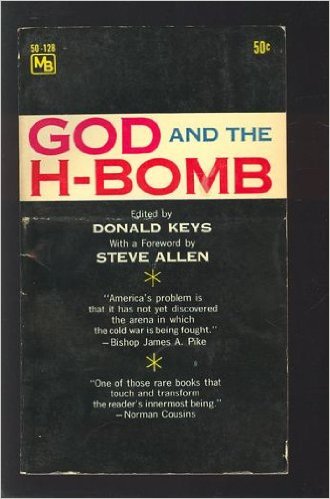
In 1961, a book called God and the H-Bomb was published. It’s not in print, but you might find a copy used or in a library, as I did a few years ago. The cover carries this question: “What counsel do our spiritual leaders offer in response to mankind’s greatest challenge?”

The roster of contributors is an impressive list of thinkers, some of whom are still recognized names, some less familiar. Paul Tillich, Martin Buber, Pope Pius XII, and so on.

We don’t see many—any—religious and spiritual leaders interviewed about the North Korean test, about the Iran deal, or about any Bomb related stories. Except for those religious and spiritual leaders with political strategy in mind or a political axe to grind.

That’s not what this 55-year-old book is about. It is about the moral and spiritual dimensions of the H-Bomb. That is reflected in the titles of the pieces. The power of self-destruction. War and Christian conscience. Fifteen years in hell is enough. Thy neighbor as thyself. The road of sanity.

The foreword is by Steve Allen, who is a little remembered as a significant television personality, but less as one of the most entertaining and brilliant public intellectuals of the middle twentieth century. Here’s what he writes:

That our nation is in the throes of moral collapse of serious dimensions is, apparently, no longer a debatable conclusion. Liberal and conservative spokesmen vie to see who shall express the conviction most vigorously. Churchmen and secularists, too, agree that we have fallen upon evil days. These various groups naturally differ as to the reasons for the situation, but that it exists no one seems to doubt….

Will our nation be guided in this dread hour by the moral code it professes to honor?

Will it?

War on ISIS: You Can’t Ask About Boots on the Ground Without Asking About the Draft

No poll about sending ground troops to fight ISIS—or anywhere else—is complete without asking questions about the military draft.

A recent NBC News poll taken after the events in Paris asked:

Would you support or oppose the United States sending additional ground troops to fight ISIS (Islamic militants) in Iraq and Syria?

Strongly support: 33%
Somewhat support: 32%
Somewhat oppose: 18%
Strongly oppose: 13%
DK/NA: 3%

The following questions should be added:

Do you have any family members in the eligible age range for Selective Service registration, between ages 18 and 25?

If a military draft was put in place by Congress, would you support or oppose the United States sending additional ground troops to fight ISIS in Iraq and Syria?

If your representative in Congress voted in favor of a military draft, would you be more likely or less likely to vote for them in the next election?

(That age range is based on the current requirement for men between 18 and 25 to register with Selective Service. At various times, the draft has covered a much wider range, all the way up to age 45.)

If a military draft was in place, the support for ground troops would likely plummet, if respondents were honest (which they sometimes aren’t). If the mandatory service included women—as it does in Israel, the darling of conservatives—the support number might approach zero. Especially if respondents/voters weren’t sure they could pull strings to get their loved ones out of serving.

Any member of Congress who voted in favor of a military draft, men only or men and women, is almost assured of losing the next election.

This is no way diminishes regard and thanks for the extraordinary valor and service of those who voluntary choose to serve in any military action. This is simply to suggest that those who righteously support such actions in the abstract might have a very different opinion when they, to put it bluntly, crudely and literally, have precious skin in the game.

Defeating ISIS: Lessons from the American and Israeli Wars of Independence

We can’t “defeat” ISIS. Not if that means declaring “victory” over Middle East-based Muslim radicalism and terror.

There are lessons from the American and Israeli Wars of Independence. This isn’t to suggest any moral equivalence comparing those world-changing events to the monstrosity of ISIS. But there are things to learn.

Both Wars of Independence were attempts to upend empire and established order and create a new model (both uprisings, not coincidentally, involving the British). Both were insurgencies by True Believers, one political and economic, one religious. Both are examples of the power of the heart, because the heart not only wants what the heart wants, it will do anything to get what the heart wants. True belief will find a way.

The British thought that their massive and formal force would roll right over the Americans. They did not count on all sorts of stealthy and tricky techniques, on secret communications, on a guerilla war. Mostly, the British didn’t account for the depth of American commitment: hearts and minds and souls. It may not always work that way, but competitions often go, simply, to the side that just wants it more. And that would be the Americans.

The British were never quite sure what they were doing in Palestine. But they did know something about world order and keeping order. Besides, some Brits didn’t much like the Jews anyway. The Zionists believed, literally, that they had God on their side. As far as hearts and minds and souls getting what they want, doing anything to win did mean the occasional act of terror (for example, the 1946 bombing of the King David Hotel in Jerusalem, leaving 96 dead). As far as who wanted it more, the founders of the modern Jewish state not only defeated the British, but turned back all attempts by hate-fueled neighbors to root them out.

In the aftermath of Paris, just as with 9/11 and other recent terrible events, if we keep talking simplistically about “defeating”, “eliminating” or “building American-style democracy”, we are—there’s no other way to say this—fools. We should eliminate and prevent horror, terror and monstrosity wherever and whenever we can. But if we think that the toxic mixture of true belief, grievance and pathology is just going to vanish because we are purer and more powerful, that would be funny if it weren’t so sad and dangerous.

If you don’t think that hearts, minds and souls matter when it comes to extremism, just look at the sorry record of irresolute and wasteful wars when we ignore that. We may feel righteous and superior, and want to vindicate civilization. But that doesn’t relieve us of the responsibility to be smart. Smart about what we face, what we can accomplish and how to accomplish it. So we can do some good, and do less harm.

The I Ching of Paris

Hexagrams 44 and 29

Question for the I Ching (using the coin method of consultation): How do we deal with the events in Paris?

The I Ching replies:

Hexagram 44 – Gou (Encountering, Coming to Meet)
Heaven above, Wind below.
Changing lines in the third, fourth and top place.

Changes to:

Hexagram 29 – Kan (Water, Darkness, The Abysmal)
Water above, Water below.

Excerpts from two leading translations:

The Complete I Ching
Alfred Huang

Hexagram 44 – Gou

The structure of the gua [hexagram] is Heaven above, Wind below. The wind blows everywhere under Heaven, encountering every being. It should be an auspicious gua. However, there is only one yielding line beneath five solid lines, symbolizing that the yin element is advancing and approaching the yang elements. When King Wen saw this happening, he heightened his vigilance. He realized that an unworthy person was worming his way into favor at the court. The growing negative influences would displace good people one after another. Darkness and difficulties had been eliminated, but their negative influences had not totally faded. These influences were permeating different areas. One must beware of this tendency and take prompt precautions against possible misfortune. Thus King Wen’s Decision and the Duke of Zhou’s Yao Text are full of warnings. But Confucius’s commentaries still shed light on the positive side.

This gua discusses the principle of encountering. In Chinese, meeting a person (or anything) unexpectedly is defined as encountering. When people encounter each other, either they are attracted, making adjustment for a harmonious relationship, or they reject each other, creating conflict between them. In human life sometimes one cannot refrain from misunderstanding and conflict. But one should not indulge in it and think that conflict is unavoidable and cannot be resolved. The ancient sages advocated adopting a conciliatory attitude. Here one yin element approaches five yang elements. She dares to come forward because her strength grows stronger. In this situation, one should not overlook taking preventive measures.

King Wen’s strategy of eliminating evil forces was to show no animosity but to act without tolerance. His administration constrained evil elements like tying up rams. But evil elements still wormed themselves into the favor of the court. King Wen realized that the evil forces had been eliminated, yet their influence had not totally faded. His analogy was that the maiden was too strong; it was not good to marry such a woman. The Duke of Zhou describes the evil forces as waiting to move forward like a lean pig. They should be stopped as if fastened with a metal brake. It is wise to restrain their influence by not letting them influence other people, but it was wiser to influence people with positive virtue.

[Changes to:]

Hexagram 29 – Kan

The central theme of this gua is: falling but not drowned; in danger but not lost. Maintain your confidence: soothe your mind. With assurance and faith, caution and trust, you can pass through any difficult situation. Both Abysmal and Abyss carry the sense of being bottomless. Kan is a pit, but it is not bottomless. There is hope.

Darkness represents not only a pit but also a situation of difficulty or danger. The structure of this gua is a doubling of the primary gua, Water. The image of Water is a yang line plunging between two yin lines, like running water flowing along and between the banks of a river. In ancient times, crossing a river represented a great danger. Thus, the attribute of Water was designated a situation of difficulty or danger. Here, Water is doubled, suggesting that one is plunging into a situation fraught with difficulties or danger. However, the ancient Chinese believed that no matter how dangerous or dark a situation was, if one was able to follow the way of Heaven, one could pass through it as safely as water passes through a ravine.

Water flows on twice over,
Darkness is doubled.
In correspondence with this,
The superior person cultivates and practices virtue constantly
And responds through teaching.


The I Ching
Wilhelm/Baynes

Hexagram 44 – Kou

This hexagram indicates a situation in which the principle of darkness, after having been eliminated, furtively and unexpectedly obtrudes again from within and below. Of its own accord the female principle comes to meet the male. It is an unfavorable and dangerous situation, and we must understand and promptly prevent the possible consequences.

The inferior man rises only because the superior man does not regard him as dangerous and so lends him power. If he were resisted from the first, he could never gain influence.
The time of COMING TO MEET is important in still another way. Although as a general rule the weak should not come to meet the strong, there are times when this has great significance. When heaven and earth come to meet each other, all creatures prosper; when a prince and his official come to meet each other, the world is put in order. It is necessary for elements predestined to be joined and mutually dependent to come to meet one another halfway. But the coming together must be free of dishonest ulterior motives, otherwise harm will result.

[Changes to:]

Hexagram 29 – K’an

In man’s world K’an represents the heart, the soul locked up within the body, the principle of light inclosed in the dark—that is, reason. The name of the hexagram, because the trigram is doubled, has the additional meaning, “repetition of danger.” Thus the hexagram is intended to designate an objective situation to which one must become accustomed, not a subjective attitude. For danger due to a subjective attitude means either foolhardiness or guile. Hence too a ravine is used to symbolize danger; it is a situation in which a man is in the same pass as the water in a ravine, and, like the water, he can escape if he behaves correctly.

Through repetition of danger we grow accustomed to it. Water sets the example for the right conduct under such circumstances. It flows on and on, and merely fills up all the places through which it flows; it does not shrink from any dangerous spot nor from any plunge, and nothing can make it lose its own essential nature. It remains true to itself under all conditions. Thus likewise, if one is sincere when confronted with difficulties, the heart can penetrate the meaning of the situation. And once we have gained inner mastery of a problem, it will come about naturally that the action we take will succeed. In danger all that counts is really carrying out all that has to be done—thoroughness—and going forward, in order not to perish through tarrying in the danger.

Properly used, danger can have an important meaning as a protective measure. Thus heaven has its perilous height protecting it against every attempt at invasion, and earth has its mountains and bodies of water, separating countries by their dangers. Thus also rulers make use of danger to protect themselves against attacks from without and against turmoil within.

If You’re Tired of Hearing About the Vietnam War, Tell Our Leaders to Stop Reenacting It

This weekend, an administration official tried to explain in an interview what exactly we are now doing in Iraq and Syria. It was like a ghost or the walking dead, sounding eerily and unhappily exactly like the rhetoric that was rolled out in the middle days of the Vietnam War.

There are roughly three groups about Vietnam: those who lived through it on the home front, those who lived through it (or not) in battle, and a generation or more that is so tired of hearing about a war that ended forty years ago. So tired of it. Can’t you all ever get over it?

Too bad. No, we should never “get over” Vietnam, no matter how many generations pass, and no matter how tired those generations are about the lessons we might learn. Vietnam was the first truly modern war of the media age and of the post-national era.

In media terms, it offered the best possibility up to that time to say positive stuff about a complex war policy, have it widely broadcast (though not as widely as digital today), and have the media endorse it and people believe it. Okay, that does sound like a description of what happened in Iraq, but that just proves the point.

As far as post-national warfare, Vietnam was technically a civil war, but it was obviously something else too. There was an army of North Vietnam, but there were also indigenous forces and a people’s movement trying to upset an unacceptable status quo, which we supported and ultimately defended. For a while. Until there was no more government of South Vietnam. And then it became a matter of just not losing. Which we did.

Another parallel is not paying attention to history, our own and that of others. The French abandoned Indochina, but that was supposedly just because they were, well, French. Americans know and are better than that. Just as in Afghanistan, where the Soviets abandoned their war, but that was supposedly because, well, they were Commies. Freedom loving Americans know and are better.

Which brings us back round to Iraq and Syria today. If you make the effort, you could go back to the LBJ days of Vietnam and hear exactly the same words that were spoken this weekend. Not just something like it, but exactly. Such as: it’s their fight, not ours.

There are things worth fighting for on the world stage, even when it is not on our homeland. But it is hard enough to figure out what those things are, and even harder to commit ourselves and our loved ones to the fight, when we are swimming in a sea of official stuff and nonsense. We want the brutal truth, if our leaders can tell it, especially when it is bound to be a brutal and long fight.

No Refugees in the Democratic Debate

Adding insult to their injury, Syrian refugees were missing from last week’s Democratic debate.

There were some other important issues mentioned, often presented in sound bites, but many more conspicuous by their absence. But you would think the party that considers itself the more progressive, caring, humane and globally sensitive would take the opportunity to at least mention to the 15 million viewers that we are experiencing one of the biggest humanitarian crises since the end of World War II. The same goes, maybe goes double, for the individual candidates who had the floor and could have just once brought it up.

(Note: Jim Webb did raise refugees while talking about his wife, who is a refugee from Vietnam. But that was not in the context of the current crisis.)

The explanation of this is simple and typical, though not particularly happy. Raising questions you can’t answer, or can’t answer with some vague, equivocal, pointless comment is to be avoided. Either voters will realize that you have no answer, or if you do answer from your conscience and heart, you just might lose votes. Either way, as a candidate, you’re screwed.

This isn’t a Democratic purview. When Republicans get together in their overstuffed debate scrum, there isn’t much to be said about the refugee crisis, except that it is an obvious ruse to allow Islamic terrorists to enter our country. It does seem like an elaborate scheme—displacing millions of men, women, and children just to get a chance to disrupt American stability—but you know how tricky those people can be.

And so, the next time a Democratic candidate wants to tell one of those rise from adversity stories that is a sure fire way to seem human and humane, maybe he or she can mention the shared and horrific adversity that won’t just go away—even if he or she has some magic plan to “fix” Syria (which he or she doesn’t). Maybe the next time, at the podium or on a debate stage. Those refugees will certainly still be there, in an increasing hell on earth.