Bob Schwartz

Category: Media

The Saints Francis

St. Francis of Assisi
Right now, there are millions of words being written and spoken about who Pope Francis is and what kind of Pope he will be. Read and listen with care and a bit of skepticism, knowing that some (but not all) have an agenda or a bit of rosy vision, and knowing that almost all of the “experts” got this papal selection wrong. The fact is that predictions are all we have at the moment, but they will fade in the shadow of what the Pope actually does or doesn’t do and accomplish.

Instead or in addition, spend some time with the saints, particularly the various Saints Francis. Even for us non-Catholics and non-Christians, the saints are an enormously interesting, educational and in some cases enlightening phenomenon. If you don’t have some appreciation for the saints, whether or not you believe the intrinsic or underlying theology, you cannot understand the Catholic Church. Besides that, in the world of religion, not just Catholicism, the lives of the saints are just plain entertaining and their teachings often edifying and inspiring.

Here is the list of Saint Francis variations, taken from the SPQN site, a go-to location for summary saint information and references:

Francis Gil de Frederich
Francis Isidore Gagelin
Francis Jaccard
Francis Jerome
Francis Johnson
Francis Man
Francis Mary Paul Libermann
Francis Page
Francis Palau y Quer
Francis Patrizzi
Francis Pontillo
Francis Possenti
Francis Regis Clet
Francis Rogaczewski
Francis Seelos
Francis Solano
Francis Solanus
Francis Trung Von Tran
Francis Webb
Francis Xavier
Francis Xavier Bianchi
Francis Xavier Can Nguyen
Francis Xavier Mau
Francis Xavier Seelos
Francis de Capillas
Francis de Geronimo
Francis de Hieronymo
Francis de Montmorency Laval
Francis de Sales
Francis di Girolamo
Francis of Assisi
Francis of Girolamo
Francis of Nagasaki
Francis of Paola
Francis of Saint Michael
Francis of Sales
Francis, Caius
Francis, Gaius
Francisca Aviat
Francisca de Ambrosia
Francisca Salesia
Francisca Salesia Aviat
Francisco Castells Brenuy
Francisco Ferro, Ambrosio
Francisco José López-Caamaño García-Pérez
Francisco Marto
Francisco of the Child Jesus
Francisco Palau y Quer
Francisco Pascual Sánchez
Francisco Shoyemon
Franciscus de Hieronymo

The most-discussed and obvious of the lives behind Cardinal Bergoglio’s groundbreaking choice of name (he is the first Pope Francis) is Francis of Assisi. His turning from a worldly life to a mission of simplicity, service, peace and, of course, living with nature led to his founding of one of the Church’s most significant orders (the Franciscans) and indirectly to the founding of another by his star student (the Poor Clares). He is also a patron saint of dozens of occupations, causes and places, including

against dying alone
against fire
animal welfare societies
animals
birds
ecologists
ecology
environment
environmentalism
environmentalists
families
lace makers
lace workers
merchants
needle workers
peace
tapestry workers
zoos
Italy
Colorado
Ahuacatlán, Mexico
Assisi, Italy
Freising, Germany
Massa, Italy
Nambe Indian Pueblo
Quibdo, Choco, Colombia
San Pawl il-Bahar, Malta
Sante Fe, New Mexico
Sorbo, Italy
Denver, Colorado, archdiocese of
Kottapuram, India, diocese of
Lancaster, England, diocese of
Metuchen, New Jersey, diocese of
Salina, Kansas, diocese of
San Francisco, California, archdiocese of
Sante Fe, New Mexico, archdiocese of
Viana, Angola, diocese of

But he is not the only Saint Francis with a substantial presence in the Church. Saint Francis de Sales, for example, is the namesake of schools worldwide, founder of his own order (the Salesians), and in 1923 was named patron saint of writers and journalists (and presumably bloggers) by Pope Pius XI.

However you are celebrating the upcoming St. Patrick’s Day—if you are—you might start your study of the saints with him.  But don’t stop there. Take this opportunity of a new Pope to learn about the Saints Francis, from the big names to the lesser known but still worthy ones. You’ll find it a special experience, no matter what your spiritual perspective, and maybe much more fun and useful than listening to the earnest babble of certain media talking heads.

If We Could See the Children of Sandy Hook

Sandy Hook School
Early in the Iraq War, President Bush tried to block taking pictures of the arrival of the coffins of fallen soldiers at Dover Air Force Base. The proposal was couched as a gesture of respect to the families, but the real point was to shield citizens from the ultimate cost of war.

There are different opinions on the impact of viewing carnage, fictional and real. Does constant exposure immunize us from taking violence seriously? Would we pursue wars so readily, or at least try to better distinguish the necessary from the chosen, if we were bombarded by those images? If we saw footage of the early days of the camps in real time, would we have allowed the Holocaust to proceed?

The images of the children killed at Sandy Hook School in Newtown are blocked from us. This choice is almost beyond argument. We have heard the reaction of those who did witness the aftermath, and even those who have participated in war said that scene was worse. We are protecting the dignity of those lives unlived and respecting the immeasurable grief of the families. Our imaginations are already enough to rend our hearts.

And so instead we have pictures of those children as they are remembered, beautiful angels, joy and potential, and we have the testimony and imploring of their parents. But somehow, this doesn’t seem to be quite enough to stop abstract arguments about the essential value of the Second Amendment, how it must continue unconditioned even by sensible restrictions that meet moral, practical and constitutional muster. First they come for my AR-15, this line goes, and next the deer and the police will be hunting me.

There is a way to end this argument, though for good reasons we will not do it. If we ever get to see the killing field at Sandy Hook, there will be little more talk of a free trade in assault weapons and big ammunition clips. There may be talk, but it will be silenced by a new and more powerful outrage. The NRA might try to keep repeating a mantra that is already falling on more deaf ears, and some of their political operatives will follow. But the vast majority of Americans will move from just saying the right thing to a pollster to demanding that the right thing be done. Now.

If we could, as we won’t, see the children.

Adorable Animals Instead of Politicians

John Boehner - Golden Retriever Puppies
It’s a hard life for a political junkie. Not because politics is difficult to find these days. To the contrary, it is everywhere, all the time. If politics is the drug, there are dealers literally giving it away—begging you to take it—at millions of media storefronts. It’s like Amsterdam, where women are on display behind glass and drugs flow like water—except that it’s all free.

The problem isn’t supply. The problem is that once you’re hooked, after a while you no longer get the thrill you once did. In fact, you often feel pretty bad. But by that time, it’s too late.

Last year was the best and the worst of times for political junkies. Not only was it an election year; it was an election year like none other. Talking heads couldn’t stop talking and we couldn’t stop listening and retorting. But it didn’t make us feel good. Whether we liked the outcome of the elections or not, we felt icky, cynical, pessimistic. Maybe, we hoped, we could get a break, enjoy some spiritual renewal as we celebrated somebody’s—anybody’s—savior being born, and could start a new year clean.

No such luck. Politically, the year ended at a low point, and with the new year, the chances of climbing out of the gutter seem slim. If political junkies could only distance themselves from these shenanigans (a great word Joe Biden used last week), maybe we could clear our heads a little.

Unfortunately, with so many serious issues at stake, staying away seems unlikely. Instead, here is a radical solution that might just help.

Every time a politician is mentioned or shown, imagine an adorable animal. Nothing fierce, nothing threatening, nothing ugly. Something unbearably cute and irresistible, guaranteed to bring a smile, however fleeting, to your face. (Note: If you think that the politician mentioned is adorable, cute and irresistible, no substitution is necessary.)

This is loosely based on various cognitive therapies, but the truth is that there is no real science behind it. On the other hand, there is nothing to lose either. If you’re addicted to politics, very little is going to lift you up right now. Any way you look at it, there are too many politicians and not enough adorable animals. This is just a small step to redress the balance in your unbalanced life.

The World Makes Sense Of America, One Front Page At A Time

COL_EC
The Newseum in Washington, D.C. is America’s news museum. It is a valuable resource that fortunately offers a lot of online content. One of its focuses is the still alive and kicking medium of print newspapers, and the Newsuem offers something that highlights one unique feature of these supposed media dinosaurs. Each day the Newsweum collects the front pages of hundreds of American and global papers and makes them available digitally.

For particular eventful days, like 9/11, the Newseum archives those front pages for posterity. The archive for Saturday, December 15, 2012, the day newspapers first reported about Sandy Hook, is particularly enlightening. Most nations had at least one front page featuring the story. American gun culture is so singular, even in places undergoing short-term or protracted states of war, that the stories mix perplexity with maybe some sense of “we’ve got plenty of problems, but this ain’t one.”

Even for those who love a well-crafted Web page or mobile screen, newspaper front pages remain an expressive art form, a story before and within the story. This is at its truest and most challenging in the face of big events.

The one above is from Medillin, Colombia. Medillin is the country’s second largest city and the infamous home of the Medillin drug cartel, which for about two decades terrorized the nation. Medillin is no stranger to brutality and guns.

The headline reads: “Golpe Al Alma de Estados Unidos”. Blow to the Soul of the United States.

Here are a few more:

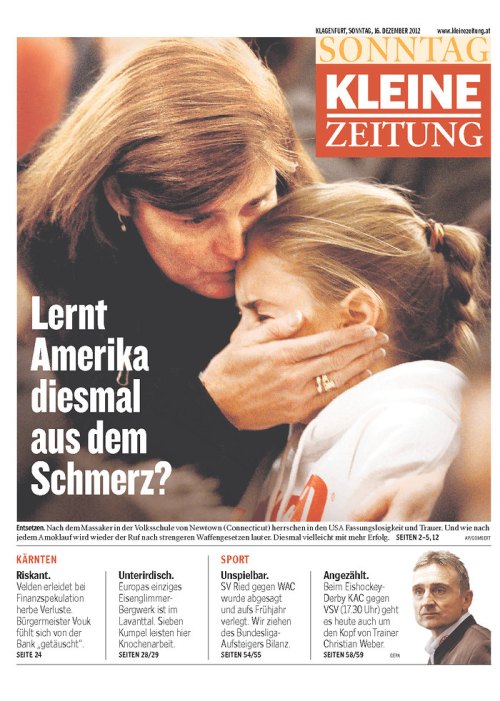
Austria
Austria
Has America Learned from the Pain This Time?

PanamaPanama
Massacre
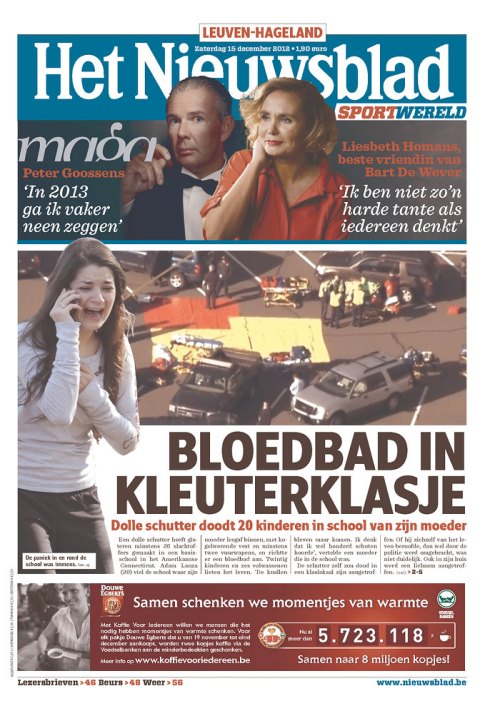
BelgiumBelgium
Bloodbath in Kindergarten
BrazilBrazil
Why?

Citizens United Lives: Money Will Still Buy Elections

Thomas Nast
In the aftermath of the election, a certain joyous complacency has set in regarding Citizens United and the impact of Big Money on the electoral process. A derisive attitude of “epic fail” has attached to Sheldon Adelson, Karl Rove and all the others who seemingly wasted their billions (or other people’s billions) on influencing the results. Some have wondered out loud about how much real good those billions would have done for a country and world in need.

In fact, the money was merely mismanaged, channeled into outdated and ineffective strategies, and thereby wasted. But that will not last. There are plenty of talented operatives and strategists out there, even now working on better ways to address electoral problems using modern means. Yes, they are outnumbered by old school consultants relying on some combination of charm, reputation and useless technique, but like the blind squirrels, even Big Money will find the acorns sometimes.

And when the billionaires do find the operatives working on the cutting edge of 21st century electoral influence, what many feared would happen in the 2012 election—but didn’t—will eventually happen. Elections will be bought, even on behalf of those candidates who appear to some as unqualified and even clownish.

It’s time to stop laughing at Karl Rove’s misfortunes and start doubling up on the efforts to neutralize the impact of Citizens United. Proposals are out there, ranging from enhanced disclosure to a constitutional amendment. Whatever the approach, pursue it now. It’s the only way to avoid the Wednesday morning in November we didn’t have, the one where we wake up shaking our heads and asking: How in the world did that happen?

Have Morsy Morsi Mursi


It is Gadhafi, Qaddafi, Kadafi, Gaddafi, Gadafy all over again. Except that the former Prime Minister of Libya is dead, while the President of neighboring Egypt is very much alive and at the center of global affairs.

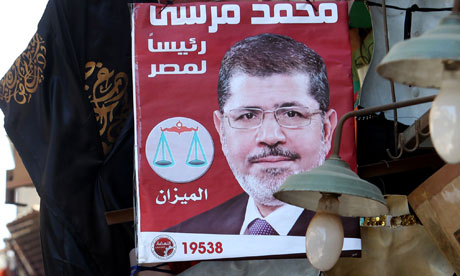
The English version of the official Egyptian information website lists the President as Mohammad Mohamed Morsy al-Ayat. That is the way they are writing the name in the Latin alphabet. And therein lies a problem.

Egypt, Libya and most other countries in the region are Arabic-speaking and Arabic-writing. As with Hebrew—another important language in the region, though with far fewer speakers—transliterating the words into English spelling and vocalization is an adventure, and sometimes a pretty imprecise task.

News organizations seem to have settled on a consensus for the spelling of his first name as Mohamed—though as one of the most popular names in the world, it has naturally led to variants including Mohammad, Muhammad, Muhamme, Mohamed, Mohammed.

(For language junkies, other common Arabic names share the three-consonant root of  H-M-D, meaning “praise.” This is at the base of many commonly-heard names beside Mohamed, including Hamid, Ahmed, Mahmud, and others that are often in the news.)

What news organizations can’t seem to agree on is how to spell the President’s last name. As mentioned, the official Egyptian site says “Morsy,” so CNN, Time and a few others are going that way. The BBC and Reuters have decided on “Mursi” (it must be a Brit thing, some special privilege left over from colonial days, though the BBC has taken the extra step of adding an “m” to his first name: Mohammed).

By and large though, according to the New York Times and most others, the President of Egypt is Mohamed Morsi.

Does it matter? How we deal with him and his country matters much more in this dynamic time than how we spell his name in English, just as it is more important to act wisely than to spell correctly when dealing with China or any of the other countries that don’t speak English and don’t even bother to use our alphabet. It’s just a nice lesson in globalism, about how what we know is small compared to what we have to learn.

More Proof That Baseball Is Better Than Politics


The political polling analyst Nate Silver is something of a hero, both for his accurate predictions and for his amazingly clear explanation of the statistics that lead to his seemingly prescient conclusions. To paraphrase Barack Obama talking about Bill Clinton’s ability to make complex budget math simple, Nate Silver should be the Secretary of Explaining Things statistical.

Those of us who have followed Nate’s career, even before the New York Times made him and his Five Thirty Eight blog a must-read fixture, know that his roots are not in politics but in the art and science of baseball stats. That’s why it was wonderful to see him switch gears yesterday from the election to the most contentious baseball argument of the moment: who should be this year’s American League Most Valuable Player, an award voted on by the Baseball Writers of America?

To make this basic for non-baseball fans, two players in the league had historic, exceptional seasons. Miguel Cabrera, playing for the pennant-winning but World Series-losing Detroit Tigers, was the first player in forty-five years to win the Triple Crown, leading the league in Batting Average, Runs Batted In and Home Runs. Twenty-year-old Los Angeles Angels rookie Mike Trout not only had one of the best first seasons ever (unanimously winning Rookie of the Year award), he had one of the best seasons period. Of the so-called five tools (hitting for average, hitting for power, baserunning, throwing and fielding), few players of his age have ever exhibited such an array of gifts.

Yesterday, the Major League Baseball Network convened a conclave of baseball experts for a one-hour debate on the matter; that’s how significant it is (at least to lovers of the game). And yesterday Nate posted The Statistical Case Against Cabrera for M.V.P.

The point here is neither Nate’s argument nor the merits of the debate (Cabrera will most likely win, though the best outcome, given how micrometer-close it is, would be for a shared award). The point is that soon after the blog post, hundreds of comments arrived. Not just a few interesting comments mixed with uninformed, borderline psychotic rants, as we’ve come to expect from political posts. This was an amazing collection of intelligent, articulate, deeply researched responses, offering perspectives that even the most attentive fan might not have considered.

That’s why we are happy that Nate returned, at least for the moment, to baseball. And that’s why baseball is, inarguably, better than politics.

The Story of the Generals: Prurience or Public Interest? Desperately Needed Break?


I see a little silhouetto of a man,
Scaramouche, Scaramouche, will you do the Fandango?
Thunderbolt and lightning, very, very frightening me.
Queen, Bohemian Rhapsody

Responsible media personalities have had to admit that they are hanging on every detail of the The Story of the Generals, even as they question whether private behavior, however crazy, however famous the players, rises above the level of celebrity gossip.

That’s a great and important question—in general. But in this particular case, something is happening. The details are growing exponentially, to the point that every story about it, even in this up-to-the-microsecond digital news age, is old the moment it is published. And practically all of the revelations have a public facet. It was tantalizing to learn that Jill Kelley had an identical twin sister who, among other things, was involved in a bitter child custody battle that ended with her losing custody and being branded “psychologically unstable” by the judge. It was another thing entirely to learn that both General Petraeus and General Allen had written letters to the court supporting her. And it was still another thing to learn that this sister’s ex-husband at one time worked for the Coalition Provisional Authority in Iraq.

On the public-private scale, stories all deserve the benefit of the doubt that leans toward privacy, and it’s better to err on that side. That’s what all of us would want for ourselves and our families. But this story sits at a previously unknown nexus of the strange personal and strange public. It is sui generis (and if it turns out not to be one of a kind, we are in serious terra incognita). We are stuck being unable to extricate prurience from public interest until we know it all, or at least much more. The evidence is compelling that there is something here we might deserve to care about as citizens, not just as voyeurs.

One of the other factors that plays into the fascination with this story is that we need a civic break. That is no comfort for the genuine pain that surrounds it, nor is it an acceptable excuse for prying. But it is a fact. We are supposed to immediately care about how we will resolve the looming fiscal crisis, about who is in leadership positions in Congress, about why Mitt Romney lost and Barack Obama won, about who will be running in the 2016 Presidential race, etc. Enough, for just this moment, is enough. Yesterday brought two horrific reports, one from Arizona about a Romney supporter who ran over and critically injured her husband in a parking lot because he had failed to vote, another from Florida about a man who committed suicide because Obama was re-elected.

That’s a reason we can’t get enough of this story, and miraculously, the story keeps growing to distract us in unimaginably original ways. And who knows? Maybe while we are so distracted, those who are elected to solve our problems—and a few who lost their jobs because they didn’t—will take the opportunity while we aren’t looking to start solving them in a cooperative way. That would be a much shinier and more substantial story to mesmerize us.

Des Moines Register Endorses Richard Nixon


The story of the Des Moines Register’s endorsing Mitt Romney—the first time the newspaper has endorsed a Republican since Richard Nixon in 1972—has been covered with entirely the wrong emphasis.

The point is not Mitt Romney’s potential for success in the office or Barack Obama’s supposed failures.

The point is that the Des Moines Register endorsed Richard Nixon. Yes, that Richard Nixon.

The Register was far from alone among major newspapers endorsing Nixon that year. Unfortunately, no archive has been found with the particular words of praise and support the newspaper used, though the search continues. It would be lovely to read those words—and then to compare them to the actualities of Nixon’s truncated term in office.

Absent that record, it is a good guess that the Des Moines Register did not predict that Nixon would lead a criminal conspiracy from the Oval Office, and that the cover-up of that behavior would include the undermining of the U.S. Constitution. That would not make for a very effective endorsement. Nor did the newspaper likely mention his nickname “Tricky Dick”, an allusion to his reputation for deviousness and ruthlessness.

The well-known moniker began not with his 1968 presidential campaign, nor with his 1962 gubernatorial campaign, nor with his 1960 presidential campaign, nor with his 1952 vice-presidential campaign, but with his 1950 senatorial campaign. By the time of the 1972 campaign, Nixon had been touted by some respectable people as “Tricky Dick” for 22 years.

For whatever reason, the Des Moines Register refused to believe it. They endorsed Nixon, and though we can’t really blame them for the election results—the late George McGovern’s historic loss—they didn’t help, and the rest is history.

I Read Newsweek Today, Oh Boy


If we hold a wake for each print publication that dies or goes digital-only, we’d be drinking all the time (which is not a bad response). Newsweek today announced, in spite of recent protestations, that it was indeed ending publication of its print edition this year.

Volumes have been written about this phenomenon, and more will be on the way. You can read them on your computer, e-reader, or mobile device. In the meantime, an observation.

Print media are in fundamental ways different than their digital counterparts as tools. Not better or worse, just different. This is not the conceit of old-school anachronists who defy the new guard to take the paper magazines or books from their (sooner than later) cold, dead hands. To understand how that could be so, read the increasingly unread Marshall McLuhan. The message of the medium is the message is that each medium is particular in granular ways (not sure if McLuhan would have loved, hated, or wished he had coined that buzzword). Those ways are not just meaningful, they are some of the most important meaning. If you can’t make a long list of conceptual, non-practical ways that identical content is deeply different in paper and digital form, you aren’t thinking hard enough, and you haven’t read McLuhan.

Suffice it to say that in ways that matter, the Newsweek that doesn’t require electrons is different than the one that does, even if the content is the same.

After saying all those important and noble things, a small confession of complicity. There was a time when a mailbox full of top-tier magazines was both a sign and a source of erudition. Many news junkies got their start when their parents subscribed to the newsweeklies—one, two or, if you were lucky, all three. Newsweek, Time and U.S. News and World Report every week, highly anticipated and absorbed cover to cover once they arrived.

The arrival of paper magazines is still a thrill. But one by one, the subscriptions were allowed to dwindle. It wasn’t just access to free and instantaneous alternatives; as far as expense, many print magazines priced themselves ridiculously low. It was like a relationship that lapses and fades, even if you know you might well be better off in keeping it alive. It was just the times, the way of the world.

Maybe Newsweek and other print editions would have lasted if subscribers had been willing to make an effort and work on the relationship. But they didn’t. We may look back and see these print magazines as the ones that got away, but we shouldn’t have let them. Just because it’s the way of the world doesn’t mean it’s for the best.