Bob Schwartz

Category: Media

The Comcast-Time Warner Cable Merger
Comcast TWC
Meet the new boss
Same as the old boss
The Who, Won’t Get Fooled Again

Comcast and Time Warner Cable are not bad companies, but their proposed merger is a bad idea, for consumers and for the country. For one thing, it would put cable Internet service for the majority of the country—including 19 of 20 metros—in the hands of a single enterprise. Consumers Union among others has come out against the merger. For an excellent overview, see Free Press, which has been articulate and vocal in its opposition.

Even in these first weeks after the proposal, this should have caused more public concern than it has. Some of that diffidence may be understandable. Without impugning motives, in this 2014 election cycle, federal candidates have received $1,184,535 in contributions related to Comcast ($3,188,117 for 2012) and $351,649 related to TWC ($845,616 for 2012)—split almost evenly across party lines.

MSNBC, the chatty and progressive cable outlet, has been relatively quiet. You can determine this by searching for “merger” on the MSNBC.com site over the last month. Of the 54 hits, it looks like all but one reflect a February 14 Morning Joe joint appearance by Comcast CEO Brian Roberts and TWC CEO Robert Marcus. Their positive talk was expected. But the lack of sharp questioning is a different matter. In fact, at one point Joe Scarborough strangely prefaced his praise for Comcast this way: “It’ll sound like a softball question, but I’m genuinely intrigued: what is Comcast doing right over the past several years?” Why is that so strange? Because Joe and Mika and everyone else on Morning Joe and the network work for Brian Roberts, since Comcast owns NBCUniversal. None of that was discussed or disclosed.

But even that isn’t the solution to the puzzle of why this issue hasn’t and may never reach the level of concern it deserves. It’s this: consumers aren’t worried about living with cable monopoly because they already do, and have for a long time.

To understand that, we have to go back to the start of broadcast regulation. Radio was the beginning of over-the-air broadcasting. Just because the radio pipeline was invisible didn’t mean it couldn’t be filled to overcapacity; the radio spectrum was finite. People could build bigger and more powerful transmitters, using brute force to fight over frequencies, leaving the radio listener lost in chaos. Order had to be imposed so that some body—now the FCC—could control who was on the air, how they maintained their presence on the air, and, most controversially, what they said on the air.

Cable turned that (and cutting-edge modernity) on its head. Instead of just building bigger and more powerful transmitters to reach farther and more people invisibly, old-fashioned physical wires would be strung and laid to connect consumers to a network. Theoretically, there was no limit to how many cables you could build over mountains and across valleys, on poles and underground, all to bring broadcasts, and eventually Internet, from a source to your home. But practically, building out that infrastructure was expensive and inconvenient. To maintain, expand and improve service, cable companies wanted assurance that it would be worth it. And so local cable monopoly was born. For decades, and to this day, municipalities across the country enter into agreements with cable providers to be the sole source for particular areas, with loose oversight of rates and service. In general the place you live will be served by one particular provider.

This squeeze was a little relieved by certain technological advances. Satellite service could provide both television and Internet, though the physical requirement of line-of-sight to the sky made it sometimes impractical. DSL Internet over phone lines also offers an alternative, though as Internet needs have grown, cable has proven a much “fatter” pipeline for data. In the end, as a practical matter, the local cable provider is for many consumers the best choice.

If you can call it a choice. Those consumers may not be as concerned about whether Comcast/TWC acquires some sort of monopoly because for years those consumers have been living with a local cable monopoly. This is another of the strange moments from the Morning Joe interview with Comcast’s Brian Roberts. One of the arguments used to defend the merger is that there is practically no overlap between the Comcast and TWC markets. Of course, that is precisely the point. Roberts’s argument, though it isn’t what he meant to say, is that since consumers never had a choice in the first place, they won’t notice the difference.

And maybe, just maybe, he’s right.

Comic Book Plus: Digital Superheroes

Comic Book Plus
If it isn’t apparent from previous posts, the premier pop cultural medium of these times (meaning the last century) may not be movies or music or television or any of the usual suspects. It is comic books, and while explaining that in detail will have to wait for another post, just ask the entertainment enterprises that have built billion-dollar franchises on that foundation. Hint: Don’t just look at the movies; look at video games, which are sometimes expressly, sometimes implicitly interactive comic books at heart.

Digital has provided new ways to enjoy the old and the new. Comixology, for example, offers an excellent cross-device platform for digital comics. But if you love comic books as essential cultural artifacts, the digital pickings have been slim and erratic. Of course comic book connoisseurs and scholars have been scanning and distributing them for as long as there has been an internet, but organization, information and, above all, copyright integrity has been missing.

The developers of the Comic Book Plus are digital and cultural superheroes. “Free and Legal” they trumpet, and nowhere in the universe can you both read and download such a collection representing decades of this historical basis of American—of world—culture. Free and legal. (Note: The downloads are in special comic book file formats that require some sort of reader. One way to deal with this is with Calibre, the world’s most popular free ebook manager and converter. Calibre will convert the comics to any format you choose, e.g., epub or pdf, to be read on your existing readers.)

If you love comic books and graphic novels, no more needs to be said. If you love pop culture and its origins, immerse yourself in the sequential art of these digital waters. Just make sure you have some time to spare because you won’t want to come out. And for those in the know, just tell them Will Eisner sent you.

Lesson from The Voice: Caveat Inspector

The Voice
The Voice is now the dominant singing competition on television, having surpassed, probably permanently, American Idol. There is a lesson from The Voice that goes beyond just music, a lesson that goes to the heart of what has become a more media centric/entertainment centric society.

The reasons for the success of The Voice are pretty simple:

A substantial number of solidly talented and interesting contestants.

Panels of likeable and helpful celebrity coaches, with real musical expertise and real chemistry between them: Adam Levine, Cee-Lo Green, Christina Aguilera and Blake Shelton in the fall; Shakira, Usher with Levine and Shelton in the spring.

The show process begins with the uber-concept in the show’s name. The first round is a blind competition, where the panelists can hear but not see the contestants sing. It is, at least in part, all about “the voice.”

This week began the Knockout Rounds, where votes from the TV audience determine who will stay and who will be eliminated. The first of two nights on Monday was peculiar, anomalous for any singing competition. Of the ten singers who performed, not a single one was criticized, even for a tiny misstep—even though a few performances were very good, some were okay, and some were just not quality singing.

American Idol never quite figured out how to deal with judges’ criticism of contestants. Starting with the original panel, and continuing through the revolving door of judges who failed, there were more or less roles for the judges: the more brutal but somewhat constructive one (Simon Cowell), the kind, encouraging and heart-on-the-sleeve, maybe a little ditzy one (Paul Abdul) and whatever one (Randy Jackson).

There was an underlying issue in all that. There is little doubt that the producers of Idol shaded and spun the show so that certain contestants might rise a little higher than others. Whether this amounted to rigging results is unsubstantiated overstatement. But clearly, with all the elements at their command, producers could shine a different light on different singers, light that might affect voting. A judge’s praise or criticism could certainly be one of those elements.

In so many ways, for the better, The Voice is not American Idol. But the toolbox has some of the same tools: heartwarming or heartrending back stories, strategic song choices, etc. If the panelists/coaches criticism could affect the outcome, on Monday the decision seemed to be to have none at all.

And it was weird. At some point, even as the least trained audience ears could sense a musical problem, you could see coaches forcing smiles and faint praise. One big tell is when a panelist begins by telling a singer how good they look or how wonderful a person they are. Which is utterly ironic, since the show is based on the premise that voice matters above all.

If Monday’s absence of criticism was notable, it was even more apparent as soon as the Tuesday Knockout Round began. From the first singer on, many of the performances received what was in all cases deserved small critiques—never devastating, sometimes not as big as it could have been, but critique nonetheless. It was as if someone behind the scenes had noticed and said: our audience may like certain singers for their look, their attitude, their personality, but the audience isn’t deaf or stupid. We have a panel with four eminently talented musicians, and while we don’t want brutality, their credibility as judges of performances—their honesty—is on the line.

Which brings us to the greater lesson that should never be forgotten. From the beginning of advertiser-paid media, newspapers to now, all of those media have dual roles to play. They are whatever they essentially do—report news, entertain us, stage competitions, offer ways to publish short messages to the world, etc. But they are all also ways of delivering eyes, ears, hearts and minds to advertisers. There is nothing wrong with this. Nor is there anything wrong with media not being transparent about this obvious dual role and announcing all the things they do to increase the audience.

So enjoy. Get invested in your favorites (this season: Caroline Pennell, Tessanne Chin and Cole Vosberry, all of whom could be The Voice, all of whom deserve success). But remember that in commercial media, along with caveat emptor (buyer beware), it is caveat lector (reader beware), caveat inspector (viewer beware), and on this day of the Twitter IPO, caveat tweeter.

There Is Still a War in Syria

Paris Hilton As Miley Cyrus
When there was less to people’s news and info lives—a newspaper or two a day, a half-hour network news show, a couple of news magazines a week—there were stories that rose to the top and stayed there, depending on importance. This didn’t mean that second-tier or frivolous stories didn’t get coverage or traction. People always loved celebrities, always loved hearing gossip, and when man bites dog, that’s always news. The down side was a certain provincialism that came with a narrow channel and less worldly attitudes: if millions were suffering in a place nobody heard of, with people unlike us, most readers and viewers might have no idea.

Now we can know anything, though we don’t know everything, or care about everything. This has left news leaders in a delicate position. There are going to be stories that appeal to a journalist sense and a humanist sense, that deserve at least regular mention, if not coverage that might only say, “And in the misery of this place or that war, it’s still happening, with no end in sight.” The dual problem is that people can find and figure that out for themselves, without a multi-billion dollar media enterprise telling them, and those media consumers might just as well pay attention to something else.

Which is why, unlike its predecessors World War II, Korean War and Vietnam War, the Iraq War was not the top story every day of its ten years. Which is why the current violence in Iraq is barely covered, a turning away that in part must come from some profound but unspoken embarrassment.

For a few moments a few months ago, Syria was a bright shiny object. Red lines, chemical warfare, threats of military action, etc. After some erratic movement, slight progress is being made. But that progress does not include ending the civil war.

The New York Times, still possibly the world’s greatest news enterprise, has an ongoing section devoted to the Crisis in Syria. The increasing numbers stupefy: 6.5 million Syrians displaced from their homes, more than 2 million of them seeking refuge in other countries. Now we hear about a cluster of polio cases among Syrian children.

We have plenty of our own problems, individually and as a country. Some of those are not small at all. But there is no polio. And the entire population of the state of Tennessee or Indiana has not had to leave their homes behind, dodging mayhem, unsure if they will ever return, or if there will be anything to return to.

We shouldn’t expect ourselves to be exhausted or crushed by the miseries of the world; that’s what keeping track of all the problems all the time would do. So yes, you can argue that it is important to learn from the news today that Paris Hilton has spent $5,000 on Halloween costumes so that she can dress up as Miley Cyrus. But for a change of pace, a regular, maybe daily, reminder that there is still a war in Syria might be of value.

John Kerry’s Munich Moment: Is Political Reporting Too Polite?

Fear and Loathing on the Campaign Trail
When the going gets weird, the weird turn pro.
Hunter S. Thompson

About a week ago, President Obama said that if Syria’s Bashar Assad was not stopped from using chemical weapons, we might find those same weapons used against America. When asked about this days later, a presidential spokesman ignored the question. This weekend Secretary of State John Kerry said that the decision to stop Assad’s use of the weapons was a “Munich moment.” Meaning: Just as the Munich Agreement of 1938 condoned Hitler’s occupation of Czech territory, emboldening and enabling his vision of global conquest, so would our failure to respond to Assad’s use of chemical weapons further his insidious master plan.

Experts who have bothered to talk about the prospect of these chemical weapons being used against America have dismissed it out of hand. As for the “Munich moment,” that requires a bit more nuance. Nobody claims, at least not yet, that Assad has any extra-territorial plans or delusions of regional grandeur. His plan seems to be simply to punish any Syrians who stand in the way of him and his family fiercely holding on to power. Garden variety despotry; Assad is no Hitler. If “Munich” means appeasing his inhumanity, that is also silly. The bulk of Assad’s inhumanity is also garden variety: guns, bombs, etc. Nothing that Obama has proposed is intended to take care of that.

The region really did have a Munich moment in 1990. Saddam Hussein invaded and annexed Kuwait. A thirty-four nation coalition, led by the U.S., pushed him back to his own borders. Both the history of the Gulf War and its aftermath—including the decision by Bush 1 to go no further and the decision by Bush 2 to finish the job—are beyond the scope of this note. This is just to say that if you want to know what a Munich moment looks like, that was it.

The authenticity and civility of our political life are always in question. We ask whether politicians and their supporters are speaking truth, saying what they mean, meaning what they say, and saying it all in a way that is reasonably respectful and polite. That’s a lot to ask of them, and our expectations are right now pretty low. It’s also a lot to ask of political pundits and commentators. Unconstrained by the limitations of office or election, some of them, left to right, go wherever their opinions take them. Fish gotta swim, birds gotta fly.

Then there are political journalists. This is where things get tricky. Calling a political statement a lie or stupid, or calling a politician a liar or stupid, is supposed to fail the professional standard on a few scores. It supposedly puts a journalist’s objectivity in question; that sort of discourse is best left to political minions and commentators. And if not carefully couched or softened, it can come off as inappropriately impolite and uncivil, another professional faux pas.

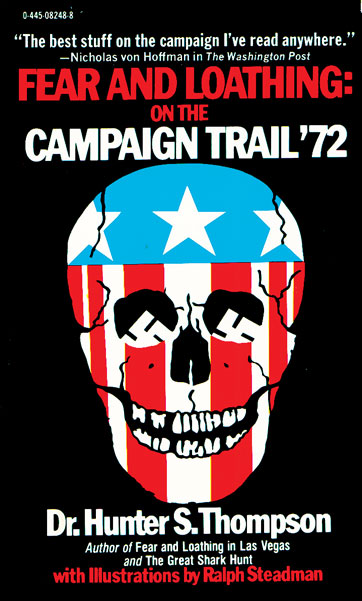
We should all miss Hunter S. Thompson right about now. His suicide in 2005 left a gap in political journalism that hasn’t been filled and probably never will be. He didn’t begin as a political reporter. He came up as a writer during the time of the so-called “new journalism” in the 1960s (Tom Wolfe, Gay Talese, et al), when the lines between the factual, the personal and the expressive broke down. By his own admission, Thompson was crazy, formally or informally; he was also a stunningly talented observer and writer. When he hit the political beat, it was right place, right time, right writer. If politics was an exercise in duplicity, venality and near-insanity, it needed a professional journalist just as insane. The collection of his Rolling Stone coverage of the 1972 presidential election, Fear and Loathing on the Campaign Trail, is not just on another planet from the classic campaign coverage up to then; it is in another solar system.

Thompson had a special relationship with Richard Nixon. He ended up respecting and applauding Nixon’s brilliant mind as an expert football strategist, but otherwise Thompson despised him. He wrote a 1994 obituary of Nixon.  In it he continues the case for that untempered loathing, but in this excerpt also explains why it is an appropriate attitude for a journalist:

Kissinger was only one of the many historians who suddenly came to see Nixon as more than the sum of his many squalid parts. He seemed to be saying that History will not have to absolve Nixon, because he has already done it himself in a massive act of will and crazed arrogance that already ranks him supreme, along with other Nietzschean supermen like Hitler, Jesus, Bismarck and the Emperor Hirohito. These revisionists have catapulted Nixon to the status of an American Caesar, claiming that when the definitive history of the 20th century is written, no other president will come close to Nixon in stature. “He will dwarf FDR and Truman,” according to one scholar from Duke University.

It was all gibberish, of course. Nixon was no more a Saint than he was a Great President. He was more like Sammy Glick than Winston Churchill. He was a cheap crook and a merciless war criminal who bombed more people to death in Laos and Cambodia than the U.S. Army lost in all of World War II, and he denied it to the day of his death. When students at Kent State University, in Ohio, protested the bombing, he connived to have them attacked and slain by troops from the National Guard.

Some people will say that words like scum and rotten are wrong for Objective Journalism — which is true, but they miss the point. It was the built-in blind spots of the Objective rules and dogma that allowed Nixon to slither into the White House in the first place. He looked so good on paper that you could almost vote for him sight unseen. He seemed so all-American, so much like Horatio Alger, that he was able to slip through the cracks of Objective Journalism. You had to get Subjective to see Nixon clearly, and the shock of recognition was often painful.

It’s not that we don’t have good and great political journalists working today; we may have more than ever. And it’s not that there aren’t plenty of partisans pointing out gaps in someone else’s facts and reasoning.

It’s just that an amazing amount of stuff gets said and seems to get by far too unchallenged or challenged too narrowly or politely. It wasn’t so long ago that the Republican party produced a nominating spectacle that is widely characterized as a circus or a clown car. But at the time, journalists were unwilling to even hint at how ridiculous some of it was, as the party of Lincoln earnestly considered nominating Herman Cain or Donald Trump as their standard bearer.

Sure we need objectivity, maybe now more than ever in a social media enriched/poisoned environment. What we shouldn’t do is confuse objectivity with comity and politeness. If Hunter Thompson was shockingly blunt—and so much fun to read—it was to wake people up from the soporific effect of treating truth and lies, intelligence and stupidity, as rhetorical equivalents, in the name of objectivity, politeness and respect. In the name of keeping the peace. That would be the media Munich moment.

Update: Rereading this post, I have to add that the closest we come to Hunter S. Thompson’s “gonzo” political journalism is The Daily Show on Comedy Central. This revelation came watching the first few days of Jon Stewart’s return after his summer away, coming back to a grim and arguably ridiculous political crisis. The Daily Show’s trick is to protest (too much) that it is a “fake” news show, which gives it total license to completely get its facts straight while speaking truth to absurdity. And when, as this week, vicious jokes aren’t quite enough, Stewart vents his frustration directly and straight, no humor. Oh, to see what The Daily Show would have made of the Nixon Years.

Kate’s Baby

Rosemary's Baby

Meaning no disrespect (and if in any way disrespectful, hopefully less so than ten thousand other privacy-invading media sources). For some reason, the frenzy surrounding every detail of the birth of Kate Middleton’s baby, heir to the British throne, brought to mind the final scene of the movie Rosemary’s Baby.

For those who haven’t seen Roman Polanski’s masterful study of subtle scariness—as good as any Hitchcock—the simple plot explanation is that Rosemary’s husband has made a deal with the devil. He will succeed as an actor and his wife will, unwittingly, give birth to the devil’s baby. The entire local satanic coven dotes on her pregnancy, and when the baby is born, they show up en masse to take photos and rejoice at the prospect of a new leader.

Once again, no disrespect, no suggestion that Prince William is the devil or that Kate is implicated in any arcane and complex birth ritual that goes back centuries. This is a bright, happy and hopefully healthy occasion. It’s just a thought.

Duran Adam in Turkey

Duran Adam
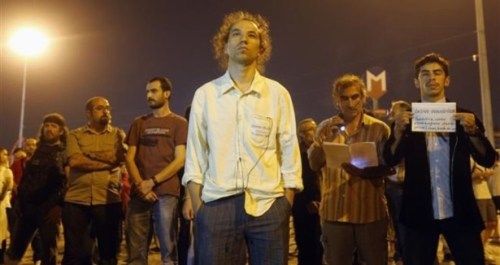
He is “duran adam”—the standing man. On Monday, Erdem Gunduz stood still for hours in Istanbul’s Taksim Square, staring at a public portrait of Kemal Ataturk, to protest the latest ban on demonstrations. Others joined him, as the image went national and then global. Police moved in: he was able to walk away and escape arrest, others didn’t.

As pointed out in a previous post, we should pay attention to Turkey because it is so special and so different than our preconceptions of what the world is and how it works. It is certainly a democracy today, but has not always been, and not quite what we think of as a democracy. It is certainly a Muslim country, but has not always been, and not quite what we think of as a Muslim country.

Whether Prime Minister Erdogan has been too long in office, whether he is taking Turkey in directions that defy many citizens and the ideals of Ataturk, whether he is truly a democrat, are things to be determined.

It is clear that he has crossed the line between firm response and heavy-handed overreach. It is clear that he is facing the quandary of all reformers, real or putative: your practice of reform is never the only game in town, and others have very different ideas. Most of all, Erdogan, like many leaders, seems to have no idea what he is dealing with, so he is under the impression that power is always the trump card.

He is half right. Power is always the trump card, but it is hard to know exactly which kind of power you are talking about or having to deal with. Is one man standing a power? What about a thousand people, or a million? History tells us that you can jail the thousands and even kill the millions. But as long as there are witnesses, might still is forced to co-exist with right, even when might wins.

The difference between witnessing and watching is a fine line. As this spreads, we will see if the media have the courage to cover a bunch of people just standing still. The media seem to like their reality shows with a little more action. Fortunately, the people’s media, the social media, may have more tolerance and a longer attention span. If you look long enough, standing still starts looking like moving forward, and that gets people really excited. It is how for millennia, from Christian origins through Gandhi through the civil right movement and on and on, nothing seemed to turn into something—because it was always something.

It was a standing man, that would not be moved.

Mountains or Molehills: How to Unflatten the News

Mt Everest - Justin Bieber
Digital access has made the news world flat. Flat as in if you use a news aggregator, there is some attempt on the site to stack the most important stories within a category, but since all categories have the same dignity, you really wouldn’t know, being from another planet, whether the civil war in Syria is more or less significant than Justin Bieber racing his Maserati through his exclusive California neighborhood (hint: it’s not Bieber).

Just as digital has created this unsortable mess and mass of news, such that Hamlet, who insane or not could tell a hawk from a handsaw/heron, would have trouble telling an important story from an inconsequential one (hint: your uncle killing your father to marry your mother is an important story).

Here is a solution. Since it is very easy to adjust type size digitally, stories that aggregators, editors or writers are willing to admit are not earthshaking might be presented in a smaller font, while those that are vital could use a larger one. This was always a convention of print news, and there is no reason that the capabilities of digital information shouldn’t be used to bring this approach up to date. As in:

Top Stories

Civil war in Syria threatens regional and global stability and peace.

Justin Bieber continues to race his Maserati around his neighborhood, despite complaints from neighbors.

Pepsi and the Line between Stupid and Clever

Mountain Dew
You’ve got to love the movie Spinal Tap. Below the surface of this hilarious fake “rockumentary”, beyond the wisdom of lines such as “It’s such a fine line between stupid and, uh…clever”, is a genuine commentary about what happens when popular art meets commerce.

When the band tries to revive its fading fortunes with an album called “Smell the Glove”, the record label rejects a cover photo of a woman on a leash being forced to, well, smell a glove. Instead, the album is released with a plain black cover.

Pepsi has long looked at its Mountain Dew brand as the edgiest of its beverages, with potential youth appeal. That would explain why it hired a 22-year-old hip-hop artist and music producer known as Tyler the Creator to create a series of videos for the brand. The storyline is that a goat named Felicia, voiced by Tyler, is obsessed with Dew and angry at its being in short supply. The goat brutally attacks a white waitress. In the third video, the injured waitress is at a police station, looking over a lineup of four black men and the goat. The goat threatens her, among other things reminding her that “snitches get stitches.” She is scared off and will not “dew” it.

After complaints about its being the most racist commercial ever, PepsiCo removed it from the web (you may still be able to see it here).

PepsiCo said, “We understand how this video could be perceived by some as offensive, and we apologize to those who were offended. We have removed the video from all Mountain Dew channels and have been informed that Tyler is removing it from his channels as well.”

Tyler’s manager said:

“It was never Tyler’s intention to offend, however offense is personal and valid to anyone who is offended. Out of respect to those that were offended, the ad was taken down. For those who know and respect Tyler, he is known for pushing boundaries and challenging stereotypes thr[ough] humor. This is someone who grew up on David Chappelle. This situation is layered with context and is a discussion that Tyler would love to address in the right forum as he does have a point of view. As someone who hasn’t had the experience of being discriminated against I choose to respect the opinion of those who have. What I can speak to is Tyler, who represents much more than the current narrative this story suggests.”

“Contrary to what many may discern from this, Tyler is the embodiment of not judging others, his delivery may not be for everyone (which is true for anyone who pushes boundaries) but his voice is nonetheless important to the conversation since his demographic understands what he ultimately stands for and sees the irony of it all. Context may or not help those who are offended and I wholly respect that, but for those who are interested, I can offer the following and leave the rest to Tyler.

“1. This spot was part of an overall admittedly absurd storyline about a crazy goat who becomes obsessed with Mountain Dew, 2. The lady in front of the line-up is the waitress from the first spot, 3. The line-up consists of Tyler’s friends and Odd Future members who were available that day. (L-Boy, Left Brain, Garret from Trash Talk and Errol) 4. He absolutely never intended to spark a controversy about race. It was simply an…admittedly absurd story that was never meant to be taken seriously. Again, we apologize if this was taken out of context and would never trivialize racism, especially now in America where voting and civil rights are being challenged at the highest level. I can however stand firmly by someone I have believed in since we met, only because I know him and I know all of this was never his intent.”

It’s not clear who this “David Chappelle” that the manager mentions is, but Dave Chappelle is one of the funniest, strangest, most boundary-pushing comic artists of recent times. Chappelle created one great piece after another, including a bit where a blind black man is a vicious anti-black racist, because he thinks he is white. That’s brilliant, so let’s start with the fact that Tyler has a long way to go.

Artists are supposed to do whatever their vision tells them, and we shouldn’t be stopping them. Sometimes it works, sometimes it doesn’t, and sometimes the art is behind or ahead of its times.

But that doesn’t mean that those who pay for the work have to go along with everything that artists conceive and produce. There is actually a bit of cleverness here, but it is plagued by so much troubling text, context and subtext that it could not possibly have passed any feasibility test that any mainstream corporate advertiser might apply.

One thing that makes this even a little more troubling is PepsiCo’s quasi-apology. We are supposed to have gotten used to cleverly crafted statements that are meant to sound like apologies but aren’t quite. That is now the norm. We are not that stupid. “We apologize to those who were offended” is a defensive or even condescending posture: if you are among those who don’t get it (or as Tyler’s manager says, not part of “his demographic [that] understands what he ultimately stands for and sees the irony of it all”), then we are sorry. Mass media have mass audiences, and if you want to put something out there that is likely to cause trouble but you believe will help you, either stand behind it or don’t. Apologize or don’t. It may turn out to be commercially smart or stupid. But at least you’re brave.

Crime and Punishment

Crime and Punishment
It is just like a movie, some are saying.

No, like a novel.

Two brothers. The older one dead, run over by the younger. The younger on the run—maybe caught or even dead by the time this is read.

In the media, fragments of information are spun into explanations, like Rumplestiltskin’s straw into gold. It is the job of experts to provide answers, and when pieces are missing, to speculate. Can they be blamed?

Writers are the real experts at helping us on this. In 1962, when Truman Capote applied his considerable skill as storyteller to a pair of real-life cold-blooded killers, the book In Cold Blood became something new: the non-fiction novel. Critics celebrated, but others complained that the humanizing of evil made the author an accomplice.

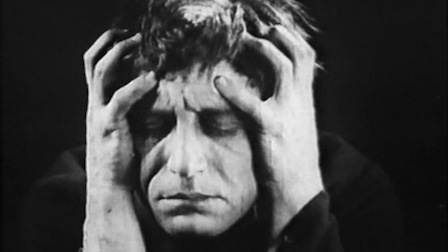
A century earlier, Fyodor Dostoyevsky took an even deeper look at the mind of the killer, a fictional one, in Crime and Punishment. He did not minimize the horror of the crime or humanize the killer for purposes of sympathy, empathy or excuse. He instead set the standard for psychological depth and ambiguity that is the hallmark of modern literature since.

Standard or simplistic explanations and labels fit many needs, including the need of broadcasters to fill dead air while an extended manhunt and its aftermath proceed. But Dostoevsky demanded a trip on the subtle dark seas of family, society and the mind. That’s not just a way we understand the bad actors. It’s how we understand ourselves, even when our own seas are not nearly so dark.

From Crime and Punishment, as Rodion Raskolnikoff  pursues his plan to kill the moneylender Alena Ivanovna. He walks down the street, when someone remarks about his unusual hat:

“I knew it,” he muttered in confusion, “I thought so! That’s the worst of all! Why, a stupid thing like this, the most trivial detail might spoil the whole plan. Yes, my hat is too noticeable…. It looks absurd and that makes it noticeable….With my rags I ought to wear a cap, any sort of old pancake, but not this grotesque thing. Nobody wears such a hat, it would be noticed a mile off, it would be remembered…. What matters is that people would remember it, and that would
give them a clue. For this business one should be as little conspicuous as possible….Trifles, trifles are what matter! Why, it’s just such trifles that always ruin everything….”

He had not far to go; he knew indeed how many steps it was from the gate of his lodging house: exactly seven hundred and thirty. He had counted them once when he had been lost in dreams. At the time he had put no faith in those dreams and was only tantalizing himself by their hideous but daring recklessness. Now, a month later, he had begun to look upon them differently, and, in spite of the monologues in which he jeered at his own impotence and indecision, he had involuntarily come to regard this “hideous” dream as an exploit to be attempted, although he still did not realize this himself. He was positively going now for a “rehearsal” of his project, and at every step his excitement grew more and more violent.