Bob Schwartz

Category: History

The Gates Book and the Gates Speeches

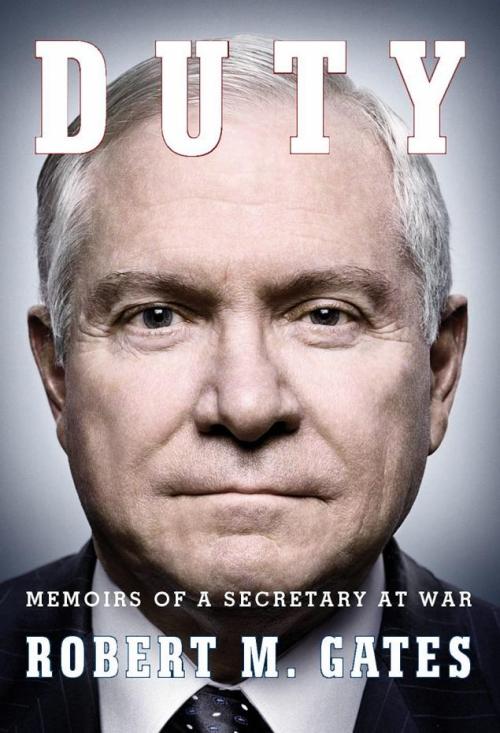
Duty
Former Secretary of Defense Robert M. Gates is about to release a memoir of his tenure under Presidents Bush and Obama. Provocative advance excerpts from Duty are now being released, and these explosive devices are anything but improvised.

Every news outlet, pundit and politician is already busy making points about President Obama, Vice President Biden, former Secretary of State Hillary Clinton and others, based on comments clipped from these excerpts, rather than having read the whole book. Even out of context, it is clear that Gates has formed some definite opinions based on working for and with these American leaders. That is anyone’s privilege, but particularly that of a man who spent forty-five years in laudable public service, much of it at the highest levels of government.

As always, though, opinion and criticism is a matter of perspective, that is, where the critic stands underlies what a critic sees and says.

You can read all the speeches that Gates delivered as Secretary of Defense. This is guaranteed not to be as titillating as reading or hearing about the “best parts” of Duty, but it might give you additional insight that will make the context of the book clearer.

Here, for example, are excerpts from remarks he made to the Heritage Foundation on May 13, 2008, when he was serving under President George W. Bush. (You can read the entire speech here) At that point, the Iraq war was five years old, only halfway to its conclusion. At that point, he had been Secretary of Defense for two years, and from that point, he would remain in that position under President Obama until July 2011.

But there is a more fundamental point that I will close with – and again, historical perspective is important. It is impossible to separate discussions of the “broken” Army following Vietnam – a conscription army – from the ultimate result of that conflict. At a congressional hearing last year, General Jack Keane, former Vice Chief of Staff of the Army, recounted the profound damage done to the Service’s “fiber and soul” by the reality of defeat in that war.

The risk of overextending the Army is real. But I believe the risk is far greater – to that institution, as well as to our country – if we were to fail in Iraq. That is the war we are in. That is the war we must win.

There it is, the context: Iraq was “the war we must win.” Gates’ insights into military matters is often brilliant and sensible, informed by his intelligence, experience and education. But on this point he candidly reveals a premise that for some colors everything else he offers. We must win Iraq because the failure to win would “break” the military the way that Vietnam did.

We did not win in Iraq, but technically, we did not lose. That current events in Iraq point to some devolution doesn’t really settle the question. That some U.S. Senators are calling for us to return to Iraq to avoid that loss or at least to avoid the appearance of futility is a partial reflection of exactly what Gates said.

We know that Gates’ personal critiques are based on close working relationships and observations. We also know, or should recognize, that those critiques are grounded in a worldview that others may not, very legitimately, share. If for Gates one of the measuring sticks is whether someone believes that Iraq had to be won, that measure may be skewed by genuine differences in informed opinion. One opinion is that as valorous as the service and sacrifice was, Iraq was a mistake, to be abandoned as prudently as possible; others might now say the same about Afghanistan. What Gates has to say about our leaders is certainly worth listening to, provided we pay equal attention to the mindset of the speaker.

Finite and Infinite Games: Thoughts to End and Begin a Year

Finite and Infinite Games
James P. Carse, now Professor Emeritus of history and literature of religion at NYU, published Finite and Infinite Games in 1986. The book’s spare 160 pages belie its significance. It is a masterpiece of clear, poetic and transformative thought, as Carse takes on the big question that faces us now and always: What are we doing and saying when we act and talk about things religious—or for that matter about life?

His answer—and this is impossibly oversimplified—is that we are playing games. To say even that little is misleading. The only way to appreciate the book and its power is to follow its 101 very brief sections end to end.

This was written at a time when the idea of religion as myth was enjoying renewed currency. It was not a new idea, but by the 1980s a generation of thinkers was trying to make intellectually honest sense of a conundrum: If religious narrative is merely myth, how can religious history have any value or substantial meaning, and how then can we be religious? It turned out in their view that it was not “merely” myth, but a matter that necessarily coexisted with, complemented  and completed religion.

This continues to be something both hard for many to accept or wrap their heads around and equally hard to articulate. Carse articulates this better than anybody else has, and elevates the entire area to a platform for considering the whole of existence and life. If that sounds like hyperbole, please read the book and decide.

In the meantime, a wholly inadequate sample, given that many definitions and premises are missing:

1

THERE ARE at least two kinds of games. One could be called finite, the other infinite.
A finite game is played for the purpose of winning, an infinite game for the purpose of continuing the play.

. . .

99

If it is true that myth provokes explanation, then it is also true that explanation’s ultimate design is to eliminate myth. It is not just that the availability of bells in churches and town halls of Europe makes it possible to forge new cannon; it is that the cannon are forged in order to silence the bells. This is the contradiction of finite play in its highest form: to play in such a way that all need for play is erased.

The loudspeaker, successfully muting all other voices and therefore all possibility of conversation, is not listened to at all, and for that reason loses its own voice and becomes mere noise. Whenever we succeed in being the only speaker, there is no speaker at all. Julius Caesar originally sought power in Rome because he loved to play the very dangerous style of politics common to the Republic; but he played the game so well that he destroyed all his opponents, making it impossible for him to find genuinely dangerous combat. He was unable to do the very thing for which he sought power. His word was now irresistible, and for that reason he could speak with no one, and his isolation was complete. “We might almost say this man was looking for an assassination” (Syme).

If we are to say that all explanation is meant to silence myth itself, then it will follow that whenever we find people deeply committed to explanation and ideology, whenever play takes on the seriousness of warfare, we will find persons troubled by myths they cannot forget they have forgotten. The myths that cannot be forgotten are those so resonant with the paradox of silence they become the source of our thinking, even our culture, and our civilization.

These are the myths we can easily discover and name, but whose meanings continually elude us, myths whose conversion to truth never quite fills the bells of their resonance with the sand of metaphysical interpretation. These are often exceedingly simple stories. Abraham is an example. Although only two children were born to Abraham in his long life, and one of those was illegitimate, he was promised that his descendants would be as numberless as the stars of the heavens. All three of the West’s major religions consider themselves children of Abraham, though each has often understood to be itself the only and final family of the patriarch, an understanding always threatened by the resounding phrase: numbered as the stars of the heavens. This is the myth of a future that always has a future; there is no closure in it. It is a myth of horizon.

The myth of the Buddha’s enlightenment has the same paradox in it, the same provocation to explanation but with as little possibility of settling the matter. It is the story of a mere mortal, completely without divine aid, undertaking successfully a spiritual quest for release from all forms of bondage, including the need to report this release to others. The perfect unspeakability of this event has given rise to an immense flow of literature in scores of languages that shows no signs of abating.

Perhaps the Christian myth has been the narrative most disturbing to the ideological mind. It is, like those of Abraham and the Buddha, a very simple tale: that of a god who listens by becoming one of us. It is a god “emptied” of divinity, who gave up all privilege of commanding speech and “dwelt among us,” coming “not to be served, but to serve,” “being all things to all persons.” But the worlds to which he came received him not. They no doubt preferred a god of magisterial utterance, a commanding idol, a theatrical likeness of their own finite designs. They did not expect an infinite listener who joyously took their unlikeness on himself, giving them their own voice through the silence of wonder, a healing and holy metaphor that leaves everything still to be said.

Those Christians who deafened themselves to the resonance of their own myth have driven their killing machines through the garden of history, but they did not kill the myth. The emptied divinity whom they have made into an Instrument of Vengeance continues to return as the Man of Sorrows bringing with him his unfinished story, and restoring the voices of the silenced.

100

The myth of Jesus is exemplary, but not necessary. No myth is necessary. There is no story that must be told. Stories do not have a truth that someone needs to reveal, or someone needs to hear. It is part of the myth of Jesus that it makes itself unnecessary; it is a narrative of the word becoming flesh, of language entering history; a narrative of the word becoming flesh and dying, of history entering language. Who listens to his myth cannot rise above history to utter timeless truths about it.

It is not necessary for infinite players to be Christians; indeed it is not possible for them to be Christians—seriously. Neither is it possible for them to be Buddhists, or Muslims, or atheists, or New Yorkers—seriously. All such titles can only be playful abstractions, mere performances for the sake of laughter.

Infinite players are not serious actors in any story, but the joyful poets of a story that continues to originate what they cannot finish.

101

There is but one infinite game.

Thanksgiving and Hanukkah in America: A History

Hanukkah in America
Hanukkah is getting lots more attention this year than it usually does, because it starts on Thanksgiving, rather than on or about Christmas.

This is nearly unprecedented. Of course there’s lots of controversy about just how rare it is, partly because Thanksgiving has officially moved from the last Thursday in November to the fourth Thursday, partly because the Jewish calendar is a lunar calendar, partly because of some esoterica of interest to extreme calendar freaks. Some say it won’t happen again for 70,000 years, others say it will never, ever happen again. If you happen to be around when it does, if it does, please e-mail, post, tweet, or whatever sort of advanced messaging will be used then to communicate with the curious but departed.

Thanksgivingukkah, or whatever other ridiculous and ear-hurting names people are coming up with, is second only to Black Friday as a cultural meme this week. We will be seeing lots of turkeys with Hanukkah candles stuck in them—actual ones, not just Photoshopped ones, at actual Thanksgiving tables, with plenty of videos to prove it. Might even see some turkey selfies. On the food front, we will have combined cuisines, where things not usually seen on the Thanksgiving table make an appearance, such as latkes and sour cream. (Note: I am promoting latke stuffing as the best of all possible hybrids.)

There’s a lot to talk about when Hanukkah and Christmas collide and coincide, theologically, historically and socially. Both involve charismatic Jewish religious leaders taking on tyranny—though one battles on the military and political front, while the other wields an entirely different set of weapons. As a central theme, both at some point take on the profaning of the Temple, in one case made unholy by soldiers, in the other made unholy by turning sacred space into a commercial enterprise. Both involve miracles and miraculous lights challenging the darkness. Not to mention that at the time of Jesus, Jews knew and marked the events of the Maccabee revolution, which had taken place less than two hundred years earlier.

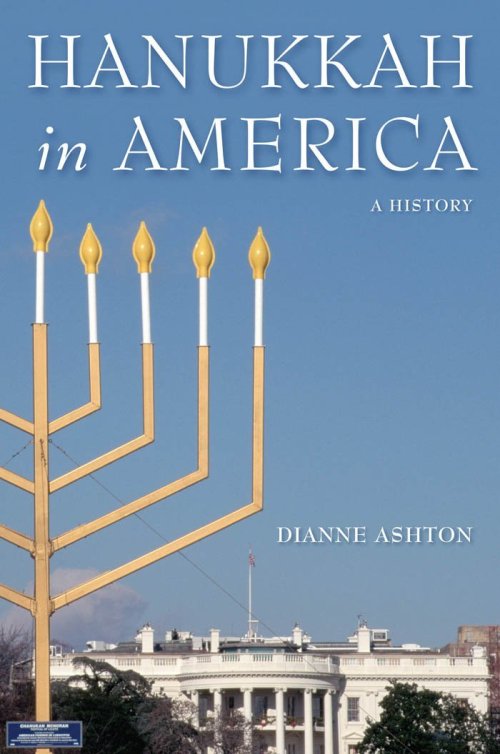
Whether you are Jewish, or just newly fascinated by Hanukkah because it is for once not getting lost in the Christmas mishegas (“craziness” in Yiddish), have I got a book for you. Hanukkah in America: A History by Dianne Ashton is more than just a review of how American Jews regarded and celebrated this once-minor holiday. It is the definitive and delightful book about how Hanukkah evolved to become a laboratory for what it means to be a Jew in America, and for that matter what it means to be Americans of any kind.

Here’s something Ashton writes about Thanksgiving and the “deluxe Hanukkah turkey dinner”:

Many Jews combined food products available in America with recipes they deemed appropriate for Hanukkah meals. Even with a simple meal at home, immigrants could imagine a different Hanukkah past than the one in Eastern Europe. They could envision a personal bond with Judah Maccabee by selecting Carmel wine, which claimed to be “what the Maccabees drank.” Local food shops such as Goldman’s Tea and Coffee Store held special sales in honor of Sabbath Hanukkah. Jewish restaurateurs sometimes targeted immigrants’ desires for American foods at special occasions. Perhaps no food is so identified with America as the turkey, an animal native to North America and the featured dish of the Thanksgiving dinners that take place across the country only a few weeks before Hanukkah. When Gorfein’s, a kosher restaurant, advertised a deluxe Hanukkah turkey dinner in the Forverts, it apologized in print the next day to “hundreds [who had to be] turned away” because the restaurant “had no space or food left for them.” Gorfein’s offered the same dinner a second night.

My usual Hanukkah post, sometime around Christmas, ends with a mention of a wonderful Comedy Central special, A Colbert Christmas: The Greatest Gift of All. Our comic saviors Jon Stewart and Stephen Colbert perform the song Can I Interest You In Hanukkah? with Stewart making the case for the Jewish holiday:

Jon: Can I interest you in Hanukkah? Maybe something in a Festival of Lights. It’s a sensible alternative to Christmas. And it lasts for seven – for you – eight nights.
Stephen: Hanukkah huh? I’ve never really thought about it.
Jon: Well, you could do worse.
Stephen: Is it merry?
Jon: It’s kind of merry.
Stephen: Is it cheery?
Jon: It’s got some cheer.
Stephen: Is it jolly?
Jon: Look, I wouldn’t know from jolly. But it’s not my least unfavorite time of year.
Stephen: When’s it start?
Jon: The 25th.
Stephen: Of December?
Jon: Kislev.
Stephen: Which is when exactly?
Jon: I will check
Stephen: Are there presents?
Jon: Yes, indeed eight days of presents. Which means one nice one, then a week of dreck.
Stephen: Does Hanukkah commemorate events profound and holy? A king who came to save the world?
Jon: No, oil that burned quite slowly.
Stephen: Well, it sounds fantastic!
Jon: There’s more. We have latkes.
Stephen: What are they?
Jon: Potato pancakes. We have dreidels.
Stephen: What are they?
Jon: Wooden tops. We have candles.
Stephen: What are they?
Jon: THEY ARE CANDLES! And when we light them, oh the fun it never stops. What do you say, Stephen, do you want to give Hanukkah a try?
Stephen: I’m trying see me as a Jew. I’m trying even harder. But I believe in Jesus Christ
So it’s a real non-starter.
Jon: I can’t interest you in Hanukkah? Just a little bit?
Stephen: No thanks I’ll pass. I’ll keep Jesus, you keep your potato pancakes. But I hope that you enjoy ‘em on behalf of all of the goyim.
Jon: Be sure to tell the Pontiff, my people say “good yontif”.
Stephen: That’s exactly what I’ll do.
Both: Happy holidays, you
Jon: too!
Stephen: Jew!
Jon: Too?

That’s it for this holiday mashup. Read the book; it’s great. Celebrate religious freedom by eating too much food. Spin the turkey. Light the candles. But whatever you do, don’t smoke the turkey, because it is impossible to keep that thing lit.

Happy holidays. Be safe.

The Book of Matt: Hidden Truths About the Murder of Matthew Shepard

Kennedy Monore Kennedy
When the legend becomes fact, print the legend.
Director John Ford in The Man Who Shot Liberty Valence

The Book of Matt by Stephen Jimenez is about the heinous and now-legendary murder of Matthew Shepard. It obliquely brings three people to mind: John F. Kennedy, Bobby Kennedy and Marilyn Monroe.

All three are legends apart, so maybe it is not surprising that legends have grown up about all three in various pairings, and even all together on at least one purported occasion. Whether or not Monroe had an affair with either or both of the Kennedys, whether Bobby was with her on the night of her death, whether evidence of those affairs was covered up or destroyed, is almost certainly never going to be incontrovertibly established. Some will say that some of it appears near certain while other of it is sordid and unsubstantiated conjecture. For the most part, we’ve reached a general consensus that none were saints, none were complete role models, but that we liked some of what they did, and we liked them for what they did, including inspiring us, and the rest is just shades of humanity. JFK helped prevent a nuclear war, Bobby Kennedy helped end the Vietnam War, and Marilyn was just Marilyn. If they didn’t live like saints, they died as complex and heartbreaking lessons.

Jimenez has investigated the Matthew Shepard murder for more than a decade. He concludes that this was not a vicious hate crime against a young gay man. Instead, it is a cautionary tale about the epidemic of methamphetamine. According to this report, Shepard was troubled, and was involved in the Laramie meth scene. The killer, who knew Shepard, was a meth head who had been up for a week, and was trying to get information from Shepard about a meth deal. He intended to coerce the information from Shepard, but out of his mind, simply beat Shepard mercilessly and insanely. The killer and his accomplice pled guilty, which kept details of the local meth market and the killer’s gay dealings with Shepard—trading meth for sex—secret.

The police investigation never involved a hate crime. The now-infamous imagining of Shepard being trussed up on a fence in a crucifix position never happened; he was found on the ground, hands tied behind his back. The anti-gay angle for the horrific event was soon added.

This might present a problem.

Jiminez has found himself in an odd position. He is accused of being anti-gay, though he is gay himself, in which case he is accused of being a “traitor” to a cause. He is accused of being a tool of the reactionary right wing, though he himself is far from being a right winger. What he is, he repeats, is a journalist who wants to do what he is supposed to do: find and tell the truth, as best as it ever can be found and told.

Matthew Shepard has become very important to the movement for gay rights. It is a powerful story: the young man who did nothing wrong, who only wanted to live a free and openly gay life, who had the misfortune of running into a black-hearted, hate-filled, intolerant stranger—the sort that fifteen years ago, and today, you can meet anywhere.

If it turns out that some or more than some of what Jimenez concludes is true, what happens to Matthew Shepard, the young man and the legend? In essence, Jimenez says that nothing happens. The issues remain the same, the good fight remains the good fight, but we will be fighting it armed with a little more truth about the story, convenient or not.

That sort of complication should be welcome, but it may not be, at least not everywhere. We like our stories simple, because so much of life is convoluted and mysterious. There are lines that are clear, but simple stories are mostly for children. Grownups have to work and stretch. This is a warts-and-all age, so we take our big characters as they come: flawed but still valuable. People work every day, their entire lives, on establishing equality—some of those people under the Matthew Shepard banner. That cause isn’t going away, and if we have to accept a little bit of historical adjustment, that’s the price we pay for having our eyes open.

Un-Americans in Congress

Capitol Flag
The first appearance of un-Americanism came during the American Revolution. Conservative colonists who remained loyal to the British crown were reviled by those who pledged their fortunes to a new and forward-looking vision. To the Patriots, the Loyalists were backward-looking un-Americans—even though “America” was not quite yet a reality.

The next appearance came during the Civil War. This time, a powerful portion of American citizens and leaders made philosophical and economic arguments that being a “real American” meant having the freedom to own people as property and, if that was taken away, the freedom to split the nation. Many other Americans disagreed, and in a war that took 620,000 lives, having a united nation and government was established as the bedrock of Americanism. Disagree and fight vigorously to change policy and direction, but when your initiatives threaten the integrity of that union, your Americanism is in question or even forfeited.

Right now, Republican members of Congress are on track to bring parts of the American government to a standstill, and probably damage a still-unstable American economy. This is un-American. Pointing fingers and trying to avoid accountability is childish; at least take credit or blame if the principles are so important. We need adult Americans. What we seem to be getting in some quarters are childish un-Americans. Nothing could be more sad or dangerous.

Ted Cruz and Joe McCarthy

Ted Cruz - Joe McCarthy
For a while now, virulent anti-Obamaism has looked a lot like the anti-Communist vendetta of McCarthyism in the 1950s. Barack Obama is in fact the scary culmination of the fear that swept the nation fifty years ago. Not only are there Communist infiltrators in government offices; the White House itself is in the hands of a godless liberty-taker—or so it seems to millions.

U.S. Senator Joe McCarthy from Wisconsin did not invent this brand of hate and paranoia. He just perfected it through a combination of extreme showboating, angry rhetoric and, most of all, fear. Nothing could be worse than to be branded an enemy of the state (in McCarthyist terms), which might lead to a loss of a citizen’s reputation, job and career or, more to the point, to a politician’s losing office.

This week, Ted Cruz’s attempt to hog the American stage with his fauxbuster (media are still working on a term for a filibuster that isn’t one) has had a notable effect on some of his Republican Congressional colleagues. Since the 2010 elections, and certainly in the 2012 presidential campaign, there has been a reluctance to publicly break ranks and call an ambitious, self-absorbed blowhard that (e.g., Donald Trump) or a fool a fool (take your pick). In recent days, a few Republican Senators have stopped holding back, realizing that as much as they agree in their opposition to Obama policies, this is not a constructive way to proceed, governmentally or politically. Oklahoma Senator Tom Coburn, a loyal Republican and unassailable conservative, said that it appears that to Cruz and others of that ilk, he is just not conservative enough.

This is the Ted Cruz/Joe McCarthy strategy: if you are not with me, you are against America. To torture a quote from King Louis XIV, “America c’est moi.” (I am America). And if you are not for my definition of America, you are an enemy of the state—even if you purport to be a Republican, even if you are a Senator with many more years than my nine months in the Senate. And if you are an enemy of the state, I and my millions of like-minded Americans will destroy you. That is my mission.

Joe McCarthy’s brief demagogic career ended in ignominy (and ill health from his alcoholism). He went from holding center stage to banishment when more and more of his colleagues and the media stood up to his bullying. It wasn’t that anti-Communism went away; it remained a force for years to come and, as pointed out, lives still even in the post-Cold War era. It was that serious people put up with over-ambitious clowns as long as a common agenda is advanced, but at some point even the threat of losing office takes second place to what’s good for America.

In the end, McCarthyism lost to Americanism. Let’s hope that Cruzism suffers the same fate.

Are Presidential Comparisons Odious?

Lydgate - Horse, Sheep and Goose
Comparisons are odious.

This phrase, roughly meaning that comparing people and situations can be unhelpful and counterproductive, is centuries old. It is variously attributed, but as good a source as any seems to be medieval British writer John Lydgate. It comes from his poem The Debate of the Horse, Goose, and Sheep (1436–37).

(For those concerned that this blog just makes stuff up, be assured that scholarly authorities have been consulted. Maura Nolan’s John Lydgate and the Making of Public Culture (2006) was not read in its 290-page entirety, but it was used. Consider this pertinent passage:

Lydgate’s debt to Gower in this passage is obvious; though he has clearly read both Isidore and Higden’s accounts (and possibly Bromyard’s as well), he takes from the Confessio Amantis the notion that the vagaries of Fortune constitute the lesson of the exemplum, a lesson he later directly applies to present-day rulers, ‘‘wise gouernours of euery londe and region’’ (65, lines 25–26). Note: Lydgate makes a similar point in ‘‘The Debate of the Horse, Goose, and Sheep,’’ dated 1436–37 by Pearsall ( John Lydgate (1371–1449), 51), telling his readers that ‘‘thees emperours . . . with ther victories & triumphes’’ (lines 638–39) are subject to Fortune and fall. The political message is explicit: ‘‘Beth war, ye pryncis, your suggettis to despise’’ (line 643). See MacCracken, ed., Minor Poems of John Lydgate, part 2, 539–66)

(Please feel free to show off to your friends and colleagues who wonder if your liberal arts degree, if you have one, is worth anything. Knowing that “In the fifteenth century Lydgate was the most famous poet in England, filling commissions for the court, the aristocracy, and the guilds. He wrote for an elite London readership that was historically very small, but that saw itself as dominating the cultural life of the nation” should impress them.)

About Presidents and odious comparisons: In the many crises of his presidency, including the most recent, President Obama has endured more comparisons than perhaps any other President. Just in the past few days, we have heard about Woodrow Wilson, George W. Bush, Lyndon B. Johnson, Ronald Reagan, Bill Clinton, Jimmy Carter, John F. Kennedy, and in this very blog, Harry Truman.

Comparisons are natural for a few reasons. It is an office that has been held by a relatively small number of people over more than two centuries, and so how you do the job is defined as much by what others did as some sort of abstract definitions and expectations. There is also the flawed logic: the United States is the greatest country in the world, the President is the leader of the United States, therefore the President is the greatest leader in the world. At moments yes, but please check history, the sometimes impossibility of situations, and the nature of imperfection of all powerful humans. Finally, Obama is so unlikely, if not unlike any of his predecessors, that you almost want to jump to comparisons.

My best attempts to find out what the horse, sheep and goose were debating about six centuries ago, and what it has to do with comparisons, have come up empty. So I do have had to make this part up. If the debate was about which one is superior—whether a horse, sheep or goose is better—the answer is elusive and equivocal. This is in no way to cut the current President the slightest bit of slack, as readers of the blog already know. But the presidency is not a single job, even in more stable and simple times, which these are not. So compare away, but don’t let those comparisons obscure clear thinking and distract us with reveries (or lingering antipathies) about this leader or that. That would be odious, in a country and world with odium enough.

What Would Truman Do?

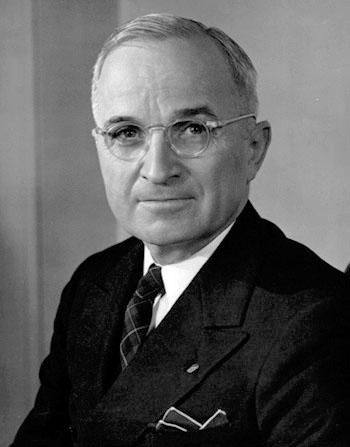
Harry Truman
Harry Truman is maybe the most interesting American President of the twentieth century, and maybe the most significant.

He held a power that no one had held in human history and he took the decision to use it. He had no precedent to guide him—except maybe God in the Bible. He dropped atomic bombs on Hiroshima and Nagasaki. From that point forward, everyone who uses nuclear weapons will be the second or third to do it.

He is also the only President in the twentieth century without a college degree, and one of the relatively few in American history. Grover Cleveland was the last before him. But there are some before that who did manage to stand out without college, such as George Washington and Abraham Lincoln.

Obama shares some things with Truman, and on other scores couldn’t be more unlike. Truman was an unabashed though pragmatic reformer: he used executive power to desegregate the military, but his Fair Deal liberal agenda failed in the face of a recalcitrant Republican Congress. Truman’s second term was the model for all other second term disasters, marked by a war that was both unpopular and unsuccessful and by a President whose effectiveness was a constant question.

Unlike Obama, Truman was not a spell-binding orator or a scholar. He had come up through politics and to the Senate the old back room way, and his ascension to the 1944 presidential ticket was a matter of political manipulation and happenstance. The legendary 1948 election pitted him against the dapper, smooth talking, hard-nosed, well-educated federal prosecutor and New York Governor. It was considered no contest for Thomas E. Dewey. Truman won.

The reasons that Truman has risen to the top ten on nearly all lists of great American Presidents (he is number 5 on a few) are many. This puts him in the range of both Roosevelts, TR and FDR, both of whom went to Harvard, both of them charismatic patricians with colorful histories and silver tongues. Among Truman’s gifts, the one most associated with him was a plain-spoken decisiveness in word and deed, even if the decision turned out troublesome or wrong.

There were reasons to like Truman at the time of his presidency, and a number of reasons not to. But there was a sense—even those who were his enemies at the time acknowledge it and historians have come to treasure it—that underneath it all was a man who had fought in a world war (only a few Presidents have), a man who had lived a modest life, a man who knew how to practice politics, a man who could surprise by analyzing deeply, a man who faced with the prospect of killing hundreds of thousands of people in a moment gave the order to do it.

Plain speaking. Decisive action. Truman was not the ideal President because there is no such thing. But at every critical juncture, it can’t hurt to ask: what would Truman do?

Labor Day 2013

ILGWU - Yiddish, Italian, English
In talking about the labor movement, there are reasons to be encouraging and critical.

I grew up in a union household. My grandfather was an immigrant who joined and trained in the International Ladies Garment Workers Union (ILGWU), famous for its “Look for the union label” song. I keep his union card handy in my desk.

The contributions of unions to American life, to the creation of a huge middle class, are beyond debate. Whatever you think of unions today, the labor movement helped make America.

Any critical comments will be taken as ammunition by those who oppose unions reflexively as an un-American scourge on our economy and way of life. Some of these people would not only eliminate the labor movement from present day America, but would be pleased to go back in a time machine and wipe it from history. There is little doubt that if this could somehow be accomplished, America might look like Czarist Russia or some other unbalanced and benighted society.

Those are the caveats. Here is the current situation.

Organized labor is disappearing from American life. Union membership as a percentage of the work force was 35% in the 1950s; it now hovers around 11% and is still dropping. The relentless push for right to work laws goes on, but even without that, the numbers may not rise, and may continue to decline.

It doesn’t matter how it got like this. There are plenty of rear view mirror analyses, including things like admitted abuses and overreaching, along with a shortsighted sense that the party would never end. For a lot of workers, union and otherwise, the party is over.

This, however, is not the end of the story. A heroic effort to re-imagine and re-vision unions and the labor movement can take place. This is going to take brutal self-examination and, as is implied, imagination and vision. Unions can evaluate who they are and who they can be in the context of 2013 and beyond—including being a centerpiece for progressive change. But with that, unions must also figure out who they can’t be and shouldn’t be. This is where having eyes wide open comes in. It is also where courage comes in and defensiveness must go out.

The idea that agents of progress look the same in every age is patently untrue. It is one of the traps of progressive movements, thinking that who and what worked a century ago or a few decades ago will work forever. It won’t. But there is something that will. Creating that something doesn’t begin by blaming the enemies, though enemies there be. It begins by admitting that there is a problem making unions fit in with current America, and an opportunity to create a labor movement that does.

There are Labor Day cakes in the local supermarket, decorated with American flags. The stores probably didn’t mean that Labor Day is the patriotic, all-American equivalent of Independence Day. Last night the local country club exploded Labor Day fireworks. That probably isn’t a political or economic statement. So maybe, as organized labor gets to work trying to figure out what exactly a 2013 movement looks like, it might start with the simple task of putting the “labor” back in Labor Day.

Analogies to Egypt

Rosetta Stone

Who doesn’t love analytical analogies—situations past that bear a resemblance to current circumstances and might offer at least a little usable insight.

The current state of Egypt, like many situations in the new global age, is a bit sui generis—a unique thing of its own that we neither know how to classify or handle. For some, it is like going to watch a sports competition where you don’t exactly understand the game, don’t know nearly enough about the teams, and yet are being expected to choose sides—to root for somebody.

Here are a few of what we might call impressionistic analogies: examples from recent history that won’t withstand close scrutiny as directly related scenarios, but do have a certain similarity that at least gives us food for thought.

Iran – The impending release of Mubarek by the military government—ostensibly because the fraud case leading to his arrest would not hold up—brings to mind Iran and the last Shah. The Iranian Revolution of 1979 deposed the Shah and ended the West-friendly dynasty that the U.S. had long supported. One of the small but historically high-profile early incidents was President Jimmy Carter allowing the very ill Shah to seek medical help here in 1980—a factor in the subsequent hostage-taking, that in turn was (just one) of the reasons that Carter was not re-elected.

The U.S. is not alone in having to bet on somebody in turbulent times. Leaders are both real and symbolic in these contests. In Iran, our betting on the Shah—who was like us, who we understood, and who wss not like “them”—has proven disastrous. In the case of Mubarek in Egypt, what we wanted with him all those years was stability and moderation, but when it became apparent during the Arab Spring that we were looking decidedly anti-democratic, we opted to cut him loose and hope for democracy to follow. When that democracy started looking theocratic, possibly militantly so (Muslim Brotherhood), we were very confused and concerned—and so were the remnants of Mubarekism still in or near power. Military and stability or democracy and “adventure”. The Egyptian military made their decision, but we seem unable to decide. Will the military try to re-install Mubarek, or just leave him as a symbol of better days. Do we wish that we had handled Iran better, maybe helping to ease out the Shah and autocratic rule? It probably would not have prevented theocracy, but we didn’t try.

Iraq – Iraq, like Egypt, is another example of wanting to act strategically, while looking like the “good guy” and trying to figure out what a good guy looks like or acts like in these times. We supported Saddam Hussein, we refused to topple him, we toppled him, we executed him. All hell broke loose, and that fire may burn for generations. Whatever our skill at playing a real-world version of Risk globally, our track record in the Middle East is atrocious. At this point, we may want to consider where we stand relative to the historic record of the British and the French. (Note: We seem to have a bizarre predilection for following in their footsteps with little more, or even less, success than they had. See, e.g, Vietnam, Afghanistan, etc.)

Latin America – Our experiences in Latin America may serve as the most interesting of these tenuous analogies. The policy and history is easy to understand. We feared (still do) the incursion of Communism into the continent. We would support just about anybody who promised to keep the threat of socialism/Communism down. This put us in bed with a very bad lot, alliances that have had two lasting impacts. American fingerprints are all over the legacy of some despicable regimes. And now that many of those regimes are in the dustbin of history, residual anti-Americanism lingers on.

None of these alone, or even taken together, may offer much guidance in figuring out what to do in Egypt. Maybe a general lesson is that being powerful is not the same as being smart or being right. Maybe it’s that America is not as powerful as it thinks—back then, or even more so now—in a world it does not fully understand (again, ask the British and the French).

Egypt today is not that different from Egypt two years ago, or Syria now, or Iran or Iraq or Latin America. America has to expressly define and transparently decide how to stack our values and principles. Do we want American-style democracy or are we willing to settle for one of its other versions? Do we want democracy no matter what the results, or are we willing to trade democracy for authoritarian rule? Is authoritarian rule better than democratic or quasi-democratic Islamism, socialism or Communism? What is regional or global stability worth? What is peace worth? What is a Syrian or Egyptian or American life worth? Could billions in Egyptian aid, aside from whether or not we continue or suspend it, be better used to help Americans in an age of sequestration and austerity?

Grown up questions for grownups at the table.