Bob Schwartz

Category: History

Thanksgiving: Simple Gifts

Shaker Sewing Table

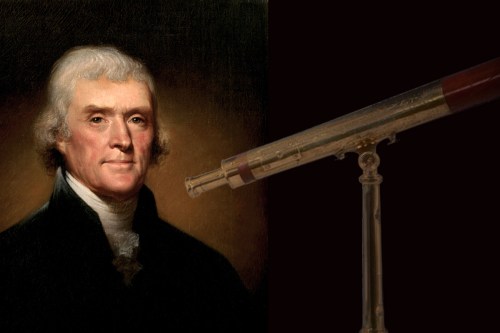
The Shaker dance song Simple Gifts (Joseph Brackett, 1848) is the ultimate Thanksgiving song. It is also the ultimate American song, provided we recognize that in America, the most religious and richest nation on earth, simplicity and humility are ideals worth aspiring to and striving for.

Ken Burns writes this about his documentary The Shakers:

They called themselves the United Society of Believers in Christ’s Second Appearing, but because of their ecstatic dancing, the world called them Shakers. Though they were celibate, they are the most enduring religious experiment in American history. They believed in pacifism, natural health and hygiene, and for more than 200 years insisted that their followers should strive for simplicity and perfection in everything they did.

Shaker design, including furniture and baskets, may be familiar to you. So may the melody of Simple Gifts. It is frequently used in pop culture, and is most famous musically in Aaron Copland’s orchestral masterpiece, Appalachian Spring. And while the tune is often heard, the lyrics are not as frequently sung. Here is an appropriately unadorned version by Judy Collins.

Even if you can’t read music, you can look at the musical score and see how very simple this song is:

SimpleGifts

Here are the lyrics. Happy Thanksgiving.

‘Tis the gift to be simple, ’tis the gift to be free
‘Tis the gift to come down where we ought to be,
And when we find ourselves in the place just right,
‘Twill be in the valley of love and delight.

When true simplicity is gain’d,
To bow and to bend we shan’t be asham’d,
To turn, turn will be our delight,
Till by turning, turning we come ’round right.

Return to the Four Freedoms

Four Freedoms

As we approach the holiday season, we might think about the big metaphorical American family gathering around the big metaphorical American table. One thing you notice, as with a lot of families and tables, is that there’s going to be a few disagreements, some pretty heated.

But at some point, in keeping with the spirit of the season, the family will be looking for common ground, those shared ideals that unite us. Unfortunately, we seem to be losing sight of those ideals because, to be honest, it isn’t always clear what they are.

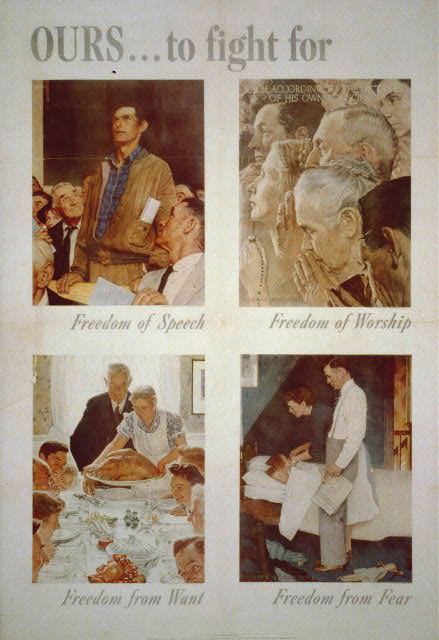
In early 1941, while war was already raging in Europe, but almost a year before Pearl Harbor, FDR gave one of the most famous speeches of the era and of American history. It was the 1941 State of the Union address, but it will always be known as the Four Freedoms speech. To bolster American support for our almost inevitable involvement in the war, he enunciated the Four Freedoms we would be fighting for: Freedom of Speech, Freedom of Worship, Freedom from Want, Freedom from Fear:

In the future days, which we seek to make secure, we look forward to a world founded upon four essential human freedoms.

The first is freedom of speech and expression — everywhere in the world.

The second is freedom of every person to worship God in his own way — everywhere in the world.

The third is freedom from want, which, translated into world terms, means economic understandings which will secure to every nation a healthy peacetime life for its inhabitants — everywhere in the world.

The fourth is freedom from fear, which, translated into world terms, means a world-wide reduction of armaments to such a point and in such a thorough fashion that no nation will be in a position to commit an act of physical aggression against any neighbor — anywhere in the world.

Art turned out to play an important role in keeping these ideals front and center, especially as the prospect of American sacrifice became a reality. The most famous example may be a series of paintings by Norman Rockwell (above), who was then and maybe still the greatest American illustrator. The Library of Congress explains:

Taken from Franklin Roosevelt’s 1941 speech to Congress, the “Four Freedoms” –Freedom of Speech, Freedom of Worship, Freedom from Want, and Freedom from Fear–became a rallying point for the United States during WWII. Artist Norman Rockwell created four vignettes to illustrate the concepts. Rockwell intended to donate the paintings to the War Department, but after receiving no response, the painter offered them to the Saturday Evening Post, where they were first published on February 20, 1943. Popular reaction was overwhelming, and more than 25,000 readers requested full-color reproductions suitable for framing.

Some will say that these Four Freedoms are today “controversial” because we don’t seem to be able as a nation—as an American family—to agree on the strategies to maintain and attain those ideals. Those disagreements are undeniable, as are the related invective, disparagement, and even hatefulness that goes with them. But those disagreements can’t make us give up. On the contrary, they should send us back to the words of FDR, getting past the ideologies and labels, and really look within and at the family of Americans.

Do you really believe that these ideals are exclusive to you, and not shared by others of good will? Are your principles and affiliations so very important that you would sacrifice those ideals to be “right?” Or can we come to the table, dig deeper, and not leave until we have given up a little of our own self-importance and focused instead on getting a little closer to the country and world envisioned in the shared Four Freedoms? And maybe just a little closer to each other?

Notes on Interstellar

Interstellar

1

Christopher Nolan’s movie Interstellar is more interesting than it is imperfect. See it if you like space movies, sci-fi movies, intellectually curious movies, spectacular movies, etc.

It is filled with wonders. It is like the car trunk stuffed with luggage for a vacation, so much colorful and significant luggage creatively crammed in that when you open it on arrival you say: Wow, I wonder how we ever got all that stuff in there?

No spoilers here, but a couple of things.

Look for all the tiny (and not so tiny) echoes of space and sci-fi movies past. Star Wars, Close Encounters, etc., but most of all 2001. Why not? Right now, “they” are probably having a good 5th dimensional laugh watching Stanley Kubrick’s proto-human apes tossing that bone.

Interstellar has the most subtly cool robots ever. TARS doesn’t sing like HAL, but he has moves like Jagger and is great with the snappy patter.

2

The movie is much about cosmology—the origin and nature of existence. Cosmology is the domain of all kinds of people, including religionists and philosophers. But in greater part, we have handed over many of those considerations, as in this movie, to theoretical physicists—Einstein, Hawking, etc. I am a big fan of cosmology.

It is not a spoiler to mention that plenty of people, including some in this movie, believe that the Apollo 11 moon landing was faked. Which raises this way-out-there question: What if the moon landing was real but all the cosmological theoretical physics is faked? Going back before Einstein, theoretical physics spends much of its time (as we understand it) looking for physical proof of those theories. What if all the theory is so utterly astounding and enlightening that when the evidence failed to support it, all the scientists engaged in the study conspired to make it seem as if those theories are supported?

Faking the moon landing mission has never been put entirely to rest because, in fact, only three people experienced it first-hand. Everyone else was second-hand or more distanced from the actuality. But the basic elements of it are well within our understanding: astronauts, rocket, spaceship, lunar lander, moon, television pictures. The cosmological speculation and supporting discoveries are so far beyond anything that most of us can fully—or slightly—grasp that we could easily be fooled into taking it for “reality.”

By the way, for those wondering about the earnestness of all that, be assured that I am just playing. Or am I?

3

We don’t have to be space pilots to experience cosmology, or be theoretical physicists or movie directors to think about it. Cosmology is ordinary. Interstellar and other movies and thousands of works of art and literature point to this. Everybody is a cosmologist, like it or not.

Cosmology is an excellent topic that does not necessarily require specialized knowledge. You may not know a worm hole from a black hole. But you already know a ton about time, space, being, and gravity. You just have to know how to know and that you know.

This is from an essay almost 800 years old. No more or less spectacular than Interstellar, it is no more or less a non-theoretical description:

Do not think that time merely flies away. Do not see flying away as the only function of time. If time merely flies away, you would be separated from time. The reason you do not clearly understand the time being is that you think of time only as passing.

In essence, all things in the entire world are linked with one another as moments. Because all moments are the time being, they are your time being….

You may suppose that time is only passing away, and not understand that time never arrives. Although understanding itself is time, understanding does not depend on its own arrival.

People only see time’s coming and going, and do not thoroughly understand that the time being abides in each moment. Then, when can they penetrate the barrier? Even if people recognized the time being in each moment, who could give expression to this recognition? Even if they could give expression to this recognition for a long time, who could stop looking for the realization of the original face? According to an ordinary person’s view of the time being, even enlightenment and nirvana as the time being would be merely aspects of coming and going….

Mountains are time. Oceans are time. If they were not time, there would be no mountains or oceans. Do not think that mountains and oceans here and now are not time. If time is annihilated, mountains and oceans are annihilated. As time is not annihilated, mountains and oceans are not annihilated.

Dogen
The Time Being (1240)
Treasury of the True Dharma Eye

The Road of Life: A New Musical

Road of Life

Some of our greatest and most popular musicals have been set against the background of darkest history. Les Miserables. Miss Saigon. Fiddler on the Roof. Cabaret. In the context of adversity, shining stories of love and human spirit stand out starkly, movingly—and musically.

The German Siege of Leningrad, lasting 900 days between 1941 and 1944, has been relatively ignored when we think about the atrocities of that atrocious war. A million people died over the course of more than two years, and millions of others suffered attacks and depravations that brought them to the brink and marked their lives forever.

Ann Reid writes in Leningrad: The Epic Siege of World War II:

[T]he siege of Leningrad, the deadliest blockade of a city in human history…. Other modern sieges – those of Madrid and Sarajevo – lasted longer, but none killed even a tenth as many people. Around thirty-five times more civilians died in Leningrad than in London’s Blitz; four times more than in the bombings of Nagasaki and Hiroshima put together.

Hope, wrote Emily Dickinson, is the thing with feathers. A songbird who lifted the people of Leningrad during this cold hell was a poet named Olga Burggolts. Each day she broadcast from Leningrad’s only radio station—reporting events, reading her poems, exemplifying the imperative of survival. Just as the siege is too forgotten, so she is not very well-known or celebrated for her achievement. But as much as we may dismiss poetry as an idle pastime, maybe nowhere at no time has a poet done more to affect so many—and to help those people withstand the brutality of history.

The team of Jay Jacques and Mark Chimsky have created a bold and uplifting new musical intertwining this big history with the individual lives, loves, and losses that are its true components. It is an invitation to see this chapter of the not-so-distant past in a new light, one that demonstrates in theater and song how dreams rise from the depths. To find out more, please visit The Road of Life. Read the story, listen to the music, and be inspired.

Obama Speech: Is It ISIS, ISIL or IS, and What is a True Religion?

Obama ISIS Speech

This is not a comprehensive review of last night’s speech by President Obama about ISIS/ISIL/IS. But if you asked me to join the millions of reviewers, descriptors that come to mind are lukewarm, vague, uninspiring, insufficiently informative, tactical (the speech, not the plan), and blah-blah-blah.

Here is one paragraph that stuck out, because it reflects two issues that may not get enough attention:

And one of those groups is ISIL — which calls itself the “Islamic State.”

Now let’s make two things clear: ISIL is not “Islamic.” No religion condones the killing of innocents. And the vast majority of ISIL’s victims have been Muslim. And ISIL is certainly not a state. It was formerly al Qaeda’s affiliate in Iraq, and has taken advantage of sectarian strife and Syria’s civil war to gain territory on both sides of the Iraq-Syrian border. It is recognized by no government, nor by the people it subjugates. ISIL is a terrorist organization, pure and simple. And it has no vision other than the slaughter of all who stand in its way.

What Is the Name of This Enterprise That We Are at War Against?

Is it ISIS, ISIL, or Islamic State? This is much more significant than whether the English transliteration of the name of the Egyptian President was Morsy, Morsi, or Mursi or the Libyan dictator was Gadhafi, Qaddafi, Kadafi, Gaddafi, or Gadafy. This is our new mortal enemy, and besides, all these IS names are in English.

Different nations and different news media have different approaches to this. The BBC, for example, has settled on Islamic State, apparently opting for whatever the organization chooses to call itself. What is totally strange about the “official” U.S. nomenclature is that at the highest levels, there is no consistency. The President prefers ISIL, while those in his cabinet regularly use ISIS.

One small matter about ISIL does deserve note. The full name is the Islamic State in Syria and the Levant. I challenge many in the administration, and many in Congress, and many in the media, to explain—without Google or cheat sheet—what the Levant is. For five hundred years or so it has described the land of the eastern Mediterranean, now roughly comprising Syria, Lebanon, Israel, and contiguous countries. The word comes from the French word for “rising”, as in the east where the sun rises. It isn’t much in use any more, outside of scholarly circles and, of course, in our latest war.

So please, President Obama, if you are gathering the support of dozens of nations and hundreds of millions of Americans, let’s all decide on what to call this organization that, in the words of Vice President Joe Biden, we will pursue to the Gates of Hell.

What is a True Religion?

“No religion condones the killing of innocents,” the President said. Without going into historic and contemporary detail, this is patently false. I believe the President knows better, but he didn’t want to get into a deep discussion, and instead just wanted to make a rhetorical flourish. If he doesn’t know, there are thousands of histories he can read and scholars he can consult, or even easier, news reports from the past few weeks, months, and years he can read.

If, however, he really did mean it, he has disqualified the majority of world religions from being classified as such. Which, by the way, plenty of critics of religion would applaud.

The President doesn’t have to be the Teacher in Chief, the Scholar in Chief, the Explainer in Chief, etc. Being Communicator in Chief is enough of a job, but if he just wants to say stuff for effect, without regard to its making sense or being true, we’ve already had plenty of that in years past, from those less smart or thoughtful than you. We get enough nonsense from many in Congress. Speak as if some of us are actually thinking about what you say. Because some of us are.

The Abstract Perpetual War Is Real

Rome

Consider this: If you have a child or grandchild age 12 or younger, they have lived their lives with America at war.

And this: In six years that child will be old enough for military service, but will not necessarily have to serve because we have no mandatory universal service. So even if we are still at war, that child is probably not at risk.

And this: Why don’t we have mandatory universal service, especially if we are in perpetual war? Do we have perpetual war because we don’t have mandatory universal service?

Michael Auslin, a Resident Scholar at the American Enterprise Institute, has a fascinating piece in Politico about the prospect of a perpetual war footing, Don’t Do As the Romans Did… His politics may not be yours, but his analysis is compelling and worth reading in its entirety:

For Washington, which has already spent at least $2 trillion on relatively limited wars in Iraq and Afghanistan, the prospect of decades more competition, deterrence and fighting at an unknown cost represents the greatest security challenge since the Cold War, and perhaps since World War II. It is just as much a domestic political issue, and will figure as prominently in the debates over the future direction of the country, as do the battles over Obamacare, the regulatory burden or the transformation of the economy. Yet so far, it does not seem that either the country’s political elites or ordinary citizens have fully appreciated both the scope and, more importantly, the nature of America’s new two-front conflict. They soon will, as the country’s economic health and domestic political stability will be directly affected by rising global risk. To quote Leon Trotsky, “You may not be interested in war, but war is interested in you.”

Americans must accept the fact that, while their country may not be engaged in daily fighting, neither will it know peace for the foreseeable future. The world will become far more insecure and unstable over the next decades, and the amorphous yet crucial idea of global “order” will be strained, perhaps to the breaking point.

America’s greatest strength is also its greatest weakness. The spirit of can-do, roll up your sleeves, and in the words of Larry the Cable Guy, “get ‘er done” is a model for the world. But a related failure to think things through, apply broad and deep vision, and act deliberately and more slowly, can neutralize or outweigh the benefits of that spirit.

Living in the moment, in the now, is a great way for people to not be mired in the mistakes of the past and not be intimidated by the hypothetical misfortunes of the future. That is, unfortunately, not a luxury that nations, particularly super powerful ones, have. When you can spend trillions of dollars of your citizens’ money, send thousands of citizens to their deaths, and have the potential to blow up cities and the whole world, we expect you to think twice or more before you roll up those sleeves and get ‘er done.

Newark and Detroit: The Long Hot Summer of 1967

Newark 1967

The last post about James Baldwin’s The Fire Next Time (1963) skipped a beat about what happened next. What happened in America was the race riots between 1964 and 1966 (including Watts in Los Angeles), culminating with the so-called Long Hot Summer of 1967. During that summer, among the many cities affected, the two disturbances that stand out are Newark and Detroit.

Baldwin did not overstate any prophetic intention in his book. Instead, he simply opened with this epigraph, from which he took the book’s title:

God gave Noah the rainbow sign,
No more water, the fire next time!

Newark, July 12-17, began with the arrest of a black cabdriver for passing a police car. The riots left 26 dead and hundreds injured.

Detroit, July 23-27, began with a police raid of a black drinking club. The riots left 43 dead, 1,189 injured, over 7,200 arrests, and more than 2,000 buildings destroyed.

There are at least three reasons we don’t hear much or talk much about that summer in the context of Ferguson.

We are abysmally ahistorical. If it isn’t in the latest Twitter feed, it may already be old news. Things that happened forty or fifty years ago might as well be from the Middle Ages.

We want to highlight and not overshadow the clear progress that has been made. Progress to be sure, as reflected in the photo of a black President talking to a black Attorney General about the events in Ferguson.

We are afraid. Afraid that the progress we have made may be as illusory as it is real. Afraid that we solved the easier problems, leaving us with stubborn, intractable ones that are beyond comfortable solutions. Afraid that we may not be as good as we think we are. Mostly afraid that history is TMI, telling us way more than we want to know, showing us images not from the distant past but from tomorrow.

Ferguson and The Fire Next Time

James Baldwin - The Fire Next Time

James Baldwin’s The Fire Next Time may be the best and most eloquent statement of relations between whites and blacks in America ever written. From the publisher:

The appearance of The Fire Next Time in 1963, just as the civil rights movement was exploding across the American South, galvanized the nation and continues to reverberate as perhaps the most prophetic and defining statement ever written of the continuing costs of Americans’ refusal to face their own history. It became a national bestseller, and Baldwin was featured on the cover of Time magazine. Critic Irving Howe said that The Fire Next Time achieved “heights of passionate exhortation unmatched in modern American writing.”

Baldwin was one of the great writers of his or any other American generation. He shouldered the burden of being a triple threat to America of the 1960s—a black man, a brilliant and outspoken intellectual, and gay. This he did with unequaled prose grace, and this work and others are required reading for anyone who wants or claims to be a writer.

The first of the two essays is My Dungeon Shook: Letter to My Nephew on the One Hundredth Anniversary of the Emancipation. Brief and unforgettable, it is a summary of how things are and why his teenage namesake cannot give up and in. It does no justice to this book to excerpt it; it stands as a whole that must be read—not the least of all because with the real progress we have made, we are foolish and destructive to over-measure how far we have come. But here is how the essay closes:

And if the word integration means anything, this is what it means: that we, with love, shall force our brothers to see themselves as they are, to cease fleeing from reality and begin to change it. For this is your home, my friend, do not be driven from it; great men have done great things here, and will again, and we can make America what America must become. It will be hard, James, but you come from sturdy, peasant stock, men who picked cotton and dammed rivers and built railroads, and, in the teeth of the most terrifying odds, achieved an unassailable and monumental dignity. You come from a long line of great poets, some of the greatest poets since Homer. One of them said, “The very time I thought I was lost, My dungeon shook and my chains fell off.”

You know, and I know, that the country is celebrating one hundred years of freedom one hundred years too soon. We cannot be free until they are free. God bless you, James, and Godspeed.

Your uncle,
James

Fortune Magazine Pleads: Heed the Authentic Cry of Our Youth

Youth in Turmoil Cover

It is January 1969. Fortune, one of the world’s most conservative business magazines, publishes a special issue about Youth in Turmoil. It then adapts the issue into a book, with an image of a flame on the cover.

The message is not, as you might expect, about how these ungrateful long-haired drug-addled rebels are destroying the country. On the contrary, the message is that these young people are trying to tell us something important and we should listen—before it’s too late.

Here is the introduction:

American youth is trying to tell us something important. The brightest of our young men and women are telling us that as far as they are concerned the choices for our society are narrowing rapidly. We can, at worst, look ahead to a future, very near, in which they lose all heart for our national effort, thus robbing it of its nerve, vitality, and point—a state of affairs in which they range themselves against us either in violence or in withdrawal. Or we can heed the cry of these young adults. Though often marred by shrillness, arrogance, and negativism, that cry is authentic and valid in its central message. It tells us that in our rush to well-being we have left much undone at the same time we have made so much more do-able. It tells us that we should rechannel our enormous energies to deal with the lengthening list of environmental and social grievances. If we can enlist these young idealists and they can enlist us, the nation will evolve toward a life style that once again sets a new standard for the world. I hope that this book, adapted from the January, 1969, special issue of FORTUNE, will contribute to that mutual enlistment.

LOUIS BANKS,
MANAGING EDITOR, FORTUNE

Please read this word-for-word. It is extraordinary. This is a bible of the establishment, during one of our most anti-establishment times, acknowledging that many things are wrong—including environmental and social problems—and admitting that young people are trying to remind us of our responsibilities to make it right. If the establishment fails, Fortune says, “We can, at worst, look ahead to a future, very near, in which they lose all heart for our national effort, thus robbing it of its nerve, vitality, and point—a state of affairs in which they range themselves against us either in violence or in withdrawal.”

Consider how far we have come. Youth seems to be somewhat disaffected, maybe even having lost heart and been robbed of its nerve—but not exactly in turmoil. Much of the conservative establishment would now never dream of agreeing that we have justifiable environmental and social grievances, let alone that these should be aggressively addressed.

The Sixties are variously celebrated, trivialized, and even laughed at. Maybe it’s funny to see a Big Business publication like Fortune willing to open its eyes, look around, and decide that these kids just might have a point and we can do a whole lot better. Or maybe it’s a little sad that we don’t see more of that today.

Honeywell Kitchen Computer and the Delights of Old Tech

Kitchen Computer - Menu Selection

Some people love old cars. Others of us delight in old digital tech.

We are not alone. The latest episode of Mad Men on AMC includes the installation of a computer at the agency. And the new AMC series Halt and Catch Fire is (coincidentally?) about the early days of personal computing. (Halt and Catch Fire is a real/apocryphal/funny code instruction that might send a computer into an endless loop, resulting in its ultimately stopping or bursting into flames.)

This is a page from the Neiman-Marcus Christmas 1969 catalog. The impeccably dressed N-M housewife is standing next to what appears to be an unusual table, but is actually the Honeywell Kitchen computer, which can be purchased for $10,000. (The apron will cost you another $28.) “If she can only cook as well as Honeywell can compute.” Indeed.

Kitchen Computer

Here is something completely different from the era, prophetic rather than silly. It is Isaac Asimov, a science fiction great, advertising Radio Shack’s TRS-80.

Asimov - TRS-80

Note that in the spirit of what goes around comes around, this is a pocket computer almost exactly the size of a smartphone—or is a smartphone a pocket computer exactly the size of a TRS-80? Either way, Neiman-Marcus and Honeywell were clueless, but Asimov and Radio Shack were not.

That would be a pretty good close for this post. Except that the following ad is irresistible, telling us something else about the early days of computing.

TSP Plotter

Just as cars were, and to some extent still are, sold by using sex, sometimes so were computers. This is an ad for a plotter, possibly the least sexy of all peripherals. The copy is mostly bone-dry and technical. But then there’s the trio of the model with her dress open to her navel, the headline “New, Fast, and Efficient!”, and the lead “The TSP-212 Plotting System is a real swinger.” $3,300 COMPLETE. Well, almost complete, as the model is presumably not included. But you know, that cool plotter just might attract one.