Bob Schwartz

Category: Government

In Advance of the Marriage Equality Decisions

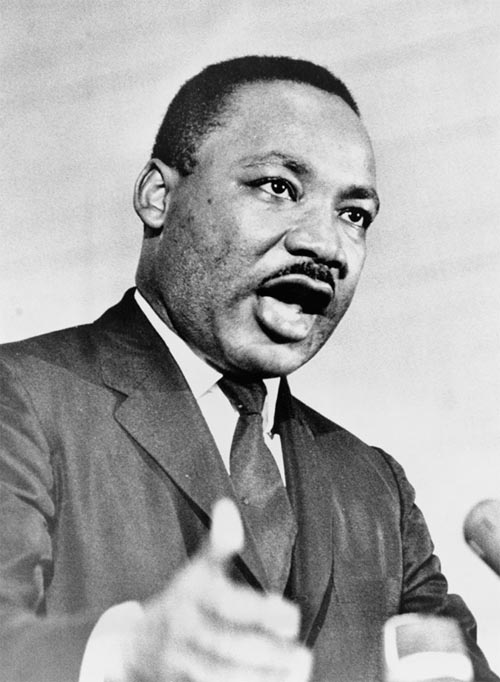
MLK

It appears it may be only a few minutes before the Supreme Court releases its opinions in the marriage equality cases, California Proposition 8 and DOMA. As always, when it does happen, please read the opinions yourselves, and don’t just take anybody’s word for what they say or mean.

Meanwhile, some are bound to be disappointed because the decisions don’t go far enough, if they seem to go anywhere at all. So here is a quote from Martin Luther King, Jr. so familiar that we may have stopped actually hearing it. Listen and believe.

I have not lost faith. I’m not in despair, because I know that there is a moral order. I haven’t lost faith, because the arc of the moral universe is long, but it bends toward justice.

The Wait We Carry

The Wait We Carry
IAVA has been at the forefront of modern veterans advocacy—something desperately needed in the face of modern veterans benefit challenges (that is, much talk, little action).

The latest of these advocacy tools is dazzlingly innovative and personalizing. Here is the IAVA introduction:

This is the true face of the backlog. Introducing: The Wait We Carry.

By now, you’ve seen the big numbers behind the VA disability benefits backlog — over 565,000 vets waiting too long to get their claims resolved. But it’s not enough to talk about the numbers. We wondered: what are those vets going through? How is their wait for benefits affecting them and their families?

We asked vets to tell us about their experiences while waiting for their benefits. Their stories blew me away. I knew immediately that I wanted to do something that would give a voice to their struggle. Harnessing the power of technology, we have created a state-of-the-art data visualization tool to bring those stories to the world. It’s called The Wait We Carry.

The Wait We Carry is an interactive way for anybody to engage with the folks waiting for their benefits through their stories. There are several different search options so you can find a specific story, or you can simply take your time browsing through all of the stories. It drives our point home that there isn’t just one backlog experience. The weight of the wait is different for everybody.

The power of this tool is that it holds everybody accountable for the unacceptably long wait times. That’s why it’s crucial that this thing goes viral.

I’ve been working on this for months, and I am certain that The Wait We Carry is powerful enough to end the VA backlog for good. Make sure you check it out today — thewaitwecarry.org

Thanks,

Jacob Worrell
OIF Veteran, US Army 2004-2007
Product Strategy Associate
Iraq and Afghanistan Veterans of America (IAVA)

Immigration: The Right People and the Wrong People

Pilgrims - Superman - Jews
Today brings another high-profile politician talking about immigration policy that lets “the right people” in (those who will create the next Google) and keeps “the wrong people” out (vaguely defined, but you’ll know them when you see them).

A reminder that except for continental natives, all Americans are immigrants. Even the Mayflower people. Even Superman, an undocumented immigrant who for years was hidden by a seemingly kind and gentle Midwestern couple—of outlaws; why weren’t Ma and Pa Kent ever put in jail?

In the lead up to World War II, America could not find a place for thousands of Jews fleeing Hitler. These were apparently the wrong people, or the right people at the wrong time, or something. Any country is apt to make mistakes; America is no exception. Still, it is ironic that some of the people who were turned away might have started hundreds of Googles, or the 1930s equivalents. As it is, we can only imagine.

We can’t let everybody in, or so we say, but we don’t really talk about why not and what that means. Instead, we have immigrants who are “the wrong people”, but we also have “the right people” to serve particular national or individual interests (see also involuntary immigrants who were cheaper and more versatile than machines).

Not everybody is Superman. Not everybody is a bunch of unwanted people who will become the cliché of founding stock (Pilgrims) or unwanted people who never make it to shore (Jews). Not everybody is an entrepreneur. Not everybody is willing to take the worst jobs that few others want. Immigrants are people, not “right” or “wrong”. We can and should have a conversation without forgetting that.

The Next Civil War: Religion

Lincoln Penny
A few years ago, I proposed that the American divide over abortion might one day reach the dangerous depths of a much earlier conflict over slavery. Not since slavery—not even with still-festering questions about racial and other inequalities—has an issue had such a basic and visceral impact.

The poll numbers on abortion have shifted, the judicial context may be stable (for the moment), but the legislative activity is still a battlefield: among the initiatives, just today Pennsylvania Governor Tom Corbett signed a law prohibiting insurers that offer abortion coverage from participating in the state’s exchange under the Affordable Care Act.

Yet even with that, abortion will not be the biggest issue that cleaves America in the next few years. It will be, much more than it is now, religion.

Not one religion against another, or one religion-based position against another. We are approaching the point where half of America has an explicit or implicit affinity with some organized religious denomination or belief, and half does not. The not includes a wide range from atheists, agnostics, areligionists or anti-religionists to those who are “spiritual but not religious.”

America is not a theocracy or, officially, a theocratic democracy. But “theocratic democracy” (see Israel) is the way a number of Americans see it approvingly. Our conventions, traditions and even our money support this, and when they didn’t support it sufficiently, it was enhanced—as when during the Cold War against godless Communism, “under God” was added to the Pledge of Allegiance.

The dynamic between religious and secular has long played out in America in just about every official sphere. But in the past, those who fought for the secular and even succeeded (prayer in schools) were considered an aberrant and weird fringe. The fringe is now a minority, but still in some eyes, aberrant and weird. What happens when that fringe turned minority becomes an equal partner in American civics, citizens who are guided by bright moral lights, just not those that emanate from lamps they don’t believe in and refuse to support—or allow to rule their lives? What then?

Abraham Lincoln said we could not survive half-slave and half-free. The nineteenth century would not have hinted at it. but the American twenty-first may be half-God, half-not. What might Lincoln say then?

Moral Mondays

Moral Mondays

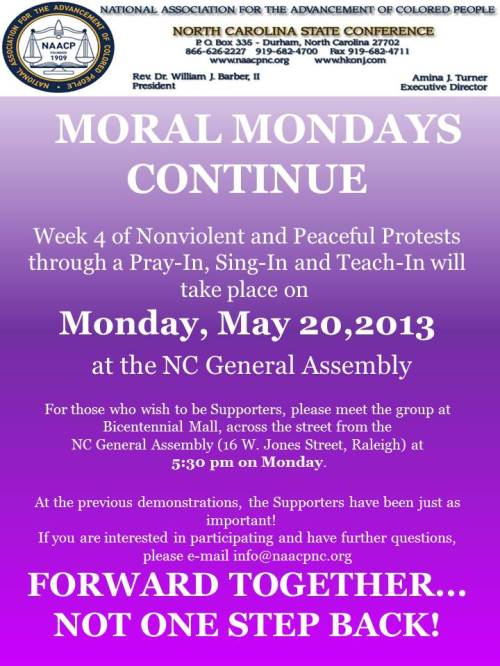
Today, Monday, June 3, is another Moral Monday in North Carolina. A Mega Moral Monday. Small and local right now, Moral Mondays have the potential to be the kind of broad movement that in recent years progressives have wanted but so far been unable to achieve.

In May, the North Carolina NAACP began peaceful protests each Monday at the General Assembly. The civil disobedience is meant to bring attention to legislative curbs on Medicaid expansion, workers’ rights and voting rights, and to the lack of legislative progress on gun control and public education funding. There have been an increasing number of arrests of activists, 153 so far. This week, the protests are expanding across the state.

All movements are more likely to fall flat than catch fire. The Occupy movement reflected real dissatisfaction and outrage, but never sufficiently articulated the underlying principles that would galvanize people to commit and to connect with each other in big numbers.

Moral Monday is built on a foundation that is at the heart of what bothers so many Americans. As is apparent from many of our political controversies, some of those who claim the moral high ground sometimes seem to ignore possible moral shortcomings in their policies, e.g., a Christian imperative to lift the poor and heal the damaged may be at odds with extreme cuts in government support and programs. (In this regard, see questions about Ayn Rand that arose in the most recent election.)

Moral Monday simplifies what is admittedly a set of very complex issues to a very basic baseline: If you claim, by the light of faith or by a sense of enlightened humanity, to believe in moral action, then your idea of morality must be your primary guide. You are free to choose that morality; no constitution, no set of laws, nothing can or should move it. But once you have chosen, and especially after you say it loudly every Friday, Saturday, or Sunday, or on whatever days you proclaim your core beliefs, your duty is to act on it. If you don’t act morally, or if you try to rationalize around that morality for some supposed greater cause, you are only human, but should investigate and consider your action, and even your possible hypocrisy.

Moral Mondays may not make it beyond North Carolina. But it is possible that in a little while, all around the country, more and more people will start the week by taking a stand and, if necessary, getting arrested for it. There is a global and historic tradition for this sort of action, and great change has been made.

Thank you North Carolina NAACP. Mondays will never be the same.

Politics Usual or Unusual

Barack Obama
Most presidents, even the ones you love to hate, are idealists. At least at the start. For some, depending on the times, the makeup of Congress, and the skills of the national CEO , the presidency is where dreams go to die. Since the enemies of Obama–and he has bitter enemies in high places—have raised the ghost of Nixon, it is a good time to honestly set perspective.

The best way to measure the historic egregiousness of presidential misperformance is to count the friends who remained even as it was unfolding. There is a point at which that inchoate thing we might call the honor of the country is at stake, rather than just individual transgressions. Lying in office, either about sex or about phantom weapons, is apparently not enough to turn everybody against you. Killing the economy and then handing a near lifeless body to your successor isn’t either. Blowing up the Constitution is.

So what we have at this moment is not Nixonian by any stretch. What we have is the unpretty side of presidential pragmatism, the point at which feeling forced to play the game as it is played, rather than the way you had dreamed it could be played, is on unflattering display. Obama’s no good very bad week has led to a variety of dancing that no one should watch. There is Republican grave dancing, Obama supporter apologist dancing, and administration pretzel dancing. This last is exemplified by the Attorney General distancing himself from a possibly justifiable but absolutely controversial decision to monitor journalists to discover leaks, and at the same time pushing for a media shield law that would help make the particular investigation more difficult, less likely, or even impossible. That is, stop us before we kill again.

This all adds up to something not that spectacular, but for some a little disheartening in its plainness and obviousness. Politics is a life size business. Once in a while, some come along who stand taller, act more forthrightly, speak a little more inspiringly in ways that make us believe in the possible and in ourselves. We must have this because without vision, the people really do perish. Obama seems to be one of those. This week, though, he is stuck in a moment that is more usual, looking more usual. The unusual will be back, or at least it should, but right now, what it is is governing.

Publius Speaks to Congress

Federalist Papers
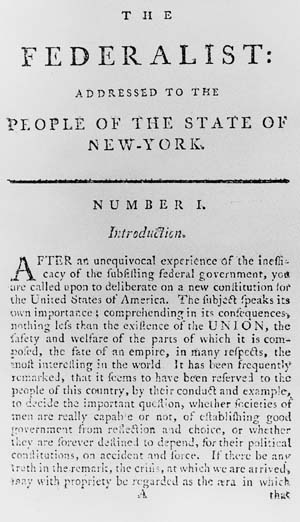
Publius Valerius Publicola (“friend of the people”) was a Roman consul who helped found the Roman Republic circa 509 BCE. When James Madison, Alexander Hamilton and John Jay began publishing The Federalist Papers in 1787, they attached his name to their arguments for adoption of the Constitution.

We don’t know how many current members of Congress have read the Federalist Papers—not even all 85 papers, maybe just a few. We also don’t know how many senior members of the executive branch have done so. We can assume that all nine Supreme Court Justices have; these are, after all, an essential part of the legislative history of the Constitution.

Every time you see politicians brandishing the Constitution as a weapon, well-meaningly or just plain meanly; every time you hear a half-baked political argument or analysis that makes absolutely no sense, but is based mostly or entirely on emotion or ambition; every time you wonder whether a particular politician is taking the best interests of the country to heart or is just interested I getting ahead, the Federalist Papers are your talisman.

The Federalist Papers are a brilliant combination of careful philosophy and political realities—a balance between aspiration and actuality, between the way we want to be and the way we are.

When we hear today about “grand bargains” being struck in Congress—or often not being reached at all—you have to laugh. The very same founders who are treated as saints or even gods had to make the grandest of all bargains so that this nation could exist and endure. And in the Federalist Papers, we find the philosophical intelligence, the political courage and the candid self-awareness to expose how narrow interest and pettiness can stand in the way of solutions. If anything has changed in more than two centuries, it’s that we seem to have fewer Madisons, Hamiltons and Jays front and center in our national discourse:

A torrent of angry and malignant passions will be let loose. To judge from the conduct of the opposite parties, we shall be led to conclude that they will mutually hope to evince the justness of their opinions, and to increase the number of their converts by the loudness of their declamations and the bitterness of their invectives.

An enlightened zeal for the energy and efficiency of government will be stigmatized as the offspring of a temper fond of despotic power and hostile to the principles of liberty. An over-scrupulous jealousy of danger to the rights of the people, which is more commonly the fault of the head than of the heart, will be represented as mere pretense and artifice, the stale bait for popularity at the expense of the public good.

It will be forgotten, on the one hand, that jealousy is the usual concomitant of love, and that the noble enthusiasm of liberty is apt to be infected with a spirit of narrow and illiberal distrust. On the other hand, it will be equally forgotten that the vigor of government is essential to the security of liberty; that, in the contemplation of a sound and well-informed judgment, their interest can never be separated; and that a dangerous ambition more often lurks behind the specious mask of zeal for the rights of the people than under the forbidden appearance of zeal for the firmness and efficiency of government.

Federalist No. 1

Your Congressional District on Drugs

Brain on Drugs
This is your geography.

NEO

This is your Congressional District on drugs.

Ohio 13th District

Any questions?

198 Ways to Make Change

Gene Sharp
The Albert Einstein Institution may be the most important organization you’ve never heard of, and Gene Sharp may be the most important person. Since 1983, he has dedicated himself to advancing the study and use of strategic nonviolent action in conflicts throughout the world.

These are just a few of the headlines he has garnered in the past year or so:

The New Statesman – Gene Sharp: The Machiavelli of non-violence.
The Progressive – Nonviolence Strategist Gets Deserved Recognition.
Deutsche Welle – Alternative Nobel Winner says non-violence works.
The New York Times – The Quiet American.
CNN – Gene Sharp: A dictator’s worst nightmare.
The Nation – Gene Sharp, Nonviolent Warrior.
The Boston Globe – Sharp: The man who changed the world.

His book From Dictatorship to Democracy is an introduction to the use of nonviolent action to change regimes. It has been translated into seventeen languages and has served as a pro-democracy guide for movements around the world. This and other books are available free for download on the website.

Even if you are not living in a dictatorship and are not planning to topple a government, you will find a very small and very valuable item at AEI. Think of it as a jewel of social action. It is a two-page list of 198 Methods of Nonviolent Action. You will find the list below.

For those who want to make change, big or small, the keys are commitment and creativity. We’ve seen some inspired actions take hold. We’ve also seen some well-meaning initiatives pop-up and die almost as quickly. There is no blame in this. Sometimes all that’s needed is a fresh spring wind to revive the spirit of change.

This list is that spring wind. Look it over. This may go without saying, but be well aware that a number of these actions are obviously aimed at a serious lack of or breach of democracy, and are appropriately serious for those situations. All of them necessarily involve social, economic, legal, moral and ethical issues that must be considered. Maybe you will find something to do. Maybe you won’t do anything, but will be uplifted by knowing that such things can be done, have been done, and have moved communities and whole nations—today, in this very world—a little way along a path to freedom and justice.

198 Methods of Nonviolent Action
Albert Einstein Institution

The Methods of Nonviolent Protest and Persuasion

Formal Statements
1. Public Speeches
2. Letters of opposition or support
3. Declarations by organizations and institutions
4. Signed public statements
5. Declarations of indictment and intention
6. Group or mass petitions

Communications with a Wider Audience
7. Slogans, caricatures, and symbols
8. Banners, posters, displayed communications
9. Leaflets, pamphlets, and books
10. Newspapers and journals
11. Records, radio, and television
12. Skywriting and earthwriting

Group Representations
13. Deputations
14. Mock awards
15. Group lobbying
16. Picketing
17. Mock elections

Symbolic Public Acts
18. Displays of flags and symbolic colors
19. Wearing of symbols
20. Prayer and worship
21. Delivering symbolic objects
22. Protest disrobings
23. Destruction of own property
24. Symbolic lights
25. Displays of portraits
26. Paint as protest
27. New signs and names
28. Symbolic sounds
29. Symbolic reclamations
30. Rude gestures

Pressures on Individuals
31. “Haunting” officials
32. Taunting officials
33. Fraternization
34. Vigils

Drama and Music
35. Humorous skits and pranks
36. Performances of plays and music
37. Singing

Processions
38. Marches
39. Parades
40. Religious processions
41. Pilgrimages
42. Motorcades

Honoring the Dead
43. Political mourning
44. Mock funerals
45. Demonstrative funerals
46. Homage at burial places

Public Assemblies
47. Assemblies of protest or support
48. Protest meetings
49. Camouflaged meetings of protest
50. Teach-ins

Withdrawal and Renunciation
51. Walk-outs
52. Silence
53. Renouncing honors
54. Turning one’s back

The Methods Of Social Noncooperation

Ostracism of Persons
55. Social boycott
56. Selective social boycott
57. Lysistratic nonaction
58. Excommunication
59. Interdict

Noncooperation with Social Events, Customs, and Institutions
60. Suspension of social and sports activities
61. Boycott of social affairs
62. Student strike
63. Social disobedience
64. Withdrawal from social institutions

Withdrawal from the Social System
65. Stay-at-home
66. Total personal noncooperation
67. “Flight” of workers
68. Sanctuary
69. Collective disappearance
70. Protest emigration (hijrat)

The Methods of Economic Noncooperation: Economic Boycotts

Actions by Consumers
71. Consumers’ boycott
72. Nonconsumption of boycotted goods
73. Policy of austerity
74. Rent withholding
75. Refusal to rent
76. National consumers’ boycott
77. International consumers’ boycott

Action by Workers and Producers
78. Workmen’s boycott
79. Producers’ boycott

Action by Middlemen
80. Suppliers’ and handlers’ boycott

Action by Owners and Management
81. Traders’ boycott
82. Refusal to let or sell property
83. Lockout
84. Refusal of industrial assistance
85. Merchants’ “general strike”

Action by Holders of Financial Resources
86. Withdrawal of bank deposits
87. Refusal to pay fees, dues, and assessments
88. Refusal to pay debts or interest
89. Severance of funds and credit
90. Revenue refusal
91. Refusal of a government’s money

Action by Governments
92. Domestic embargo
93. Blacklisting of traders
94. International sellers’ embargo
95. International buyers’ embargo
96. International trade embargo

The Methods Of Economic Noncooperation: The Strike

Symbolic Strikes
97. Protest strike
98. Quickie walkout (lightning strike)

Agricultural Strikes
99. Peasant strike
100. Farm Workers’ strike

Strikes by Special Groups
101. Refusal of impressed labor
102. Prisoners’ strike
103. Craft strike
104. Professional strike

Ordinary Industrial Strikes
105. Establishment strike
106. Industry strike
107. Sympathetic strike

Restricted Strikes
108. Detailed strike
109. Bumper strike
110. Slowdown strike
111. Working-to-rule strike
112. Reporting “sick” (sick-in)
113. Strike by resignation
114. Limited strike
115. Selective strike

Multi-Industry Strikes
116. Generalized strike
117. General strike

Combination of Strikes and Economic Closures
118. Hartal
119. Economic shutdown

The Methods Of Political Noncooperation

Rejection of Authority
120. Withholding or withdrawal of allegiance
121. Refusal of public support
122. Literature and speeches advocating resistance

Citizens’ Noncooperation with Government
123. Boycott of legislative bodies
124. Boycott of elections
125. Boycott of government employment and positions
126. Boycott of government depts., agencies, and other bodies
127. Withdrawal from government educational institutions
128. Boycott of government-supported organizations
129. Refusal of assistance to enforcement agents
130. Removal of own signs and placemarks
131. Refusal to accept appointed officials
132. Refusal to dissolve existing institutions

Citizens’ Alternatives to Obedience
133. Reluctant and slow compliance
134. Nonobedience in absence of direct supervision
135. Popular nonobedience
136. Disguised disobedience
137. Refusal of an assemblage or meeting to disperse
138. Sitdown
139. Noncooperation with conscription and deportation
140. Hiding, escape, and false identities
141. Civil disobedience of “illegitimate” laws

Action by Government Personnel
142. Selective refusal of assistance by government aides
143. Blocking of lines of command and information
144. Stalling and obstruction
145. General administrative noncooperation
146. Judicial noncooperation
147. Deliberate inefficiency and selective noncooperation by enforcement agents
148. Mutiny

Domestic Governmental Action
149. Quasi-legal evasions and delays
150. Noncooperation by constituent governmental units

International Governmental Action
151. Changes in diplomatic and other representations
152. Delay and cancellation of diplomatic events
153. Withholding of diplomatic recognition
154. Severance of diplomatic relations
155. Withdrawal from international organizations
156. Refusal of membership in international bodies
157. Expulsion from international organizations

The Methods Of Nonviolent Intervention

Psychological Intervention
158. Self-exposure to the elements
159. The fast
a) Fast of moral pressure
b) Hunger strike
c) Satyagrahic fast
160. Reverse trial
161. Nonviolent harassment

Physical Intervention
162. Sit-in
163. Stand-in
164. Ride-in
165. Wade-in
166. Mill-in
167. Pray-in
168. Nonviolent raids
169. Nonviolent air raids
170. Nonviolent invasion
171. Nonviolent interjection
172. Nonviolent obstruction
173. Nonviolent occupation

Social Intervention
174. Establishing new social patterns
175. Overloading of facilities
176. Stall-in
177. Speak-in
178. Guerrilla theater
179. Alternative social institutions
180. Alternative communication system

Economic Intervention
181. Reverse strike
182. Stay-in strike
183. Nonviolent land seizure
184. Defiance of blockades
185. Politically motivated counterfeiting
186. Preclusive purchasing
187. Seizure of assets
188. Dumping
189. Selective patronage
190. Alternative markets
191. Alternative transportation systems
192. Alternative economic institutions

Political Intervention
193. Overloading of administrative systems
194. Disclosing identities of secret agents
195. Seeking imprisonment
196. Civil disobedience of “neutral” laws
197. Work-on without collaboration
198. Dual sovereignty and parallel government
The Iraq War and the Ryan Budget: A Modest Proposal

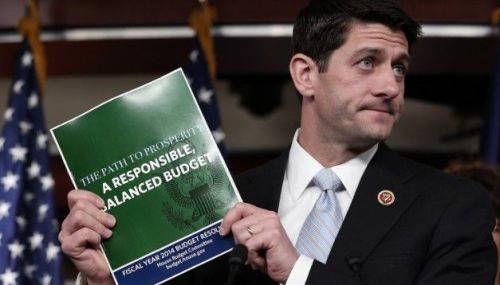
Paul Ryan Budget
We have two budget crises. One is the budget itself, which is clearly in need of work to make concrete our priorities and the willingness of citizens to support those priorities in the form of taxes. The second crisis is political dysfunction, where real and constructive talk about those priorities and that support is transformed and devolved into useless politalk. One way that uselessness is hidden is by obfuscation and throwing around lots of numbers, details, and core American principles.

Simplify, simplify.

We just marked the 10th anniversary of the Iraq War. There is going to be disagreement about many aspects of that war for generations.

But there is consensus on two things.

The war was financially expensive. How expensive is another matter of contention. The Costs of War Project pegs it at a few trillion dollars, give or take. So how expensive? Very expensive.

The war was not paid for. More precisely, the war was paid for by debt, not by taxes. The United States had never done this before. There are two perfectly good reasons to ask Americans to pay for and sacrifice for wars. Wars are expensive. And taxing for war asks all citizens at all economic levels to make real sacrifice, even if they or their loved ones are not in harm’s way. As a political matter, when the sacrifice outweighs support for the war, there may be pressure to question or even end the war.

It is uncontested that George W. Bush and Congress did not ask for that sacrifice. Without arguing about how that happened, it is the fact. There is no argument about the result. In the midst of this massive borrowing to pay for the war, the economy fell down, and is still having trouble getting up.

With a sense of humility, and standing in the shadow of today’s esteemed Congress, here is a simple and modest proposal.

1. Agree on the financial cost of the Iraq War. For purposes of discussion, let’s say $3 trillion, though it is certainly more.

2. Agree to taxes that will generate that amount of revenue, not a cent more or less. That revenue would then be spent on all the important things that would otherwise be underfunded or unfunded, including every possible entitlement for veterans.

3. Once that money is raised and spent, taxes will revert to the earlier levels, and some members of Congress can go back to babbling, bickering and posturing.

Simple, maybe even naïve. Certainly too naive for the sophisticated politicians who are busy building a budgetary hall of mirrors that only they can navigate, where they think they can hide themselves and some simple, inconvenient truths.