Bob Schwartz

Category: Business

Black Friday

The shopping day after Thanksgiving, Black Friday is so named because for retailers, it can mean the difference between loss and profit–being in the black.

Like it or not, the Christmas shopping season is an important contributor to this consumer economy. But the term is an overwhelmingly bleak one, particularly in relation to Christmas. In all other contexts, Black Friday is historically associated with financial crises, weather disasters, fires, military attacks and massacres. Rather than concerning Christmas and the birth of Jesus, the death of Jesus is marked by what is called Good Friday–also known as Black Friday.

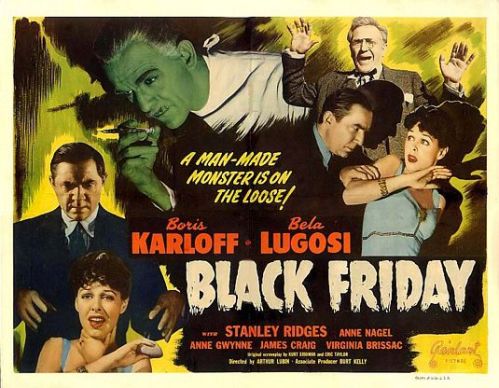
And then there is the 1940 horror movie (see above)…

Compassion for Karl


In the movie Runaway Jury, based on the John Grisham novel, a gun company is being sued for the death of a man in an office shooting. Gene Hackman plays Fitch, a jury consultant who specializes in using dirty tricks to extort the “correct” verdict out of jury members. The chief executive of the gun company has paid Fitch big bucks to “buy” a verdict. But the trial doesn’t seem to be going well:

Mr. Fitch, I looked into the faces of those jurors. I didn’t see any friends sitting there. Now where the hell are we with securing my verdict?

It’s a cat-and-mouse game. We’re about to change all that…

You just be a little more cat, a little less mouse.

That’s Karl Rove above, honored by fellow conservative and conceptual artist Stephen Colbert with the sculpture “Ham Rove.”

Like Fitch, Rove promised some very rich men a verdict. And like Fitch, he ultimately didn’t deliver. A little too much mouse.

Unlike the scripted moment above, we don’t know what the conversations have been like in the aftermath of the election. We would like to know, and are sure that is much, much more dramatic than the Grisham book or film.

Rove’s anticipation of that moment is probably what explains his now-legendary appearance on Fox News last night, immediately after Fox called Ohio and the election for Barack Obama. Rove simply refused to believe it, babbling and furiously calculating in a scene worthy of a tragic absurdist mathematical drama. He was undoubtedly imagining the conversations he would soon have to have with some very powerful and disappointed people, and he genuinely appeared on the verge of a breakdown. Having questioned the capability and integrity of the very news channel that has served him, the decision desk at Fox was brought in to assure him that they were right to call the race.

This led—and this is completely earnest—to feeling a little sorry for Karl Rove. Strategists lose, whether in business, war or politics, and there is always a price to pay. Some learn from it, some don’t. There is no indication of what, if anything, Karl Rove has learned. But when the stakes are very high, that loss can leave “the smartest people in the room” as the loneliest people in the world. And that’s sad.

Of course, Rove’s response to such sentiment might be that he doesn’t need anyone’s pity and that there’s no crying in politics. Okay then, but for a moment, it did look like that was exactly what was about to happen on Fox last night. Or maybe not.

This closes with good news. Maybe juries can be bought, maybe they have been. After Citizens United, we have been right to worry that maybe elections were now going to be regularly bought. We still have to fix that, but in the meantime, the result of this particular election is that floating on oceans of money, democracy is alive and well.

Soylent Green, My Friend, Is People


Mother Jones has already changed the trajectory of the Presidential campaign with the “47%” video. It’s latest video find may not have the same effect, but it is still revealing.

It comes from a promotional Bain Capital CD-ROM from 1998. Along with other artifacts of the Bain culture at the time, it includes a video of Mitt Romney from 1985 explaining the Bain business model:

Bain Capital is an investment partnership which was formed to invest in startup companies and ongoing companies, then to take an active hand in managing them and hopefully, five to eight years later, to harvest them at a significant profit…The fund was formed on September 30th of last year. It’s been about 10 months then. It was formed with $37 million in invested cash. An additional $50 million or so of what I’ll call a call pool, which is money that we can call upon if the deals are large enough that they require more than a $2 or $3 million dollar initial investment. Why in the world did Bain and Company get involved in this kind of a business? We’re not particularly noted for having years and years of experience in financing. Three reasons. We recognized that we had the potential to develop a significant and proprietary flow of business opportunities. Secondly, we had concepts and experience which would allow us to identify potential value and hidden value in a particular investment candidate. And third, we had the consulting resources and management skills and management resources to become actively involved in the companies we invested in to help them realize their potential value.

It’s the “harvest” line that is getting the most attention, presumably because it suggests to some that the companies are viewed primarily as abstract opportunities that are optimized for profit, rather than enterprises that make particular things and where particular people work and build their lives.

Fans of sci-fi movies are burdened by seeing the “real” world through the lens of those films. So this line flashed two iconic and unforgettable scenes.

One is from The Matrix (1999), when we first see the humans being used as living batteries to power the world of the Matrix.

The other is from Soylent Green (1973). In 2022, the desperate population of overcrowded New York City is being kept alive by the nutritional drink Soylent Green. At the end, we learn the dark secret of Soylent Corporation, as screamed by Charlton Heston (spoiler alert): “Soylent Green is people!” Yes, it is processed from the oversupply of corpses.

All this probably has nothing to do with Bain Capital harvesting companies. Somehow, though, “Corporations, my friend, are people!” just got mixed up with “Soylent Green is people!”, Charleston Heston got mixed up with Clint Eastwood and Mitt Romney.

As noted in a post a few days ago, this campaign may not just be threatening to drive us—candidates and voters—mad. It may have done that already.

Think the Same: Apple as IBM, Android as Apple


Think Different.

That was the theme of Apple’s award-winning and successful ad campaign that ran from 1997 to 2002. Among other creative inspirations, the concept played off of the even more famous one-word IBM slogan “Think”, which had been in use since the 1920’s, when it was devised by IBM founder Thomas J. Watson, Sr.

To make the point, Apple created a series of commercials and posters featuring those who had thought differently, including Albert Einstein.

The ad copy included this:

Here’s to the crazy ones. The misfits. The rebels. The troublemakers. The round pegs in the square holes.

The ones who see things differently. They’re not fond of rules. And they have no respect for the status quo. You can quote them, disagree with them, glorify or vilify them.

Keep this in mind as thousands line up—camp out in tents on the street—to be one of the first to own an iPhone 5. Even many self-aware tech pundits have had to admit it: in the current state-of-the-art, the iPhone 5 is not all that cutting edge. But even knowing that, they too are craving it. Resistance is futile.

Apple began as the “other” personal computer. The IBM/Microsoft-based paradigm relentlessly rolled on and over the market. The hardware technology was almost universally licensed and adopted as a standard. Microsoft dominated the operating system, and software was developed for it. PCs were available at every price point and capability, and the market exploded.

Apple thought differently. From the beginning, and with only one brief foray into third-party licensing, Apple decided it would control everything. Quality and style could not be left to the vagaries of the market and to the poor judgment and penny-pinching ways of third party vendors. The result in personal computing was that while Apple won only a minority share of market, its products were not only different but (in the view of some) better, and adopted by creative and thought leaders.

The turning point came when Apple went mobile with the iPod. There had been portable music players for years, beginning with Sony’s revolutionary Walkman. By applying its computing model to this device, Apple did something just as revolutionary. Unlike having a minority position in computing, Apple took the lead in digital music players and never looked back. It not only owned the device, it owned the store for feeding the device. Apple was no longer the other; Apple was it.

Apple took the same tack as it always had when it entered the mobile phone market: superior technology plus superior style. And as with its earliest computers, it maintained complete ownership and control. This was more than just a matter of not sharing the rewards with third-parties. As a consumer, you could be sure that any application would run flawlessly with the Apple OS on an Apple device.

The iPhone is now a standard, one embraced by millions with a fanaticism that approaches a cult. Henry Ford’s famous message to car buyers of the original Model T was that you could have any color, as long as it was black. Steve Jobs may have never quoted this, but this is the experience of the iPhone buyer. And they are ecstatic at the lack of choice.

The iPhone is a standard, but not the standard. The other force in mobile phones is Android.

The metaphorical differences between Apple and Android are infinite. If Apple makes the trains run on time, Android has powerful trains still looking for the conductor, the schedules and even the track. If Apple is a tightly produced Broadway show, Android is a three-ring circus with the ringmaster on acid. If Apple is Singapore, Android is the Wild West.

And yet, Android is the dominant mobile platform in the world, and its lead over Apple is widening.

The Android system—if you can call it that—works like this. The operating system is developed and upgrades. Each version goes out to device makers, who adopt it to their own needs, including overlaying it with proprietary additions, and test its integrity and compatibility. These devices are then sent to carriers and service providers who add their own proprietary touches and do further testing. It is a lengthy process that is fraught with missteps, and explains why new versions and upgrades can take months to reach consumers.

Then there are the applications and developers. Quality and qualified developers face the challenge of making sure that their applications work properly on all permutations of Android versions and device-specific overlays. Developing for Apple iOS, on the other hand, is as simple as developing for Apple iOS: if it works, it will work for everyone. And anyone can and does develop for Android. With the exception of malicious apps kept out of the Android market, anything goes. There are thousands of Android apps that are dysfunctional, sometimes comically so.

For some of us who appreciate the excellent and forward-thinking devices in the Android world, even the weirdos and app pranksters are part of the charm. Yes, it can take far too long to get Android upgrades, and even then things may not work perfectly. But most of the time, the results are spectacular. If that is the price to pay for not enlisting in the Apple Army, we’ll pay it.

In the final analysis, that is the irony. Apple has become the world’s leading tech company the way IBM did in the 1950s and 1960s: by telling the world how computing should be done and making them accept it. IBM salesmen—in fact everyone in the company—was required to wear a uniform white shirt and tie. One of the legendary mantras of that period was recited by corporate purchasing agents: “Nobody ever got fired for buying IBM.”

Android is an adventure. It might say of itself, as one corporate iconoclast used to:

Here’s to the crazy ones. The misfits. The rebels. The troublemakers. The round pegs in the square holes.

The ones who see things differently. They’re not fond of rules. And they have no respect for the status quo.

Apple is now IBM. Android is now Apple. It doesn’t take a genius to see that.
Mitt Romney Doesn’t Really Want To Be President


Mitt Romney doesn’t want to be President. This has been apparent for a while, but it seemed so unlikely—so strange for a person who is actually a nominee—that it defied saying. But it is the clearest explanation of everything that is happening.

Why would Romney run if he doesn’t want the office? The clichéd but useful explanation goes to a father-son dynamic.

In at least one objective respect, Mitt has spectacularly surpassed George Romney. Mitt Romney is a very, very rich man, wealthier than his father ever was.

As a businessman, it is a little more complicated. George Romney was, as the saying used to go, a captain of industry. He worked his way up to become head of one of the largest automakers, back when that mattered much more than it does now. Even if American Motors wasn’t one of the Big Three, it was a notable, forward-looking player in the field.

Mitt Romney’s success is different. Even treating the financial world as a discrete industry, which it of course is, the term “captain of industry” doesn’t seem to apply to Mitt. In the annals of financial history, no one will be talking about the creativity of Bain Capital the way business historians still do about the ahead-of-its-time thinking that marked American Motors—the company that believed the oversized car era was over, and that consumers would be buying compact and efficient automobiles. Eventually they would.

Politics is where the distinction is sharpest. George Romney was elected Republican Governor of Michigan three times—a state that was then decidedly Democratic. He had substantial political appeal and support, but his dream of being President was scuttled in part by the infamous “brainwashing” incident. He had visited Vietnam, and was told by the generals how well the war was going—in spite of evidence to the contrary. When he spoke about his opposition to the war, he said he had been “brainwashed” by the generals. George Romney’s political career never recovered.

As a politician, Mitt Romney has run for office just twice, and won only once. He was defeated for U.S. Senate from Massachusetts in 1994, and then was elected Governor in 2002. He chose not to run for re-election in 2006. Indications were that he would have a difficult race, and he instead began his run for the Presidency the day before he left office.

This father-son analysis—that Mitt Romney is trying, at all costs and for whatever reasons, to do what his father never could—may sound too easy. But the story of fathers and sons is just about the oldest story ever told. The patriarchal sagas of the Old Testament begin there, and great stories derive their greatness from the fact that some things never change.

Mitt Romney is following a program that he may not see or understand but that he has little or no choice about. It is a program, this running for President, that normally requires some combination of skill and desire. A surplus of one can balance out a deficit in the other. But trying to run without either—which we have never seen in a Presidential race—is bound to produce some anomalous results.

In the case of Mitt Romney, we can set aside the issue of how much political skill he has, though many have their doubts. The real question is how much desire he has. The answer, strangely, is little or none.

The outcome of the election is far from written. In case Mitt Romney loses, there is reason to believe that he will suffer some nagging psychic pain. But given the possibility that it is not something he really wants. there is also reason to believe he will go back to an extraordinarily comfortable life, and secretly be relieved.

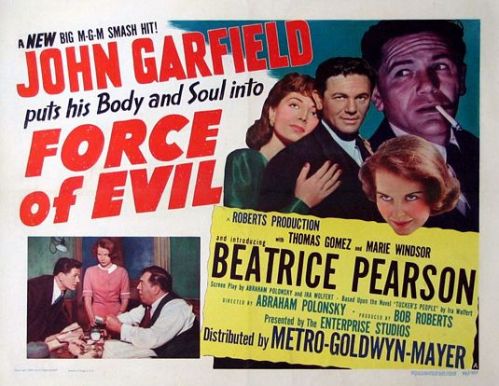
Movies: Force of Evil


The overlooked movie Force of Evil (1948)  is one of the most striking creative critiques of big business in any medium. It was produced by the major, decidedly capitalistic studio MGM, and it featured one of Hollywood’s biggest stars at the time, John Garfield, in what many consider his greatest performance. A standout of intelligent film noir, it has a brilliant and poetic script, written and directed by Abraham Polonsky.

Garfield is still a celebrated name in movies. Polonsky is more narrowly known, mostly among film historians. Shortly after Force of Evil, both Polonsky and Garfield were blacklisted in the craze of anti-Communist McCarthyism that swept the movie industry. Polonsky would not work again for twenty-one years.

There are two kinds of political movies. One is expressly and directly about political issues. The other kind—the one that so worried Commie-hunters—are films that look entertaining on the surface, but have a subversive and counter-cultural subtext. Force of Evil is a sort of third wave. You can watch it as a well-acted and engaging melodrama, which it is. But at some points, the politics explicitly but gracefully rises above subtext, in a way that is mostly undidactic, so it doesn’t get in the way of enjoying and appreciating the movie. It is quite a trick that Polonsky pulls off.

One of the archetypes of storytelling is the two brothers who end up on opposite sides of the law—Cain and Abel, the cop and the gangster. In this movie, both brothers are on the wrong side, just on a different scale. Leo is small-time, running a modest numbers betting business. (Numbers, sometimes called the policy racket, is an illegal lottery, long popular in low-income neighborhoods. Small bets are placed on the last three digits of the daily betting take at a race track; the odds are thus 1000 to 1.)  Joe (John Garfield), the younger brother who Leo helped put through Harvard Law, works for Ben, one of the biggest racketeers in New York.

Joe wants to make his first million, and he believes he will thanks to an ingenious plan to rig the outcome of the numbers on the Fourth of July. Since bettors often pick the numbers 776 on Independence Day, when that number comes up, the bettors will win for a change, but all the small-time numbers operators will go out of business, and be taken over by Ben. It is a strategy of forced, one-sided, underhanded mergers. (That’s right, the corrupt big business will play its dirty tricks on the slightly less corrupt small businesses—and on the innocent poor people—on the Fourth of July.)

Joe tries to save his brother by bringing him over to the bigger, richer and slightly darker side. But there are few heroes here. Events overtake characters, and in the end everyone, including a rival boss, is dead—except for Joe and the young woman he loves. While not exactly a happy ending, this outcome led some to complain that this sort of redemption was inconsistent with the rest of the movie. Maybe so, but this was made by one of the world’s biggest movie studios, and anyway, we all deserve a break in the face of this bleakness.

Bleak it may be, but Force of Evil is not some sort of dull lesson in ideology. It is a great, entertaining and rarely-seen film that deserves attention, whatever your politics.

Should the U.S. Disguise Itself As An Emerging Market?

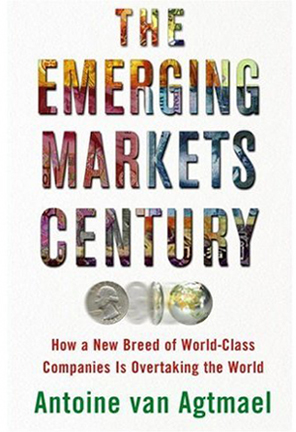
The term “emerging market” was coined in 1981 by Antoine van Agtmael. According to the Economist:

He was trying to start a “Third-World Equity Fund” to invest in developing-country shares, but his efforts to attract money were being constantly rebuffed. “Racking my brain, at last I came up with a term that sounded more positive and invigorating: emerging markets. ‘Third world’ suggested stagnation; ‘emerging markets’ suggested progress, uplift and dynamism.”

The term stuck, but like many neologisms, its meaning has expanded and shifted according to the times. The Economist suggests that it has outlived its usefulness:

Is it time to retire the phrase “emerging markets”? Many of the people interviewed for this special report think so. Surely South Korea, with sophisticated companies such as Samsung, has fully emerged by now. And China already has the world’s fourth-largest economy.

Whatever they are called, emerging markets continue to be prime targets for investment, with clear risks but enormous upside potential.

The U.S. is having problems getting investors to loosen their purse strings and flood our businesses with cash. Our economy is long past and beyond emerging; the perception among some is that it is post-post-emerged, which is to say a little old and over the hill.

That is a perception, not a reality, but perceptions matter as much in investment as elsewhere. So let us change the perception.

The proposal is to declare the U.S. an emerging market. There is a huge underclass just waiting for the means and opportunity to take their place in the middle. There is a middle class with upside potential of its own: although that potential is due to its having receded recently, potential is still potential.

Will investors be fooled by such a trick, what amounts to a name change and disguise? It wouldn’t be the first time. Anyway, as Antoine van Agtmael might say, “emerging market” sounds more positive and invigorating than “mired in recession.”

Scissoring And Shunning Sheldon

Pay no attention, just for a moment, to the images above of billionaire Romney supporter Sheldon Adelson and to Sarah Silverman demonstrating the sexual act she would perform on him, if he agrees to instead give his money to Barack Obama.

The diversity of Jewish views on spiritual, social and political issues might be described as a crazy quilt that has never been pieced together. Or as a big tent without a ringmaster, no Pope to say what goes and what does not. This is admirable in some ways, but especially in stressed times, it can be uneasy and inconvenient.

Progressivism is a constant in Jewish thought and action, and just as constantly challenged by pragmatic and contrary considerations. The rise of Jewish neo-conservatism in America is a recent example, and the ready acceptance of Christian Evangelical support of Israel is another—paradoxical in that certain Christian eschatology clearly envisions the end of the Jewish people in Israel, at least as Jews.

Sheldon Adelson is taking this to a next step. He is using his unlimited campaign resources to target and convince Jews who may have mistakenly voted for Obama last time that only Mitt Romney and the Republicans offer a true Jewish vision of America and the world.

That’s where Sarah Silverman comes in. Having little by way of intellectual or humanistic argument to convince him, she offers to perform an exotic sex act on him,  if he will transfer to Obama the $100 million he has promised to use on behalf of Romney. We are going to hear a lot about bad taste, going too far, etc., but this is an indecent and brilliant piece of satire on many levels, worthy of tragic comic god Lenny Bruce.

Still, Sheldon Adelson is not going to take up this proposal. So here is another more decent one.

Even though Judaism has no final arbiter, outside of certain sects, this doesn’t mean that the Jewish communities are judgment-free. So while Sheldon Adelson can’t be “excommunicated” it can be made clear by other Jews that the agenda he is promoting with a tiny bit of his massive fortune does not represent Jewish ideals and that what he is doing is a schanda fur die goyim—a shame before the people and the nations.

Whether or not he gets scissored by Sarah Silverman, Sheldon Adelson should be shunned. There is no way to make it official, and even if there were the guess is that his billions could fix it. But conscience can’t be bought, any more than elections can (or that’s what we used to think anyway). Whether or not one is a Jew, let alone a “good” Jew, is something ultimately left to God and the individual. But that shouldn’t stop us from making clear that those who claim to act in the name of Judaism are not necessarily one of us.

There Is No MAD In Politics


The Supreme Court decision in American Tradition Partnership, Inc. v. Bullock confirms that states like Montana must follow the rule of Citizens United and allow corporations the same political speech rights as individuals, including speaking money in elections.

War Games (1983) is a charming movie with a serious message. The charming comes from a young Matthew Broderick, playing a computer geek whose gaming nearly starts a global thermonuclear war. He is able to avert it, and the serious message for everyone is spoken by the computer: “The only winning move is not to play.”

When nuclear weapons were used for the first and only time in 1945, and it was obvious that portions of the world could be destroyed in an instant, responses followed.  There were moves to keep them out of the hands of “bad guys”, there were demonstrations to “ban the bomb” from everyone, there were attempts to limit and reduce the weapons that everyone eventually got.

And then there was the idea of Mutually Assured Destruction (MAD). It was simple: If anyone with those weapons could as easily be destroyed as they could destroy, it would be “madness” for them to strike. And as much as our deepest humanity wants to deny it, MAD is the reigning paradigm that has prevented nuclear weapons from being used even once in the almost seventy years since Hiroshima and Nagasaki.

In post-Citizens United politics, there is no MAD. There is worthwhile talk of disclosure, transparency and constitutional amendments to at least moderate the influence of corporate money in elections. But there is also a realpolitik sense that in the meantime those with the biggest weapons may well win. And the prospective winners have no worries about being destroyed by any opposing arsenal. That is why, understandably, the Obama campaign very quickly pivoted on the issue of Super Pacs. It was a matter of political survival.

MAD has saved us from blowing ourselves up. It is not available to save the politics of democracy. It is time for the most creative minds to figure out something beyond the virtuously obvious but ineffective. Whatever that might be.

Elizabeth Warren And Native American Lending

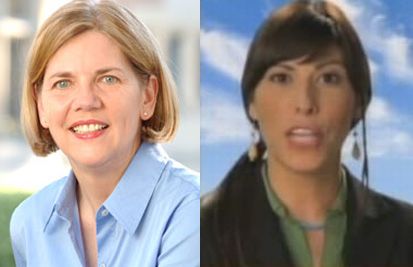
Elizabeth Warren is a figure of considerable talent and successful public service. On the heels of a controversy that has been dogging her, though, an irony has cropped up that is worth a note in passing.

Even in a political season where the bizarre has become the everyday, Elizabeth Warren’s run for a U.S. Senate seat from Massachusetts has taken some strange turns. While her claim to Native American heritage is entirely legitimate, her handling of the politics surrounding it has been less than smooth. And now there is an unremarked upon twist to it.

You’ve probably seen television ads for the Internet lender Western Sky Financial. A pretty woman in braids looks you straight in the eye and offers you a personal loan. “Yes, the money is expensive,” she admits, “but it is a lot cheaper than a payday advance.” All the while, the Western Sky three-tipi logo is emblazoned onscreen, as a drum beats softly in the background.

The Western Sky site explains:

Western Sky Financial is owned wholly by an individual Tribal Member of the Cheyenne River Sioux Tribe and is not owned or operated by the Cheyenne River Sioux Tribe or any of its political subdivisions. Western Sky Financial is a Native American business operating within the exterior boundaries of the Cheyenne River Sioux Reservation, a sovereign nation located within the United States of America.

In an earnest section on Responsible Lending, Western Sky outlines its philosophy:

Fair Dealing among people is a Lakota Tradition, and a concept that is fully embraced by Western Sky. Fair Dealing requires parties to be open and honest and to treat others with respect. Western Sky believes Fair Dealing to be an important aspect of being a responsible Lender.

Western Sky seeks to employ the concept of Fair Dealing at all levels of customer relations, from the application process to the details of loan repayment. This page outlines our approach and what we ask you in return. If you have any questions regarding our commitment to Fair Dealing or our expectations of you, please feel free to ask.

Here are some of the loan rates:

Loan Product Borrower Proceeds Loan Fee  APR   Number of Payments Payment Amount
$10,000 Loan      $9,925          $75   89.68%        84              $743.49
$5,075 Loan       $5,000          $75   116.73%       84              $486.58
$2,600 Loan       $2,525          $75   139.22%       47              $294.46
$1,500 Loan       $1,000          $500  234.25%       24              $198.19
$850 Loan         $500            $350  342.86%       12              $150.72

Demand for easy but high-interest loans has skyrocketed in these hard times. In response to possible overreaching, a number of states that had previously kept their legislative hands off have jumped in to try and set some limits.

It appears that hundreds of Native American-related lending companies, including Western Sky, have cropped up to meet consumer demand. Despite state efforts to weigh in on this development, tribal sovereignty in the face of state laws has prevailed. In 2011 the Native American Lending Alliance  was formed to establish best practices and to make sure that sovereignty in this area remains intact and unassaied.

The only entity empowered to take on any question of tribal-related lending is the federal government. In recent years the federal government did generally take on consumer lending and related  issues with the establishment of the Consumer Financial Protection Bureau. But Native American lending is a legally complex and sensitive matter, and neither the federal government nor the CFPB is currently addressing it as frontline cause.

And that’s where the irony comes in. The CFPB is to a great extent the creation of Elizabeth Warren. She conceived it and helped build it. So at a time when Native American interests are operating just outside the purview and the spirit of the CFPB, Elizabeth Warren’s own Native American heritage has become a bit of a campaign issue.

The two have no direct connection, and all we know tells us that Elizabeth Warren always stands squarely on the side of consumers. But it is ironic: not a big irony, but certainly a curious twist in an endlessly curious and twisted political season.