Bob Schwartz

Category: Business

Scissoring And Shunning Sheldon

Pay no attention, just for a moment, to the images above of billionaire Romney supporter Sheldon Adelson and to Sarah Silverman demonstrating the sexual act she would perform on him, if he agrees to instead give his money to Barack Obama.

The diversity of Jewish views on spiritual, social and political issues might be described as a crazy quilt that has never been pieced together. Or as a big tent without a ringmaster, no Pope to say what goes and what does not. This is admirable in some ways, but especially in stressed times, it can be uneasy and inconvenient.

Progressivism is a constant in Jewish thought and action, and just as constantly challenged by pragmatic and contrary considerations. The rise of Jewish neo-conservatism in America is a recent example, and the ready acceptance of Christian Evangelical support of Israel is another—paradoxical in that certain Christian eschatology clearly envisions the end of the Jewish people in Israel, at least as Jews.

Sheldon Adelson is taking this to a next step. He is using his unlimited campaign resources to target and convince Jews who may have mistakenly voted for Obama last time that only Mitt Romney and the Republicans offer a true Jewish vision of America and the world.

That’s where Sarah Silverman comes in. Having little by way of intellectual or humanistic argument to convince him, she offers to perform an exotic sex act on him,  if he will transfer to Obama the $100 million he has promised to use on behalf of Romney. We are going to hear a lot about bad taste, going too far, etc., but this is an indecent and brilliant piece of satire on many levels, worthy of tragic comic god Lenny Bruce.

Still, Sheldon Adelson is not going to take up this proposal. So here is another more decent one.

Even though Judaism has no final arbiter, outside of certain sects, this doesn’t mean that the Jewish communities are judgment-free. So while Sheldon Adelson can’t be “excommunicated” it can be made clear by other Jews that the agenda he is promoting with a tiny bit of his massive fortune does not represent Jewish ideals and that what he is doing is a schanda fur die goyim—a shame before the people and the nations.

Whether or not he gets scissored by Sarah Silverman, Sheldon Adelson should be shunned. There is no way to make it official, and even if there were the guess is that his billions could fix it. But conscience can’t be bought, any more than elections can (or that’s what we used to think anyway). Whether or not one is a Jew, let alone a “good” Jew, is something ultimately left to God and the individual. But that shouldn’t stop us from making clear that those who claim to act in the name of Judaism are not necessarily one of us.

There Is No MAD In Politics


The Supreme Court decision in American Tradition Partnership, Inc. v. Bullock confirms that states like Montana must follow the rule of Citizens United and allow corporations the same political speech rights as individuals, including speaking money in elections.

War Games (1983) is a charming movie with a serious message. The charming comes from a young Matthew Broderick, playing a computer geek whose gaming nearly starts a global thermonuclear war. He is able to avert it, and the serious message for everyone is spoken by the computer: “The only winning move is not to play.”

When nuclear weapons were used for the first and only time in 1945, and it was obvious that portions of the world could be destroyed in an instant, responses followed.  There were moves to keep them out of the hands of “bad guys”, there were demonstrations to “ban the bomb” from everyone, there were attempts to limit and reduce the weapons that everyone eventually got.

And then there was the idea of Mutually Assured Destruction (MAD). It was simple: If anyone with those weapons could as easily be destroyed as they could destroy, it would be “madness” for them to strike. And as much as our deepest humanity wants to deny it, MAD is the reigning paradigm that has prevented nuclear weapons from being used even once in the almost seventy years since Hiroshima and Nagasaki.

In post-Citizens United politics, there is no MAD. There is worthwhile talk of disclosure, transparency and constitutional amendments to at least moderate the influence of corporate money in elections. But there is also a realpolitik sense that in the meantime those with the biggest weapons may well win. And the prospective winners have no worries about being destroyed by any opposing arsenal. That is why, understandably, the Obama campaign very quickly pivoted on the issue of Super Pacs. It was a matter of political survival.

MAD has saved us from blowing ourselves up. It is not available to save the politics of democracy. It is time for the most creative minds to figure out something beyond the virtuously obvious but ineffective. Whatever that might be.

Elizabeth Warren And Native American Lending

Elizabeth Warren is a figure of considerable talent and successful public service. On the heels of a controversy that has been dogging her, though, an irony has cropped up that is worth a note in passing.

Even in a political season where the bizarre has become the everyday, Elizabeth Warren’s run for a U.S. Senate seat from Massachusetts has taken some strange turns. While her claim to Native American heritage is entirely legitimate, her handling of the politics surrounding it has been less than smooth. And now there is an unremarked upon twist to it.

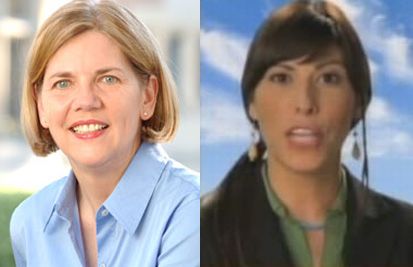
You’ve probably seen television ads for the Internet lender Western Sky Financial. A pretty woman in braids looks you straight in the eye and offers you a personal loan. “Yes, the money is expensive,” she admits, “but it is a lot cheaper than a payday advance.” All the while, the Western Sky three-tipi logo is emblazoned onscreen, as a drum beats softly in the background.

The Western Sky site explains:

Western Sky Financial is owned wholly by an individual Tribal Member of the Cheyenne River Sioux Tribe and is not owned or operated by the Cheyenne River Sioux Tribe or any of its political subdivisions. Western Sky Financial is a Native American business operating within the exterior boundaries of the Cheyenne River Sioux Reservation, a sovereign nation located within the United States of America.

In an earnest section on Responsible Lending, Western Sky outlines its philosophy:

Fair Dealing among people is a Lakota Tradition, and a concept that is fully embraced by Western Sky. Fair Dealing requires parties to be open and honest and to treat others with respect. Western Sky believes Fair Dealing to be an important aspect of being a responsible Lender.

Western Sky seeks to employ the concept of Fair Dealing at all levels of customer relations, from the application process to the details of loan repayment. This page outlines our approach and what we ask you in return. If you have any questions regarding our commitment to Fair Dealing or our expectations of you, please feel free to ask.

Here are some of the loan rates:

Loan Product Borrower Proceeds Loan Fee  APR   Number of Payments Payment Amount
$10,000 Loan      $9,925          $75   89.68%        84              $743.49
$5,075 Loan       $5,000          $75   116.73%       84              $486.58
$2,600 Loan       $2,525          $75   139.22%       47              $294.46
$1,500 Loan       $1,000          $500  234.25%       24              $198.19
$850 Loan         $500            $350  342.86%       12              $150.72

Demand for easy but high-interest loans has skyrocketed in these hard times. In response to possible overreaching, a number of states that had previously kept their legislative hands off have jumped in to try and set some limits.

It appears that hundreds of Native American-related lending companies, including Western Sky, have cropped up to meet consumer demand. Despite state efforts to weigh in on this development, tribal sovereignty in the face of state laws has prevailed. In 2011 the Native American Lending Alliance  was formed to establish best practices and to make sure that sovereignty in this area remains intact and unassaied.

The only entity empowered to take on any question of tribal-related lending is the federal government. In recent years the federal government did generally take on consumer lending and related  issues with the establishment of the Consumer Financial Protection Bureau. But Native American lending is a legally complex and sensitive matter, and neither the federal government nor the CFPB is currently addressing it as frontline cause.

And that’s where the irony comes in. The CFPB is to a great extent the creation of Elizabeth Warren. She conceived it and helped build it. So at a time when Native American interests are operating just outside the purview and the spirit of the CFPB, Elizabeth Warren’s own Native American heritage has become a bit of a campaign issue.

The two have no direct connection, and all we know tells us that Elizabeth Warren always stands squarely on the side of consumers. But it is ironic: not a big irony, but certainly a curious twist in an endlessly curious and twisted political season.

Money, Power & Wall Street: The Don’t-Miss Can’t-Watch Documentary

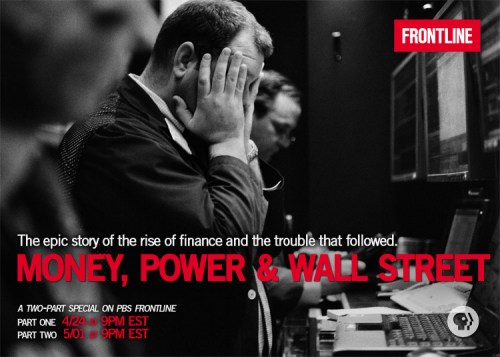
It is hard to recommend the four-part PBS Frontline documentary Money, Power & Wall Street and hard not to. Difficult as it is to watch the financial crisis unfolding, the film is superior even by Frontline’s high standard of excellence. As a history and prospectus, it is an insightful, even-handed and essential work of reporting. As a source of optimism, it is a complete failure, because the conclusion is that nothing has substantially changed, and that maybe nothing will.

It is as good as any disaster movie in pulling us in and moving us inexorably along. We see the scenes in detail, meet the cast of characters—lead and supporting actors—and have a growing sense of foreboding: this can’t end well.

It is different than most disaster movies in two ways. Most have some heroes, and with a few exceptions, there are no heroes here. And most disaster movies end with some movement toward rebuilding and reform, and with a sense of lessons learned: we will keep better watch for asteroids, we will build a system of asteroid warning and protection, we will come out this with a fundamentally better society. There is none of that here.

Yet Money Power & Wall Street has to be seen by every American. Those with political agendas will no doubt point to particular decisions or non-decisions, or particular actions or inactions, to prove a partisan point. But when they do, they will have missed the bigger point. In a world where financial forces become too big to understand or control, it is still our job as citizens and public servants to understand and control them. Because when it finally hits, ideologies and political badges are not really going to matter.

MoneyDesignDigitalSex

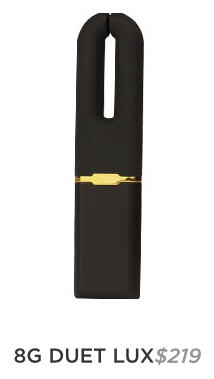
Sometimes you stumble upon an item that perfectly embodies America, the 21st century, and America in the 21st century. All in a good way. This is from a company called Crave:

Our first product – DUET – was submitted for pre-release funding on international design funding platform CKIE.com in August 2011 where it raised $104,000 from over 950 backers – 694% of the original target. Word of DUET consequently spread across the web, which has effectively raised the profile of the product even before its official release, while also providing a springboard for further CRAVE products and developments.

Crowdfunding. Check. Design. Check.

But what exactly is Duet?

In a world where high technology and luxury design seem to touch every corner of our lives, the most intimate experiences should be no exception. The dominating culture in adult products often feels cheap and sleazy. We were craving something better: something beautiful, something discreet, something environmentally friendly, and something sophisticated. After all, if anything deserves good design, it’s the things we bring to bed with us.

Design, again. Check. Sex. Check.

But what exactly is Duet?

With dual motors and a V-shaped angle, DUET delivers powerful and precise vibration for external clitoral stimulation. The tip, inside edges, and outside edges provide slightly different intensities, while the flat surface is ideal for massaging the area around and on the clitoris. The dual motors’ unique ‘split at the tip’ combines with the four vibration patterns to enable a variety of sensations for you to explore…

Duet will let you how much charge remains when you turn it on. It will pulse one to four times – one pulse meaning 25% full, and four pulses indicating your DUET is 100% charged. When plugged into a USB port, a light indicator will blink to let you know your DUET is charging. The intensity of blinking will change depending on how close to being fully charged. With four vibration modes and four power levels, DUET gives you flexibility to find the perfect intensity and pattern. The settings have been designed to be easily altered at whim, but won’t accidentally change on you in the heat of the moment. Vibration modes include steady, dual pulsing, circular pulse, and wave.

Sex, again. Check. USB port??

Yes, this is Duet. A vibrator and a USB flash drive.

This is, without irony, the sort of creativity that makes America great. Purse-sized vibrators have long been around, as have flash drives. But this story that combines cutting-edge financing through crowdfunding, high-level design, digital capability, and, of course, sex goes well beyond bringing together chocolate and peanut butter. This is American genius.