Bob Schwartz

Category: Bible

Babel On

Babel On

What is the point and price of
The tower of words and thoughts?

High and fine
To reach higher and finer.

Was God protective,
Jealous even,
Of the secret word
That would reveal all
And make him redundant,
Obsolete, inferior?

Or was it a sign
We couldn’t read
That in the clouds,
On the moon,
Mars, the stars
We would find nothing but ourselves
Still babbling
Traveling
Going nowhere?

Donald Trump Wants to Make the Bible Great Again!

2 Corinthians

Donald Trump spoke to an assembly of students at Liberty University, one of the best-known evangelical colleges in the country. He quoted a Bible passage to show his depth of Christian faith and knowledge.

In doing that, he mispronounced the name of the New Testament book “2 Corinthians” as “Two Corinthians.” It is in fact universally called “Second Corinthians.” Anyone who has glancing familiarity with the Bible knows that, including five-year-olds in Sunday School. Every time there is a numbered series of books (such as 1 Kings and 2 Kings in the Old Testament, etc.), they are called by the ordinal number (First, Second).

Does this prove that Trump has little familiarity with the Bible? Yes. Does this prove that he is willing to cynically use faith as a tool to “close the deal” on the Republican nomination? Yes. Will this affect his support among evangelical Christians, Christians in general, or people of faith? Who knows?

Here’s the thing. It was no mistake.

Trump may not know much about the Bible or about the Presbyterian Church he identifies himself as belonging to. But he knows a “not great” situation when he sees it. Calling these books “First” or “Second” makes no sense. Plus, it’s a waste of time and breath. Everyone knows that Trump is all about making sense and not wasting breath.

And so, this is part of his strategy to make everything terrific. He wants to change the way people have been referring to the Bible for centuries.

He wants to make the Bible great again! Who can blame him? Thank you, Donald.

Hanukkah as Game of Thrones

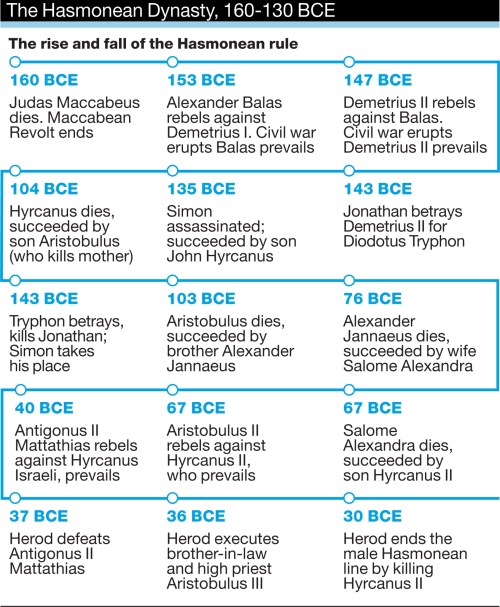
The Hanukkah story of the Maccabees and the Hasmonean dynasty they founded is not for children. The aftermath of the overthrow of the Seleucid overlords is for grown-ups, a history of empire, guerilla wars, massacres, alliances made and betrayed, power marriages, expansionism, hegemony, and subjugation. And of course faith—the right kind, the wrong kind, and none at all.

It is the sort of story that belongs in Game of Thrones. You won’t see that series on HBO. We want simple tales of faith and miracles, for ourselves and especially for the kids. And why not? In troubled times and a troubled world, no one can begrudge any injection of light or miracles we can find or conjure up.

For a summary of this history, see this from the Israeli newspaper Haaretz: A Brief History of a Violent Epoch: Judas Maccabeus’ death would mark the end of the Maccabean revolt against the Greeks – and the start of the extremely unstable Hasmonean dynasty.

Here is a chart that outlines the chronology of the Hasmonean Dynasty:

Hasmonean Dynasty

Hanukkah has never been a major Jewish religious holiday, not on a par with Yom Kippur, Rosh Hashanah, Passover, and the rest. The events celebrated on Hanukkah do not appear in the Jewish bible. The canon of the Tanakh was closed before the Books of Maccabees could be included. Some of those books, though, can be found in Christian versions of the Old Testament.

Hanukkah was elevated, especially in America, as a seasonal companion to Christmas, for Jews living in decidedly Christian cultures. For a complete treatment of this phenomenon, see the book Hanukkah in America: A History.

The comparison to Christmas does suggest why we don’t have an epic series devoted to the Maccabees and their historical legacy.

The Christmas story has an even bigger and more significant and spectacular sequel. The newly born Jesus grows up to become the foundation of the faith and one of the great teachers in world history. The next part of his mission is told in the story of Easter. Sequels don’t get any bigger, clearer or cleaner than that.

The historical follow-up to the story of the Maccabees is more equivocal. It puts that era in Jewish history in a very real, human, political light that may clash with the simple idealized version of candles and dreidels.

This doesn’t mean we shouldn’t light the candles, eat the latkes, spin the dreidels, and commemorate the victory of God’s rule over the rule of the less godly. It’s just that sometime during the holiday, we might leave behind childish things and look at the history with eyes open. Not because it takes away from the holiday, but because it adds to it a fuller sense and understanding.

And because for two millennia, the exact same complexity has been unfolding in the exact same place. Not a children’s game. More like Game of Thrones. Only much more real.

New Beginnings: The Torah and the I Ching

Bet

In Jewish congregations, the annual Torah reading cycle begins again this week with the first chapters of the Bible. In Hebrew it begins with the word b’reishit, and in its best-known translation, the first verse goes like this:

In the beginning, God created the heavens and the earth.

And with that comes a puzzle.

If B’reishit is the beginning of a very big and consequential story, and if the creators of the Torah were sensitive to the mystical meanings of the Hebrew alphabet and language, why does the Torah begin with the second letter bet (B) rather than the first letter alef (A)?

Looking at a bigger picture, this connects to a related puzzle and an unlikely source: the I Ching.

The I Ching is a classic of Chinese literature and philosophy, a text as ancient as the Torah and just as influential.

Richard J. Smith writes in The I Ching: A Biography:

The Changes first took shape about three thousand years ago as a divination manual, consisting of sixty-four six-line symbols known as hexagrams. Each hexagram was uniquely constructed, distinguished from all the others by its combination of solid (——) and/or broken (— —) lines. The first two hexagrams in the conventional order are Qian and Kun; the remaining sixty-two hexagrams represent permutations of these two paradigmatic symbols….

The operating assumption of the Changes, as it developed over time, was that these hexagrams represented the basic circumstances of change in the universe, and that by selecting a particular hexagram or hexagrams and correctly interpreting the various symbolic elements of each, a person could gain insight into the patterns of cosmic change and devise a strategy for dealing with problems or uncertainties concerning the present and the future.

The first intriguing note is that the I Ching (pronounced Yi Jing) begins with those hexagrams Qian and Kun—known generally in English as Heaven and Earth. The cosmos of change and the I Ching begin then with Heaven and Earth.

It is at the close of the 64 hexagrams that the conundrum appears. Hexagram 63, the penultimate one, is Ji Ji—After Completion. This should be the end of the story. But it isn’t. The final hexagram, Hexagram 64, is Wei Jei—Before Completion. In the end, it doesn’t stop. It begins again. The Book of Changes emphasizes that the changes never end.

This is an explanation of why the Torah does not begin with the beginning of the alphabet. If it starts with A, that presumes a Z, A to Z, or in Hebrew, alef to tav. Creation would thus be represented as a finite element of a finite cosmos. In the text it starts instead, as the Latin phrase goes, in media res—in the middle of things. Just as the Torah will end in the middle of things, after completion of a journey, but with Moses never allowed to experience what is yet to happen, before the next completion. On and on, always beginning, never done. Just like the I Ching. Just like the Torah itself.

Pope Francis, Kim Davis and Caesar

Caesar Coin

Pope Francis tried very hard in his U.S. visit to watch the line between moral guidance that has political effect and politics itself. He appears, maybe unwittingly, to have crossed the line. In a big way.

His visit with Kim Davis belies a misunderstanding of who she is and what she represents. It’s not that freedom of religious conscience is not an important issue. It’s that Kim Davis is the wrong poster person.

It appears from the context that he may have seen her in the line of great conscientious objectors. He reportedly thanked her for her courage and told her to be strong.

Kim Davis does have a religious conscience. And she does object to authorizing same-sex marriages. But there are two problems.

First, unlike true conscientious objectors, she doesn’t really want to suffer for her beliefs. Civil disobedients and conscientious objectors expect to be punished; sometimes they welcome it. But Kim Davis wants to have it both ways. Martin Luther King Jr. did not write in his letter from a Birmingham jail: For God’s sake, let me out of here. As far as we know, Kim Davis didn’t write any letters from her jail, at least not ones that will be in literary anthologies for the next fifty years.

The second problem is that her objection, at its heart, is that the Constitution and the Supreme Court are wrong, and that’s why she gets to keep her job and perform her duties as she sees fit. As a public servant, she is either explicitly by oath or implicitly by understanding sworn to uphold the Constitution. If she chooses not to, she has no privilege to hold that job, nor is she privileged to be free of sanction. That’s it.

Pope Francis, who I have expressed admiration for, may not understand that or the background of the Kim Davis saga. In that event, he should have followed the advice of Jesus in these situations:

‘Tell us, then, what you think. Is it lawful to pay taxes to the emperor, or not?’ But Jesus, aware of their malice, said, ‘Why are you putting me to the test, you hypocrites? Show me the coin used for the tax.’ And they brought him a denarius. Then he said to them, ‘Whose head is this, and whose title?’ They answered, ‘The emperor’s.’ Then he said to them, ‘Give therefore to the emperor the things that are the emperor’s, and to God the things that are God’s.’

Matthew 22:17-21 (NRSV)

The Radical Book of Job

The Bible is a radical document. Just ask Pope Francis, who will be visiting the U.S. for Yom Kippur. Just ask the conservative critics of Pope Francis, who have been made very uncomfortable.

The Gospels particularly offer subversive guidelines for individuals and society. But there is also much of this in the Old Testament. Take the Book of Job.

As a Bible text, the book of Job is one of the most complex and challenging for biblical translators, interpreters and scholars. So it is no surprise that it has been boiled down in common understanding and tradition to a simple story. A good man suffers, his faith in God is shaken, God explains, the man renews his faith, God returns him to good fortune. End of story.

Except that is not what happens. There are many ways to interpret Job that look nothing like that. A number of characters appear, do a lot of talking, and offer divergent views of what Job should do in the face of his intolerable burden. Most infamously his wife, whose recommendation to her husband is “Curse God and die.” Someone named Elihu makes a late brief appearance (likely the result of a later addition to the book), offering his own take on things. And of course, God has (almost) the final word.

In his overview of Job in The Jewish Study Bible, Prof. Ed Greenstein reviews the possibilities, including this one:

A second, and arguably even more prevalent, theme in Job is that of honesty in talking about God. The book examines and tests the limits of appropriate speech. The test of Job is all about speech—will Job, severely afflicted with anguish and physical distress, “blaspheme [God] to [His] face” (1.11)? The dialogues, it goes without saying, consist only of speech—there is no action within them. Job’s companions continually denigrate the way he talks (e.g., 11.2–4), and he feels he must beg to be heard (13.13). Their view is shared by readers such as the Talmudic Sage Rav, who suggests that “dirt be put in Job’s mouth” to silence him.

But while the friends regard Job’s discourse as no more than hot air, “useless talk” (e.g., 15.2–3), Job takes pride in his absolute commitment to speaking only truth (see 27.3–4). The radical turning point in the book comes at its conclusion: God turns to Job’s companions and reproves them for not speaking “truthfully” (nekhonah is adverbial) about Him as Job “My servant” had done (42.7–8). Job may not have arrived at the truth, but he had reason to believe in what he was saying, as it came to him honestly, unlike the words of the companions, who merely repeated uncritically the wisdom they had received. Seen this way, the book of Job promotes honesty in theological discourse and rejects a blind reliance on tradition.

Promoting honesty in theological discourse and rejecting blind reliance on tradition. A radical approach we can consider this Yom Kippur, along with the universe of our humble introspections and pleas for forgiveness. A radical approach that Pope Francis seems very good at. A radical approach missing in the hot air and useless talk we hear from so many of our self-righteous public figures.

Politics of Pessimism

Book of Job

It is one thing to say that things could be better in America. Another to say that things are terrible, horrible, very bad.

At the moment, that seems to be a Republican approach to “lifting up” the nation and winning the presidency. Make sure we realize just how dire things really are and then promise to swoop in as our rescuer. First we kill all hope.

Hope isn’t dead. Crushing our current spirit for the sake of future dominance is a terrible, horrible, very bad idea. The more Bible-minded will recognize this as one of the tricks played by some legendary figures. See, for example, the Book of Job.

For a post-debate review of this, see The ‘Everything is Bad’ Party.

Why We Should Not Give Up on Global Nuclear Disarmament

Ban the Bomb

It is picture as quaint as someone dialing a telephone: protestors in the 1950s and 1960s marching around with signs that say “Ban the Bomb.”

Quaint because so many countries now have nuclear weapons that getting rid of them all borders on the ridiculous. And it’s not just major powers; smaller nations who have developed nuclear weapons consider themselves “major” for having done so. (It sure beats the trouble of developing a sustainable, healthy economy and democracy.) Speaking of democracy, nuclear armament is all so complex that one of the bright lights of a hyperdangerous region refuses to acknowledge even having a nuclear stockpile, pretending to maintain the worst kept geopolitical secret in the world.

And yet: Blessed are the peacemakers. According to someone or other, they will be called children of God. This doesn’t mean that warmakers and hoarders of nuclear weapons aren’t children of God. It just means that the billions who live in the shadows of those bombs and missile warheads might not feel particularly blessed. That’s why we, and our children and our generations, shouldn’t give up on global nuclear disarmament, no matter how naïve or impossible it seems.

Pope Francis’ Encyclical Laudato Si’

Laudato Si'

The Pope’s new encyclical, Laudato Si’, has been much in the news. Whatever you’ve heard about it, if you haven’t seen it, you really don’t know the whole story.

You’ve heard it is about the environment and climate change, which is in small part true. You’ve heard Catholic presidential hopefuls such as Jeb Bush and Bobby Jindal admonish the Pope, their spiritual father, telling him to stick to religion and stay out of politics.

The encyclical is much bigger than climate change, the environment, and certainly bigger than Bush or Jindal or dozens of politicians. It is a big statement about the moral and religious shortcomings of this modern world and us modern people. You don’t have to be Catholic or Christian or faithful or religious to read and appreciate it. You just have to read it.

It is full of inconvenient and uncomfortable truths. Which is probably why the coverage has focused on the environmental exhortations, rather than on the broader cultural, media, technological and social ones. In essence, it is nothing less than a call for radical evolution, in the spirit of the radical evolutionary upon whom the church is built. There are plenty of established institutions and powerful interests and individuals, including the media, who could be forced to change if such radical evolution came to pass. And many of them don’t want to change, and don’t even want us to listen to the Pope talking about it.

The encyclical is a long and deep but very readable work. Download it, sample it. You don’t have to read it all, or all at once. It is naturally grounded in theology, and in some particular theology, but be assured that the observations and conclusions don’t require you to hold any sectarian beliefs. It only requires that we believe that things are far from perfect, and that after we take a close look at ourselves and others, we believe that we have the power and obligation to make things better.

It is filled with so much quotable inspired thought and inspiration. Here is just one brief excerpt:

114. All of this shows the urgent need for us to move forward in a bold cultural revolution. Science and technology are not neutral; from the beginning to the end of a process, various intentions and possibilities are in play and can take on distinct shapes. Nobody is suggesting a return to the Stone Age, but we do need to slow down and look at reality in a different way, to appropriate the positive and sustainable progress which has been made, but also to recover the values and the great goals swept away by our unrestrained delusions of grandeur.

Laudato Si’ PDF

Laudato Si’ epub and Kindle

Chaos and Order in the Bible

The most important section of the Old Testament, even for non-readers and non-believers, is the beginning, the stories of creation up to the appearance of people. (Stories plural, because there are two different versions of creation in Genesis.)

The second thing that happens in the Bible is that God brings order. But the first thing is the chaos from which that order is brought, chaos presumably also created, and created first.

For most of our religions and their histories, this task of putting matters in good order has been a primary mission. Protocols, hierarchies, calendars, rules. In imitation of God. Orderliness is next to godliness. Order, though, in religion and in our lives, can take on the color of compulsion.

Chaos not only preceded order in the Bible, it became a continuing theme. People are constantly getting lost and tossed around, in floods, in deserts. Being found or finding a way is presumed to be the highest value. And yet the very first moment is not just chaos, but created chaos. Not just a necessary predicate, but a necessary ongoing and perpetual element. No lost, no found.