Are you helping the Reds bury your children? (Better Homes & Gardens, September 1961)
by Bob Schwartz

The Red Scare is back!
The magazine above is the September 1961 issue of Better Homes & Gardens. At the time BH&G was one of the most popular magazines in America, with a monthly circulation of 3.4 million.
Also at the the time, the Communist threat was maybe the single most worrisome issue in America. The postwar Red Scare of the 1950s had not yet abated. In what has been described as a witch hunt, Americans had been jailed and blacklisted from industries and jobs for expressing liberal and leftist ideas and for seeming sympathetic to the Reds.
The revival of this is almost hard to believe, but here it is. “Liberal” and “woke” are apparently not strong enough charges. The theme of Republican attacks in 2026 is that all who disagree with them are Communists. The witch hunt decades ago engulfed commercial, cultural and political life in America. This time around, particularly on the 250th anniversary of American independence, it will hopefully not take hold again.
When the Red Scare was in its 1950s heyday, a chief warrior was Senator Joseph McCarthy of Wisconsin. McCarthy was known for making outrageous and unsupported claims about Communists in the government and military. Fortunately, he was finally discredited.
Unfortunately, his lawyer and chief henchman, Roy Cohn, was not done. In the 1980s, Cohn was mentor to a young businessman named Donald Trump. The relationship is dramatized in the movie The Apprentice. Some say that many of Trump’s attitudes and tricks are thanks to the tutelage of Cohn.
Here is the transcription of the article “Don’t let your youngster learn about Communism the hard way!” (September 1961). If you find some of this article deeply ironic in terms of the threats Americans today face from their own anti-communist government in 2026, you should.
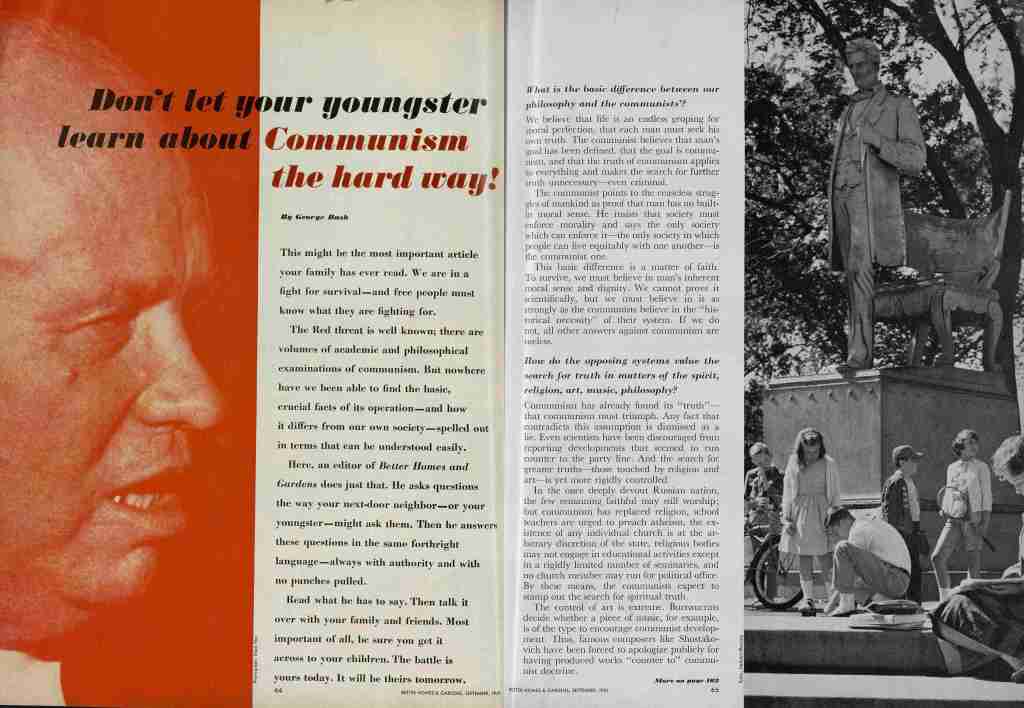
Don’t let your youngster learn about Communism the hard way!
By George Bush
This might be the most important article your family has ever read. We are in a fight for survival—and free people must know what they are fighting for.
The Red threat is well known; there are volumes of academic and philosophical examinations of communism. But nowhere have we been able to find the basic, crucial facts of its operation—and how it differs from our own society—spelled out in terms that can be understood easily.
Here, an editor of Better Homes and Gardens does just that. He asks questions the way your next-door neighbor—or your youngster—might ask them. Then he answers these questions in the same forthright language—always with authority and with no punches pulled.
Read what he has to say. Then talk it over with your family and friends. Most important of all, be sure you get it across to your children. The battle is yours today. It will be theirs tomorrow.
What is the basic difference between our philosophy and the communists?
We believe that life is an endless groping for moral perfection, that each man must seek his own truth. The communist believes that man’s goal has been defined, that the goal is communism, and that the truth of communism applies to everything and makes the search for further truth unnecessary—even criminal.
The communist points to the ceaseless struggles of mankind as proof that man has no built-in moral sense. He insists that society must enforce morality and says the only society which can enforce it—the only society in which people can live equitably with one another—is the communist one.
This basic difference is a matter of faith. To survive, we must believe in man’s inherent moral sense and dignity. We cannot prove it scientifically, but we must believe in it as strongly as the communists believe in the “historical necessity” of their system. If we do not, all other answers against communism are useless.
How do the opposing systems value the search for truth in matters of the spirit, religion, art, music, philosophy?
Communism has already found its “truth”—that communism must triumph. Any fact that contradicts this assumption is dismissed as a lie. Even scientists have been discouraged from reporting developments that seemed to run counter to the party line. And the search for greater truths—those touched by religion and art—is yet more rigidly controlled.
In the once deeply devout Russian nation, the few remaining faithful may still worship; but communism has replaced religion, school teachers are urged to preach atheism, the existence of any individual church is at the arbitrary discretion of the state, religious bodies may not engage in educational activities except in a rigidly limited number of seminaries, and no church member may run for political office. By these means, the communists expect to stamp out the search for spiritual truth.
The control of art is extreme. Bureaucrats decide whether a piece of music, for example, is of the type to encourage communist development. Thus, famous composers like Shostakovich have been forced to apologize publicly for having produced works “counter to” communist doctrine.
In schools, only the communist party line may be taught. History is constantly distorted depending on the current line. Foreign countries, especially ours, are never presented in their true light.
In a free society, the most fundamental of our freedoms is our right to pursue truth in our own ways. We may worship if and as we please; we may seek truth in all manner of art; we may even criticize democracy if that is how we feel.
We try to expose our children to all the conflicting ideas of thinkers throughout history, for we are convinced that only in the vigorous exchange of opinions may truth ever be approached.
Occasionally, timid souls among us feel that we can triumph against communism only if we suppress this free exchange of thought in our land; these panickers forget completely that, once we surrender our prerogative to seek the truth, we will have lost democracy.
What rights do you have as a free man? What rights would you have under communism?
Our concept of human rights is founded on the faith that man is a child of God—no matter how we may visualize Him. We believe that God has given us the power to do both good and evil, and the freedom to choose between them. Thus, each of us has the right and duty to manage his own life. How we exercise this right is the measure of our worth.
Ever since man’s first recognition of his obligation to develop to his fullest capacity as an individual, free societies have tried to spell out his rights and freedoms. Our laws are in the tradition of this age-old search for guarantees of life, liberty, and the pursuit of happiness, and they recognize:
• Freedom of worship, speech, press, assembly, and movement.
• Freedom to own property.
• Freedom to engage in one’s own business and personal affairs; to compete and bargain; to choose one’s own occupation and mode of life.
• Freedom to choose one’s leaders by secret ballot.
• The right to equal protection under the law and to immediate public trial by an impartial jury.
• Freedom from arbitrary government regulation and control, and from arbitrary search, seizure, or detention.
• The right to enjoy equal educational, social, and economic opportunities.
• The right of privacy.
Of course, efforts are sometimes made both by government and by private interests to abridge these rights and freedoms. Unfortunately, these efforts sometimes meet with limited success. Most of the time, however, they are defeated, thanks to our right to defend our rights in court. To gain justice in a world of men is not easy, and the price one pays is high. But it is a blessing to have the right to pay this price, and it is a right that you enjoy only in a free society.
Like ours, the Soviet constitution guarantees freedom of speech, freedom of the press, and freedom of assembly. But it guarantees these and all other rights and freedoms only in conformity with the interests of the working people and the socialist system, and since the communist party has the power of decision on what conforms, it can chop off freedoms at will.
The practical result is that, even in relatively lenient times, people cannot speak if they dissent; they cannot hold meetings to criticize policy; travel abroad requires special government approval, and even within their country and daily life, Soviet citizens are often limited by what the party considers important for the State. A Russian collective farmer, for instance, cannot leave the soil without specific permission, and industrial workers take the risk of losing privileges (such as “special” housing) if they insist on changing jobs.
What role do you play in a democratic government? How important is a citizen under communist rule?
Our rights and freedoms impose a great responsibility—that of respecting the same rights and freedoms of our fellow citizens. That is why we have a government. Acting for us, it protects everyone’s rights and freedoms through police and regulatory agencies fighting abuses within, and armed services opposing threats from without.
Since we often disagree on the best ways for government to serve our interests, we give all ideas a public hearing and a private vote. Then we accept the rule of the majority. Under this system, many men of divergent views gain office, and their exchange of opinion stimulates vigorous government. But no matter which men are in office, our basic laws remain the same. So long as we, as a nation, respect these laws and do not panic in the face of the communist attack, no loyal, law-abiding citizen need ever feel threatened by his government.
Unfortunately, it is true that democratic government has often been at the mercy of men tempted to abuse their office—sometimes for power, more often for economic gain. The occasional misdeeds of these irresponsible and greedy politicians are but a small price to pay for our right to gamble on a man’s promise that he will serve us well. Only when we are too lazy to keep an eye on our government do crooked politicians succeed in doing serious harm. On such occasions, we tend to blame the democratic system when, in all fairness, we should be blaming ourselves.
Under communism, the party is the core of the government. Only party members may hold key “elective” posts in government and then only with special approval. Voters simply okay a single slate of approved candidates while election officials watch them. If voters wish to oppose the approved slate, they can go to a special polling booth and vote in “secret.” But of course election officials then know who voted secretly and they draw their own conclusions.
Election is only one phase of government. What about the actual administration of the state?
In keeping with the communist belief that the end result—the achievement of the perfect communist world society—is more important than the means by which it is achieved, communist government is relatively flexible. It can change its policy from day to day, depending on what party leaders think is the best “line” to take.
Here, truly, might is right; for as leaders change, ideas on the line may change, and the hero of today often finds himself the villain of tomorrow. Inevitably, then, no public figure can ever live with an easy conscience; he must be ready at any moment to confess his failures, repudiate his acts of yesterday, and ask for punishment. Less purging is going on today than during Stalin’s time, but under a government of men rather than of laws, no citizen can ever count on being free of terror.
What would happen to you if you were suspected of a crime in Russia? What happens to you here?
In Russia, no house is safe from search, no citizen immune against arbitrary arrest. If you are accused of a crime, you may be held indefinitely without trial and without being informed of the charges against you. Your guilt or innocence will not be determined by a jury, but by a judge who has at least been screened, and usually directly appointed, by the communist party.
Under our law, you are presumed innocent until proved guilty. Unless surprised in the commission of a crime, you may not be arrested without a warrant. You must be informed of the charge, and you cannot be held indefinitely without arraignment—that is, without a hearing to determine whether the evidence justifies your being tried. Even before arraignment, you can force police to show cause for your arrest before a judge. You can sue for false arrest.
You also have the right to trial by a jury of your peers. You have the right to confront your accuser, and you are entitled to a defense counsel of your own choosing. Hearsay evidence is not admissible in court. Judges, usually elected by the people, do not determine your guilt or innocence unless you waive your right to trial by jury.
You have the right to remain silent, too; you cannot be forced to incriminate yourself. A case against you must be proved by the prosecution’s evidence. And even if convicted, you have right-of-appeal.
Just as a man depends on his earnings for a living, so does a nation’s growth and well-being rest on its economic life. What are the differences between capitalism and communism?
Democracy has never functioned well in poverty-stricken countries. It takes a relatively high standard of living for all to ensure that the poorer segment of the population will not revolt against the rich. We were fortunate as Americans to be blessed with enough resources to allow development of a free society. At the same time, the capitalism which is possible under democracy has enhanced our wealth.
We need not tell here of the high standard of living enjoyed under our democratic capitalist system, but let us examine some of the reasons for its continued growth:
• Citizens of a democracy may choose their own occupations. The result is greater work enthusiasm and greater productivity.
• Private ownership stimulates work-pride and imagination.
• Free competition encourages research and product improvement.
• Freedom to buy what we like tends to eliminate inferior products; it lowers prices and creates a wide range of products and services.
• Fair profits provide production incentives and capital for expansion.
• Collective bargaining and the right to strike assure a just reward for labor. Mass purchasing power increases, and in turn leads to greater production, higher profits, more reinvestment.
• Much of labor participates in ownership of the means of production. The New York Stock Exchange estimates 15 million security holders in the United States. Evidently, all these people are not “Wall Street bankers.” In fact, more than half of them have incomes of less than $7,500 a year, and only 23 per cent make over $10,000.
Karl Marx, who fathered the economic doctrines underlying communism, promised that in a communist society every person would “work according to his ability” and be rewarded “according to his need.”
But how can government determine ability and need? Need, particularly, is a flexible concept. A human being really needs pitifully little merely to survive. The Russians have solved this dilemma neatly: They admit openly that ideal communism has not yet been achieved. That is supposed to happen at some indefinite future date. In the meanwhile, they don’t worry about what a man needs; instead, they are concerned with how much he can produce. In effect, the government demands “from each according to his ability” and rewards “each according to his work.”
Admittedly, the Soviet government—which owns virtually all means of production—has made tremendous strides. In less than 50 years, Russia has developed into one of the most advanced industrial nations of the world. But the workers responsible for this growth have not reaped its benefits. Since communism’s efforts are directed toward the mythical future when ideal communism is to take effect, Russian production has concentrated on laying the economic groundwork by making capital goods—that is, machines to make more machines. The production of consumer goods such as clothing, refrigerators, and cars has been sacrificed. The result is that the Soviet worker gets back little of his output, and his standard of living remains much lower than that of the worker in the capitalist countries.
Nor are the few available consumer goods equally distributed. Skilled workers get about three times as much as the unskilled workers (the pay range in Russia is just as great as that in any capitalist country), and high-ranking party members and government officials, though they do not get enormous salaries, receive juicy bonuses in the form of de luxe housing, automobiles, and other privileges.
Furthermore, the average worker is handicapped by a system of taxation grossly favoring high-income communists. Although income taxes are extremely low, sales taxes are extraordinarily high—from 50 to 100 per cent of every purchase price. Thus the charges for consumer goods, already overpriced because of their scarcity, jump even higher. A worker has to work for days to pay for a pair of shoes.
If a worker is dissatisfied with his lot, he has no recourse. Strikes are banned in the Soviet Union. Strikers may be punished for “counter-revolutionary activity” or “sabotage.” People who do not choose to work at all can be seized as “idlers” and banished for two to five years of forced labor in “restricted localities”—a polite name for labor camps.
Millions of people in communist countries have been and are in such camps, a convenient if ugly method of achieving a much higher per-capita consumption. There is considerably less forced labor in Russia than there used to be, but China unrelentingly takes advantage of slave work.
Despite the great emphasis on production, communist countries often do not meet their quotas. Harassed factory workers frequently will report misleading statistics or certify inferior goods to boost their output.
The situation is yet worse in agriculture, the weakest link of the Soviet economy. Scarcities are acute, partly because the farmer’s enthusiasm is dampened by the collectivization of the land he works, and partly because of typical bureaucratic inefficiency. As recently as 1959, Khrushchev told the Central Committee of the Communist Party that about four million acres of badly needed grain had to be left to rot because the necessary pieces of equipment, including 32,000 combines and 11,000 reapers, were in such poor repair that they could not be used.
Nevertheless, we must not underestimate Russia’s potential to provide for her people a standard of living equal to our own. Communist countries today are still going through a period of amassing wealth with which to produce more wealth, a period every society must face when it accepts industrialization. In our case, the sweatshops of the industrial revolution played their part in helping to provide a basis for capital accumulation.
And here lies a stunning irony. It was the sweatshops of the capitalist countries that prompted Marx to dream up the communist system. He did not realize that to amass the means of production, socialist industrialization also would have to start by confiscating labor’s output; nor did he understand that capitalism would soon outgrow the sweatshop and so make his teachings obsolete.
The communists accuse us—and our Western allies—of trying to own the world. What are the facts?
When the communists took over Russia, they renounced the imperialistic policies of the czars. But here, as elsewhere, facts had little to do with Soviet words. Soviet colonialism started in the early 1920s with Chinese Outer Mongolia, then extended to other Chinese territories. Since World War II, the USSR has annexed the three Baltic republics of Estonia, Lithuania, and Latvia, a whole slice of eastern Poland and eastern Czechoslovakia, East Prussia, and parts of Rumania.
The Soviet Union, furthermore, has made political and economic satellites out of Hungary, Rumania, Bulgaria, Czechoslovakia, Poland, and East Germany. And in the Far East, Russia, with Red China, controls North Korea and North Vietnam.
After the war, the Communists not only stripped industries in Germany, but shipped whole plants and their workers to the Soviet Union from other areas they occupied in Europe. Soviet power in the satellite areas is maintained through puppet governments, secret police, and vast military establishments. Any attempt to achieve independence is drowned in blood, as was the case in Hungary.
The latest evidence of Soviet ambitions to dominate the earth is Russia’s attempt to extend its influence to the Western Hemisphere, using Cuba as a spearhead.
While the Soviet sphere has been expanding, the Western empires have shrunk—usually relinquishing their territories voluntarily. The United States has won two major wars in 50 years, and we never took a scrap of land. Instead, we lived up to an old treaty and gave independence to the Philippines. At the same time, we used our influence to persuade our allies to release their colonies.
Will the communists start a war? Will we be able to prevent it—or to survive if it comes?
The communist party conveniently distinguishes between “just” and “unjust” wars. “Just” wars are fought to strengthen communism; “unjust” wars are those directed against communism.
From the start, communism has relied on “just” wars as a tool for expansion. As early as 1918, Lenin predicted that war against the democratic world was inevitable. “As long as capitalism and socialism exist we cannot live in peace,” he said.
Russia’s frank admission that communism must fight capitalism was seemingly modified in 1956 by Khrushchev’s famous speech on “peaceful coexistence.” In the same address, however, Khrushchev said that war and internal violence will only be avoided if “bourgeois democracy” surrenders, and later, in one of his less diplomatic moments, he made the often-quoted statement, “History is on our side. We will bury you all.”
We must never forget that the communists consider war a positive force in social development. Nor must we overlook that in communist societies the system is more important than its members, and that some communist leaders might not be unwilling—in a moment of delusion—to sacrifice millions of their people in an attempt to insure the perpetuation of the communist system. We must be fully prepared that any brush-fire war fought in the next few years could develop into an intercontinental rocket duel.
Experts in our government think that the best hope for avoiding nuclear war may lie—ironically—in Russia’s strong nationalism. The Russians may decide that preemption carries no guarantees of safety, and that expansion of international communism is not worth the risk of destruction of their homeland. It is a fair guess that their caution in this regard will increase with their standard of living, and they will not push so hard for cold war gains a few years hence.
China is another question. While Russia herself is primarily interested in possessing men’s minds rather than their territories, China is obsessed with greed for both. With only 1.8 acres of arable land for each Chinese, food is a grave problem. China must decide whether to starve, expand, or buy in the world market. It is likely that China will decide on expansion; in that case, southeast Asia would present the most probable immediate goal. We may only hope that Russia will continue to discourage Chinese colonial ambitions, if not in the world’s interest then surely in her own. For the day may come when China, as she has done over the centuries, once again will look for new territories to the north and west and thus pose a threat to Russia.
Our greatest danger may lie in our fatalistic acceptance that a nuclear war would wipe us off the map. Consequently, although we are ready to retaliate, we are not preparing for survival. Those of us who propose extensive air raid shelters are exposed to public ridicule. In all but six states, private shelters may be—and often are—taxed as home improvements, depending on local practices and the assessor’s mood. Zoning laws also sometimes prevent shelter construction. If we do not change our attitude in this respect, the communists may triumph.
Is the triumph of communism really inevitable, as the communists claim?
Communist faith in victory is based on Marx’s prediction that in an industrial society the rich would unavoidably get richer, the poor inescapably poorer, and that this would lead to automatic revolt.
But what really happened was that the early excesses of industrial capitalism were followed by an overwhelming trend toward self-control and economic equality, and not a single industrial state has yet fallen to a communist revolt. In fact, quite the opposite has happened. Communism has been most successful in the non-industrial, underdeveloped countries that still suffered from the vestiges of feudal robber-baron life.
This shows that communism is not an exact science, as its adherents claim, but merely an individual philosophy perpetuated long beyond its proper time. Its claim of inevitability is based on a prediction that history has proved false.
To survive, we must take advantage of the error of the communist prediction. While hoping that man’s intelligence—on both sides of the Iron Curtain—will stop him from committing the folly of atomic war, we must do our utmost to ensure the rapid industrial and agricultural advancement of the uncommitted nations, so that they may attain standards of living where communism and its Russian counterfeit no longer hold allure.
This is our only and last chance. If we fail to take it, we shall be either red or dead—and international communism will have been inevitable because we let it be.
Better Homes & Gardens, September 1961

