Ole & Trufa: A Story of Two Leaves by Isaac Bashevis Singer
by Bob Schwartz
A breeze came and lifted Ole and Trufa in the air, and they soared with the bliss known only by those who have freed themselves and have joined with eternity.
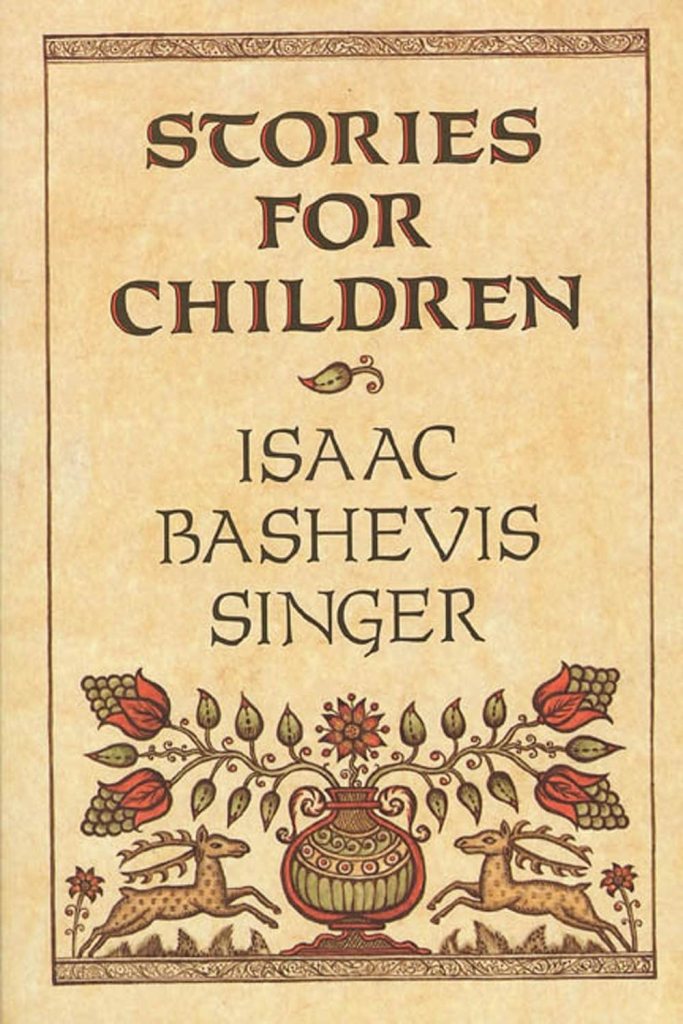
Ole & Trufa: A Story of Two Leaves can be read in Stories for Children by Isaac Bashevis Singer. This Nobel Prize winning author is mostly known for stories and novels for adults. All the stories “for children” can be enjoyed by anyone.
Ole & Trufa is particularly a story for anyone since it is a short and simple tale about death. It is the work of a master storyteller to make the life together of two leaves so moving and their deaths so uplifting, “with the bliss known only by those who have freed themselves and have joined with eternity.”
Ole & Trufa: A Story of Two Leaves by Isaac Bashevis Singer
The forest was large and thickly overgrown with all kinds of leaf-bearing trees. It was in the month of November. Usually it’s cold this time of year and it even happens that it snows, but this November was relatively warm. The nights were cool and windy, but as soon as the sun came out in the mornings, it turned warm. You might have thought it was summer except that the whole forest was strewn with fallen leaves—some yellow as saffron, some red as wine, some the color of gold, and some of mixed color. The leaves had been torn down by the rain, by the wind, some by day, some at night, and they now formed a deep carpet over the forest floor. Although their juices had run dry, the leaves still exuded a pleasant aroma. The sun shone down on them through the living branches, and worms and flies which had somehow survived the autumn storms crawled over them. The space beneath the leaves provided hiding places for crickets, field mice, and many other creatures who sought protection in the earth. The birds that don’t migrate to warmer climates in the winter but stay behind perched on the bare tree limbs. Among them were sparrows—tiny birds, but endowed with much courage and the experience accumulated through thousands of generations. They hopped, twittered, and searched for the food the forest offered this time of year. Many, many insects and worms had perished in recent weeks, but no one mourned their loss. God’s creatures know that death is merely a phase of life. With the coming of spring, the forest would again fill with grasses, green leaves, blossoms, and flowers. The migrating birds would return from far-off lands and locate their abandoned nests. Even if the wind or the rain had disturbed a nest, it could be easily repaired.
On the tip of a tree which had lost all its other leaves, two still remained. One leaf was named Ole and the other, Trufa. Ole and Trufa both hung from one twig. Since they were at the very tip of the tree they received lots of sunlight. For some reason unknown to Ole or Trufa, they had survived all the rains, all the cold nights and winds, and still clung to the tip of the twig. Who knows the reason one leaf falls and another remains? But Ole and Trufa believed the answer lay in the great love they bore each other. Ole was slightly bigger than Trufa and a few days older, but Trufa was prettier and more delicate. One leaf can do little for another when the wind blows, the rain pours, or the hail begins to fall. It even happens in summer that a leaf is torn loose—come autumn and winter nothing can be done. Still, Ole encouraged Trufa at every opportunity. During the worst storms, when the thunder clapped, the lightning flashed, and the wind tore off not only leaves but even whole branches, Ole pleaded with Trufa, “Hang on, Trufa! Hang on with all your might!”
At times during cold and stormy nights, Trufa would complain, “My time has come, Ole, but you hang on!”
“What for?” Ole asked. “Without you, my life is senseless. If you fall, I’ll fall with you.”
“No, Ole, don’t do it! So long as a leaf can stay up it mustn’t let go …”
“It all depends if you stay with me,” Ole replied. “By day I look at you and admire your beauty. At night I sense your fragrance. Be the only leaf on a tree? No, never!”
“Ole, your words are so sweet but they’re not true,” Trufa said. “You know very well that I’m no longer pretty. Look how wrinkled I am! All my juices have dried out and I’m ashamed before the birds. They look at me with such pity. At times it seems to me they’re laughing at how shriveled I’ve become. I’ve lost everything, but one thing is still left me—my love for you.”
“Isn’t that enough? Of all our powers love is the highest, the finest,” Ole said. “So long as we love each other we remain here, and no wind, rain, or storm can destroy us. I’ll tell you something, Trufa—I never loved you as much as I love you now.”
“Why, Ole? Why? I’m all yellow.”
“Who says green is pretty and yellow is not? All colors are equally handsome.”
And just as Ole spoke these words, that which Trufa had feared all these months happened—a wind came up and tore Ole loose from the twig. Trufa began to tremble and flutter until it seemed that she, too, would soon be torn away, but she held fast. She saw Ole fall and sway in the air, and she called to him in leafy language, “Ole! Come back! Ole! Ole!”
But before she could even finish Ole vanished from sight. He blended in with the other leaves on the ground and Trufa was left all alone on the tree.
So long as it was still day, Trufa managed somehow to endure her grief. But when it grew dark and cold and a piercing rain began to fall, she sank into despair. Somehow she felt that the blame for all the leafy misfortunes lay with the tree, the trunk with all its mighty limbs. Leaves fell but the trunk stood tall, thick, and firmly rooted in the ground. No wind, rain, or hail could upset it. What did it matter to a tree which probably lived forever what became of a leaf? To Trufa, the trunk was a kind of God. It covered itself with leaves for a few months, then it shook them off. It nourished them with its sap for as long as it pleased, then it let them die of thirst. Trufa pleaded with the tree to give her back her Ole and to make it summer again, but the tree didn’t heed, or refused to heed, her prayers …
Trufa didn’t think a night could be so long as this one—so dark, so frosty. She spoke to Ole and hoped for an answer, but Ole was silent and gave no sign of his presence.
Trufa said to the tree, “Since you’ve taken Ole from me, take me, too.”
But the tree didn’t acknowledge even this prayer.
After a while, Trufa dozed off. This wasn’t sleep but a strange languor. Trufa awoke and to her amazement found that she was no longer hanging on the tree. The wind had blown her down while she was asleep. This was different from the way she used to feel when she awoke on the tree with the sunrise. All her fears and anxieties had now vanished. The awakening also brought with it an awareness she had never felt before. She knew now that she wasn’t just a leaf that depended on every whim of the wind, but that she was a part of the universe. She no longer was small or weak or transient, but a part of eternity. Through some mysterious force, Trufa understood the miracle of her molecules, atoms, protons, and electrons—the enormous energy she represented and the divine plan of which she was a part. Next to her lay Ole and they greeted each other with a love they hadn’t been aware of before. This wasn’t a love that depended on chance or caprice, but a love as mighty and eternal as the universe itself. That which they had feared all the days and nights between April and November turned out to be not death but redemption. A breeze came and lifted Ole and Trufa in the air, and they soared with the bliss known only by those who have freed themselves and have joined with eternity.
Translated by Joseph Singer

