Bob Schwartz

Tag: Zen

Rickroll Zazen

Rickroll Zazen

To understand this, you need to know a little about two things: Zen and the 1980s pop star Rick Astley.

The centerpiece of Zen is zazen, sitting meditation, and the center of that is shikantaza, just sitting. Sitting without mantra or visualization or other objective technique. Just sitting and breathing. If thoughts arise, let them go.

In his great but now out of print Approach to Zen (incorporated into his later, greater and available Opening the Hand of Thought, Kosho Uchiyama Roshi included a very primitive but excellent line drawing to represent how zazen works.  After reading countless explanations, this drawing still says it as well as any other description:

Uchiyama Zazen

You sit. Along the way you think about a. Then you return to just sitting (Z). You think about b. Then you return to just sitting (Z). You think about c, apparently a lovely woman or whatever. Then you return to just sitting (Z). It is both simple and hard.

Rickrolling is a cultural phenomenon surrounding pop star Rick Astley. In 1987, he had a huge hit with the track Never Gonna Give You Up. It was the heyday of MTV, so naturally there was a video.

Sometime around 2007, something happened with the video for Never Gonna Give You Up. It began showing up as a surprise at completely unlikely and inappropriate moments. You would click on something, but instead it would be Rick. Rickrolling continues to this day.

Because of this, Rick Astley remains one of the most recognized 1980s pop music icons, even for people who have no idea who he was. He just released his first album in years. And it was reading about him and that new album that got me started.

You cannot read about Rickrolling, let alone hear the track or view the video, without getting Never Gonna Give You Up stuck in your head. Which is not convenient if the very next thing you are doing is zazen. As a regular practitioner with a complex life, I’ve had to put some very serious things out of mind when I sit. But Rick Astley, for a few minutes, was as stubborn and sticky as it gets.

Above, borrowing from Uchiyama Roshi’s drawing, you will see what Rickroll zazen looks like.

Note: For those who don’t know the video (it has about 250 million views on YouTube) here it is. And no, you are not being Rickrolled.

Poem, Joke, Etc.: Confused Birds

Confused Birds

These birds are confused
Not angry
Wondering where
The cold winds are.
Exulting in
Extended summer.
What’s time to a bird
Or me?

The line “What’s time to a bird” is borrowed from a favorite joke with a surprisingly philosophical punch line. It goes something like this:

A guy is driving along a country road. He sees a farmer under an oak tree, holding up a pig so the pig can eat acorns. The guy stops. “You know,” the guy says, “it would be a lot easier and take a lot less time if you just shook the tree and let the acorns fall to the ground.” “Maybe,” says the farmer, “but what’s time to a pig?”

More about birds:

In the sky a bird was heard to cry.
Misty morning whisperings and gentle stirring sounds
Belied a deathly silence that lay all around.
Hear the lark and harken to the barking of the dog fox gone to ground.
See the splashing of the kingfisher flashing to the water.
Grantchester Meadow, Pink Floyd

“Well, then, just what does it mean that everybody has the Buddha Mind?…in the course of listening to my talk, if a dog barks outside the temple, you recognize it as the voice of a dog; if a crow caws, you know it’s a crow…you didn’t come with any preconceived idea that if, while I was talking, there were sounds of dogs and birds, children or grown-ups somewhere outside, you were deliberately going to try to hear them. Yet here in the meeting you recognize the noises of dogs and crows outside and the sounds of people talking… the fact that you recognize these things you didn’t expect to see or hear shows you’re seeing and hearing with the Unborn Buddha Mind.”
From Bankei Zen: Translations from the Record of Bankei

Days of Awesome: Day 1 (Rosh Hashanah)


I brought them out of the land of Egypt and I led them into the wilderness. I gave them My laws and taught them My rules, by the pursuit of which a man shall live. Moreover, I gave them My sabbaths to serve as a sign between Me and them, that they might know that it is I the Lord who sanctify them.
Ezekiel 20:10-12 (New Jewish Publication Society translation)

Note from The Jewish Study Bible:

The Sabbath is the foundational sign of the covenant (Exod. 20.8–11; 31.12–17). Scholars have suggested that the Sabbath became particularly significant in the exile, as holy time replaced the vacuum of holy space (the Temple); this might explain why the Sabbath plays such a significant role here. As in Exod. 31.13, 17 (from the Priestly tradition), it is viewed as a sign, namely a symbol acknowledging God as Creator.

Here we are confronted with the phenomenon at the heart of this holiday. At the heart of every holiday. At the heart of religion and reality itself. We are concerned with space. We are concerned with being. We are concerned with time too. But we may not be properly concerned, in a balanced way that accounts for time, space and being.

We can rule space, or at least pretend to. If you visit New York or other great cities, you see how people have shaped space to their liking and purposes. But where in New York or elsewhere have even the richest and most powerful ultimately shaped time? We can mark time, but do we understand? To help us understand, time is set aside. It may be by God, it may be by our society or community, it may be by and for those close to us.

The Sabbath each week, and the Days of Awe each year, are set aside to be different than the other days of the week or of the year. Different in fact than any other days of eternity. In part to remind us of present eternity.

For more, see The Sabbath by Abraham Joshua Heschel and The Time-Being by Zen Master Dogen, which can be found in Enlightenment Unfolds.

This is the first post in a very small project/experiment in random wisdom I call The Days of Awesome. In addition to the standard and traditional forms of worship and contemplation associated with the Jewish High Holy Days (also known as Days of Awe), each day of the holiday I will be studying a randomly selected chapter of the Tanakh (also known as the Jewish Bible or the Old Testament), which has 39 books containing a total of 929 chapters.

Among other things, this is inspired by the I Ching and by social theorist and philosopher Gregory Bateson, who is quoted as saying “I am going to build a church someday. It will have a holy of holies and a holy of holy of holies, and in that ultimate box will be a random number table.”

Dragon Poems (About a Plant)

Madagascar Dragon

The Dragon at the Wall

The dragon guards the wall
I sit before.
A fine pair we are.
I breathe in the oxygen
He breathes out.
He asks for water and light
I ask to learn to sit
As naturally as he does.

The Dragon Awakes

The dragon wakes up
When I open the blinds
Long green scales
Gracefully still
In the morning light.

These poems are about a plant. A dracaena marginata, which means “Madagascar dragon.” Whether or not it is a real dragon is a question.

In his Treasury of the True Dharma Eye (Shobo Genzo), Dogen Zenji also writes about a dragon and a plant. Actually, a tree. Fascicle 65, Dragon Song, includes the question “Is there a dragon singing in a withered tree?” Is there?

Touzi, Great Master Ciji of Shu Region, was once asked by a monk, “Is there a dragon singing in a withered tree?”

Touzi replied, “I say there is a lion roaring in a skull.”

Discussions about a withered tree and dead ash [composure in stillness] are originally teachings outside the way. But the withered tree spoken of by those outside the way and that spoken of by buddha ancestors are far apart. Those outside the way talk about a withered tree, but they don’t authentically know it; how can they hear the dragon singing? They think that a withered tree is a dead tree which does not grow leaves in spring.

The withered tree spoken of by buddha ancestors is the understanding of the ocean drying up. The ocean drying up is the tree withering. The tree withering encounters spring. The immovability of the tree is its witheredness. The mountain trees, ocean trees, and sky trees right now are all withered trees. That which sprouts buds is a dragon singing in a withered tree. Those who embrace it one hundredfold, one thousand-fold, and one myriadfold are descendants of the withered tree.

Zen and Intellectualism: Sit Down and Dance

By inclination and training, I can do some pretty fancy intellectual dancing. There’s a lot of stuff I can understand and learn to understand, a lot of stuff I can talk about and write about in complex and sometimes coherent ways.

Yet I’ve cultivated a view that doesn’t exactly see all that as real, a view that puts every bit of that in perspective.

I was just reading a summary of the development of literary theory, from ancient times to modern. Structuralism. Formalism. Deconstruction. Poststructuralism. On and on. Like all of the sophisticated intellectual arts, this requires real work to understand what analysts and proponents are up to, and even more to get into the conversation and make a contribution. In the end, the aim of practitioners is not only to fill journals and books with these thoughts, but to affect and improve the way we live. Sometimes, they succeed.

Yet there is a part of me that is certain that no matter how cogent and valuable this is, by its nature it misses the target. I am so certain because I am certain of what the nature of that target is, and it doesn’t look, sound or feel like that.

If you think I am suggesting an end to all that as futile and pointless, I am not. There is no point in dancing, but many people love it, and engage in it spontaneously, as soon as they hear the beat. The only suggestion is to consider gaining the perspective that poststrucuralism is poststructuralism, dancing is dancing, and not those are not those.

My intellect loves to dance. Especially when I’m sitting down.

Tuning Fork

Tuning Fork

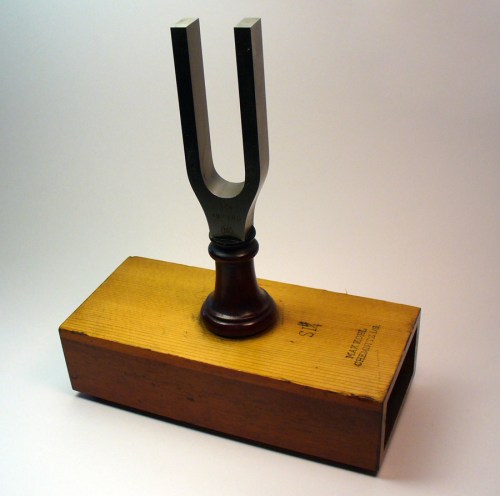
Tuning Fork

Strike and resound
A single perfect note
Against which
Our poor play is practiced.
The texts are ancient
Thoughts in a case
Replaced by the
Younger and fresher.
This tuning fork
Centuries old.
Bring me a gadget
A gizmo
To give me my pitch.
Ah but
The warm simple beauty
Of the vibrating metal
Is the practice
Before the practice.

It’s Not for Me to Say

“It’s not for me to say.”

One of the keynotes of Buddhism and Zen is nondiscrimination, that is, not getting trapped by thinking this is better and that’s worse, this is right and that’s wrong. This doesn’t mean that things aren’t by their nature or manufacture different or preferable, or that you can’t or shouldn’t recognize that. It’s just that clinging to that difference is unhelpful and can be the source of unnecessary conflict.

In the wake of some typically silly arguments, I have an idea for a way to remind myself of this, since it can be so easily forgotten in the heat of the moment.

Confronted by the endless opportunities to offer an opinion, to counter another’s opinion, or just to show off how smart and discerning one thinks one is, consider just reciting this, silently or out loud:

“It’s not for me to say.”

This isn’t a magical mantra, but it is meaningful. Of course, if someone asks for the quickest directions, or how to best cook something, or where to live, you will be welcome to offer your practical knowledge and expertise, if you have those. But often, when the difference of opinion is of no consequence, or of less consequence than the conflict is worth, having no opinion can be the best way.

It may be for someone else to say. But not me.

Practices

Practices

Our practices grow ragged
From disuse
Or irregularity.
Don’t fret.
There they are
Patient for our return.
Once a day
Once a year
Once in a lifetime.
Always ready and waiting.

A Zen Harvest: An Essential Zen No Zen Book for No Zen People

A Zen Harvest

While I often write about Zen and Buddhism in this blog, I have never suggested a “where to begin” book. There are a lot of reasons for this, but that’s for another time.

(For those who might be interested, a leading Buddhist publication did a survey of where its readers did get started, and the overwhelming first book was Shunryu Suzuki’s Zen Mind, Beginner’s Mind, pretty clearly the most popular book on Zen in English. It is also where I got started.)

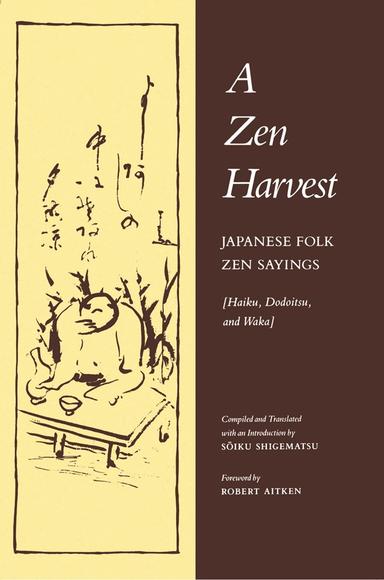
A Zen Harvest: Japanese Folk Zen Sayings (1988), compiled and translated by Soiku Shigematsu, is something different and special. (His first book, A Zen Forest: Sayings of the Masters (1981), is sadly out of print, but you can find a PDF if you go fishing in the Web sea.)

Shigematsu does a lovely job of explaining the text in his excellent Introduction. I actually suggest you not read the Introduction, at least not at first. Robert Aitken Roshi (author of another popular introduction to Zen) offers an appreciative Foreword. You can initially skip that too.

Instead, just browse anywhere in this collection of nearly 800 poem-like sayings. Anywhere. Don’t think of these as Zen. Don’t even think of these as poems. Don’t care about who said it or wrote it.

I am not even going to offer a sample saying, because it would not do the collection justice. Just get it and read in it, a few seconds at a time. You may or may not learn or find out anything about yourself, your life, other people’s lives, the world, the universe, or Zen. Does that really matter?

Be Stupid!

Bankei

You may think of yourself as clever. Or half-clever. Other people may think so too.

Be stupid!

That’s the advice from Bankei (1622-1693), a Zen master I’ve written about before.

Thousands of people came from all over Japan to hear Bankei speak. Ordinary people who came to hear really extraordinary messages from a very wise man. Such as: Be stupid!

“I tell my students and those of you coming regularly here to the temple: ‘Be stupid!’ Because you’ve got the dynamic function of the marvelously illuminating Buddha Mind, even if you get rid of discriminative understanding, you won’t be foolish. So, all of you, from here on, be stupid! Even if you’re stupid, when you’re hungry, you’ll ask for something to eat, when you’re thirsty, you’ll ask for some tea; when it gets warm, you’ll put on thin, light clothes, and when it’s cold, you’ll put on more clothes. As far as your activities of today are concerned, you’re not lacking a thing!

“With people who are clever, there are sure to be a great many shortcomings. To have transcended those clever people whom all the world holds in great esteem is what’s meant by ‘stupidity.’ There’s really nothing wrong with being a blockhead!

“When people say that someone is a clever fellow, I ask to meet him, and when I do and we have a chance to talk, it looks to me as if people in the world are praising an awful lot of foolishness. The fact is that those clever people acclaimed by the world are, from the start, deluded by their own cleverness. . .The true man’s ideal is to show kindness to those who are foolish and help those who are evil. To be recognized as a good man by the people of the world is precisely what makes being born a human being worthwhile. How can it be any good to earn yourself the reputation of a wicked person?

“So when you go back to your homes and meet your old acquaintances, you should have them wondering about you all: ‘How did Bankei teach them Buddhism, anyway? Why, they’ve come back even more stupid than before they left!’

“What I’m talking about isn’t the stupidity of stupidity and understanding. That which transcends stupidity and understanding is what I mean by stupidity!

From Bankei Zen: Translations from the Record of Bankei, Peter Haskel

Also:

Unborn: The Life and Teachings of Zen Master Bankei, Norman Waddell