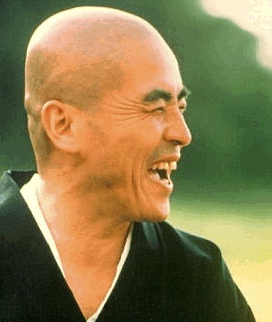
Bob Schwartz

Tag: Zen

Light the Icicle

icicles

Happy Hanukkah. Happy Christmas.


The Icicle

A zaddik told:

“On a winter’s day, I went to the bath with the master. It was so cold that icicles hung from the roofs. We entered and as soon as he did the Unification, the bath grew warm. He stood in the water for a very long time, until the candle began to drip and gutter. ‘Rabbi,’ I said, ‘the candle is guttering and going out.’

‘Fool,’ he answered, ‘take an icicle from the roof and light it! He who spoke to the oil and it leaped into flame, will speak to this too, and it will kindle.’ The icicle burned brightly for a good while, until I went home, and when I got home there was a little water in my hand.”

Martin Buber,  Tales of the Hasidim


“People ask, ‘What is the Buddha?’ An icicle forming in fire.”

Dogen Zenji

A Benefit of Observing Hateful Speech: Patience and Compassion

shodoka-3

A conventional reason for promoting free speech, even if hateful, is that it brings the hate out in the open, where it can be exposed and counteracted.

Here is another benefit, found in a verse from The Song of Realizing the Way (Shodoka) by Zen Master Yongjia Xuanjue (665-713):

There is benefit to observing hateful speech;
it makes you a good guiding teacher.
If you don’t hold a grudge against those who slander,
you don’t need to express patience and compassion.
(Translated by Peter Levitt and the Kazuaki Tanahashi)

Another translation:

When I consider the virtue of abusive words,
I find the scandal-monger is my good teacher.
If we do not become angry at gossip,
We have no need for powerful endurance and compassion.
(Translated by Robert Aitken)

Talk

Talk

Breathe
While you talk
And every word
Is silent.

To Live Is Just to Live

dainin-katagiri

“How often in our lives have we had feelings of happiness, unhappiness, pros and cons, success and failure? Countless numbers of times. But we are still alive. Regardless of whether or not we awaken to how important the essence of human life is, basically we are peaceful and harmonious. In other words, our life is just a continuation of living, that is all, “being living” constantly. That is why everyone can survive, no matter what happens. Is it our effort that makes it possible for us to survive for twenty years or forty years? No. Is it our judgment? No. Strictly speaking, it is just a continuation of becoming one with the process of living, that is all. This is the essence of living. The truth of living is just to live. This is a very simple practice.”

Dainin Katagiri, Returning to Silence: Zen Practice in Daily Life

Star Trek Koan

kirk-mccoy-scott

Captain Kirk faced a crisis on the Enterprise. He summoned his ship’s doctor and his ship’s engineer. Bones says, “Damn it Jim, I’m a doctor, not an engineer.” Scotty says, “I’m an engineer, Captain, not a doctor.” Who is right?

No Preferences

Xinxin Ming

The Great Way is not difficult
for those who have no preferences.
When love and hate are both absent
everything becomes clear and undisguised.
Make the smallest distinction, however,
and heaven and earth are set infinitely apart.

Thus begins one of the most famous Zen texts, Verses on the Faith-Mind  (Xinxin Ming), attributed to Jianzhi Sengcan (d. 606), the Third Ancestor of Zen.

This is one of the most common themes for way seekers. And as difficult as it is ubiquitous.

Smart or less smart, knowledgeable or less knowledgeable, all of us have preferences and opinions about this and that. We make distinctions. Good and bad. Better and best. All of us. All the time. Some people more than others.

There can be practical reasons. We want to know what to embrace or avoid.  And if we think we know that, we want to tell others. On the less practical side, we may want to demonstrate just how discerning we are. How smart we are. That happens.

The point is to be watchful of our tendencies to fill our lives and time with those preferences and distinctions. They will, without our noticing, take us over.

Zen goes one step further. The reason to give up preferences is not primarily to improve something about ourselves and our relationships with others, though that may be an effect. More than that, those preferences and distinctions don’t exist. At all. We just impose them on whatever is. This idea seems not just unlikely from our experience, but impossible.

Don’t believe Zen? Believe Jesus, who made the same point. “Do not judge and you will not be judged” is not just about being fair and self aware and not being hypocritical. It is about the hollowness of judgments themselves. Of course we will make judgments, but clinging to them and making them the centerpiece of our time and life is not the way.

Infinitely large and infinitely small;
no difference, for definitions have vanished
and no boundaries are seen.
So too with Being and non-Being.
Waste no time in doubts and arguments
that have nothing to do with this.

One thing, all things;
move among and intermingle,
without distinction.
To live in this realization
is to be without anxiety about nonperfection.
To live in this faith is the road to nonduality,
because the nondual is one with the trusting mind.

Words!
The Way is beyond language,
for in it there is
no yesterday
no tomorrow
no today.

From Hsin-Hsin Ming: Verses on the Faith-Mind, translated by Richard B. Clarke


Rickroll Zazen

Rickroll Zazen

To understand this, you need to know a little about two things: Zen and the 1980s pop star Rick Astley.

The centerpiece of Zen is zazen, sitting meditation, and the center of that is shikantaza, just sitting. Sitting without mantra or visualization or other objective technique. Just sitting and breathing. If thoughts arise, let them go.

In his great but now out of print Approach to Zen (incorporated into his later, greater and available Opening the Hand of Thought, Kosho Uchiyama Roshi included a very primitive but excellent line drawing to represent how zazen works.  After reading countless explanations, this drawing still says it as well as any other description:

Uchiyama Zazen

You sit. Along the way you think about a. Then you return to just sitting (Z). You think about b. Then you return to just sitting (Z). You think about c, apparently a lovely woman or whatever. Then you return to just sitting (Z). It is both simple and hard.

Rickrolling is a cultural phenomenon surrounding pop star Rick Astley. In 1987, he had a huge hit with the track Never Gonna Give You Up. It was the heyday of MTV, so naturally there was a video.

Sometime around 2007, something happened with the video for Never Gonna Give You Up. It began showing up as a surprise at completely unlikely and inappropriate moments. You would click on something, but instead it would be Rick. Rickrolling continues to this day.

Because of this, Rick Astley remains one of the most recognized 1980s pop music icons, even for people who have no idea who he was. He just released his first album in years. And it was reading about him and that new album that got me started.

You cannot read about Rickrolling, let alone hear the track or view the video, without getting Never Gonna Give You Up stuck in your head. Which is not convenient if the very next thing you are doing is zazen. As a regular practitioner with a complex life, I’ve had to put some very serious things out of mind when I sit. But Rick Astley, for a few minutes, was as stubborn and sticky as it gets.

Above, borrowing from Uchiyama Roshi’s drawing, you will see what Rickroll zazen looks like.

Note: For those who don’t know the video (it has about 250 million views on YouTube) here it is. And no, you are not being Rickrolled.

Poem, Joke, Etc.: Confused Birds

Confused Birds

These birds are confused
Not angry
Wondering where
The cold winds are.
Exulting in
Extended summer.
What’s time to a bird
Or me?

The line “What’s time to a bird” is borrowed from a favorite joke with a surprisingly philosophical punch line. It goes something like this:

A guy is driving along a country road. He sees a farmer under an oak tree, holding up a pig so the pig can eat acorns. The guy stops. “You know,” the guy says, “it would be a lot easier and take a lot less time if you just shook the tree and let the acorns fall to the ground.” “Maybe,” says the farmer, “but what’s time to a pig?”

More about birds:

In the sky a bird was heard to cry.
Misty morning whisperings and gentle stirring sounds
Belied a deathly silence that lay all around.
Hear the lark and harken to the barking of the dog fox gone to ground.
See the splashing of the kingfisher flashing to the water.
Grantchester Meadow, Pink Floyd

“Well, then, just what does it mean that everybody has the Buddha Mind?…in the course of listening to my talk, if a dog barks outside the temple, you recognize it as the voice of a dog; if a crow caws, you know it’s a crow…you didn’t come with any preconceived idea that if, while I was talking, there were sounds of dogs and birds, children or grown-ups somewhere outside, you were deliberately going to try to hear them. Yet here in the meeting you recognize the noises of dogs and crows outside and the sounds of people talking… the fact that you recognize these things you didn’t expect to see or hear shows you’re seeing and hearing with the Unborn Buddha Mind.”
From Bankei Zen: Translations from the Record of Bankei

Days of Awesome: Day 1 (Rosh Hashanah)


I brought them out of the land of Egypt and I led them into the wilderness. I gave them My laws and taught them My rules, by the pursuit of which a man shall live. Moreover, I gave them My sabbaths to serve as a sign between Me and them, that they might know that it is I the Lord who sanctify them.
Ezekiel 20:10-12 (New Jewish Publication Society translation)

Note from The Jewish Study Bible:

The Sabbath is the foundational sign of the covenant (Exod. 20.8–11; 31.12–17). Scholars have suggested that the Sabbath became particularly significant in the exile, as holy time replaced the vacuum of holy space (the Temple); this might explain why the Sabbath plays such a significant role here. As in Exod. 31.13, 17 (from the Priestly tradition), it is viewed as a sign, namely a symbol acknowledging God as Creator.

Here we are confronted with the phenomenon at the heart of this holiday. At the heart of every holiday. At the heart of religion and reality itself. We are concerned with space. We are concerned with being. We are concerned with time too. But we may not be properly concerned, in a balanced way that accounts for time, space and being.

We can rule space, or at least pretend to. If you visit New York or other great cities, you see how people have shaped space to their liking and purposes. But where in New York or elsewhere have even the richest and most powerful ultimately shaped time? We can mark time, but do we understand? To help us understand, time is set aside. It may be by God, it may be by our society or community, it may be by and for those close to us.

The Sabbath each week, and the Days of Awe each year, are set aside to be different than the other days of the week or of the year. Different in fact than any other days of eternity. In part to remind us of present eternity.

For more, see The Sabbath by Abraham Joshua Heschel and The Time-Being by Zen Master Dogen, which can be found in Enlightenment Unfolds.

This is the first post in a very small project/experiment in random wisdom I call The Days of Awesome. In addition to the standard and traditional forms of worship and contemplation associated with the Jewish High Holy Days (also known as Days of Awe), each day of the holiday I will be studying a randomly selected chapter of the Tanakh (also known as the Jewish Bible or the Old Testament), which has 39 books containing a total of 929 chapters.

Among other things, this is inspired by the I Ching and by social theorist and philosopher Gregory Bateson, who is quoted as saying “I am going to build a church someday. It will have a holy of holies and a holy of holy of holies, and in that ultimate box will be a random number table.”

Dragon Poems (About a Plant)

Madagascar Dragon

The Dragon at the Wall

The dragon guards the wall
I sit before.
A fine pair we are.
I breathe in the oxygen
He breathes out.
He asks for water and light
I ask to learn to sit
As naturally as he does.

The Dragon Awakes

The dragon wakes up
When I open the blinds
Long green scales
Gracefully still
In the morning light.

These poems are about a plant. A dracaena marginata, which means “Madagascar dragon.” Whether or not it is a real dragon is a question.

In his Treasury of the True Dharma Eye (Shobo Genzo), Dogen Zenji also writes about a dragon and a plant. Actually, a tree. Fascicle 65, Dragon Song, includes the question “Is there a dragon singing in a withered tree?” Is there?

Touzi, Great Master Ciji of Shu Region, was once asked by a monk, “Is there a dragon singing in a withered tree?”

Touzi replied, “I say there is a lion roaring in a skull.”

Discussions about a withered tree and dead ash [composure in stillness] are originally teachings outside the way. But the withered tree spoken of by those outside the way and that spoken of by buddha ancestors are far apart. Those outside the way talk about a withered tree, but they don’t authentically know it; how can they hear the dragon singing? They think that a withered tree is a dead tree which does not grow leaves in spring.

The withered tree spoken of by buddha ancestors is the understanding of the ocean drying up. The ocean drying up is the tree withering. The tree withering encounters spring. The immovability of the tree is its witheredness. The mountain trees, ocean trees, and sky trees right now are all withered trees. That which sprouts buds is a dragon singing in a withered tree. Those who embrace it one hundredfold, one thousand-fold, and one myriadfold are descendants of the withered tree.