Cushion
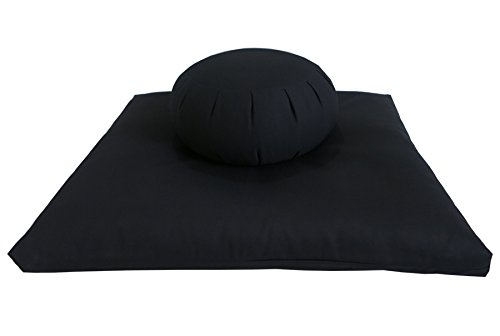
Cushion
I look at the cushion
The cushion looks back
It has no clock
But I do
Come it says
Early I say
Come it says
And I do
Cushion
I look at the cushion
The cushion looks back
It has no clock
But I do
Come it says
Early I say
Come it says
And I do
I began today listening to birds:
If birds sing in the morning
Why not me
Why not we
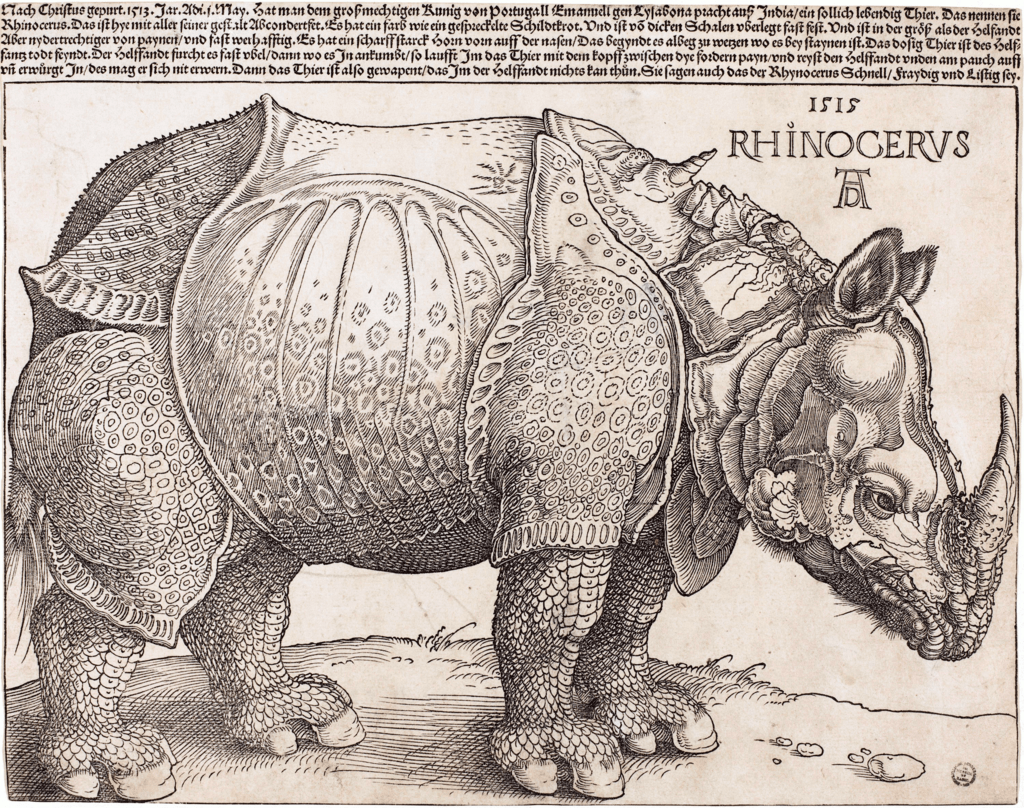
I quickly turned to a rhinoceros.* There is a famous Zen koan that has nothing to do with birds. Also everything to do with birds, even if they are not mentioned.
I thought of writing about the koan here. Funny that I haven’t before. I thought of sending friends the koan, found at Blue Cliff Record 92, without explanation or commentary. What would they think? What do you think?
Yanguan (750-843) called to his attendant, saying, “Bring me the rhinoceros fan**.”
The attendant said, “It’s broken.”
Yanguan said, “If the fan is broken, then bring me the rhinoceros.”
The attendant didn’t answer.
*I didn’t intend for that sentence to be multi-layered, but it could be. I wrote “turned to” to mean changing the subject. One of the great absurdist plays by Eugene Ionesco is Rhinoceros, in which the people of a town one-by-one turn into a rhinoceros. It is sometimes interpreted as a parable about people turning into Nazis during World War II.
**Likely an expensive item, made of rhinoceros horn or picturing a rhinoceros. Not someone who is fanatical about rhinoceros.
© 2024 by Bob Schwartz

This is it
Ah but what is this?
This is it
Ah but what is this?
This is it
Ah but what is this?
Sweet silly fool
Stay silent.
Why would tinkering with Zen bring me to Wittgenstein? Why not?
Mine the treasures of mind deep enough through the earth and, as the old nostrum goes, you will end up in China. Ha!
Kidding. Mine the treasures of mind deep enough and you will find something that is nothing. When you try to describe or picture it, it will look and sound like…everything?
As a younger philosopher Wittgenstein wrote Tractatus Logico-Philosophicus. The final section is much quoted and interpreted:
7
Whereof one cannot speak, thereof one must be silent.
Wittgenstein claimed at the time that he had answered all the questions of philosophy. Later and older, he changed his mind, repudiating some of the things he had said before.
No matter. His endorsement of silent surrender remains.
Except. It is not conventional surrender. Boshan prescribes great doubt through questions. But those who arrogantly pretend to have answers and those who earnestly work for answers both fall short. The final answer is not enough and so not final. Surrender and go on.
What is this?
© 2023 by Bob Schwartz
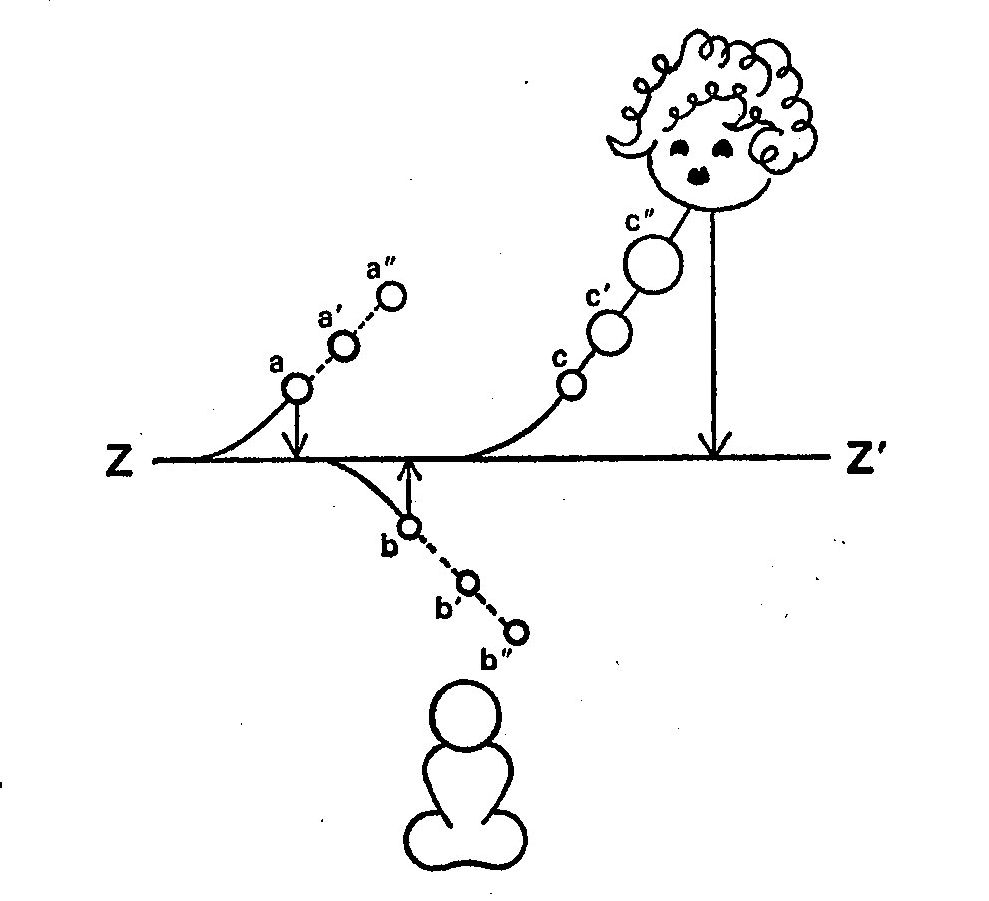
The above is my favorite illustration about meditation ever. Drawn by Zen master Kōshō Uchiyama, it is included in his book Opening the Hand of Thought. If you practice any type of meditation, not just Zen, or if you are interested in meditation but don’t know much about it, this illustration tells you so much.
About Kōshō Uchiyama:
Kōshō Uchiyama was born in Tokyo in 1912. He received a master’s degree in Western philosophy at Waseda University in 1937 and became a Zen priest three years later under Kōdō Sawaki Roshi. Upon Sawaki’s death in 1965, he became abbot of Antaiji, a temple and monastery then located on the outskirts of Kyoto. Uchiyama Roshi developed the practice at Antaiji and traveled extensively throughout Japan, lecturing and leading sesshins. He retired from Antaiji in 1975 and lived with his wife at Noke-in, a small temple outside Kyoto, where he continued to write, publish, and meet with the many people who found their way to his door, until his death in 1999. He wrote over twenty books on Zen, including translations of Dōgen Zenji in modern Japanese with commentaries, a few of which are available in English, as are various shorter essays. He was an origami master as well as a Zen master and published several books on origami.
The text accompanying the illustration:
Actually, zazen is not just being somehow glued to line ZZ’. Doing zazen is a continuation of this kind of returning up from sleepiness and down from chasing after thoughts. That is, the posture of waking up and returning to ZZ’ at any time is itself zazen. This is one of the most vital points regarding zazen. When we are doing zazen line ZZ‘, or just doing zazen, represents our reality, so it is essential to maintain that line. Actually, ZZ’ represents the reality of the posture of zazen, but the reality of our life is not just ZZ’. If it were only ZZ’, we would be as unchanging and lifeless as a rock! Although we aim at the line ZZ’, we can never actually adhere to it, because it (ZZ’) does not exist by itself. Nevertheless, we keep aiming at ZZ‘, because it is through clinging to thoughts that we keep veering away from it. The very power to wake up to ZZ’ and return to it is the reality of the life of zazen.
That is all you may need to know. Really.

Mindfulness is a popular practice of spiritual and psychological progress. That is a good thing. Transformation and evolution are more needed and valuable than ever.
Being aware of mind is a step towards full presence. As is no mind:
140
Dayi’s “No Mind”
MAIN CASE
Dayi Daoxin asked his teacher Jianzhi Sengcan, the Third Ancestor, “What is the mind of the ancient buddhas?”
Sengcan said, “What kind of mind do you have now?”
Dayi said, “I have no mind.”
Sengcan said, “Since you have no mind, why would you think buddhas have mind?”
Dayi immediately ceased to have doubt.
COMMENTARY
It is clear that Dayi is an adept and has investigated the Way. He has to a certain degree eliminated conceptual thought and intellectual defilement. But still, there is this “What is the mind of the ancient buddha?” Indeed, what is the mind—any mind, your mind? How big is it? Where does it reside? Does it really exist or not? The answers to these questions require that each one of us plummet the depths of our own mind.
When pressed by his teacher, Dayi, like his dharma grandfather Huike before him, has to admit that mind is ultimately ungraspable. Do you understand? Because the mind has no form, it pervades the whole universe, existing right here now. This truth comes from the direct experience of plunging into another dimension of consciousness. It is not a matter of understanding or knowing.
Sengcan presses again, saying, “Since you have no mind, why would you think buddhas have mind?” The ice begins to melt, the waters begin to flow, and no further communication is possible.
But say, since Dayi has no mind, where was he holding the doubt that he ceased to have?
CAPPING VERSE
When thoughts disappear, the thinker disappears,
and all things manifest as they are.
In this reality, all intentional efforts vanish.
In this world of suchness, nothing is excluded.
The True Dharma Eye: Zen Master Dōgen’s Three Hundred Kōans
With Commentary and Verse by John Daido Loori
Translated by Kazuaki Tanahashi And John Daido Loori
No mind, not just full mind. There is not a popular term no-mindedness. Maybe there should be.
© 2023 by Bob Schwartz

Yoshitsune was a famous warrior who lived in medieval Japan. Because of the situation of the country at that time, he was sent to the northern provinces, where he was killed. Before he left he bade farewell to his wife [Lady Shizuka], and soon after she wrote in a poem, “Just as you unreel the thread from a spool, I want the past to become present.” When she said this, actually she made past time present. In her mind the past became alive and was the present. So as Dogen said, “Time goes from present to past.” This is not true in our logical mind, but it is in the actual experience of making past time present. There we have poetry, and there we have human life.
Shunryu Suzuki, Zen Mind, Beginner’s Mind
Do not think that time merely flies away. Do not see flying away as the only function of time. If time merely flies away, you would be separated from time. The reason you do not clearly understand the time being is that you think of time only as passing.
In essence, all things in the entire world are linked with one another as moments. Because all moments are the time being, they are your time being.
The time being has a characteristic of flowing. So-called today flows into tomorrow, today flows into yesterday, yesterday flows into today. And today flows into today, tomorrow flows into tomorrow.
Dogen, Shobo Genzo/Treasury of the True Dharma Eye, Uji/The Time Being

Thomas Merton hermitage in Kentucky
Though the hut is small, it includes the entire world.
Hermit—one who lives in solitude—is from Greek erēmia desert, which is from erēmos desolate. In the fourth century, Christians dissatisfied with the artificial complexities of the Church fled to the Egyptian desert to be alone and closer to God. Thus began Christian monasticism. On the other side of the world, Buddhists in China went to the mountains, also to be alone.
Both the Christian desert fathers and mothers and the Buddhist hermits left behind a treasury of wisdom. Centuries later, in another part of the world Thomas Merton fled the chaos of civilization to build a hermitage of his own in Kentucky, and similarly provided an inspiring record of his experiences.
The following Song of the Grass Roof Hut is the work of Shitou Xiqian [Japanese: Sekitō Kisen] (700–790, China).
I’ve built a grass hut where there’s nothing of value.
After eating, I relax and enjoy a nap.
When it was completed, fresh weeds appeared.
Now it’s been lived in – covered by weeds.
The person in the hut lives here calmly,
Not stuck to inside, outside, or in between.
Places worldly people live, he doesn’t live.
Realms worldly people love, he doesn’t love.
Though the hut is small, it includes the entire world.
In ten square feet, an old man illumines forms and their nature.
A Great Vehicle bodhisattva trusts without doubt.
The middling or lowly can’t help wondering;
Will this hut perish or not?
Perishable or not, the original master is present,
not dwelling south or north, east or west.
Firmly based on steadiness, it can’t be surpassed.
A shining window below the green pines –
Jade palaces or vermilion towers can’t compare with it.
Just sitting with head covered, all things are at rest.
Thus, this mountain monk doesn’t understand at all.
Living here he no longer works to get free.
Who would proudly arrange seats, trying to entice guests?
Turn around the light to shine within, then just return.
The vast inconceivable source can’t be faced or turned away from.
Meet the ancestral teachers, be familiar with their instruction,
Bind grasses to build a hut, and don’t give up.
Let go of hundreds of years and relax completely.
Open your hands and walk, innocent.
Thousands of words, myriad interpretations,
Are only to free you from obstructions.
If you want to know the undying person in the hut,
Don’t separate from this skin bag here and now.
Shitou Xiqian
(translation by Taigen Daniel Leighton)

I. Can’t. Say.
ask me today
where I am from
I
can’t
say
ask me tomorrow
I
will
tell
you
I am not from where
© Bob Schwartz
Note: There is a cold morning rain in the desert. Waiting long enough there will be cloudless sun and scorching heat.

Searching for Bobby Fischer is a movie about a real life chess prodigy. In a memorable scene, his teacher sweeps the pieces off the chessboard, so the child can better concentrate on the actual state of play, undistracted by the apparent state of play.
Meditation and related attention practices are all about clearing the chessboard. What comes next depends on the context, whether it’s a way to relax or a search for enlightenment. The point is that the apparent state of play, the pieces on the chessboard, are distractions and may become obsessions. Only by focusing on the empty chessboard can you see the game for what it is.

Labels harm us as much as they help us. They may destroy us. Social, cultural, political, religious, intellectual labels. Even as we use labels as shorthand that helps us identify our friends and our kind and our foes and our others, we are mistaken. They keep us from reality, keep us from the rewarding but hard work of knowing more and deeply, keep us apart. Labels are as much weapons and disabilities as they are conveniences.
Can we live without labels? In some circumstances they appear to us essential. Don’t we want to know, and want others to know, what party or cause or religious denomination or ethnicity or gender we associate with? We may want that, and we may find benefit in it, but as with most benefits, they may be illusory and they have a cost.
Dogen was the 13th century founder of the Soto Zen school of Buddhism. It is one of the many schools and sects that were developing during Dogen’s time and that have developed during the centuries since.
He fiercely opposed the naming of schools of Buddhism, Zen or otherwise:
In this way, know that the buddha way that has been transmitted from past buddhas is not called Zen meditation, so how could there be the name “Zen School”? Clearly understand that it is an extreme mistake to use the name “Zen School.” Those who are ignorant assume that there is an “existence school” and an “emptiness school.” They feel bad not having a special name as a school, as if there is nothing to study. But the buddha way is not like that. It should be determined that in the past there was no such name as “Zen School.”
The Buddha Way, from Treasury of the True Dharma Eye
The first verse of the Tao Te Ching addresses the way that naming may keep us from the reality of things:
A name that can be named
is not The Name
tr. Jonathan Star
The name you can say
isn’t the real name.
tr. Ursula Le Guin
Names that can be Named
Are not True Names.
tr. John Minford
the name that becomes a name
is not the Immortal Name
tr. Red Pine (Bill Porter)
Red Pine continues: “During Lao-tzu’s day, philosophers were concerned with the correspondence, or lack of it, between name and reality. The things we distinguish as real change, while their names do not. How then can reality be known through names?”

