Bob Schwartz

Tag: Shantideva

5787: The Jewish New Year of Compassion

May I be a guard for those who are protectorless,
A guide for those who journey on the road.
For those who wish to cross the water,
May I be a boat, a raft, a bridge.

Rosh Hashanah, the Jewish New Year 5787, begins this evening.

For what it’s worth, I have declared 5787 a Year of Jewish Compassion. This requires explanation.

It is not to suggest that Judaism and fellow Jews, together and individually, are not compassionate, in thought and action. That would be wrong.

Instead, it may lead to questions. Have we been compassionate enough and often enough? Have we been unconditionally and universally compassionate? How can we cultivate compassion in ourselves and others?

Of the major religious traditions, Buddhism maintains a particular focus on compassion. Hundreds of teachers, beginning with the Buddha, and thousands of texts ask this of us, in thought and action.

Here is just one text, excerpted from The Way of the Bodhisattva by Shantideva (685-763), with an excerpt from commentary by the current Dalai Lama:


May I be a guard for those who are protectorless,
A guide for those who journey on the road.
For those who wish to cross the water,
May I be a boat, a raft, a bridge.

May I be an isle for those who yearn for land,
A lamp for those who long for light;
For all who need a resting place, a bed;
For those who need a servant, may I be their slave.

May I be the wishing jewel, the vase of plenty,
A word of power, and the supreme healing;
May I be the tree of miracles,
And for every being the abundant cow.

Just like the earth and space itself
And other of the mighty elements,
For boundless multitudes of beings,
May I always be the ground of life, the source of varied sustenance.

Thus for everything that lives,
As far as are the limits of the sky,
May I be constantly their source of livelihood
Until they pass beyond all sorrow.

The Way of the Bodhisattva, Chapter 3, Verses 18–22


These last two lines are very powerful, are they not? The lives of a great many beings depend on the presence of the five elements, so let us think: Just like the earth, may I support beings as numerous as the sky is vast….Consider that we are surrounded by all the beings in the universe and generate compassion for them….

Now that we have taken this vow, we should try to be good human beings in our daily lives. We should not, for example, pretend to be very nice while we are in this tent and start fighting with each other as soon as we get out! We should from now on try to have a positive and kind mind: we are going to be happy in life. I really think that the future depends on the quality of one’s mind, on a good mind. So we must try to be good people and be good examples for those around us. The initiative to be like this has to come from each one of us individually.

For the Benefit of All Beings: A Commentary on The Way of the Bodhisattva, Tenzin Gyatso, the Fourteenth Dalai Lama


Shana Tova! May you have and give a good and sweet year!

Cover the earth with leather? Easier to wear shoes.

Chapter 5 – Guarding Awareness
13.
How could there be sufficient leather
To cover the earth entirely?
With just the leather for my soles,
It is as if the whole earth’s covered.
–Shantideva (7th-8th century CE), The Way of the Bodhisattva, translated by Khenpo David Karma Choephel

Making things better. Making other people better. Making the world better.

All for the good.

As Shantideva says in his classic work of Buddhist wisdom, one way to smooth our walking would be to cover the entire earth in leather. Of course that would be impossible.

Instead, we could just choose to wear shoes. Simple.

While we want things, other people and the world to be better, we should start with ourselves. Get those shoes, make those shoes, wear those shoes. Easier than covering the earth.

© 2026 Bob Schwartz

We are passersby (says Jesus) and tourists (says the Dalai Lama)

Whenever we can connect the Dalai Lama and Jesus, we know we are in the right place.

The Gospel of Thomas, sometimes called the Fifth Gospel, is a collection of sayings of Jesus that parallel and supplement the canonical gospels.

It contains this short and simple direction:

  1. Be passersby

This enigmatic saying for me has the depth of any words in scripture.

Today I came across related wisdom from the Dalai Lama, who makes the same point. Just as Jesus is not offering a limited Christian perspective, the Dalai Lama is not offering a limited Buddhist perspective. It is a fact of human life.

Here the Dalai Lama comments on verses from Shantideva’s The Way of the Bodhisattva.


We are all here on this planet, as it were, as tourists. None of us can live here forever. The longest we might live is a hundred years. So while we are here we should try to have a good heart and to make something positive and useful of our lives. Whether we live just a few years or a whole century, it would be truly regrettable and sad if we were to spend that time aggravating the problems that afflict other people, animals, and the environment. The most important thing is to be a good human being.

Dalai Lama, For the Benefit of All Beings: A Commentary on The Way of the Bodhisattva


Passersby. Tourists. Together.

Note: By coincidence—or is it?—this was created spontaneously today on the 90th birthday of the Dalai Lama.

Patience: “If something can’t be fixed, what good is it to be displeased?”

If there’s a remedy when trouble strikes,
What reason is there for dejection?
And if there is no help for it,
What use is there in being glum?
Shantideva, The Way of the Bodhisattva


Patience

10.
If there’s a remedy when trouble strikes,
What reason is there for dejection?
And if there is no help for it,
What use is there in being glum?
Translated by the Padmakara Translation Group

10.
If something can be fixed, what need
Is there to be displeased?
If something can’t be fixed, what good
Is it to be displeased?
Translated by David Karma Choephel

    10.
    If something can be remedied
    Why be unhappy about it?
    And if there is no remedy for it,
    There is still no point in being unhappy.
    Translated by Geshe Kelsang Gyatso Rinpoche

    His Holiness the Dalai Lama comments:

    “We should try never to let our happy frame of mind be disturbed. Whether we are suffering at present or have suffered in the past, there is no reason to be unhappy. If we can remedy it, why be unhappy? And if we cannot, what use is there in being depressed about it? That just adds more unhappiness and does no good at all.”


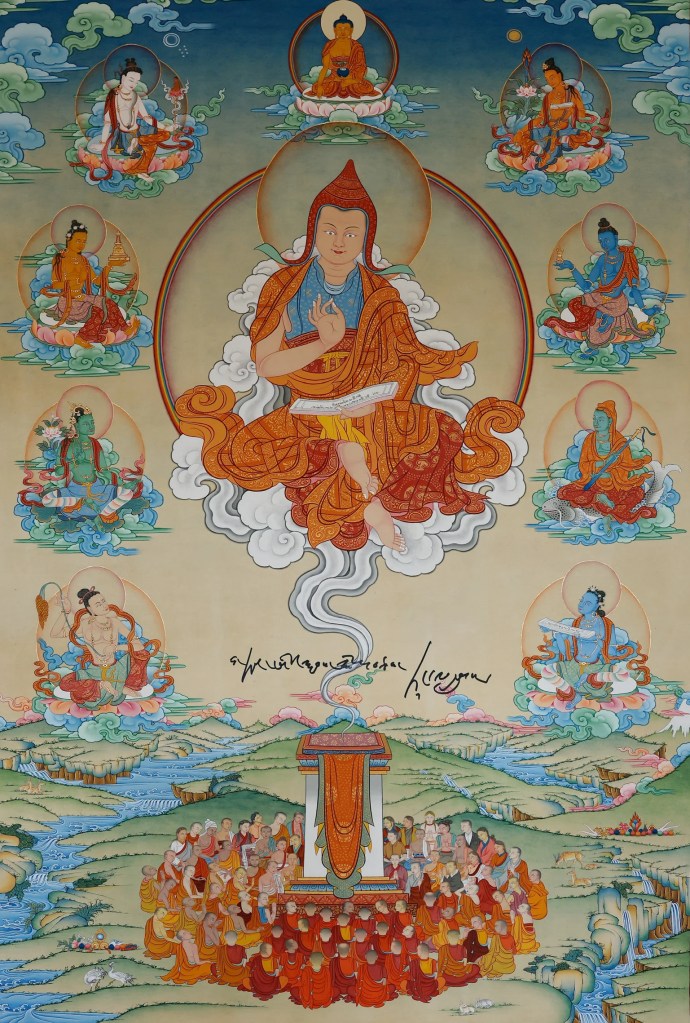
    Shantideva (695–743). Indian Buddhist scholar and author of the The Way of the Bodhisattva (Bodhicharyavatara).

    The Way of the Bodhisattva is a guide to cultivating the mind of enlightenment and generating the qualities of love, compassion, generosity, and patience. The text has been studied, practiced, and expounded upon in an unbroken tradition for centuries, first in India, and later in Tibet. It outlines the path of the Bodhisattvas—those who renounce the peace of individual enlightenment and vow to work for the liberation of all beings and to attain buddhahood for their sake.