Bob Schwartz

Tag: Religion

Philip K. Dick, Now More Than Ever
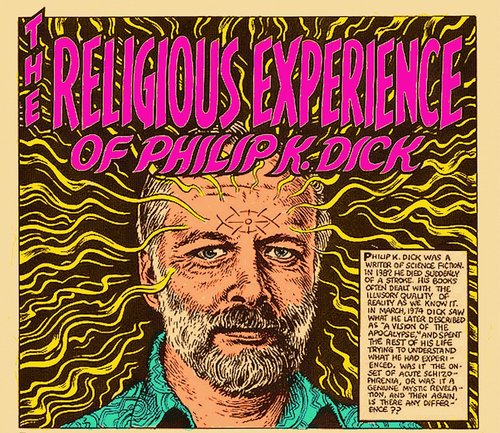
Philip K. Dick color

Pretty much every day now, my head spins, just a little. My head does not usually and chronically spin, but it does these days. I find myself not so much trying to make sense of some things, but trying to determine whether there is or will appear some appropriate and constructive response. So far, nothing.

Today, however, I did think about Philip K. Dick. I wrote a little about Dick a while ago. To say he was just a science fiction writer is not nearly enough. Some of his many books and stories have been turned into a number of successful movies (Blade Runner, Total Recall, etc.) and now into an excellent TV series (Man in the High Castle).

The reason for his books being so adaptable, and for his loyal and committed readers, is that Dick was a visionary, some might say a prophet. He was also psychologically and cognitively different. The two parts often go together.

The reason I’m thinking about Dick is the possibility that those of us who are confused about what is going on are being far too rational and far too narrow about all of it. Maybe what we need is a much bigger and stranger vision. Maybe to understand madness, we all have to try to be a little mad ourselves, or pretend to be. Just a thought.

Anyway, Dick suffered through some mental illness and/or religious experience late in his life. Some would say Dick was a bit of a madman. Or a visionary or a prophet. In any case, if we want to know what the future might look like—or for that matter what the present looks like—we can do no better than look at it through Dick’s eyes.

Writer Jonathan Lethem has written some fine appreciations of Dick. This is from Lethem’s Introduction to Selected Stories of Philip K. Dick:

Dick’s great accomplishment, on view in the twenty-one stories collected here, was to turn the materials of American pulp-style science fiction into a vocabulary for a remarkably personal vision of paranoia and dislocation. It’s a vision as yearning and anxious as Kafka’s, if considerably more homely. It’s also as funny. Dick is a kitchen-sink surrealist, gaining energy and invention from a mad piling of pulp SF tropes—and clichés—into his fiction: time travel, extrasensory powers, tentacled aliens, ray guns, androids, and robots. He loves fakes and simulacra as much as he fears them: illusory worlds, bogus religions, placebo drugs, impersonated police, cyborgs. Tyrannical world governments and ruined dystopian cities are default settings here. Not only have Orwell and Huxley been taken as givens in Dick’s worlds, so have Old Masters of genre SF like Clifford Simak, Robert Heinlein, and A. E. Van Vogt. American SF by the mid-1950s was a kind of jazz, stories built by riffing on stories. The conversation they formed might be forbiddingly hermetic, if it hadn’t quickly been incorporated by Rod Serling and Marvel Comics and Steven Spielberg (among many others) to become one of the prime vocabularies of our age….

If Dick, as a bearded, drug-taking Cal-i-fornian, might have seemed a candidate for Beatdom (and in fact did hang out with the San Francisco poets), his persistent engagement with the main materials of his culture kept him from floating off into reveries of escape. It links him instead to writers like Richard Yates, John Cheever, and Arthur Miller (the British satirist John Sladek’s bull’s-eye Dick parody was titled “Solar Shoe Salesman”). Dick’s treatment of his “realist” material can seem oddly cursory, as though the pressing agenda of his paranoiac fantasizing, which would require him to rip the facade off, drop the atomic bomb onto, or otherwise renovate ordinary reality, made that reality’s actual depiction unimportant. But no matter how many times Dick unmasks or destroys the Black Iron Prison of American suburban life, he always returns to it. Unlike the characters in William S. Burroughs, Richard Brautigan, or Thomas Pynchon, Dick’s characters, in novels and stories written well into the 1970s, go on working for grumbling bosses, carrying briefcases, sending interoffice memos, tinkering with cars in driveways, sweating alimony payments, and dreaming of getting away from it all—even when they’ve already emigrated to Mars….

Whether or not he was ready for the world, or the world ready for him, he longed for a respectable recognition, and sought it variously and unsuccessfully throughout his life. In fact, he wrote eight novels in a somber realist mode during the 1950s and early 1960s, a shadow career known mainly to the agents who failed to place the books with various New York publishers. It’s stirring to wonder what Dick might have done with a wider professional opportunity, but there’s little doubt that his SF grew more interesting for being fed by the frustrated energies of his “mainstream” ambition. Possibly, too, a restless streak in Dick’s personality better suited him for the outsider-artist status he tasted during his lifetime….Here, from an introduction written for Golden Man, a collection of stories assembled in 1980, Dick reminisces:

But I think you should know this—specifically, in case you are, say, in your twenties and rather poor and perhaps becoming filled with despair, whether you are an SF writer or not, whatever you want to make of your life. There can be a lot of fear, and often it is a justified fear. People do starve in America. I have seen uneducated street girls survive horrors that beggar description. I have seen the faces of men whose brains have been burned-out by drugs, men who could still think enough to be able to realize what had happened to them; I watched their clumsy attempt to weather that which cannot be weathered. . . . Kabir, the sixteenth-century Sufi poet, wrote, “If you have not lived through something, it is not true.” So live through it; I mean, go all the way to the end. Only then can it be understood, not along the way.
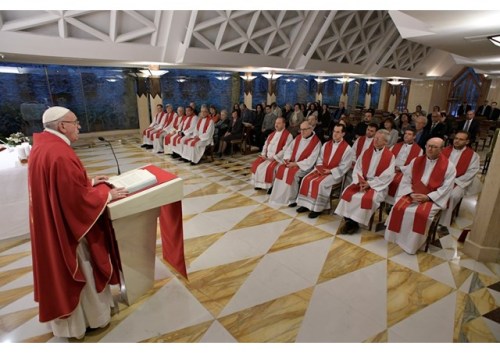
Pope: The Scandal of Christian Hypocrisy

Pope Francis

Scandal is saying one thing and doing another; it is a double life, a double life. A totally double life: ‘I am very Catholic, I always go to Mass, I belong to this association and that one; but my life is not Christian, I don’t pay my workers a just wage, I exploit people, I am dirty in my business, I launder money…’

In a homily yesterday morning, Pope Francis said this:

“But what is scandal? Scandal is saying one thing and doing another; it is a double life, a double life. A totally double life: ‘I am very Catholic, I always go to Mass, I belong to this association and that one; but my life is not Christian, I don’t pay my workers a just wage, I exploit people, I am dirty in my business, I launder money…’ A double life. And so many Christians are like this, and these people scandalize others. How many times have we heard – all of us, around the neighborhood and elsewhere – ‘but to be a Catholic like that, it’s better to be an atheist.’ It is that, scandal. You destroy. You beat down. And this happens every day, it’s enough to see the news on TV, or to read the papers. In the papers there are so many scandals, and there is also the great publicity of the scandals. And with the scandals there is destruction….

“[Y]ou will arrive in heaven and you will knock at the gate: ‘Here I am, Lord!’ – ‘But don’t you remember? I went to Church, I was close to you, I belong to this association, I did this… Don’t you remember all the offerings I made?’ ‘Yes, I remember. The offerings, I remember them: All dirty. All stolen from the poor. I don’t know you.’ That will be Jesus’ response to these scandalous people who live a double life….

“It would be good for all of us, each one of us, today, to consider if there is something of a double life within us, of appearing just, of seeming to be good believers, good Catholics, but underneath doing something else; if there is something of a double life, if there is an excessive confidence: ‘But, sure, the Lord will eventually forgive everything, but I’ll keep going as I have been…’

Ben Zoma Still Outside

waters-above

Ben Zoma Still Outside

Lost and found
Between the waters of creation
Ben Zoma
Is outside
Is still outside

And God said, “Let there be a space within the water, and let it separate between water and water.” And God made the space, and it separated between the water that was under the space and the water that was above the space. And it was so. (Gen 1:6-7)

Ben Zoma sat at the Temple Mount, lost in thought. His rebbe Yehoshua ben Chananya came by, but Ben Zoma did not notice or rise in respect. R. Yehoshua roused him from his reverie and asked what he was doing. Gazing at the space between the upper and lower waters, he replied. R.  Yehoshua explained to his disciples:

Ben Zoma is still outside.

Random Torah: Devarim/Deuteronomy 34

the_death_of_moses

Studying a random Torah chapter each Shabbat contravenes the traditional, conventional and sacred process of following the Torah through a fixed annual cycle of portions. I only recently learned from reading the revered and brilliant rabbi and scholar Aryeh Kaplan that meditation on random Torah passages is actually a historical Jewish phenomenon. Who knew?

While working on an extended explanation of my taking this iconoclastic Torah study path, today I offer a poem about breaking cycles:

Discontinuous

We see better in discontinuity
The way we see better in the dark.
We strain for every glimmer of light
However small
To make out shapes.
Cycles and patterns are comfortable
The more they repeat
The easier it seems.
But nothing is easy.
We are lulled into false confidence
That we know what is there
And what is going on.
The broken line
Is as powerful as the solid.

Deuteronomy 34 is the last chapter of the Torah. It is the death of Moses.

The Torah begins on a cosmic scale with the creation of everything. It ends with a single man, a very old and special man, sitting on a mountaintop, surveying the future. He will never see or experience that future, partly because he is old and dying, partly because he has been forbidden to enter the land he has led his people to.

Scholars will tell you that as a literary matter, this final chapter may not technically be the end of the text, that the five books (Pentateuch) are actually six (Hexateuch), and this compendium work originally continued with the story of Joshua, which now appears in the non-Torah book of Joshua.

That is an important scholarly debate in some ways, and a silly one in another. The Big Story always begins with an ineffable cosmic moment. It always ends with an old person surveying the past, present and future, with promises fulfilled and unfulfilled, barred by the nature of creation from going any further. This final chapter gets it right.

The Meek and the Mean

And very soon the wicked will be no more.
You will look at his place—he’ll be gone.
And the poor shall inherit the earth
and take pleasure from great well-being.
(Psalm 37:11-12, Robert Alter translation)

But until then, the mean and the stupid may still prevail.

Paradise

berliner-rabbinical-seminary-1988

A story is told about a rabbi who once entered heaven in a dream. He was permitted to approach the temple in Paradise where the great sages of the Talmud, the tannaim, were spending their eternal lives. He saw that they were just sitting around tables studying the Talmud. The disappointed rabbi wondered, “Is this all there is to Paradise?” But suddenly he heard a voice, “You are mistaken. The tannaim are not in Paradise. Paradise is in the tannaim.”

Abraham Joshua Heschel, Moral Grandeur and Spiritual Audacity: Essays


The Cathedral and the Grass Hut

cathedral-lafayette-la

“I’ve built a grass hut where there’s nothing of value.
After eating, I relax and enjoy a nap.”

Grand
Grander than grand.
Splendid glory
Magic carpet
Of gold and glass
Whisks us away
To God’s neighborhood.
The grass hut reminds us
That houses and vehicles
Are just that.
Means not
Journey or destination.

“A shining window below the green pines—
jade palaces or vermilion towers can’t compare with it.”

Quotes from Song of the Grass Hut by Shitou Xiqian (700–790), translated by Taigen Dan Leighton and Kazuaki Tanahashi.

Light the Icicle

icicles

Happy Hanukkah. Happy Christmas.


The Icicle

A zaddik told:

“On a winter’s day, I went to the bath with the master. It was so cold that icicles hung from the roofs. We entered and as soon as he did the Unification, the bath grew warm. He stood in the water for a very long time, until the candle began to drip and gutter. ‘Rabbi,’ I said, ‘the candle is guttering and going out.’

‘Fool,’ he answered, ‘take an icicle from the roof and light it! He who spoke to the oil and it leaped into flame, will speak to this too, and it will kindle.’ The icicle burned brightly for a good while, until I went home, and when I got home there was a little water in my hand.”

Martin Buber,  Tales of the Hasidim


“People ask, ‘What is the Buddha?’ An icicle forming in fire.”

Dogen Zenji

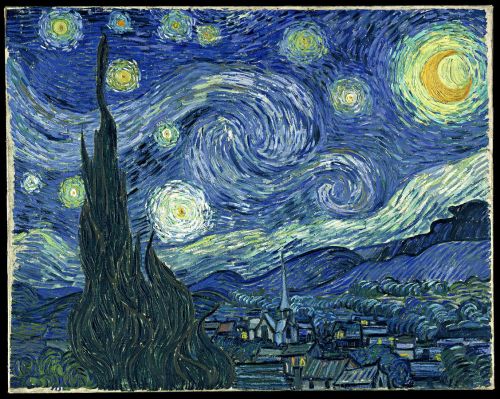
Constellator (Starry Nights)

Starry Night

Constellator (Starry Nights)

To the uninitiate
The stars are arrayed
Points of white
That delight
But mean nothing.
The constellator sees old pictures.
The artist connects them anew.
The astronomer investigates
Each by each.
On cold nights
Of black sky
I see connect investigate
Unsure which I am
While the stars
Patiently wait.

More New York Hate Attacks—On a Muslim Cop and a Subway Worker

aml-elsokary

Just as you probably didn’t see any national coverage of the assault on a Muslim college student riding the New York subway, you also probably didn’t see stories about more attacks in the last few days—including one on a New York City cop.

Sunday

‘I will cut your throat!’: Man attacks Muslim cop and her son

A suspect was arrested Sunday in the Brooklyn attack on an off-duty Muslim cop wearing a hijab.

“Go back to your country,” the man yelled at NYPD Officer Aml Elsokary during the incident Saturday.

He also targeted the cop’s 16-year-old son — shoving him and shouting a slur that referenced ISIS — before telling them both, “I will cut your throat! Go back to your country!” sources said.

The incident is being probed as a hate crime.

The suspect, whose name was not released, lives near the scene of the attack, on Ridge Boulevard and 67th Street in Bay Ridge.

Elsokary made headlines in 2014 when she helped rescue an old man and a baby from a burning building.

Monday

Muslim MTA worker in hijab pushed down stairs, called ‘terrorist’

A Muslim New York City Transit employee who was wearing a hijab with her uniform was injured when she was pushed down the stairs at Grand Central Terminal Monday morning by a man who called her a “terrorist,” officials said.

The 45-year-old woman was on her way to work at 6:20 a.m. when the man confronted her on the 7 Train.

“You’re a terrorist and you shouldn’t be working for the city,” the hate-monger spewed at her while the two were on the train, as he jabbed at her MTA patch.

He followed her off the train and pushed her down the stairs. Her ankle and knee were injured and she was taken to NYU Langone Hospital.

We have to start facing a few realities, though strategies to deal with them are still to be determined. One is not just the presence of hate and intolerance—an age-old problem—but the growing aggressive expression of that hate, possibly in light of the current political climate. Another is a certain willingness to stand by while that happens—also long-standing—because we will always have such people and that’s just the way things are. A final reality is much of the news media, which, with all due respect, spent the presidential campaign focused on all kinds of nonsense and missing all kinds of truth, sometimes in the name of being “objective” and not judging or having opinions.

These latest examples of necessary truths are not matters of opinion. What’s wrong is wrong, and if the media is uncomfortable reporting or analyzing it, maybe they have outlived their usefulness and relevance.