Bob Schwartz

Tag: religion

Donald Trump Wants to Make the Bible Great Again!

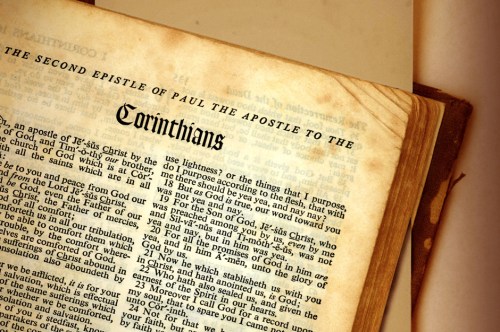
2 Corinthians

Donald Trump spoke to an assembly of students at Liberty University, one of the best-known evangelical colleges in the country. He quoted a Bible passage to show his depth of Christian faith and knowledge.

In doing that, he mispronounced the name of the New Testament book “2 Corinthians” as “Two Corinthians.” It is in fact universally called “Second Corinthians.” Anyone who has glancing familiarity with the Bible knows that, including five-year-olds in Sunday School. Every time there is a numbered series of books (such as 1 Kings and 2 Kings in the Old Testament, etc.), they are called by the ordinal number (First, Second).

Does this prove that Trump has little familiarity with the Bible? Yes. Does this prove that he is willing to cynically use faith as a tool to “close the deal” on the Republican nomination? Yes. Will this affect his support among evangelical Christians, Christians in general, or people of faith? Who knows?

Here’s the thing. It was no mistake.

Trump may not know much about the Bible or about the Presbyterian Church he identifies himself as belonging to. But he knows a “not great” situation when he sees it. Calling these books “First” or “Second” makes no sense. Plus, it’s a waste of time and breath. Everyone knows that Trump is all about making sense and not wasting breath.

And so, this is part of his strategy to make everything terrific. He wants to change the way people have been referring to the Bible for centuries.

He wants to make the Bible great again! Who can blame him? Thank you, Donald.

God and the H-Bomb

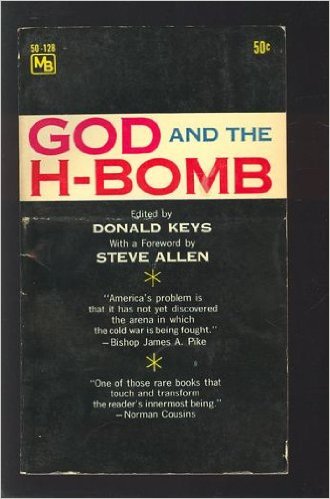
God and the H-Bomb

The Hydrogen Bomb is in the news, thanks to North Korea’s questionable claim that they have one and have tested it.

In the years following World War 2, the H-Bomb was big news. Big, just like The Bomb. The world had seen the destructive power of the A-Bomb used at Hiroshima and Nagasaki. The H-Bomb made the A-Bomb look like a stick of dynamite. Where once there was the power to destroy cities, we could now destroy the world. And ourselves. We were as gods, at least in our punishing might.

In 1961, a book called God and the H-Bomb was published. It’s not in print, but you might find a copy used or in a library, as I did a few years ago. The cover carries this question: “What counsel do our spiritual leaders offer in response to mankind’s greatest challenge?”

The roster of contributors is an impressive list of thinkers, some of whom are still recognized names, some less familiar. Paul Tillich, Martin Buber, Pope Pius XII, and so on.

We don’t see many—any—religious and spiritual leaders interviewed about the North Korean test, about the Iran deal, or about any Bomb related stories. Except for those religious and spiritual leaders with political strategy in mind or a political axe to grind.

That’s not what this 55-year-old book is about. It is about the moral and spiritual dimensions of the H-Bomb. That is reflected in the titles of the pieces. The power of self-destruction. War and Christian conscience. Fifteen years in hell is enough. Thy neighbor as thyself. The road of sanity.

The foreword is by Steve Allen, who is a little remembered as a significant television personality, but less as one of the most entertaining and brilliant public intellectuals of the middle twentieth century. Here’s what he writes:

That our nation is in the throes of moral collapse of serious dimensions is, apparently, no longer a debatable conclusion. Liberal and conservative spokesmen vie to see who shall express the conviction most vigorously. Churchmen and secularists, too, agree that we have fallen upon evil days. These various groups naturally differ as to the reasons for the situation, but that it exists no one seems to doubt….

Will our nation be guided in this dread hour by the moral code it professes to honor?

Will it?

Pay Attention to Religion in America: Even If You Don’t Drive You Can Get Hit By a Car

Pew Research Center

The final report of the Pew Research Center 2014 Religious Landscape Study has just been released: “This report focuses on Americans’ religious beliefs and practices and assesses how they have changed in recent years.” (For those who don’t like to read, here’s a topline video.)

No matter your own religious inclinations, investigate. This is the best overview of religion in America, a survey of more than 35,000 U.S. adults.

Why should you care?

Let’s say you don’t have much to do with cars. You don’t own one. Maybe you even live in a city where you don’t need one, and in fact it is trouble to have one. You think that cars are a problem, not a solution. Anything having to do with cars is totally outside your area of interest.

Except that everywhere you go, the phenomena of cars surround you as part of your world. Streets, traffic, traffic lights, energy, etc. You can’t escape it. Why? Because hundreds of millions of Americans own and use hundreds of millions of cars that occupy a huge piece of our economic, social, psychic, cultural, legal space.

You don’t have to believe in cars, but you should not ignore or dismiss them or the people who own and use them. You don’t have to be an expert on cars, but it might be helpful to have some basic understanding and interest.

Because whether or not you believe in cars, if the traffic light is broken when you cross the street, you will believe in the car that hits you.

Phyllis Tickle: The Godmother of Us All

Phyllis Tickle

Phyllis Tickle died last week at the age of 81. No matter the number, it would always be too low.

Phyllis is the godmother of contemporary religion publishing and those who worked there. She established the Religion section of Publishers Weekly, the bible of the industry. It is possible that no single individual has had a bigger impact on a significant genre of publishing.

She was also a remarkable writer and speaker on matters of religion and spirituality, including her insights into the emerging church for changing times. Among her many books: The Divine Hours, a series of guides to the ancient practice of hourly prayer, and The Shaping of a Life: A Spiritual Landscape, a memoir that is as close as those who didn’t know her will get to the unique and unforgettable person and spirit she was.

Like a brilliant and generous mother, she encouraged and enabled creative editorial talent and writing for decades. If you look at the careers of the good and the great in the field, you will find Phyllis at the nexus. She is found in the acknowledgments of scores of books, like this one picked at random:

“Phyllis Tickle answered countless e-mailed questions, no matter where in the world she was.”

I don’t precisely remember the first time I met Phyllis. She was just always there. I do remember the last time I spoke with her. That voice, the one I can hear clearly right now, that soft and distinctive Tennessee talk, just lifted and lightened you.

“I love you, Schwartz,” she would say. Love you back, Miss P. Miss you too.

Pope Francis’ Encyclical Laudato Si’

Laudato Si'

The Pope’s new encyclical, Laudato Si’, has been much in the news. Whatever you’ve heard about it, if you haven’t seen it, you really don’t know the whole story.

You’ve heard it is about the environment and climate change, which is in small part true. You’ve heard Catholic presidential hopefuls such as Jeb Bush and Bobby Jindal admonish the Pope, their spiritual father, telling him to stick to religion and stay out of politics.

The encyclical is much bigger than climate change, the environment, and certainly bigger than Bush or Jindal or dozens of politicians. It is a big statement about the moral and religious shortcomings of this modern world and us modern people. You don’t have to be Catholic or Christian or faithful or religious to read and appreciate it. You just have to read it.

It is full of inconvenient and uncomfortable truths. Which is probably why the coverage has focused on the environmental exhortations, rather than on the broader cultural, media, technological and social ones. In essence, it is nothing less than a call for radical evolution, in the spirit of the radical evolutionary upon whom the church is built. There are plenty of established institutions and powerful interests and individuals, including the media, who could be forced to change if such radical evolution came to pass. And many of them don’t want to change, and don’t even want us to listen to the Pope talking about it.

The encyclical is a long and deep but very readable work. Download it, sample it. You don’t have to read it all, or all at once. It is naturally grounded in theology, and in some particular theology, but be assured that the observations and conclusions don’t require you to hold any sectarian beliefs. It only requires that we believe that things are far from perfect, and that after we take a close look at ourselves and others, we believe that we have the power and obligation to make things better.

It is filled with so much quotable inspired thought and inspiration. Here is just one brief excerpt:

114. All of this shows the urgent need for us to move forward in a bold cultural revolution. Science and technology are not neutral; from the beginning to the end of a process, various intentions and possibilities are in play and can take on distinct shapes. Nobody is suggesting a return to the Stone Age, but we do need to slow down and look at reality in a different way, to appropriate the positive and sustainable progress which has been made, but also to recover the values and the great goals swept away by our unrestrained delusions of grandeur.

Laudato Si’ PDF

Laudato Si’ epub and Kindle

The Day the Buddha Woke Up

Buddha Comic Bodhi

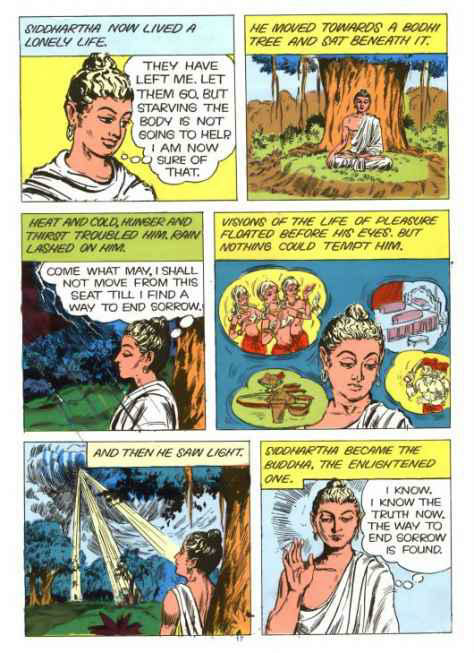
December 8 is Bodhi Day, the day on which the Buddha’s enlightenment is traditionally celebrated.

The English word “enlightenment” is so packed with meaning that it might be better to just go back to what the Buddha is reported to have said: I am awake.

This is useful because it leads to the two questions: woke up from what and woke up to what?

The Buddha, sitting there under the Bodhi tree, woke up from a journey. Born a royal son, he had fled a life of accidental privilege to answer ultimate questions about suffering and death—the very same questions that consume religious lives of all kinds. He believed that if he tried a, b, and c (such as extreme asceticism), he would discover some secret x, y, and z. There was some kind of magic formula, and all he had to do was learn it. That sort of magic is still at the heart of much of our religion.

He woke up to discover that there was no magic, not in such an instrumental sense. Nothing was different. Suffering and death would not go away, no matter what efforts we make. The best and worst aspects of life would go on, with and without us. Great fortunes would be made and lost. Great structures would be built and then destroyed, by cataclysms natural and human. Love would be here and gone.

But this: He could see something in all of that that made sense of all of that. There is no big plan in which we are players, active or passive, though we could and do make and execute our own little plans. There are just things, relationships between those things, and change, and of all those of a singular piece. We can and do overlay that with all of our very complicated details and distinctions, which is after all a definition of the life we live. But if we discover that underlying existence, we just might choose to live differently. And in that living differently, make change and wake others up. And on and on.

None of that eliminated suffering and death for the Buddha, as it won’t for anyone. He grew old and tired and, legend has it, died from being given spoiled food. He had told his followers what he had discovered, none of which involved magic. It was all about the infinite depth of the ordinary. For him, there was no more a kingdom in the clouds than the kingdom he had left behind when he started his journey. There was just what is. Strive on with diligence, he told those followers at the last.

Homeless Kodo on Religion

Kodo Sawaki

A short while ago I wrote about a new book, The Zen Teaching of Homeless Kodo. I thought it was the last I would say about it.

It is a book best read in bites. I’ve had to resist the temptation after each bite to say, “you’ve gotta taste this” and “you’ve gotta taste this.” This isn’t a blog about Zen (or about anything else in particular, for that matter). And by the time I got through pointing to all the chapters worthy of attention, I would have quoted practically the whole book.

I’ve written before about how religion is both essential in some form and so badly misused and abused. Others have said it much better. Here, Kodo Sawaki, in literary “conversation” with his student Kosho Uchiyama and with Uchiyama’s student Shohaku Okumura, talks about the value of religion, properly defined and understood.


Religion Is Life

KODO SAWAKI:

How we live our everyday lives has to be the main concern of religion.

KOSHO UCHIYAMA:

On television, it’s permissible to show scenes of explicit sex and crimes, including murder. Big posters of nude women can be posted on the street. Although kids see these TV shows and posters, not many people worry about this. At the same time, it’s illegal to teach religion in public school. To me this is one of the mysteries of twentieth-century Japan.

Maybe people think that “religion” means established sects, superstition, or fanaticism. It’s certainly true that if an innocent child is influenced by one-sided, fixed doctrines, this will lead to great problems. So one might say it’s understandable that the government bans religious education in public schools. On the other hand, if religion means teachings about the most important matter of our lives—how we should live—then we should worry about the next generation, growing up in a society without any religious education, yet constantly confronted with images of sex and violence. If things continue like this, we’ll find young people becoming more and more destructive.

I hope the time will come for religion to be taught in school without indoctrination, but as a lesson about the most important question of life: how to live.

KODO SAWAKI:

“Religion” is to live out the ever fresh self, which is not deceived by anything.

Religion must not be a system of dogma. Religion is life. Religion has to function as life. Worshiping sutras is not enough. Religion must manifest itself freely and inexhaustibly in all activities of life, everywhere and always.

SHOHAKU OKUMURA:

When the government supported religious institutions and forced people to adopt them, this caused terrible problems. An example is the State Shinto from the Meiji era to the end of World War II. When political power and religious authority are combined, there can be no freedom. I don’t think that’s what Uchiyama Roshi is recommending.

As I mentioned in chapter 2, the Japanese equivalent of the word “religion” is shukyo. This word originally referred to Buddhism: the teaching, or kyo, about fundamental reality, or shu. Sawaki Roshi and Uchiyama Roshi used the word “religion” to mean awakening to reality, rather than a system of belief and worship within a particular tradition.

Uchiyama Roshi thought the most important questions of our life should be taught in schools as the subject “Human Life.” He even wrote a textbook as an example. In that book he remarked:

When the time comes to teach “Human Life” in schools, I think the word “religion” should be eliminated. When we use the word in its traditional meaning . . . a strange atmosphere is created. This is because traditional religions always set up some authority beyond our understanding and force people to believe certain myths and doctrines. And yet in our life as the self that is born and dies naked, fundamentally no such authority and belief are necessary. We just need to straightforwardly see the reality of life as the self and teach how to live based on that reality.

Uchiyama Roshi’s searching, studying, and practicing were ways to study the “self.” He wasn’t interested in becoming a believer of a traditional religion. In his search for truth, he found some people in the Buddhist tradition who had the same attitude. One was the Buddha, who said, “The self is the only foundation of the self.” Another was Dogen, who said, “To study the Buddha way is to study the self.” Sawaki Roshi emphasized zazen practice as “the self selfing the self.” Throughout his life, Uchiyama Roshi continued to read the Bible as one of the ways to study the self. In his final days, he said, “I am neither a Buddhist nor a Christian. I am just who I am.

The Zen Teaching of Homeless Kodo
Wisdom Publications

Obama Speech: Is It ISIS, ISIL or IS, and What is a True Religion?

Obama ISIS Speech

This is not a comprehensive review of last night’s speech by President Obama about ISIS/ISIL/IS. But if you asked me to join the millions of reviewers, descriptors that come to mind are lukewarm, vague, uninspiring, insufficiently informative, tactical (the speech, not the plan), and blah-blah-blah.

Here is one paragraph that stuck out, because it reflects two issues that may not get enough attention:

And one of those groups is ISIL — which calls itself the “Islamic State.”

Now let’s make two things clear: ISIL is not “Islamic.” No religion condones the killing of innocents. And the vast majority of ISIL’s victims have been Muslim. And ISIL is certainly not a state. It was formerly al Qaeda’s affiliate in Iraq, and has taken advantage of sectarian strife and Syria’s civil war to gain territory on both sides of the Iraq-Syrian border. It is recognized by no government, nor by the people it subjugates. ISIL is a terrorist organization, pure and simple. And it has no vision other than the slaughter of all who stand in its way.

What Is the Name of This Enterprise That We Are at War Against?

Is it ISIS, ISIL, or Islamic State? This is much more significant than whether the English transliteration of the name of the Egyptian President was Morsy, Morsi, or Mursi or the Libyan dictator was Gadhafi, Qaddafi, Kadafi, Gaddafi, or Gadafy. This is our new mortal enemy, and besides, all these IS names are in English.

Different nations and different news media have different approaches to this. The BBC, for example, has settled on Islamic State, apparently opting for whatever the organization chooses to call itself. What is totally strange about the “official” U.S. nomenclature is that at the highest levels, there is no consistency. The President prefers ISIL, while those in his cabinet regularly use ISIS.

One small matter about ISIL does deserve note. The full name is the Islamic State in Syria and the Levant. I challenge many in the administration, and many in Congress, and many in the media, to explain—without Google or cheat sheet—what the Levant is. For five hundred years or so it has described the land of the eastern Mediterranean, now roughly comprising Syria, Lebanon, Israel, and contiguous countries. The word comes from the French word for “rising”, as in the east where the sun rises. It isn’t much in use any more, outside of scholarly circles and, of course, in our latest war.

So please, President Obama, if you are gathering the support of dozens of nations and hundreds of millions of Americans, let’s all decide on what to call this organization that, in the words of Vice President Joe Biden, we will pursue to the Gates of Hell.

What is a True Religion?

“No religion condones the killing of innocents,” the President said. Without going into historic and contemporary detail, this is patently false. I believe the President knows better, but he didn’t want to get into a deep discussion, and instead just wanted to make a rhetorical flourish. If he doesn’t know, there are thousands of histories he can read and scholars he can consult, or even easier, news reports from the past few weeks, months, and years he can read.

If, however, he really did mean it, he has disqualified the majority of world religions from being classified as such. Which, by the way, plenty of critics of religion would applaud.

The President doesn’t have to be the Teacher in Chief, the Scholar in Chief, the Explainer in Chief, etc. Being Communicator in Chief is enough of a job, but if he just wants to say stuff for effect, without regard to its making sense or being true, we’ve already had plenty of that in years past, from those less smart or thoughtful than you. We get enough nonsense from many in Congress. Speak as if some of us are actually thinking about what you say. Because some of us are.