Bob Schwartz

Tag: politics

The Poetry of Citizenry

“You are Whitman, you are Poe, you are Mark Twain, you are Emily Dickinson and Edna St. Vincent Millay, you are Neruda and Mayakovsky and Pasolini, you are an American or a non-American, you can conquer the conquerors with words.”
Lawrence Ferlinghetti, Poetry as Insurgent Art

“There is a strong underground tradition of the poetry of engagement, which we might also call the poetry of citizenzry.”
Edward Hirsch, A Poet’s Glossary

“Poetry, an act of the imagination, is subject to historical forces, but it also talks back to history. The idea of witnessing should be widened to go beyond the documentary response to events. ‘I am the man . . . I suffered . . . I was there,’ Walt Whitman declared. A broad imaginative sympathy was part of his lived experience.”
Edward Hirsch, A Poet’s Glossary

I’ve written before about poetry as insurgent art, a term used by Lawrence Ferlinghetti. Here I add to the conversation with three entries from A Poet’s Glossary by Edward Hirsch—an essential book for those who read write study or teach poetry.

It is no surprise to regular readers that I think these are extraordinary times. And that I think people in all quarters should consider the ways they can help right the ship and steer it in a different direction. That is, all hands on deck, including poets.

How well that works, or whether it works at all, is to be determined. But as the student Sophie Scholl said of her tiny but morally mighty White Rose resistance movement in Nazi Germany, which boldly distributed simple leaflets, “Somebody, after all, had to make a start.” As well poets as anyone else.


From A Poet’s Glossary by Edward Hirsch:

political poetry

Poetry of social concern and conscience, politically engaged poetry. The feeling often runs high in the social poetry of engagement, especially when it is partisan. Poets write on both sides of any given war, defend the State, attack it. All patriotic and nationalistic poetry is by definition political. Political poetry, ancient and modern, good and bad, frequently responds vehemently to social injustice. Thus the poet is Jeremiah crying out to the assembly to witness the folly, unprecedented in both West (Cyprus) and East (Kedar), of a people who have forsaken the fountain of living waters for the stagnant water at the bottom of a leaky cistern. The Lamentations of Jeremiah, a series of poems mourning the desolation of Jerusalem and the sufferings of her people after the siege and destruction of the city and the burning of theTemple by the Babylonians, is also a political poem.

Strabo came up with the label stasiotika (“stasis-poems”) for Alcaeus’s partisan songs, political poems, which are propagandistic poems of civil war and exile, accounts of his political commitments. The premise of political poetry is that poetry carries “news” or information crucial to the populace. Political poetry is a poetry self-consciously written inside of history, of politics. It responds to external events. “Mad Ireland hurt you into poetry,” W. H. Auden famously decreed in his elegy for W. B. Yeats, and so, too, we might say that the madness of any country’s brutality has often wounded its poets into a political response in poetry. “I stand as a witness to the common lot, / survivor of that time, that place,” Anna Akhmatova wrote in 1961. Behind the poem in quest of justice, these lines from Shakespeare’s Antony and Cleopatra (1623): “our size of sorrow, / Proportion’d to our cause, must be as great / As that which makes it.”

There is an ephemeral quality to a lot of political poetry—most of it dies with the events it responds to—but a political poem need not be a didactic poem. It can be a poem of testimony and memory. For the best political poems of the twentieth century, I think of Vahan Tekeyan’s poems of the Armenian genocide; of the Spanish Civil War poet Miguel Hernandez’s haunting prison poems, especially “Lullaby of the Onion” (1939); and the Turkish poet Nazim Hikmet’s equally poignant prison poems, especially “On Living” (1948) and “Some Advice to Those Who Will Spend Time in Prison” (1949); of Bertolt Brecht’s World War II poems and Nelly Sachs’s Holocaust poems. I think of the Italian poet Cesare Pavese’s testimonies to ordinary people in trouble, Hard Labor (Lavorare stanca, 1936), and Pablo Neruda’s epic testament, Canto General (1950). I think of the many poems of indictment and summons, of land and liberty, collected in the Nigerian writer Wole Soyinka’s breakthrough anthology, Poems of Black Africa (1975).

There is a strong tradition in England of political poems. Edmund Spenser’s Complaints (1591) takes aim at social and political targets. John Milton wrote a series of pro-Cromwellian short poems in the 1640s and ’50s. Some of John Dryden’s greatest poetry was written in response to events, such as his two-part political satire Absalom and Achitophel (1681, 1682). William Wordsworth’s political poems are among his best, such as his sonnet “To Toussaint L’Ouverture” (1803), though a few of his late patriotic poems are also among his worst. Percy Bysshe Shelley’s The Mask of Anarchy (1819), which was “Written on the Occasion of the Massacre at Manchester” (“I met Murder on the way—/ He had a mask like Castlereagh”), is a frankly political poem that always gives me a chill. Elizabeth Barrett Browning published two striking books of political poetry during her Italian sojourn, Casa Guidi Windows (1850) and Poems Before Congress (1860). The most popular Victorian poet, Alfred, Lord Tennsyon, never distinguished between the personal and the political, the private and the public.

Political poetry has always seemed somewhat suspect in American literary history. “Our wise men and wise institutions assure us that national political events are beyond the reach of ordinary, or even extraordinary, literary sensitivity,” Robert Bly writes. Yet there is a strong underground tradition of the poetry of engagement, which we might also call the poetry of citizenzry. This runs from Walt Whitman’s political poems of the 1850s, which prefigure Leaves of Grass, and John Greenleaf Whittier’s Anti-Slavery Poems (1832–1887), to leftist poets of the 1930s (Kenneth Fearing, Edwin Rolfe, Muriel Rukeyser). The civil rights movement and the Vietnam War enraged poets, and, as Bly points out, some of the most inward poets, such as Robert Duncan, Denise Levertov, and Galway Kinnell, wrote some of the best poems against the Vietnam War. Most poetry of the 1940s and ’50s shunned politics, but Thomas McGrath (“Ode for the American Dead in Korea,” retitled in the early 1970s “Ode for the American Dead in Asia”) and Kenneth Rexroth (“A Christmas Note for Geraldine Udell,” 1949) bucked the trend. For forty years, Adrienne Rich was one of the most outspoken political poets in late twentieth-century American poetry, a model for a generation of political and activist poets. She went through several phases in relationship to polemics. She proposed a position that resists didacticism in “Power and Danger: Works of a Common Woman” (1978), her introduction to a collection of poems by Judy Grahn:

No true political poetry can be written with propaganda as an aim, to persuade others “out there” of some atrocity or injustice (hence the failure, as poetry, of so much anti-Vietnam poetry of the sixties). As poetry, it can come only from the poet’s need to identify her relationship to atrocities and injustice, the sources of her pain, fear, and anger, the meaning of her resistance.

protest poetry 

Poetry of dissent, of social criticism. It protests the status quo and tries to undermine established values and ideals. The protest poet is a rebellious citizen, speaking out, expressing disapproval of a political policy or social action. Protest poetry, the most earnest of genres, is timely, oppositional, reactive, urgent. It is an activist type of political poetry born from outrage and linked to social action. It turns poetry into a medium for polemics.

The reprehensible policy of apartheid in South Africa, which legislated racism, also stimulated a powerful tradition of protest poetry. The Zulu poet Herbert I. E. Dhlomo’s long poem Valley of a Thousand Hills (1941) is the most extended work of South African protest poetry. One thinks of the contributions of Dennis Brutus (1924–2009), whose work is brought together in Poetry and Protest: A Dennis Brutus Reader (2006); Arthur Nortje (1942–1970), whose work is published posthumously in Dead Roots (1973) and Lonely Against the Light (1973); and Mazisi Kunene (1930–2006), who first sounded his aggressive, telegraphic note in Zulu Poems (1970). The New Black poetry of the 1970s, or Soweto poetry, was a protest poetry of black consciousness. In the United States, there is also a strong tradition of African American poetry that protests racism. It extends from the Harlem renaissance to the Black Arts movement. Most antiwar poetry is protest poetry. The combatant antiwar poetry of Wilfred Owen (1893–1918) and Siegfried Sassoon (1886–1967) protested the technological horrors of modern warfare. The Spanish Civil War generated both local and global protest poetry. The Vietnam War galvanized a tremendous amount of protest poetry by such poets as Robert Lowell, Allen Ginsberg, Adrienne Rich, and Robert Bly. These poets felt a cultural imperative to speak out against the war. The repression and disintegration of the American imagination is one of the persistent themes of Vietnam-era protest poetry. Much of the feminist poetry of the 1960s and ’70s is protest poetry. “A patriot is not a weapon,” Adrienne Rich writes in her long poem An Atlas of the Difficult World (1981). “A patriot is one who wrestles for the soul of her country / as she wrestles for her own being.” Sam Hamill’s anthology Poets Against the War (2003) was a hastily gathered book of protest poems against the war in Iraq. The strength of protest poetry is its sense of immediacy and outrage. However, most of these politically motivated poems, which are often made in outrage against a specific atrocity, don’t outlive their historical moment.

witness of poetry, poetry of witness 

Poetry of testimony. In the early 1990s, Carolyn Forché transformed the Polish poet Czeslaw Milosz’s phrase the witness of poetry (taken from the book of the same name, 1983) into “the poetry of witness.” Her anthology Against Forgetting: Twentieth-Century Poetry of Witness (1993) gathers together the work of 145 poets “who endured conditions of historical and social extremity during the twentieth century—through exile, state censorship, political censorship, house arrest, torture, imprisonment, military occupation, warfare, and assignation. Many poets did not survive, but their works remain with us as poetic witness to the dark times in which they lived.” Poetry, an act of the imagination, is subject to historical forces, but it also talks back to history. The idea of witnessing should be widened to go beyond the documentary response to events. “I am the man . . . I suffered . . . I was there,” Walt Whitman declared. A broad imaginative sympathy was part of his lived experience.

In 1944, the Hungarian poet Miklós Radnóti wrote four harrowing “Postcard” poems in the midst of a forced march westward across Hungary. Radnóti was one of twenty-two prisoners murdered and tossed into a collective grave. After the war, his widow had his body exhumed and these poems were found in his field jacket, written in pencil in a small Serbian exercise book. Thus his poems nearly literally rise up from a mass grave. They inscribe a suffering unimaginably intense, a consciousness of death nearly unbearable. They are purposefully entitled “Postcards.” Here the informality of the postcard (dashed off, superficial) is belied by the scrupulousness with which Radnóti describes and re-creates the scene of his impending death. The postcard is a message directed to another person. It has a particular reader in mind, but its openness also suggests that it can be read by anyone. Thus the poem in the guise of a postcard is a testimony back to life, a signal that Radnóti had pushed back the silence long enough to embody a final experience. His poems of witness display the classical brevity and poise of an Orphic art that comes back from the underworld to give testimony.

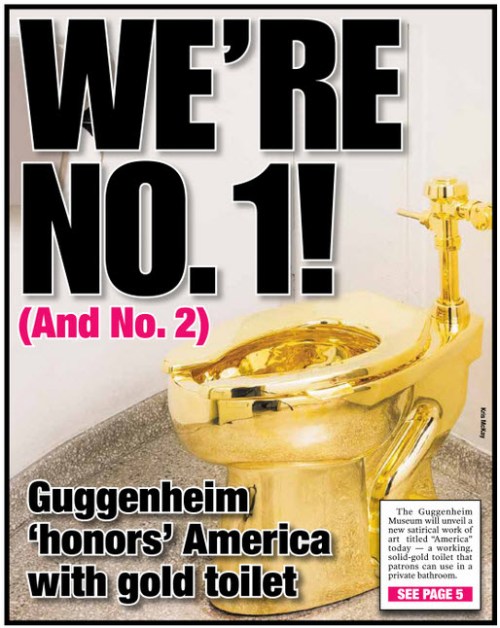
“The White House asked to borrow a van Gogh. The Guggenheim offered a gold toilet instead.”

Washington Post:

The emailed response from the Guggenheim’s chief curator to the White House was polite but firm: The museum could not accommodate a request to borrow a painting by Vincent Van Gogh for President and Melania Trump’s private living quarters.

Instead, wrote the curator, Nancy Spector, another piece was available, one that was nothing like “Landscape With Snow,” the 1888 Van Gogh rendering of a man in a black hat walking along a path in Arles, France, with his dog.

The curator’s alternative: an 18-karat, fully functioning, solid gold toilet — an interactive work titled “America” that critics have described as pointed satire aimed at the excess of wealth in this country.

For a year, the Guggenheim had exhibited “America” — the creation of contemporary artist Maurizio Cattelan — in a public restroom on the museum’s fifth floor for visitors to use.

But the exhibit was over and the toilet was available “should the President and First Lady have any interest in installing it in the White House,” Spector wrote in an email obtained by The Washington Post.

The artist “would like to offer it to the White House for a long-term loan,” wrote Spector, who has been critical of Trump. “It is, of course, extremely valuable and somewhat fragile, but we would provide all the instructions for its installation and care.”

New York Post – September 16, 2016

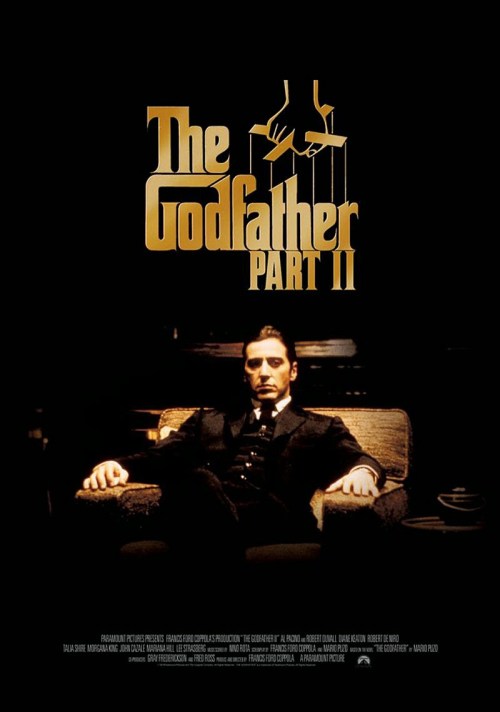
The Godfather Part II Presages the Trump Presidency

“All my people are businessmen; their loyalty is based on that…and on that basis, anything is possible.”

“Free to make our profits without the Justice Department, the FBI…looking for a man who desperately wants to be President of the United States.”

The Godfather Part II

The Godfather Part I and Part II are more than near-perfect movies, two of the most critically-acclaimed films of all time. They are compelling pictures of the unrestrained grab for power and money, fueled by mutual self-interest and governed by no other values.

These two quotes from The Godfather Part II (1974), more than forty years old, encapsulate where America finds itself today:

MICHAEL CORLEONE
“All my people are businessmen; their loyalty is based on that. One thing I learned from my father is to try to think as the people around you think…and on that basis, anything is possible.”

HYMAN ROTH
“If only I could live to see it, kid; to be there with you. How beautifully we’ve done it, step by step. Here, protected, free to make our profits without the Justice Department, the FBI; ninety miles away in partnership with a friendly government. Ninety miles, just a small step, looking for a man who desperately wants to be President of the United States, and having the cash to make it possible.”

Without a Brand New Playbook the Democrats Are Lost

Sid Gillman is a towering figure in National Football League history—in fact, in the history of American football:

He began his coaching career in an era that taught that running the ball was the surest way to victory.

It was a philosophy with which he disagreed. “The big play comes with the pass,” he would tell anyone who would take time to listen. “God bless those runners because they get you the first down, give you ball control and keep your defense off the field. But if you want to ring the cash register, you have to pass.”

Sid went on to become the foremost authority on forward passing offense. He was the first coach to produce divisional champions in both the National and American Football Leagues. Gillman’s first pro coaching job came in 1955 when he became the Los Angeles Rams head coach. In his first year he led the team to a division crown.

The rest is history. Not only did opposing teams have to learn to defend against the big pass play, which opened up the field, but they had to develop new and innovative playbooks of their own.

Like it or not, there is a new playbook in American politics, at least from one of the teams. Maybe—hopefully—it will return to a game that unconditionally rewards excellence, competence, integrity, morality, ethics, reasonableness, responsibility, accountability, civility and honesty. But not at the moment.

This isn’t to suggest that Democrats adopt the Trump playbook. But just as with the football teams that had to play against Gillman, the Democrats have to spend time—much of which they wasted in 2017—doing more than tweaking the plays or even finding better players. The old playbook is not going to work in 2018, and for all we know, in the foreseeable future.

Whatever you hear the Democrats propose, whoever you see the Democrats running, ask yourself whether it is part of a brand new playbook, or just updated versions of the same old one. Because without that new playbook, winning will remain often out of reach.

Shark Jewelry As Protection from Trump (Update)

Updated to include the Discovery Channel response to Trump’s views on sharks.

In Touch Weekly has published an interview with Stormy Daniels about her affair with Trump—while he was married to Melania, starting just after the birth of their son Barron.

It is profoundly sad, dispiriting, and disturbing. But not surprising. Not surprising either is the silence of his Republican henchmen and supporters, who seem to put up with anything, provided they can make more money or keep their jobs and power.

Among the non-sexual tidbits that have caught everyone’s attention is her relating Trump’s obsessive fear and hatred of sharks:

The strangest thing about that night — this was the best thing ever. You could see the television from the little dining room table and he was watching Shark Week and he was watching a special about the U.S.S. something and it sank and it was like the worst shark attack in history. He is obsessed with sharks. Terrified of sharks. He was like, “I donate to all these charities and I would never donate to any charity that helps sharks. I hope all the sharks die.” He was like riveted. He was like obsessed. It’s so strange, I know.

Just as vampires are put off by crosses, it is possible, just possible, that shark jewelry can protect us from Trump. Either figurative sharks or shark’s teeth might work. No guarantees, but it’s worth a try.

Update

From Mashable:


Mashable reached out to the Shark Week network after reading a report alleging that Trump once said, “I hope all sharks die.” Its response was measured.

“Shark Week celebrates the wonder of these majestic creatures and their critical importance to the ecosystem,” a Discovery Channel representative told Mashable when asked for comment about the president’s Shark Week viewing habits and fears. “Their safety and conservation is the most important message conveyed throughout the week.”


President Pmurt

Mister Mxyzptlk was an imp from the fifth dimension who was a constant nemesis of Superman in the comics. The only way this villain could be made to disappear was to trick him into saying his own name backwards.

And so, while we wait for something to rid us of our meddlesome president, one suggestion is to trick him into saying (or tweeting) his name backwards: Pmurt (pronounced puhmurt?)

How? Well, if someone were to tweet something critical, including a claim that Trump was a “pmurt”, the president could not resist answering the charge, including in his replies a flat out denial of the fake news that he is a pmurt.

Yup, that should do it.

“Dozens of U.S. Jewish Activists Stage Sit-in on Capitol Hill in Protest of Trump’s Threat to Deport Dreamers”

It was starting to appear that many faith communities might not be taking their place in standing up and resisting the daily assault on the deepest American, Judeo-Christian and human values. In fact, it appeared that some of those communities were not only silent but hypocritically complicit.

This morning’s protest at the Capitol is one of the latest rays of light. From Haaretz:

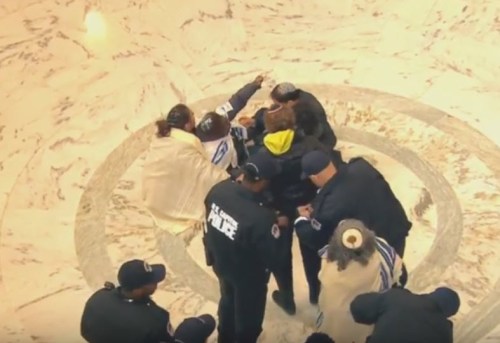
Dozens of U.S. Jewish Activists Stage Sit-in on Capitol Hill in Protest of Trump’s Threat to Deport Dreamers

‘Let my people go,’ chant a group of Dreamers alongside coalition of Jewish groups and members of Congress

WASHINGTON – Dozens of Jewish American activists demonstrated on Capitol Hill Wednesday calling on Congress to pass legislation in protection of “Dreamers,” undocumented immigrants who arrived to the United States as children.

A coalition of Jewish groups organized the demonstration, including the Religious Action Center of the Reform movement, Bend the Arc, the Anti-Defamation League and others.

A group of Dreamers also joined the demonstration, chanting “Let my people stay.” Members of Congress Ted Deutch (D-FL) and Debbie Wasserman Schultz (D-FL), who are both Jewish, also arrived at the scene to express their support as activists were arrested….

After handing a petition signed by over 5,000 people thus far to members of Congress, the protesters sat on the floor of the Russel Senate Office Building and chanted “we will not be moved.”

“As Jews, we recognize the dangers of President Trump’s inhumane policies and scapegoating of immigrants,” the petition states. “We’ve seen this before. We stand with our immigrant neighbors on the side of justice, not oppression, of liberation, not deportation.”

A number of protesters, including Reform rabbis, were arrested by Capitol Hill Police officers.

Barbara Weinstein of the Reform Movement’s Religious Action Center told Haaretz that dozens of the protesters were arrested, but that most of them are being released. “It’s long past time for Congress to pass legislation for the Dreamers,” she stated. “We need this bill immediately. We had a lot of members of Congress, from the House and Senate side, who told us they were determined to solve the crisis. It’s important to Democrats and Republicans alike.”

Weinstein added that “welcoming the stranger is an important part of our identity. We are all descendants of immigrants. It’s on all of us to support these Dreamers. They grew up here, this is the only country they’ve ever known, many of them serve in the military, this is their home. We’re going to remain focused on this issue until we see a bill reach the president’s desk and signed by him. This is not over today.”


To Understand America 2018, Read Alice’s Adventures in Wonderland

We had the best education. We went to school every day. I only took the regular course. Reeling and Writhing to begin with. Then the different branches of Arithmetic—Ambition, Distraction, Uglification, and Derision.
Alice’s Adventures in Wonderland

Read Alice’s Adventures in Wonderland now. Again if it’s been a while, and definitely now if for the first time.

Lewis Carroll (born Charles Dodgson, 1832-1898) was famously creative as a mathematician and logician. He wove puzzles and tortured logic all through his book Alice’s Adventures in Wonderland.

Puzzles and tortured logic seem likely to be a major component of America in 2018, as they were in 2017.

The leadership and the citizens of Wonderland are variously tyrannical, illogical, stupid, or just plain bizarre. Alice literally does not fit in. While she is only a child, she has more sense than everyone she meets combined.

If I had a news network like CNN, I’d interrupt the futile attempts to understand and explain what’s going on by having different news anchors read aloud one chapter from Alice in Wonderland every day. It would actually be more constructive—and more fun—than just listening to their trying to making sense of the nonsensical.

If Trump’s tweets were taken from Alice in Wonderland, would we know the difference? Would he?

Some Trump/Alice tweets:

We must have a trial. Really this morning I have nothing to do. With no jury or judge I’ll be Judge. I’ll be jury. I’ll try the whole cause and condemn you to death.

We’re all mad here. I’m mad. You’re mad. A dog growls when it’s angry and wags its tail when it’s pleased. Now I growl when I’m pleased and wag my tail when I’m angry. Therefore I’m mad.

Be what you would seem to be. Never imagine yourself not to be otherwise than what it might appear to others that what you were or might have been was not otherwise than what you had been would have appeared to them to be otherwise.

You have no right to think. Just about as much right as pigs have to fly. I give you fair warning either you or your head must be off. Take your choice!

We had the best education. We went to school every day. I only took the regular course. Reeling and Writhing to begin with. Then the different branches of Arithmetic—Ambition, Distraction, Uglification, and Derision.

Umberto Eco: Ur-Fascism

Celebrated Italian author and scholar Umberto Eco (1932-2016)  published an article in 1995 entitled Ur-Fascism .

Eco grew up during the time of Mussolini. In the article, he jumps from memories of that experience to describe some varieties of fascism and other types of totalitarianism. Not all are well-defined fascism, he says, but he does identify the core characteristics of what he calls Ur-Fascism.

I think it is possible to outline a list of features that are typical of what I would like to call Ur-Fascism, or Eternal Fascism. These features cannot be organized into a system; many of them contradict each other, and are also typical of other kinds of despotism or fanaticism. But it is enough that one of them be present to allow fascism to coagulate around it.

Eco goes on to list 14 features of Ur-Fascism. This is the excerpted list; please read the article for an expanded explanation. And as you read it, please consider which of those features you might be seeing now.

1. The first feature of Ur-Fascism is the cult of tradition….As a consequence, there can be no advancement of learning.

2. Traditionalism implies the rejection of modernism….In this sense Ur-Fascism can be defined as irrationalism.

3. Irrationalism also depends on the cult of action for action’s sake. Action being beautiful in itself, it must be taken before, or without, any previous reflection.

4. No syncretistic faith can withstand analytical criticism. The critical spirit makes distinctions, and to distinguish is a sign of modernism.

5. Besides, disagreement is a sign of diversity. Ur-Fascism grows up and seeks for consensus by exploiting and exacerbating the natural fear of difference.

6. Ur-Fascism derives from individual or social frustration. That is why one of the most typical features of the historical fascism was the appeal to a frustrated middle class, a class suffering from an economic crisis or feelings of political humiliation, and frightened by the pressure of lower social groups.

7. To people who feel deprived of a clear social identity, Ur-Fascism says that their only privilege is the most common one, to be born in the same country. This is the origin of nationalism.

8. The followers must feel humiliated by the ostentatious wealth and force of their enemies….Thus, by a continuous shifting of rhetorical focus, the enemies are at the same time too strong and too weak.

9. For Ur-Fascism there is no struggle for life but, rather, life is lived for struggle.

10. Elitism is a typical aspect of any reactionary ideology, insofar as it is fundamentally aristocratic, and aristocratic and militaristic elitism cruelly implies contempt for the weak. Ur-Fascism can only advocate a popular elitism.

11. In such a perspective everybody is educated to become a hero. In every mythology the hero is an exceptional being, but in Ur-Fascist ideology, heroism is the norm.

12. Since both permanent war and heroism are difficult games to play, the Ur-Fascist transfers his will to power to sexual matters. This is the origin of machismo (which implies both disdain for women and intolerance and condemnation of nonstandard sexual habits, from chastity to homosexuality). Since even sex is a difficult game to play, the Ur-Fascist hero tends to play with weapons—doing so becomes an ersatz phallic exercise.

13. Ur-Fascism is based upon a selective populism, a qualitative populism, one might say. In a democracy, the citizens have individual rights, but the citizens in their entirety have a political impact only from a quantitative point of view—one follows the decisions of the majority. For Ur-Fascism, however, individuals as individuals have no rights, and the People is conceived as a quality, a monolithic entity expressing the Common Will. Since no large quantity of human beings can have a common will, the Leader pretends to be their interpreter….Because of its qualitative populism Ur-Fascism must be against “rotten” parliamentary governments.

14. Ur-Fascism speaks Newspeak.

Eco closes with this:

Ur-Fascism is still around us, sometimes in plainclothes. It would be so much easier, for us, if there appeared on the world scene somebody saying, “I want to reopen Auschwitz, I want the Black Shirts to parade again in the Italian squares.” Life is not that simple. Ur-Fascism can come back under the most innocent of disguises. Our duty is to uncover it and to point our finger at any of its new instances—every day, in every part of the world.

American Nazi Rally, Madison Square Garden

This post was drafted a month ago, but I decided that maybe I had been mentioning Nazi Germany too frequently. If you’ve read some of those earlier posts (here and here, for example), you see that I have never made an explicit connection between the current situation and that one.

Now President Obama has been bold enough to speak of this expressly:

“We have to tend to this garden of democracy or else things could fall apart quickly.…That’s what happened in Germany in the 1930s, which despite the democracy of the Weimar Republic and centuries of high-level cultural and scientific achievements, Adolph Hitler rose to dominate. Sixty million people died. . . .So, you’ve got to pay attention. And vote.”

Naturally, the reaction has been swift from Trump apologists—who already hate Obama—claiming that it is heinous to compare Trump to Hitler, and no such death of democracy is in the offing. On the contrary, they say, we are finally on our way to reviving our past glory.

The message in a democracy is inarguable: know your history, pay attention, and vote. Part of not knowing and not paying attention is the delusion that “it can’t happen here.”

Above is a picture of the American Nazi Rally at Madison Square Garden on February 20, 1939. It was a full house of 22,000 “patriots”, with a giant god-like image of George Washington on stage, thought of as the father of their White Christian America.

Those who tried to disrupt the Madison Square Garden rally were arrested. Which is worse: being silent knowing that something is horribly wrong, or not being believed—actually being arrested—when you speak up?