Bob Schwartz

Tag: politics

The Moral and Legal Responsibilities of Bringing a Wild and Dangerous Animal Into Your House

No one can force you to adopt a wild and dangerous animal as your pet. To bring it into your house. To make it your own. If you do go ahead, against all advice, know the responsibilities.

Some animals are so inherently dangerous that they are not even allowed to be adopted at all. In other cases, if the animal harms or looks like it might harm neighbors, or gets loose and does more widespread damage, you will be blamed. Here is a very rough statement of part of the general law on the subject:

The owner or keeper of a domestic animal has a duty to take reasonable steps to prevent injuries that are foreseeable because the animal belongs to a class of animals that is naturally inclined to cause such injuries, regardless of whether the animal had previously caused an injury or was roaming at large and, accordingly, the owner may be held liable for negligence if he or she fails to take such reasonable steps and an injury results.

Some will say, oh, but it’s so cute and exotic and interesting. It’s the talk of the town. It may seem relatively normal, even lovable, at times. It may even be featured on the local news.

But eventually, neighbors will say: stay away from that house. And will tell others to stay away from your house. And if it does the kind of serious damage you know it is capable of, how will you live with yourself?

(What’s So Funny ‘Bout) Peace Love and Understanding?

Coldplay Glastonbury

After watching the chaos surrounding the Trump rally in Chicago on TV, I surfed and came across a Coldplay concert, which served to cleanse my soul.

The huge crowd at Glastonbury looked very happy. I wondered if, when the political conventions are held this summer, we can magically replace them with music festivals.

Coldplay performed Wonderful World, and then that anthem of making things better, Fix You:

Lights will guide you home
And ignite your bones
And I will try to fix you

I thought about other positive music I love. Like Elvis Costello’s (What’s So Funny ‘Bout) Peace Love and Understanding? What is?

As I walk on through this wicked world,
Searching for light in the darkness of insanity,
I ask myself, is all hope lost?
Is there only pain, and hatred, and misery?

And each time I feel like this inside,
There’s one thing I wanna know,
What’s so funny ’bout peace, love, and understanding?

And as I walked on through troubled times,
My spirit gets so downhearted sometimes,
So where are the strong?
And who are the trusted?
And where is the harmony?
Sweet harmony

‘Cause each time I feel it slipping away, just makes me wanna cry,
What’s so funny ’bout peace, love, and understanding?

Donald Trump, You’re No Barry Goldwater

Donald Trump is now being compared to Barry Goldwater in 1964, an unfavored Republican candidate for President who lost big yet did not destroy the party.

I wrote recently about how the Bernie Sanders phenomenon is like the Goldwater one: a philosophical wing that will eventually take over the whole party—as Goldwater conservatism took over the Republicans.

To compare Goldwater and Trump, following are excerpts from their literary masterworks: Goldwater’s erudite and principled The Conscience of a Conservative, which is for many still the Bible of the modern conservative movement, and Trump’s Trump: The Art of the Deal, which is still…something.


The root difference between the Conservatives and the Liberals of today is that Conservatives take account of the whole man, while the Liberals tend to look only at the material side of man’s nature. The Conservative believes that man is, in part, an economic, an animal creature; but that he is also a spiritual creature with spiritual needs and spiritual desires. What is more, these needs and desires reflect the superior side of man’s nature, and thus take precedence over his economic wants. Conservatism therefore looks upon the enhancement of man’s spiritual nature as the primary concern of political philosophy. Liberals, on the other hand,—in the name of a concern for “human beings”—regard the satisfaction of economic wants as the dominant mission of society. They are, moreover, in a hurry. So that their characteristic approach is to harness the society’s political and economic forces into a collective effort to compel “progress.” In this approach, I believe they fight against Nature.

Surely the first obligation of a political thinker is to understand the nature of man. The Conservative does not claim special powers of perception on this point, but he does claim a familiarity with the accumulated wisdom and experience of history, and he is not too proud to learn from the great minds of the past…

So it is that Conservatism, throughout history, has regarded man neither as a potential pawn of other men, nor as a part of a general collectivity in which the sacredness and the separate identity of individual human beings are ignored. Throughout history, true Conservatism has been at war equally with autocrats and with “democratic” Jacobins. The true Conservative was sympathetic with the plight of the hapless peasant under the tyranny of the French monarchy. And he was equally revolted at the attempt to solve that problem by a mob tyranny that paraded under the banner of egalitarianism. The conscience of the Conservative is pricked by anyone who would debase the dignity of the individual human being. Today, therefore, he is at odds with dictators who rule by terror, and equally with those gentler collectivists who ask our permission to play God with the human race.

With this view of the nature of man, it is understandable that the Conservative looks upon politics as the art of achieving the maximum amount of freedom for individuals that is consistent with the maintenance of social order. The Conservative is the first to understand that the practice of freedom requires the establishment of order: it is impossible for one man to be free if another is able to deny him the exercise of his freedom. But the Conservative also recognizes that the political power on which order is based is a self-aggrandizing force; that its appetite grows with eating. He knows that the utmost vigilance and care are required to keep political power within its proper bounds.

The Conscience of a Conservative
Barry Goldwater


I don’t do it for the money. I’ve got enough, much more than I’ll ever need. I do it to do it. Deals are my art form. Other people paint beautifully on canvas or write wonderful poetry. I like making deals, preferably big deals. That’s how I get my kicks.
Most people are surprised by the way I work. I play it very loose. I don’t carry a briefcase. I try not to schedule too many meetings. I leave my door open. You can’t be imaginative or entrepreneurial if you’ve got too much structure. I prefer to come to work each day and just see what develops.

There is no typical week in my life. I wake up most mornings very early, around six, and spend the first hour or so of each day reading the morning newspapers. I usually arrive at my office by nine, and I get on the phone. There’s rarely a day with fewer than fifty calls, and often it runs to over a hundred. In between, I have at least a dozen meetings. The majority occur on the spur of the moment, and few of them last longer than fifteen minutes. I rarely stop for lunch. I leave my office by six-thirty, but I frequently make calls from home until midnight, and all weekend long.

It never stops, and I wouldn’t have it any other way. I try to learn from the past, but I plan for the future by focusing exclusively on the present. That’s where the fun is. And if it can’t be fun, what’s the point?

Trump: The Art of the Deal
Donald J. Trump

Trump Protester Sucker-punched at Rally in North Carolina: Update

Update:

‘We might have to kill him,’ says man who punched Trump protester
Josh Hafner, USA TODAY 6:38 p.m. EST March 10, 2016

The man who punched a protester at a Donald Trump event Wednesday suggested the protester may have to be killed if seen again.

John McGraw, 78, was charged Thursday with assault and disorderly conduct after sucker-punching a man who was being led out of the Fayetteville, N.C., event by security.

After the event ended but before he was charged, McGraw told Inside Edition that he liked “knocking the hell out of that big mouth.”

“The next time we see him, we might have to kill him,” McGraw said. “We don’t know who he is. He might be with a terrorist organization”

McGraw told Inside Edition that the protester, Rakeem Jones, deserved to be hit.

“We don’t know who he is, but we know that he’s not acting like an American,” McGraw said.

Video from Wednesday’s event show Jones, a black man, being led out as McGraw walks over and quickly strikes Jones in the face.

At least one officer in the video watches Jones get hit before authorities went on to detain Jones on the ground, apparently letting McGraw walk away.

The Cumberland County Sheriff’s Office later announced it was investigating why Jones was detained but not his assailant, The Wall Street Journal reported.


The story shared here about events yesterday has just begun getting covered nationally this afternoon. It is a developing story, as the assailant has just been arrested and charged.

But that still leaves a couple of questions:

Why wasn’t this the biggest story of the campaign this morning, even with the other events of last night? It’s not like this regularly happens during every major party campaign every presidential year. Maybe the media thinks it is the new normal.

Why, at this point almost a day later, does this story have only about 130 articles showing on Google News? That’s about the same number of articles right now about Lindsay Lohan’s current dating habits. Again, is the hateful and bizarre now the new normal in major party politics? Or are some in the media actually scared, not of Donald Trump, but of prematurely killing the orange goose, with so many months of golden eggs still to be laid?

Trump protester sucker-punched at rally in North Carolina
Josh Hafner, USA TODAY 12:02 p.m. EST March 10, 2016

A protester was being led out of a Donald Trump event Wednesday night when a man attending the rally sucker-punched the protester in the face, videos show.

The incident, captured from multiple angles, involved security leading the protester, a black man, out of Trump’s Fayetville, N.C. event when an apparently white man sporting a ponytail walks over and quickly punches the protester in the face as at least one member of security watched, recordings show.

The Washington Post interviewed the protester, Rakeem Jones, who said the punch blindsided him.

“After I get it, before I could even gain my thoughts, I’m on the ground getting escorted out,” Jones said, adding, “I was basically in police custody and got hit.”

Shortly after the punch, men in uniforms that read “Sherrif’s Office” detained Rakeem on the ground. It’s not clear whether the man who assaulted him was detained.

Jones attend the rally with friends including a Muslim, a gay man and a white woman, he told The Post. He said “no one in our group attempted to get physical,” but said the woman with him began shouting after Trump’s speech began.

Other event attendees shouted back.

Ronnie Rouse, who was at the event with Jones, told The Post the audience members shouted “Go home n—–s” and “You need to get the f— out of there!”

Both the Sheriff’s Office of Cumberland County, where Fayetteville is located, and the city’s police denied detaining Jones, who was not arrested.

The altercation marks the latest violent incident between Trump supporters and protesters at the candidate’s events.

Earlier this month, video captured several white men shoving and yelling at a young black woman who protested a Trump event in Kentucky.

One of the men involved was identified as a white nationalist named Matthew Heimbach. Another, a young recruit slated to join the Marines, was later discharged by the Marine Corps for taking part in what it called a “racially charged” event.

Shaun King, an activist who helped identify the young Marine recruit, is now seeking to identify the ponytailed man who punched Jones.

A Visual Vacation in Fun and Relevant History: WPA Posters

WPA - Shall the Artist Survive

In case you think that government has no positive role to play in our lives, society or culture, especially in times of national stress, please have a look at the WPA posters from 1936 to 1943.

The Library of Congress has the largest collection:

The Work Projects Administration (WPA) Poster Collection consists of 907 posters produced from 1936 to 1943 by various branches of the WPA. Of the 2,000 WPA posters known to exist, the Library of Congress’s collection of more than 900 is the largest. The posters were designed to publicize exhibits, community activities, theatrical productions, and health and educational programs in seventeen states and the District of Columbia, with the strongest representation from California, Illinois, New York, Ohio, and Pennsylvania. The results of one of the first U.S. Government programs to support the arts, the posters were added to the Library’s holdings in the 1940s.

Here is a description of the WPA:

Of all of Roosevelt’s New Deal programs, the Works Progress Administration (WPA) is the most famous, because it affected so many people’s lives. Roosevelt’s vision of a work-relief program employed more than 8.5 million people. For an average salary of $41.57 a month, WPA employees built bridges, roads, public buildings, public parks and airports.

Under the direction of Harry Hopkins, an enthusiastic ex-social worker who had come from modest means, the WPA would spend more than $11 million in employment relief before it was canceled in 1943. The work relief program was more expensive than direct relief payments, but worth the added cost, Hopkins believed. “Give a man a dole,” he observed, “and you save his body and destroy his spirit. Give him a job and you save both body and spirit”….

When federal support of artists was questioned, Hopkins answered, “Hell! They’ve got to eat just like other people.” The WPA supported tens of thousands of artists, by funding creation of 2,566 murals and 17,744 pieces of sculpture that decorate public buildings nationwide. The federal art, theater, music, and writing programs, while not changing American culture as much as their adherents had hoped, did bring more art to more Americans than ever before or since.

It would be lovely to include dozens of the posters here. Instead, here are just a few more. Please visit and enjoy the entire collection.

WPA - Yellowstone

WPA - Mural Studies

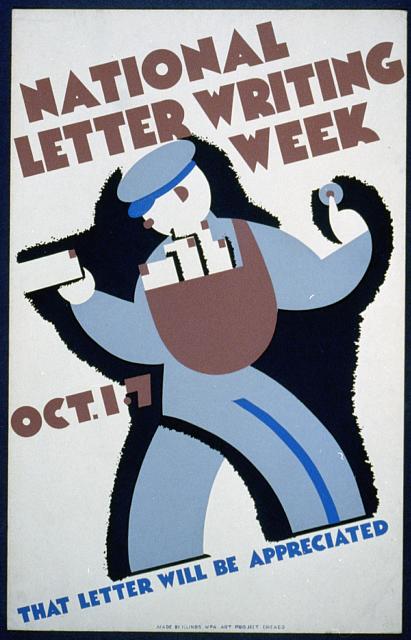
WPA - Letter Writing

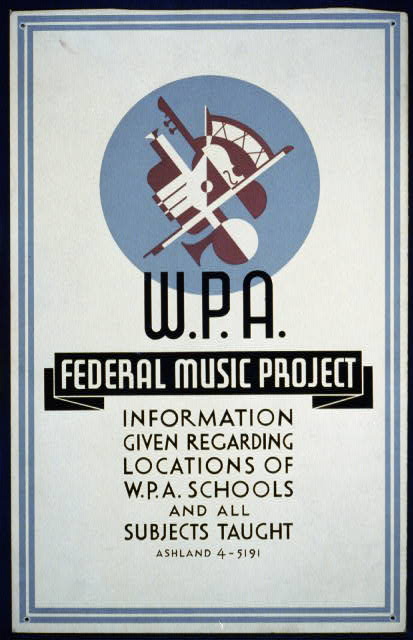
WPA - Music Project

WPA - Lack of Funds

Give to the Emperor

Render Unto Caesar

Resolutions to stay away from politics, when it’s pretty or ugly or pretty ugly, can be hard to keep. But politics, no matter how significant it may seem, can be like psychic, emotional, moral quicksand, which as it reaches your shoulders, leaves you wondering if this trip was really necessary.

So let’s see what Jesus said about all this.

The famous “Question about Paying Taxes” is one of the most discussed and interpreted passages in the Gospels. Here it is, from the Gospel of Luke in the NRSV translation:

So they watched him and sent spies who pretended to be honest, in order to trap him by what he said, so as to hand him over to the jurisdiction and authority of the governor. So they asked him, “Teacher, we know that you are right in what you say and teach, and you show deference to no one, but teach the way of God in accordance with truth. Is it lawful for us to pay taxes to the emperor, or not?” But he perceived their craftiness and said to them, “Show me a denarius. Whose head and whose title does it bear?” They said, “The emperor’s.” He said to them, “Then give to the emperor the things that are the emperor’s, and to God the things that are God’s.” And they were not able in the presence of the people to trap him by what he said; and being amazed by his answer, they became silent. (Luke 20:20-26)

Some view this as a story about the separation of state and church. Some view it as about obedience to civil or religious authority. Some view it very particularly as a directive on withholding tax payment from ungodly government. And so on.

I take this as a spiritual message, grounded in practical experience. Political speech and action can be very important, even essential, to the accomplishment of positive and beneficial goals. And very seductive. But those activities can also set you in the midst of circumstances and environments that can seriously put you at a distance from more enlightening aspirations and possibilities. Sometimes really far from them.

You can’t run away from politics and its consequences. Those coins and emperors are always going to be there. So if you get caught up in it, just remember that there are other higher callings that have nothing to do with policies and positions and politicians.

Impeaching Donald Trump As Nominee

The majority of the Republican Party has finally decided to take on the very loud, engaged and energetic Trump minority. To do it, they’ve devised the strategic approach of all those who are behind the curve and in the hole: they are gambling. Here is the strategy you may not hear about from many of the talking heads.

The Republicans aren’t sure they can stop Trump from getting the numbers he needs to secure the nomination by the time of the convention. They hope so. But whether he does have the numbers or whether it is instead a brokered convention doesn’t matter.

The point of the current movement is only partly to deny Trump the numbers. It is partly—mostly—to build a case to deny him the nomination, whether he has the numbers or not. Just walking into the convention and offering opinions about how bad Trump is and how bad he is for the party and the country won’t do.

Instead, they are going to essentially put him on trial. They are going to impeach him as a nominee. At that point, they will have evidence from Republican leaders of all kinds, from experts of all kinds, from friendly foreign leaders of all kinds, etc. Mostly, they will have Trump’s own words and behaviors. When it is all over, when all the evidence is in, a majority of the party will agree to convict and to disqualify him from any possibility of nomination.

A minority of the party will protest. The result will be that Trump, after threatening to sue (which is what he does), will walk, take his supporters with him, and run as an independent candidate.

This is where the gamble comes in.

The Republicans have to be confident that they have somebody to run who can beat Trump and the Democratic nominee (likely to be Hillary Clinton) in a three-way race. If they lose that gamble, both alternative outcomes are disastrous for them.

If you think things are strange so far, just wait until you see the impeachment trial of Donald Trump at the Republican National Convention.

Unleashing the Dogs of Hate

Birmingham

You will be forgiven for mistakenly thinking that this post about Trump was written today. IT WAS WRITTEN AND PUBLISHED IN MARCH 2016, TWO-AND-A-HALF YEARS AGO. At the time, many public people—including responsible politicians of both parties and the media—treated Trump’s pathology as a joke or a temporary symptom that would quickly pass. They should have been shouting in protest and we should have been scared. Are we scared yet?

“Cry ‘Havoc!’, and let slip the dogs of war”
William Shakespeare, Julius Caesar, Act 3, Scene 1

This time it is the dogs of hate. Enabled and emboldened by Donald Trump. He is so arrogant and ignorant of history that he probably believes he can control them. That with one word from him they will attack. That with another word from him they will stop.

Of course, that isn’t how it works.

There has long been an undercurrent of hate and intolerance in this country, no different than anywhere else at any other time. It has its outcroppings in repressive laws and unembarrassed public behavior. We have taken measures as a majority to dull its practical effect and, hopefully, to change hearts and minds.

Donald Trump is the latest—but not the last—to try to harness that dark energy for his own ambition.

But that is always playing with fire or dynamite. Haters gonna hate. And when allowed or encouraged, haters gonna take that hate out on others. Others, for example, at political rallies. Others who they blame for whatever is wrong in the country or in their lives.

No one knows where this all goes. When the dogs of hate, under the banner of legitimate politics, have been set loose.

Something is happening here but you don’t know what it is, do you, Mister Jones?

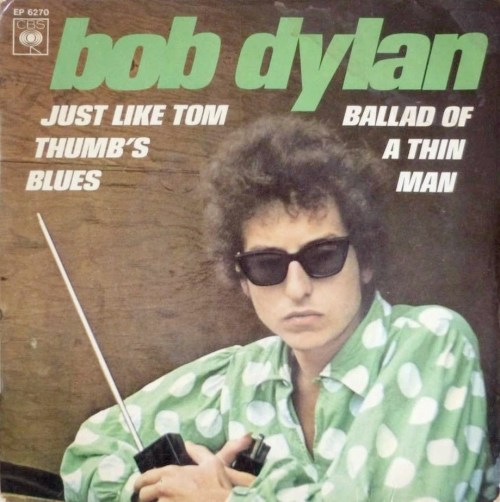
Ballad of a Thin Man

When I look at the current political scene, or listen to analysis and prognostication by dozens of clueless paid or partisan political “experts”, I keep hearing a song from Bob Dylan.

Poetic word salad? Sure. Fitting message? Absolutely.

Ballad Of A Thin Man

You walk into the room
With your pencil in your hand
You see somebody naked
And you say, “Who is that man?”
You try so hard
But you don’t understand
Just what you’ll say
When you get home

Because something is happening here
But you don’t know what it is
Do you, Mister Jones?

You raise up your head
And you ask, “Is this where it is?”
And somebody points to you and says
“It’s his”
And you say, “What’s mine?”
And somebody else says, “Where what is?”
And you say, “Oh my God
Am I here all alone?”

Because something is happening here
But you don’t know what it is
Do you, Mister Jones?

You hand in your ticket
And you go watch the geek
Who immediately walks up to you
When he hears you speak
And says, “How does it feel
To be such a freak?”
And you say, “Impossible”
As he hands you a bone

Because something is happening here
But you don’t know what it is
Do you, Mister Jones?

You have many contacts
Among the lumberjacks
To get you facts
When someone attacks your imagination
But nobody has any respect
Anyway they already expect you
To just give a check
To tax-deductible charity organizations

You’ve been with the professors
And they’ve all liked your looks
With great lawyers you have
Discussed lepers and crooks

You’ve been through all of
F. Scott Fitzgerald’s books
You’re very well read
It’s well known

Because something is happening here
But you don’t know what it is
Do you, Mister Jones?

Well, the sword swallower, he comes up to you
And then he kneels
He crosses himself
And then he clicks his high heels
And without further notice
He asks you how it feels
And he says, “Here is your throat back
Thanks for the loan”

Because something is happening here
But you don’t know what it is
Do you, Mister Jones?

Now you see this one-eyed midget
Shouting the word “NOW”
And you say, “For what reason?”
And he says, “How?”
And you say, “What does this mean?”
And he screams back, “You’re a cow
Give me some milk
Or else go home”

Because something is happening here
But you don’t know what it is
Do you, Mister Jones?

Well, you walk into the room
Like a camel and then you frown
You put your eyes in your pocket
And your nose on the ground
There ought to be a law
Against you comin’ around
You should be made
To wear earphones

Because something is happening here
But you don’t know what it is
Do you, Mister Jones?

Iraq and Afghanistan Veterans of America

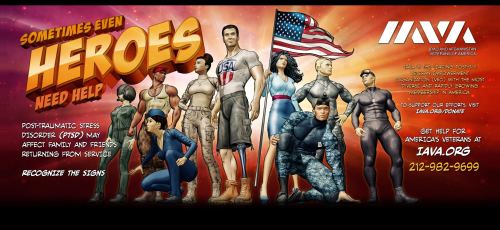
Sometimes Heroes Need Help

If it didn’t reduce the impact and get old for readers, I’d post about Iraq and Afghanistan Veterans of America (IAVA) and veterans issues just about every day. As I’ve noted many times, eagerly asking men and women to patriotically sacrifice for our security and then not treating them as the most important people in our country is a moral test we continue to flunk.

IAVA has reported its Program Impact in 2015 and it is impressive and heartening. Please read it and be astonished by how much one committed organization can do to advocate for so many important Americans. The report begins:

IAVA had huge accomplishments in 2015. We reached a record 439,269 veterans nationwide through in-person and online programs — and we did it with fewer resources, while maintaining top ratings from leading nonprofit reporting agencies, GuideStar and Charity Watch.

So if you are frustrated by how slowly and imperfectly our politics match our commitments in this area, please donate to IAVA. It is easy to say thank you to our veterans, as just about every politician does. It is harder and more costly to back it up capably and unconditionally.