Bob Schwartz

Tag: politics

The Rudest President Ever

In a tweet, the president called NBC’s respected political journalist Chuck Todd “Sleepy Eyes.” This was obviously meant as an insult, since trump has previously used tiredness and sleepiness and looks as an attack. (We know that trump sleeps little himself, so that could be the reason for this pejorative, though we’ll have to leave this for the psychoanalysts who get paid to explore the quagmire of his brain.)

We’ve had some pretty nasty presidents, though they customarily kept the worst of their invective private because…they were president. Even if you don’t want to be popular, when you are on public display, you at least want to maintain the good opinion of those who place some value on civility.

We’ve also had dealings in our own lives with very rude people. Some we can’t avoid (bosses, coworkers, family), others we have as little to do with as possible, running the other way when we can.

We have never had a president this publicly rude, not even close. Hardly even a public figure this consistently rude.

Why isn’t the president’s rudeness a bigger deal? Because his other flaws, shortcomings and failures are so great that rudeness doesn’t even seem to make the list.

But it should be on the list. As we all know, constant exposure to rudeness takes its toll. It tends to make us a little rude sometimes too, or at least normalizes it. And when rude is normal, even admirable, we have a problem.

Arcade Fire: I Give You Power, I Can Take It Away

The Clash used to call themselves “The only band that matters,” based on their political and social stances.

Arcade Fire has never been overly political, or overly self-promoting, just great. Their latest single, released in January, doesn’t make them the only band that matters, but it does confirm that they are a band that matters, and it is a track that matters.

If the band had just added Mavis Staples to the track, that might have been enough. But what she and Win Butler sing for us is an anthem pointed right at the heart of today. A reminder, an aspiration, a truth you can listen to and move to and shout and follow, when you’re feeling discouraged.

I Give You Power

I give you power, over me
I give you power, but now I gotta be free
I give you power, but now I say
I give you power, I can take it away
I can take it away
Watch me

I’m with Stupid and Stupid Is Me

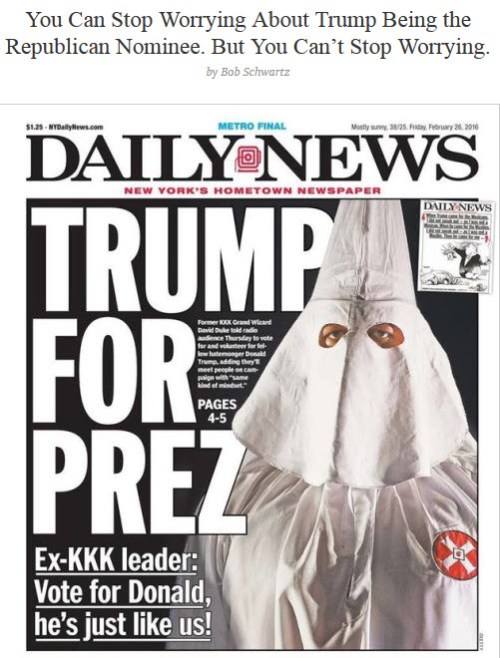
I see that today a few people were reading a post I wrote a little more than a year ago, You Can Stop Worrying About Trump Being the Republican Nominee. But You Can’t Stop Worrying.

At the time, David Duke, ex-KKK Grand Wizard, gave Trump his imprimatur, saying he was in essence “one of us.” I totally believed this would end Trump’s chances of the Republicans giving him the nomination.

I was wrong about so many things. I overestimated the Republican Party. I underestimated the haplessness of the Democratic Party establishment. I overestimated the news media. I should have known better on all those scores but as the poet/political analyst Emily Dickinson said, “Hope is the thing with feathers.”

What I wasn’t wrong about, then or now, is this:

Forget all the talk about people flocking to Trump because of their frustration and anger about political gridlock and ineffectiveness. You don’t have to take a deep dive into the research to see that tens of million Americans want to roll back progress not to the Reagan years, but to the years before civil rights and other modern principles of tolerance and equality. (My sad favorite remains the Trump supporter wearing a baseball cap saying “Make Racism Great Again!”).

These people may not be your friends, but they are your neighbors and fellow voters. Whether there are enough of them to elect a President of the United States is an open question.

That open question is answered and closed. I am stupefied. I’m with me, and I’m with stupid. And for the moment, so are we all.

Nazi in the White House: Nothing Surprises But Everything Astonishes (Update)

Update: Since publication of this story in the Forward on Thursday, two things have happened:

There has been the traditional muddying of the waters when controversial trump-related matters arise, with comments from various sources that on their face seem to put the basic matter to rest, but never directly address the question on the table. Or don’t address the question at all: neither the White House nor Gorka will talk about it.

The major news media have shied away, at least for the moment, because of their unwillingness or inability to look through muddy waters stirred up in trump-related matters. In many cases, this doesn’t go to journalistic high-mindedness or objectivity, but to weakness and timidity, and in this case, to having been scooped (or alternatively to having sat on the story).

Following the first story, the Forward has gone on to publish multiple stories, including this excellent summary from the following day, March 17. Please read in its entirety:

Sebastian Gorka: What Is The Evidence, And Why Does It Matter?

Sebastian Gorka, President Trump’s deputy assistant, and his chief adviser on counter-terrorism, has undisputed ties to the Vitézi Rend — a far-right Hungarian group who were close allies of the Nazis in World War II. Born in Britain to Hungarian parents, he became a naturalized American citizen in 2012 after marrying Katherine Cornell. No one has suggested that there is evidence he is anti-Semitic or an enemy of Israel but the ongoing political affiliations of White House advisers matter. Here is the actual evidence under discussion, and why it matters.


This from the Forward:

EXCLUSIVE: Nazi-Allied Group Claims Top Trump Aide Sebastian Gorka As Sworn Member

Sebastian Gorka, President Trump’s top counter-terrorism adviser, is a formal member of a Hungarian far-right group that is listed by the U.S. State Department as having been “under the direction of the Nazi Government of Germany” during World War II, leaders of the organization have told the Forward.

The elite order, known as the Vitézi Rend, was established as a loyalist group by Admiral Miklos Horthy, who ruled Hungary as a staunch nationalist from 1920 to October 1944. A self-confessed anti-Semite, Horthy imposed restrictive Jewish laws prior to World War II and collaborated with Hitler during the conflict. His cooperation with the Nazi regime included the deportation of hundreds of thousands of Jews into Nazi hands.

Gorka’s membership in the organization — if these Vitézi Rend leaders are correct, and if Gorka did not disclose this when he entered the United States as an immigrant — could have implications for his immigration status. The State Department’s Foreign Affairs Manual specifies that members of the Vitézi Rend “are presumed to be inadmissible” to the country under the Immigration and Nationality Act.

Gorka — who Vitézi Rend leaders say took a lifelong oath of loyalty to their group — did not respond to multiple emails sent to his work and personal accounts, asking whether he is a member of the Vitézi Rend and, if so, whether he disclosed this on his immigration application and on his application to be naturalized as a U.S. citizen in 2012. The White House also did not respond to a request for comment.

But Bruce Einhorn, a retired immigration judge who now teaches nationality law at Pepperdine University, said of this, “His silence speaks volumes.”

Republicans Need the Eggs

A great classic joke, told by Woody Allen in Annie Hall:

“It reminds me of that old joke—you know, a guy walks into a psychiatrist’s office and says, hey doc, my brother’s crazy! He thinks he’s a chicken. Then the doc says, why don’t you turn him in? Then the guy says, I would but I need the eggs.”

“there is some shit I will not eat”

It may not be my favorite E. E. Cummings poem, but i sing of Olaf glad and big is a special one. It is about someone who suffers for his moral beliefs (in this case, about war and mindless patriotism), and who is punished by a range of Americans, from fellow soldiers to the president. Someone, writes Cummings, who is “more brave than me:more blond than you.” It contains the one line of poetry I probably recite the most in non-poetry contexts, to epitomize those who take a stand.

i sing of Olaf glad and big
whose warmest heart recoiled at war:
a conscientious object-or

his wellbelovéd colonel(trig
westpointer most succinctly bred)
took erring Olaf soon in hand;
but–though an host of overjoyed
noncoms(first knocking on the head
him)do through icy waters roll
that helplessness which others stroke
with brushes recently employed
anent this muddy toiletbowl,
while kindred intellects evoke
allegiance per blunt instruments–
Olaf(being to all intents
a corpse and wanting any rag
upon what God unto him gave)
responds,without getting annoyed
“I will not kiss your fucking flag”

straightway the silver bird looked grave
(departing hurriedly to shave)

but–though all kinds of officers
(a yearning nation’s blueeyed pride)
their passive prey did kick and curse
until for wear their clarion
voices and boots were much the worse,
and egged the firstclassprivates on
his rectum wickedly to tease
by means of skilfully applied
bayonets roasted hot with heat–
Olaf(upon what were once knees)
does almost ceaselessly repeat
“there is some shit I will not eat”

our president,being of which
assertions duly notified
threw the yellowsonofabitch
into a dungeon,where he died

Christ(of His mercy infinite)
i pray to see;and Olaf,too

preponderatingly because
unless statistics lie he was
more brave than me:more blond than you.

American Freedom Seder 2017: Where There’s a Pharaoh There’s a Wilderness

It is still a while until Passover (evening of April 10), but not too early to recommend holding or attending a Freedom Seder this year. Recommended for all people—even if you’re not Jewish, even if you’re not religious. All that’s needed is faith in freedom.

Freedom Seders are a tradition that began in the 1960s, relating the Passover journey to other struggles—race, gender, justice, war, etc. It may be a long way and a long time from Egypt to the Promised Land. But we can get there.

It’s possible you believe there are some special struggles going on right now in America. Which would make it a good time to gather with like-minded friends and family, brothers and sisters, and as a community share a meal and recall that the struggle is never easy or short (and might include some flat, dry bread), but that there is a better nation at the end of the journey. One hopeful, undiscouraged step at a time.

Resistance Literature: On Tyranny

I didn’t realize there was a genre called “resistance literature” before I saw this blurb for the just-released On Tyranny: Twenty Lessons from the Twentieth Century by Professor Timothy Snyder:

“Easily the most compelling volume among the early resistance literature. . . . A slim book that fits alongside your pocket Constitution and feels only slightly less vital. . . . Clarifying and unnerving. . . . A memorable work that is grounded in history yet imbued with the fierce urgency of what now.” —Carlos Lozada, The Washington Post

On Tyranny is worth reading: it is short (128 pages), learned, wise, and inexpensive ($2.99), from a scholar who is the Levin Professor of History at Yale University, a member of the Committee on Conscience of the United States Holocaust Memorial Museum and a permanent fellow of the Institute for Human Sciences in Vienna.

Here are the twenty lessons covered:

  1. Do not obey in advance.
  2. Defend institutions.
  3. Beware the one-party state.
  4. Take responsibility for the face of the world.
  5. Remember professional ethics.
  6. Be wary of paramilitaries.
  7. Be reflective if you must be armed.
  8. Stand out.
  9. Be kind to our language.
  10. Believe in truth.
  11. Investigate.
  12. Make eye contact and small talk.
  13. Practice corporeal politics.
  14. Establish a private life.
  15. Contribute to good causes.
  16. Learn from peers in other countries.
  17. Listen for dangerous words.
  18. Be calm when the unthinkable arrives.
  19. Be a patriot.
  20. Be as courageous as you can.

Here is the close of the Epilogue:

The politics of inevitability is a self-induced intellectual coma. So long as there was a contest between communist and capitalist systems, and so long as the memory of fascism and Nazism was alive, Americans had to pay some attention to history and preserve the concepts that allowed them to imagine alternative futures. Yet once we accepted the politics of inevitability, we assumed that history was no longer relevant. If everything in the past is governed by a known tendency, then there is no need to learn the details.

The acceptance of inevitability stilted the way we talked about politics in the twenty-first century. It stifled policy debate and tended to generate party systems where one political party defended the status quo, while the other proposed total negation. We learned to say that there was “no alternative” to the basic order of things, a sensibility that the Lithuanian political theorist Leonidas Donskis called “liquid evil.” Once inevitability was taken for granted, criticism indeed became slippery. What appeared to be critical analysis often assumed that the status quo could not actually change, and thereby indirectly reinforced it.

Some spoke critically of neoliberalism, the sense that the idea of the free market has somehow crowded out all others. This was true enough, but the very use of the word was usually a kowtow before an unchangeable hegemony. Other critics spoke of the need for disruption, borrowing a term from the analysis of technological innovations. When applied to politics, it again carries the implication that nothing can really change, that the chaos that excites us will eventually be absorbed by a self-regulating system. The man who runs naked across a football field certainly disrupts, but he does not change the rules of the game. The whole notion of disruption is adolescent: It assumes that after the teenagers make a mess, the adults will come and clean it up.

But there are no adults. We own this mess.

If Hunter S. Thompson Was Here

How long, oh Lord, how long? And how much longer will we have to wait before some high-powered shark with a fistful of answers will finally bring us face-to-face with the ugly question that is already so close to the surface in this country, that sooner or later even politicians will have to cope with it?

Is the democracy worth all the risks and problems that necessarily go with it? Or, would we all be happier by admitting that the whole thing was a lark from the start and now that it hasn’t worked out, to hell with it.

Hunter S. Thompson, January 1974

Hunter S. Thompson was the great political journalist of his generation—maybe any modern generation. He brilliantly, sometimes sadly, expressed one underlying theme: politics is mostly a crazy, misguided and dishonest business, many who engage in it are crazy, misguided and dishonest people, and the only way to report on it was to be crazy yourself—but also crazily honest. Thompson knew demons when he saw them, because he had his own different demons to deal with.

Had he not committed suicide in 2005, and had he lived to see this, we don’t know what he would write. Or, as was apparent even while he has covering Nixon and Watergate, he may have already had enough. He covered political hell so many times that it was not an assignment he wanted to repeat.

The good news is that there are plenty of excellent edgy and transgressive journalists writing about politics now, which was hardly the case in the 1970s. But even these contemporary writers will tell you they are not him.

This is from the New York Times, January 1, 1974. Thompson is looking back on 1973 and the Nixon presidency (Nixon had not yet resigned):


Maybe that’s why the end of this incredible, frantic year feels so hollow. Looking back on the sixties, and even back to the fifties, the fact of President Nixon and everything that has happened to him—and to us—seem so queerly fated and inevitable that it is hard to reflect on those years and see them unfolding in any other way.

One of the strangest things about these five downhill years of the Nixon Presidency is that despite all the savage excesses committed by the people he chose to run the country, no real opposition or realistic alternative to Richard Nixon’s cheap and mean-hearted view of the American Dream has ever developed. It is almost as if that sour 1968 election rang down the curtain on career politicians.

This is the horror of American politics today—not that Richard Nixon and his fixers have been crippled, convicted, indicted, disgraced and even jailed—but that the only available alternatives are not much better; the same dim collection of burned-out hacks who have been fouling our air with their gibberish for the last twenty years.

How long, oh Lord, how long? And how much longer will we have to wait before some high-powered shark with a fistful of answers will finally bring us face-to-face with the ugly question that is already so close to the surface in this country, that sooner or later even politicians will have to cope with it?

Is the democracy worth all the risks and problems that necessarily go with it? Or, would we all be happier by admitting that the whole thing was a lark from the start and now that it hasn’t worked out, to hell with it….

George Orwell had a phrase for it. Neither he nor Aldous Huxley had much faith in the future of participatory democracy. Orwell even set a date: 1984—and the most disturbing revelation that emerged from last year’s Watergate hearings was not so much the arrogance and criminality of Nixon’s henchmen, but the aggressively totalitarian character of his whole Administration. It is ugly to know just how close we came to meeting Orwell’s deadline….

Six months ago I was getting a daily rush out of watching the nightmare unfold. There was a warm sense of poetic justice in seeing “fate” drive these money-changers out of the temple they had worked so hard to steal from its rightful owners. The word “paranoia” was no longer mentioned, except as a joke or by yahoos, in serious conversations about national politics. The truth was turning out to be even worse than my most “paranoid ravings” during that painful 1972 election.

But that high is beginning to fade, tailing down to a vague sense of angst. Whatever happens to Richard Nixon when the wolves finally rip down his door seems almost beside the point, now. He has been down in his bunker for so long, that even his friends will feel nervous if he tries to re-emerge. All we can really ask of him, at this point, is a semblance of self-restraint until some way can be found to get rid of him gracefully.

This is not a cheerful prospect, for Mr. Nixon or anyone else—but it would be a hell of a lot easier to cope with if we could pick up a glimmer of light at the end of this foul tunnel of a year that only mad dogs and milkmen can claim to have survived without serious brain damage. Or maybe it’s just me. It is ten below zero outside and the snow hasn’t stopped for two days. The sun has apparently been sucked into orbit behind the comet Kohoutek. Is this really a new year? Are we bottoming out? Or are we into The Age of The Fear?

Media and trump: The Reverse Cry Wolf Effect

The media are suffering from the Reverse Cry Wolf Effect. That is, not shouting out a warning when a real danger approaches.

Instead of pointing out what might actually be a serious danger, when trump raised the preposterous and unsupported issue of Obama’s birth, the media treated it as interesting, reportable and sort of funny. And then kept it alive, forever.

Since then, trump has continued to make preposterous allegations and statements. To put it less politely, to chronically lie about matters big and small. The media, having already decided that everything he said and did was interesting, reportable and sort of funny, kept right on treating it as normal, if a bit quirky.

The latest interesting, reportable, quirky, sort of funny thing that trump claimed without any evidence is that Obama (“Bad (or sick) guy!”) wiretapped trump tower. You can tell that the media is on the verge of saying what plenty of respectable commentators are saying: objectively, trump is trying to distract us from his incompetence and real problems, he has always had an irrational hatred of Obama, and he may also be a little bit unstable.

But the media isn’t sure whether anybody will believe them. Why should we?