Bob Schwartz

Tag: Mitt Romney

Mitt Romney Doesn’t Really Want To Be President


Mitt Romney doesn’t want to be President. This has been apparent for a while, but it seemed so unlikely—so strange for a person who is actually a nominee—that it defied saying. But it is the clearest explanation of everything that is happening.

Why would Romney run if he doesn’t want the office? The clichéd but useful explanation goes to a father-son dynamic.

In at least one objective respect, Mitt has spectacularly surpassed George Romney. Mitt Romney is a very, very rich man, wealthier than his father ever was.

As a businessman, it is a little more complicated. George Romney was, as the saying used to go, a captain of industry. He worked his way up to become head of one of the largest automakers, back when that mattered much more than it does now. Even if American Motors wasn’t one of the Big Three, it was a notable, forward-looking player in the field.

Mitt Romney’s success is different. Even treating the financial world as a discrete industry, which it of course is, the term “captain of industry” doesn’t seem to apply to Mitt. In the annals of financial history, no one will be talking about the creativity of Bain Capital the way business historians still do about the ahead-of-its-time thinking that marked American Motors—the company that believed the oversized car era was over, and that consumers would be buying compact and efficient automobiles. Eventually they would.

Politics is where the distinction is sharpest. George Romney was elected Republican Governor of Michigan three times—a state that was then decidedly Democratic. He had substantial political appeal and support, but his dream of being President was scuttled in part by the infamous “brainwashing” incident. He had visited Vietnam, and was told by the generals how well the war was going—in spite of evidence to the contrary. When he spoke about his opposition to the war, he said he had been “brainwashed” by the generals. George Romney’s political career never recovered.

As a politician, Mitt Romney has run for office just twice, and won only once. He was defeated for U.S. Senate from Massachusetts in 1994, and then was elected Governor in 2002. He chose not to run for re-election in 2006. Indications were that he would have a difficult race, and he instead began his run for the Presidency the day before he left office.

This father-son analysis—that Mitt Romney is trying, at all costs and for whatever reasons, to do what his father never could—may sound too easy. But the story of fathers and sons is just about the oldest story ever told. The patriarchal sagas of the Old Testament begin there, and great stories derive their greatness from the fact that some things never change.

Mitt Romney is following a program that he may not see or understand but that he has little or no choice about. It is a program, this running for President, that normally requires some combination of skill and desire. A surplus of one can balance out a deficit in the other. But trying to run without either—which we have never seen in a Presidential race—is bound to produce some anomalous results.

In the case of Mitt Romney, we can set aside the issue of how much political skill he has, though many have their doubts. The real question is how much desire he has. The answer, strangely, is little or none.

The outcome of the election is far from written. In case Mitt Romney loses, there is reason to believe that he will suffer some nagging psychic pain. But given the possibility that it is not something he really wants. there is also reason to believe he will go back to an extraordinarily comfortable life, and secretly be relieved.

Too Much of Nothing


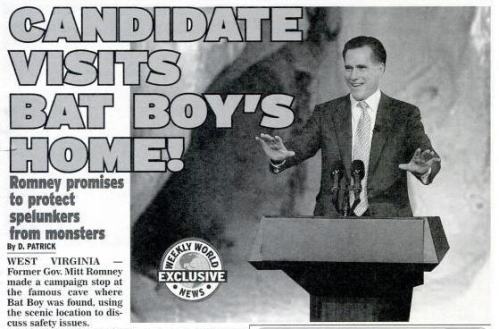
The last post was called a political break, with the prospect of returning immediately to earnest observations about the current campaign. For those who didn’t read it, that post included a Marx Brothers movie and a Weekly World News exclusive about Mitt Romney and Bat Boy. Now that’s a break.

If it’s possible for political junkies to overdose, this may be it. There are already a bunch of posts drafted and ready, political and otherwise (this is a blog about everything, not just politics). But just for a moment, the will to post seems to have gotten a little lost.

So the political break continues. In the same spirit of free association that gave rise to the guest appearance of Bat Boy, here is some commentary from Bob Dylan. “But when there’s too much of nothing, nobody should look.”:

Now, too much of nothing
Can make a man feel ill at ease
One man’s temper might rise
While another man’s temper might freeze
In the day of confession
We cannot mock a soul
Oh, when there’s too much of nothing
No one has control

Too much of nothing
Can make a man abuse a king
He can walk the streets and boast like most
But he wouldn’t know a thing
Now, it’s all been done before
It’s all been written in the book
But when there’s too much of nothing
Nobody should look

Too much of nothing
Can turn a man into a liar
It can cause one man to sleep on nails
And another man to eat fire
Ev’rybody’s doin’ somethin’
I heard it in a dream
But when there’s too much of nothing
It just makes a fella mean

Political Break: Mitt Romney and Bat Boy


“Sometimes I think I must go mad.”

That’s a quote from the Marx Brothers movie Horse Feathers (1932). And that’s how a lot of us feel right about now, after months of campaign craziness and days of political bombshells. There will be plenty of time for insightful analysis and cogent commentary. But just for a moment, a break.

Here’s something from the movie:

Retiring President of Huxley College: I am sure the students would appreciate a brief outline of your plans for the future.

Professor Quincy Adams Wagstaff (Groucho Marx): What?

President: I said the students would appreciate a brief outline of your plans for the future.

Wagstaff: You just said that! That’s the trouble around here: talk, talk, talk! Oh, sometimes I think I must go mad. Where will it all end? What is it getting you? Why don’t you go home to your wife? I’ll tell you what, I’ll go home to your wife and, outside of the improvement, she’ll never know the difference. Pull over to the side of the road there and let me see your marriage license.

President: President Wagstaff, now that you’ve stepped into my shoes…

Wagstaff: Oh, is that what I stepped in? I wondered what it was. If these are your shoes, the least you could do was have them cleaned.

And here’s something from the Weekly World News in March of 2007, during Mitt Romney’s first unsuccessful run for the Presidency:

Mitt Romney Doesn’t Believe He Is Running Against A President

A political conundrum has been solved, and the solution is a startling answer to what has been going wrong so far for the Romney-Ryan ticket.

Both candidates spent the first 24 hours of the current foreign crisis injudiciously and recklessly criticizing the President, in the face of being chastised by both Democrats and Republicans for their amateurish efforts.

The obvious question to ask both of them is what foreign policy expertise or experience informs their criticism. This would be their likely answer: well, what foreign policy expertise or experience did Barack Obama have when he took office in 2009?

Exactly. Precisely. Except for one thing. This isn’t candidate Obama they are running against. This is a man who has for four years been negotiating the wild waters of global politics, and in the view of many, though clearly not all, he isn’t doing a bad job.

That’s where the revelation came in. In a nearly literal sense, they don’t believe Barack Obama has been President for these four years. They may not subscribe to “birther” notions that would legally disqualify Obama from holding the office, though we aren’t sure of that. But functionally, they seem to believe that the smart but shallow and inexperienced young Senator who took office in 2009 is the same man they face now.

They believe they are running against young Senator Obama—or maybe even younger community organizer Obama, law student Obama, pot-smoking college student Obama. The only thing they have to do is run a better campaign than the unsuccessful John McCain did. Maybe this isn’t a clinical break from reality, enough to put their mental stability in doubt, but the effect has been to raise real questions about their political stability.

The President has tried to help them. In his speech at the Democratic National Convention, he announced loudly, plainly and unequivocally, “I am the President.” Mitt Romney and Paul Ryan apparently weren’t listening, and even if they heard, they still don’t believe.

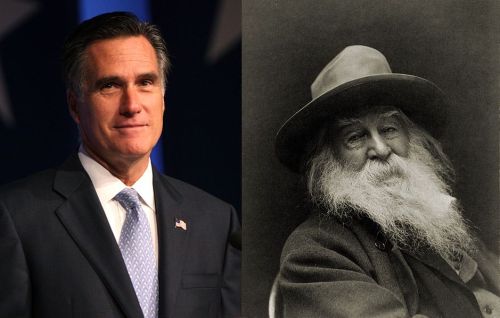
The Body Electric: Mitt Romney and Walt Whitman


Those who love America and poetry should love Walt Whitman. So should Mitt Romney.

Just as the Civil War was a dividing line in our history, Whitman was the line in poetry and culture. His lyrical innovation and his exuberant celebration of all things human and exciting—including sex and beautiful bodies—limited appreciation by nineteenth century readers. If Whitman seemed out of place then, he is right at home now:

Of Life immense in passion, pulse, and power,
Cheerful—for freest action form’d, under the laws divine,
The Modern Man I sing.

Why should Mitt Romney care about Walt Whitman?

Whitman was more than just an expert on being himself and singing about himself. He recognized that constancy and consistency is not a part of the artist’s makeup. And so he wrote the mantra for all those who stand so accused:

Do I contradict myself? Very well, then I contradict myself, I am large, I contain multitudes.

Romney should also care as a student of the Presidency. The most memorable poems about an American President (and there are surprisingly few) were written by Whitman. On the death of Abraham Lincoln, he wrote not one but two famous elegies that are still read and recited today.

From O Captain My Captain:

O CAPTAIN! my Captain! our fearful trip is done;
The ship has weather’d every rack, the prize we sought is won;
The port is near, the bells I hear, the people all exulting,
While follow eyes the steady keel, the vessel grim and daring:
But O heart! heart! heart!
O the bleeding drops of red,
Where on the deck my Captain lies,
Fallen cold and dead.

From When Lilacs Last in the Door-yard Bloom’d:

WHEN lilacs last in the door-yard bloom’d,
And the great star early droop’d in the western sky in the night,
I mourn’d—and yet shall mourn with ever-returning spring.

O ever-returning spring! trinity sure to me you bring;
Lilac blooming perennial, and drooping star in the west,             5
And thought of him I love.

Finally, while Mitt Romney may have never read the poem I Sing the Body Electric, there is an extraordinary scene in the third verse. It is a pastoral picture of a tall older man—fifteen years older than Romney—standing with his five grown sons. He is deeply beloved for who he is and what he has done. It is not just the way that Mitt Romney wants to be seen; it may be the way he is seen by those who do know and love him:

I know a man, a common farmer—the father of five sons;
And in them were the fathers of sons—and in them were the fathers of sons.

This man was of wonderful vigor, calmness, beauty of person;
The shape of his head, the pale yellow and white of his hair and beard, and the immeasurable meaning of his black eyes—the richness and breadth of his manners,
These I used to go and visit him to see—he was wise also;
He was six feet tall, he was over eighty years old—his sons were massive, clean, bearded, tan-faced, handsome;
They and his daughters loved him—all who saw him loved him;
They did not love him by allowance—they loved him with personal love;
He drank water only—the blood show’d like scarlet through the clear-brown skin of his face;
He was a frequent gunner and fisher—he sail’d his boat himself—he had a fine one presented to him by a ship-joiner—he had fowling-pieces, presented to him by men that loved him;
When he went with his five sons and many grand-sons to hunt or fish, you would pick him out as the most beautiful and vigorous of the gang.

You would wish long and long to be with him—you would wish to sit by him in the boat, that you and he might touch each other.

The Romneys And The Regular People


Wild speculation continues to spin about what the Romneys don’t want to reveal in their tax returns. Low tax rates? Offshore investments? Questionable tax shelters?

Following Occam’s razor, the simplest explanation is that they simply don’t want to bolster what we already know: the Romneys are not regular people. We have seen glimpses of that in the little bits of disclosure, but year after year of low-tax ultra-income would just make the point more overwhelming and concrete.

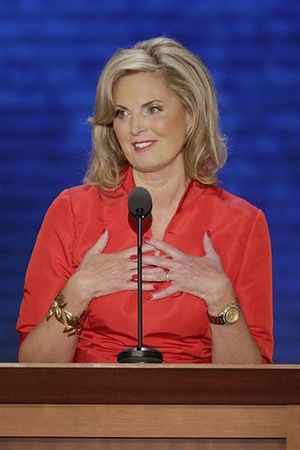
Ann Romney seems to be a good person who has been a good wife and mother. She has suffered from health problems, maybe more than her fair share. Compassion demands that we regard that suffering without criticism and with open-hearted empathy.

But her speech to the Republican National Convention was ridiculous in the literal sense. She talked about the plight of regular people as if she had long-time close relationships with lots of them and had deep, first-hand understanding of their struggles. Anything is possible, but that is far-fetched. There is nothing wrong with the Romneys’ life. People are entitled to their lives and experiences; sometimes it’s not even a matter of choice when those rarefied lives are foist on them by circumstances.

Over the years that Mitt Romney has clumsily been running for President, pundits of both parties have offered a simple solution to him and, presumably, to his wife: just be yourself, whoever that is. America hates phonies. The Republicans ought to know this, given how often they charge President Obama with that crime.

Mitt Romney is not a regular person, and has never been. Neither is Ann. Maybe you can win the Presidency as an openly stratospherically rich and out of touch person, maybe you can’t. But watching someone try so hard to hide that is not only poor politics, it is downright depressing.

Mene Mene in Tampa


We should not be surprised by the latest craziness in the Republican campaign. Anything seems possible. Even the mysterious appearance of a finger writing something like this on the wall of a $5,000-a-plate fundraiser:

MENE MENE TEKEL PARSIN

According to ancient reporting:

King Belshazzar made a great festival for a thousand of his lords, and he was drinking wine in the presence of the thousand.

Under the influence of the wine, Belshazzar commanded that they bring in the vessels of gold and silver that his father Nebuchadnezzar had taken out of the temple in Jerusalem, so that the king and his lords, his wives, and his concubines might drink from them. So they brought in the vessels of gold and silver that had been taken out of the temple, the house of God in Jerusalem, and the king and his lords, his wives, and his concubines drank from them. They drank the wine and praised the gods of gold and silver, bronze, iron, wood, and stone.

Immediately the fingers of a human hand appeared and began writing on the plaster of the wall of the royal palace, next to the lampstand….

Then Daniel was brought in before the king. The king said…”I have heard that you can give interpretations and solve problems. Now if you are able to read the writing and tell me its interpretation, you shall be clothed in purple, have a chain of gold around your neck, and rank third in the kingdom.”

Then Daniel answered in the presence of the king, “Let your gifts be for yourself, or give your rewards to someone else! Nevertheless, I will read the writing to the king and let him know the interpretation….You have exalted yourself against the Lord of heaven! The vessels of his temple have been brought in before you, and you and your lords, your wives and your concubines have been drinking wine from them. You have praised the gods of silver and gold, of bronze, iron, wood, and stone, which do not see or hear or know; but the God in whose power is your very breath, and to whom belong all your ways, you have not honored.

“So from his presence the hand was sent and this writing was inscribed. And this is the writing that was inscribed: MENE MENE TEKEL PARSIN. This is the interpretation of the matter:

MENE, God has numbered the days of your kingdom and brought it to an end
TEKEL, you have been weighed on the scales and found wanting
PARSIN, your kingdom is divided and given to the Medes and Persians

(Daniel 5, NRSV)

It is fitting that the writing on the Republican wall may have first appeared in April 2011, when Donald Trump led the field of Presidential prospects (Mitt Romney was third). Fitting because Trump will be appearing at next week’s Republican convention with a surprise “that I think is going to be I think really amazing. It’s going to be great. And we’ll see what happens. I mean, we’ll see how it’s received. But it will be pretty wild.  I think it will be potent.” Fitting also because you can just see Trump not only attending Belshazzar’s over-the-top feast, but hosting it at one of his hotels.

If Trump’s lead in last year’s polls wasn’t the sign, maybe the whole Republican primary season was. Looking back from down the road (“Years from now, when you talk about this, and you will, be kind”), people of all political persuasions will have their mood lifted by just the mention of Herman Cain, who also led the polls (and as recently as nine months ago).

The point is not that the Republicans are destined to lose the election because of this craziness; it remains a close race. The point is that we have reached the point in the tale—introduced to all the characters (or so we think: Todd Akin?), to most of the intertwined story lines, and to some of the secrets—that nothing would be surprising, and anything seems possible.

Like a biblical storm.

Biblical as in Tropical Storm Isaac, one of the few names on the National Hurricane Center storm list that comes from the Bible.

Biblical as in the belief among a few that storms are a form of divine intervention.

It appears that Isaac will turn into a hurricane, and that it may be headed near Tampa, the site of the Republican convention. Contingency plans are in the works.

As long as we have a biblical hurricane, we might as well consider whether it is a sign.

Among the Old Testament patriarchs, Isaac stands apart from his father Abraham and his son Jacob. Unlike them, he is represented as passive, pliable and indecisive in his dealings. Noted commentator Gunther Plaut has said that Isaac must be an historic figure, because no tradition would create a patriarch so weak.

We all hope—especially those of us who have lived through the devastation of a hurricane—that Isaac stays far away from everyone and everything, including the Republican convention. But for those who are so inclined, it couldn’t hurt to read the writing on the wall.

Romney v. Goldwater


There are many things to say about Barry Goldwater. Agree with him or disagree vehemently, he knew what he believed and told you what he believed, in detail. He was capable of now-famous rhetoric—“ I would remind you that extremism in the defense of liberty is no vice! And let me remind you also that moderation in the pursuit of justice is no virtue!”—but he backed his words up with specific plans, which did seem extreme to many. He was compelled to tell you because he knew that without that detail, you would not know where he stood nor how to reach the America he envisioned.

That’s what still makes the Presidential election of 1964 so interesting. When pundits talk about competing visions between candidates, that is the model. LBJ was just as clear about his beliefs, especially since he had been an unapologetic architect of mid-century America. There’s nobody then or now who doesn’t know where Goldwater and LBJ stood and the size of the gap between them. Goldwater’s extremism may have been successfully overstated and caricatured, as in Tony Schwartz’s infamous, shown-only-once Daisy ad, but the differences between them could not be overstated. American voters had a choice, and they overwhelmingly chose LBJ.

In the endless talk about what Paul Ryan’s selection as Mitt Romney’s VP candidate means, one of the touted benefits is that we will now—finally—have a clear-cut discussion about competing visions because we will have a clear, executable vision from the Romney ticket. This may be. Ryan is no Goldwater, if for no other reason than American politics has only produced one Barry Goldwater. But Ryan does seem to have a vision, even if it’s not as fully-formed as that of his hero and mentor Jack Kemp (whose political career began, not so coincidentally, as a Goldwater volunteer).

When it comes to detailed vision from Mitt Romney himself, even in the wake of the Ryan pick, expectations remain low. Romney is not only not Barry Goldwater, he is the anti-Goldwater. Besides being one of the most ardent “true believers” to ever be nominated in modern times, Goldwater was a notoriously plain-spoken Arizonan, as in plainly profane, taking no prisoners. If today he came back and got Mitt Romney in the back room, his very vocal thoughts on the candidate and the campaign might leave Romney afraid to come out of the room, assuming he survived.

For better or worse, Barry Goldwater wasn’t afraid of much of anything. And when it came to the measure of truly believing and backing up what he believed, Goldwater was just the right height.

The VP Guessing Game: Too Much Is Never Enough


Come on, political junkies, admit it: You say you’ve had enough of the Republican VP speculation, but like that bag of barbecue potato chips, you kind of hope it never ends.

Character is destiny, and the character of this Republican nominating process has been so wacky that you would expect nothing less from the Vice Presidential selection.

We are beyond “you can’t tell the players without a program,” so if you haven’t kept up, here’s where we stand, as best as anyone can tell.

The supposed short list of possibilities includes Tim Pawlenty, Rob Portman and, lately talked about, Paul Ryan.

The list of those speculated about but almost certainly not to be picked is long, and even longer if you include never-going-to-happen-in-a-million-years names such as Newt Gingrich. This season, it’s not so much an insult not to be picked as it is not to be included in the longshot list. Herman Cain deserved to have somebody floating his name.

In between are those who have or had a colorable chance of being picked, though they aren’t on the short list. Chris Christie appears to be out, since he will be giving the keynote address at the convention. From a spectator’s perspective this is too bad: with Biden and Christie as the designated loyal-to-the-death hitmen, this could have been a battle for the ages.

Marco Rubio is a strange case. Some polls show him as the preference of Republican and Republican-leaning voters, though this probably has more to do with name-recognition than anything else. Rubio is viewed as flawed in terms of experience, maturity, baggage and positions, which overweigh any Latino advantage.

Back to the top three, every day brings a different leader—kind of like the much-missed days of the Republican primaries. Just within the past few days, Ryan is being pushed as the true conservative with some real public appeal. Portman is viewed as boring, but solid and from Ohio, two real pluses. Pawlenty has governing experience, but proved in his brief Presidential run that he may lack the right stuff, or even the just okay stuff.

Strategically, it is thought that the selection will come this week. The Romney campaign doesn’t so much need a game changer as a topic changer. It needs a second candidate who can start fighting right now. And it needs to end the polarizing that is now developing around the selection among Republicans, and particularly conservatives.

Everybody is never happy with the selection of a VP candidate. In close nominating contests, the second place finisher is a politically logical choice, so complaints are muted. That’s how we get Kennedy-Johnson and Reagan-Bush. (And when dynamics trump political logic, how we don’t get Obama-Clinton.)

But there is no mandated logic to this VP pick. The longer this goes on, the more the factions will feel free to push their own ideas about what’s best for the ticket and the party. And the more that goes on, the deeper will be the disappointment when the choice is actually, finally made.

Of the top three, any prediction is subject to change in fifteen minutes.

Portman is undynamic, and there is no proof that his selection will “deliver” Ohio. He is haunted by the ghost of an Administration and budgets past. It is an invitation to bring George W. Bush to the convention he is not attending. If Portman is asked whether prosecuting two wars while offering tax breaks is sound budgeting, and whether that contributed to economic instability, he is stuck. If he says yes, he puts into question his role as Bush’s budget chief; if no, his credibility is at stake, since even some Republicans have concluded that the Bush budget was a bad idea that made things worse.

Ryan is instead haunted by the ghost of budgets future, specifically the proposed budget that bears his name. Some Republican pundits have openly said this is a good thing, since the budget should be a central issue, and Ryan will do a better job than Mitt Romney explaining, defending and promoting that budget. That may be the case, given Romney’s unwillingness to be specific about budget issues, other than his general support for…the Ryan budget. Ryan, despite being the most dynamic and appealing of the three, also shares Portman’s lack of elected executive experience.

Pawlenty is more dynamic than Portman, less than Ryan. He has executive experience as governor of Minnesota. His brief run for the Republican nomination was far from stellar, especially given the strange lineup of competitors. Set aside the clichéd test of whether you can see the VP taking over if needed. Set aside all the political calculations, including those above. Just picture the team taking that stagecoach down the home stretch, Romney driving, someone else riding shotgun. For the moment, that someone else looks like Tim Pawlenty.

At least for the next fifteen minutes.

Note: The illustration above is a photo of Vice President Thomas Riley Marshall, who served President Woodrow Wilson from 1913-1921. As a matter of political and historical trivia (for junkies who use both), Marshall was the last President or Vice President with facial hair; the last such President was William Howard Taft, who preceded Wilson in office. Almost a hundred years without a mustache or beard in an Administration explains the real reason that Herman Cain did not go further in the process: it wasn’t Pokemon, it was his mustache.

Is Mitt Romney Being Handled?

It is preposterous to think that a Presidential candidate, let alone a President, is being “handled” by other people or forces, instead of just informed and guided. Politicians at that level are accomplished and have big egos, ranging from large to XXL, that seemingly would not permit it.

But less preposterous is the idea that others believe that they should, can, or will handle the candidate. It is an idea that thrives given Mitt Romney’s uncertainty, reticence and vacillation about his positions. It is an idea that has currency. It is an idea that is bothering people, and in an election year, that means voters.

History teaches that some Presidents and candidates have been more malleable or more stubborn than others. One proposed theme of the George W. Bush Presidency is that Dick Cheney really ran the country, that he was the real President, and that Bush merely carried out his bidding. Cheney undoubtedly had huge influence, but the idea that Bush rolled over at his command is inconsistent with anything we know about the ego that was Bush.

More than a century ago, in the election of 1896, it was suggested that Mark Hanna was not only the mastermind of William McKinley’s campaign, but that Hanna was the master of the McKinley Presidency. This idea has persisted since, though some historians believe it was more of a synergistic partnership, each one playing to his political and strategic strengths.

There are not so veiled intimations from insurgent forces in the Republican Party that Romney is expected to be a “team player” once he is in the White House. We don’t know what is said in private, but in public Romney hasn’t so much failed to toe the Tea Party line as failed to toe any line. This encourages some to think that he will ultimately fall into the right place, but others to worry that he will blithely fall into the wrong place.

In other words, there is thinking—well founded or not— that Mitt Romney can or will allow himself to be handled. For some operatives and for many voters, the only question is by whom and for what.