Bob Schwartz

Tag: Literature

Unpublished Book Jacket Copy for Fear and Loathing in Las Vegas (circa 1972)

Not for the first time (see here and here) I recommend reading some Hunter S. Thompson as a tonic for the times. Strange times then, strange times now. Like always maybe, only more so. (Obviously, the overlong pages of copy never made it to the book jacket.)


So now, in closing, I want to thank everybody who helped me put this happy work of fiction together. Names are not necessary here; they know who they are—and in this foul era of Nixon, that knowledge and private laughter is probably the best we can hope for. The line between martyrdom and stupidity depends on a certain kind of tension in the body politic—but that line disappeared, in America, at the trial of the “Chicago 7/8,” and there is no point in kidding ourselves, now, about Who Has the Power.

In a nation ruled by swine, all pigs are upward-mobile—and the rest of us are fucked until we can put our acts together: Not necessarily to Win, but mainly to keep from Losing Completely. We owe that to ourselves and our crippled self-image as something better than a nation of panicked sheep … but we owe it especially to our children, who will have to live with our loss and all its long-term consequences. I don’t want my son asking me, in 1984, why his friends are calling me a “Good German.”…

The Swine are gearing down for a serious workout this time around. Four more years of Nixon means four more years of John Mitchell—and four more years of Mitchell means another decade or more of bureaucratic fascism that will be so entrenched, by 1976, that nobody will feel up to fighting it. We will feel too old by then, too beaten, and by then even the Myth of the Road will be dead—if only for lack of exercise. There will not be any wild-eyed, dope-sucking anarchists driving around the country in fireapple red convertibles if Nixon wins again in ’72….

So much, then, for The Road—and for the last possibilities of running amok in Las Vegas & living to tell the tale. But maybe we won’t really miss it. Maybe Law & Order is really the best way to go, after all.

Yeah … maybe so, and if that’s the way it happens … well, at least I’ll know I was there, neck deep in the madness, before the deal went down, and I got so high and wild that I felt like a two-ton Manta Ray jumping all the way across the Bay of Bengal.

It was a good way to go, and I recommend it highly—at least for those who can stand the trip. And for those who can’t, or won’t, there is not much else to say. Not now, and certainly not by me, or Raoul Duke either. Fear & Loathing in Las Vegas marks the end of an era … and now, on this fantastic Indian summer morning in the Rockies, I want to leave this noisy black machine and sit naked on my porch for a while, in the sun.

From The Great Shark Hunt by Hunter S. Thompson
Surrealism: An Appropriate Response to Now

Sometime during the news today, the word surreal came to mind. Again.

Andre Breton, one of the founders of the Surrealist art movement in the 1920s, defined it this way:

SURREALISM, n. Pure psychic automatism, by which it is intended to express, verbally, in writing, or by other means, the real process of thought. Thought’s dictation, in the absence of all control exercised by the reason and outside all aesthetic or moral preoccupations.

I think that now and then I may be turning to surrealist art and literature—not to explain things, just because it seems like an appropriate response to now. To things that turn up in the news, for example.

Anyway, surrealism may find its way into these posts once in a while. A work of art, a bit of literature.

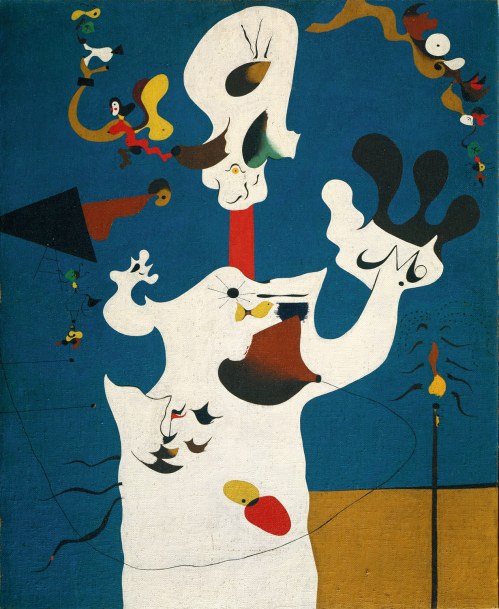
Above you will see Juan Miro’s Potato (1928). When you recognize that as possibly/certainly a potato/the potato/no potato/one potato/many potatoes/the idea of potato, you will be on your way to understanding what is going on. In the news, for example. Probably better than me.

Patti Smith

This weekend I experienced Patti Smith performing her iconic first album Horses (1975), along with other songs. She’s been on tour with this for a while, so you can read plenty of reviews elsewhere, as you can read about the significance of Horses and Patti Smith in the evolution of modern pop music.

If this was going to be a review, I’d mention her gifts as a writer, poet, musician, performer, woman, and human being, and how her infectious energy and presence aren’t just wondrous for an artist who is now 70—it’s wondrous for anybody.

I’d mention how awesomely cool she is, write about her on-stage patter. Some of it planned (after the first songs of the album, she showed the album jacket and explained that she had just performed Side A, and now we were going to flip to Side B, put it on the turntable, put the arm down, put the needle in the groove). Some of it spontaneous (a fan threw a T-shirt on stage, which she thought was a Jerry Seinfeld shirt, leading her to wonder why anyone would do that, tell her only Jerry Seinfeld personal story, and then realize that without her glasses on, she hadn’t seen that it was a picture of Jerry Garcia, leading her to tell her only personal story about Garcia, which was funny.)

But this isn’t a review. I just want to say that it was one of the best concerts I have ever been to and I’ve been to plenty of great ones. Here’s why:

Patti Smith is authentic, committed, open-hearted, honest, gentle, wild, loving and fierce. When you add that to her talent, it is totally inspiring. Still thinking about it days later inspiring. Not that most of us are or can be quite that talented, or as authentic, committed, open-hearted, honest, gentle, wild, loving or fierce, but that we can aspire to be all that. And when we aspire, we can be artists too.

Patti Smith also believes, performs and preaches the power of rock and roll, not a gospel as current as it once was, but no less true. At the end of the concert, she strapped on her electric guitar, and played some crazy, Hendrix-style riffs, wailing to heaven. And then she held up her guitar: This is a weapon, she said, a weapon of love.

A Creative Pseudonymous Psychological Analysis and Case Study of a World Leader

I have been thinking about Freud. As one of the pioneers of psychoanalysis, he and others published case studies that anonymized, and some would say took creative liberties with, their patients. One could say that analysis as practiced, developed and publicized by Freud and others is in fact a creative process.

Artists outside clinical psychology have also enjoyed the freedom to create and play—in the best sense—in the field of psychology and analysis. There are hundreds of examples: the paintings of Dali, the movies of Hitchcock, and so many more. (In some of these, Freud himself even plays a prominent role. The novelist D. M. Thomas in 1981 published The White Hotel, an extraordinary and unforgettable melding of Freud’s analyzing a patient with the surreality of the Holocaust. As a side note, The White Hotel, which has fascinated movie producers for decades, is now considered the ultimate great novel that will never actually be filmable or filmed.)

In this vein, what if professionals and creatives both were to devise case studies—entirely veiled and pseudonymous—of someone presently powerful and famous? Might that be revealing in ways that other profiles might not? Might such studies fill in the blanks in a personal portrait that is still quite mysterious and confounding?

Above all, might these case studies be true art? As I’ve written before, in the right hands, poetry and all the other arts can indeed be insurgent.

Thoreau: Life Without Principle

thoreau

Please read a little Henry David Thoreau if you have the chance. Maybe no American writer has made a plainer case for living a life of truth, a life of principle, a life that matters.

You may know of his most famous works.

There is Walden, about his choosing to live for a time in the woods, within nature and by himself (“I went to the woods because I wished to live deliberately, to front only the essential facts of life, and see if I could not learn what it had to teach, and not, when I came to die, discover that I had not lived.”) There is Civil Disobedience, about determining how, when and why defying the powers that be is a conscientious imperative.

There is much more Thoreau beyond these (see Walden and Other Writings). Following are some brief excerpts from Life Without Principle, published posthumously in the Atlantic Monthly in 1863.


In proportion as our inward life fails, we go more constantly and desperately to the post-office. You may depend on it, that the poor fellow who walks away with the greatest number of letters proud of his extensive correspondence has not heard from himself this long while…. [Note: If you substitute “greatest number of followers” for “greatest number of letters”, you will see just how timely and relevant this is today.]

I am astonished to observe how willing men are to lumber their minds with such rubbish,—to permit idle rumors and incidents of the most insignificant kind to intrude on ground which should be sacred to thought. Shall the mind be a public arena, where the affairs of the street and the gossip of the tea-table chiefly are discussed? Or shall it be a quarter of heaven itself….

Just so hollow and ineffectual, for the most part, is our ordinary conversation. Surface meets surface. When our life ceases to be inward and private, conversation degenerates into mere gossip. We rarely meet a man who can tell us any news which he has not read in a newspaper, or been told by his neighbor; and, for the most part, the only difference between us and our fellow is that he has seen the newspaper, or been out to tea, and we have not….

We may well be ashamed to tell what things we have read or heard in our day. I do not know why my news should be so trivial,—considering what one’s dreams and expectations are, why the developments should be so paltry. The news we hear, for the most part, is not news to our genius. It is the stalest repetition….

Really to see the sun rise or go down every day, so to relate ourselves to a universal fact, would preserve us sane forever. Nations! What are nations? Tartars, and Huns, and Chinamen! Like insects, they swarm. The historian strives in vain to make them memorable. It is for want of a man that there are so many men. It is individuals that populate the world….

It requires more than a day’s devotion to know and to possess the wealth of a day.

Paris 1968: A Popular Movement That Almost Toppled a Government

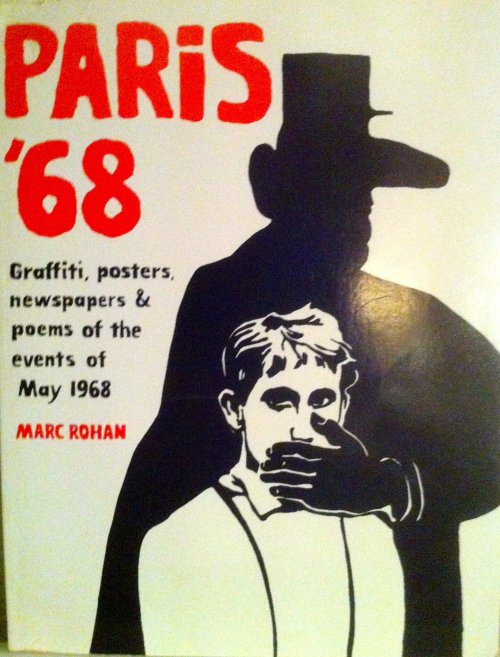
Paris '68

One of the most remarkable popular uprisings of the 1960s—possibly of the modern era—started in Paris in May 1968. It would ignite and inspire the entire nation, lead to a national general strike, and almost bring down the French government of Charles de Gaulle. It also captured the imagination of the world.

The movement did die down after a few months. But it left an indelible mark on the way cultural, social and political movements can combine and be conducted. In his Foreword to When Poetry Ruled the Streets: The Events of May 1968, Douglas Kellner writes:

In the historical memory of the Left, the Events of May ’68 in France have attained mythic proportion. The student uprising, workers’ strikes and factory occupations that erupted during a brief but explosive period in 1968 instilled fear in the hearts of ruling powers everywhere. They inspired those in revolt everywhere with the faith that social upheaval is possible and that spontaneous insurgency can overcome the force of circumstances. For an all-too-brief moment, imagination seized power, the impossible was demanded, and poetry and spontaneity ruled the streets.

Of course, the revolutionary energies of the May Events were soon exhausted, order was restored, and since then the significance of May ’68 has been passionately debated. Did the uprising reveal the exhaustion and bankruptcy of the existing political system and parties, or the immaturity and undisciplined anarchy of the forces in revolt? Did the Events indicate the possibility of fundamental change, or prove that the established system can absorb all forms of opposition and contestation? Did May ’68 signal the autonomy of cultural and social revolution, or demonstrate once again that the old economic and political forces still control the system and can resist all change?…

May ’68 demonstrates as well that spontaneous action can erupt quickly and surprisingly, that it can provide alternatives to standard politics, and that a new politics is practical and necessary. The initial inability of established Left political parties and unions to support the students and workers suggests the irrelevancy of politics as usual and the need to go outside of ordinary political channels and institutions to spark significant contestation and change. The Events also suggest the primacy of social and cultural revolution, of the need to change individuals, social relations, and culture as a prelude to political and systemic transformation. The total nature of the rebellion reflects the totalizing domination of the system which must itself be transformed if significant change is to take place….

For a brief moment, the spirit of 1968 appeared to promise fundamental change in France and in other places throughout the world. To counter historical forgetting, to keep memory and hope alive let us now rethink and relive these experiences, find connections with our contemporary situation, and strive to create our own alternative modes of thought and action.

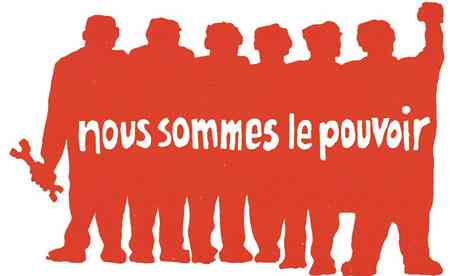
One vital legacy of May 1968 are the posters, graffiti and poetry of the movement. A gallery of posters can be found here. About these posters, Justin McGuirk of the Guardian writes:

While their fellow students engaged in pitched battles with the police and millions of workers went on general strike, students at the École des Beaux Arts in 1968 occupied the printing studios and converted them into the uprising’s very own propaganda machine. Many of the resulting posters have become icons of political design.

Be young, shut up

Be young and shut up (Charles de Gaulle silencing a protester)

We are all undesirables

We are all undesirables

We are the power

We are the power

Baseball Poetry: Joy and Tragedy in Mudville

Oh, somewhere in this favored land the sun is shining bright…

Baseball has inspired more literature, novels, stories, essays, poems, than all other sports combined. It isn’t that those other sports haven’t inspired some great works. It’s just that the volume of baseball writing is so huge.

I’ve mentioned Bart Giamatti before: Yale University President, baseball commissioner, writer of exquisite baseball elegies. Also the recently deceased W.P. Kinsella, author of the ultimate novel about baseball magic, Shoeless Joe, and many other baseball stories. For other classic baseball novels among the hundreds published, see The Natural by Bernard Malamud and Bang the Drum Slowly by Mark Harris, to name a few.

And then there are thousands of baseball poems, by professional and amateur writers/baseball fans. Poems about baseball in general, about particular teams, about particular seasons, about particular players. Multiple volumes of baseball haiku.

Here is a favorite baseball poem:

The Pitcher
by Robert Francis

His art is eccentricity, his aim
How not to hit the mark he seems to aim at,
His passion how to avoid the obvious,
His technique how to vary the avoidance.
The others throw to be comprehended. He
Throws to be a moment misunderstood.
Yet not too much. Not errant, arrant, wild,
But every seeming aberration willed.

And then there’s the most famous baseball poem ever, Casey at the Bat by Ernest Thayer. Note well: This poem, published in 1888, has been popular for more than a century. And it is a tragedy. Casey battles a nameless pitcher in the ninth inning, with two out, men on second and third. Casey strikes out. Any game that inspires such a poem, and any fans who embrace such a poem, understand something about something that goes beyond the simple and conventional. They understand baseball.

The outlook wasn’t brilliant for the Mudville nine that day:
The score stood four to two, with but one inning more to play,
And then when Cooney died at first, and Barrows did the same,
A pall-like silence fell upon the patrons of the game.

A straggling few got up to go in deep despair. The rest
Clung to the hope which springs eternal in the human breast;
They thought, “If only Casey could but get a whack at that—
We’d put up even money now, with Casey at the bat.”

But Flynn preceded Casey, as did also Jimmy Blake,
And the former was a hoodoo, while the latter was a cake;
So upon that stricken multitude grim melancholy sat,
For there seemed but little chance of Casey getting to the bat.

But Flynn let drive a single, to the wonderment of all,
And Blake, the much despised, tore the cover off the ball;
And when the dust had lifted, and men saw what had occurred,
There was Jimmy safe at second and Flynn a-hugging third.

Then from five thousand throats and more there rose a lusty yell;
It rumbled through the valley, it rattled in the dell;
It pounded on the mountain and recoiled upon the flat,
For Casey, mighty Casey, was advancing to the bat.

There was ease in Casey’s manner as he stepped into his place;
There was pride in Casey’s bearing and a smile lit Casey’s face.
And when, responding to the cheers, he lightly doffed his hat,
No stranger in the crowd could doubt ‘twas Casey at the bat.

Ten thousand eyes were on him as he rubbed his hands with dirt;
Five thousand tongues applauded when he wiped them on his
shirt;
Then while the writhing pitcher ground the ball into his hip,
Defiance flashed in Casey’s eye, a sneer curled Casey’s lip.

And now the leather-covered sphere came hurtling through the
air,
And Casey stood a-watching it in haughty grandeur there.
Close by the sturdy batsman the ball unheeded sped—
“That ain’t my style,” said Casey. “Strike one!” the umpire said.

From the benches, black with people, there went up a muffled
roar,
Like the beating of the storm-waves on a stern and distant shore;
“Kill him! Kill the umpire!” shouted someone on the stand;
And it’s likely they’d have killed him had not Casey raised his
hand.

With a smile of Christian charity great Casey’s visage shone;
He stilled the rising tumult; he bade the game go on;
He signaled to the pitcher, and once more the dun sphere flew;
But Casey still ignored it and the umpire said, “Strike two!”

“Fraud!” cried the maddened thousands, and echo answered
“Fraud!”
But one scornful look from Casey and the audience was awed.
They saw his face grow stern and cold, they saw his muscles
strain,
And they knew that Casey wouldn’t let that ball go by again.

The sneer is gone from Casey’s lip, his teeth are clenched in hate,
He pounds with cruel violence his bat upon the plate;
And now the pitcher holds the ball, and now he lets it go,
And now the air is shattered by the force of Casey’s blow.

Oh, somewhere in this favored land the sun is shining bright,
The band is playing somewhere, and somewhere hearts are light;
And somewhere men are laughing, and somewhere children
shout,
But there is no joy in Mudville—mighty Casey has struck out.


Dragon Poems (About a Plant)

Madagascar Dragon

The Dragon at the Wall

The dragon guards the wall
I sit before.
A fine pair we are.
I breathe in the oxygen
He breathes out.
He asks for water and light
I ask to learn to sit
As naturally as he does.

The Dragon Awakes

The dragon wakes up
When I open the blinds
Long green scales
Gracefully still
In the morning light.

These poems are about a plant. A dracaena marginata, which means “Madagascar dragon.” Whether or not it is a real dragon is a question.

In his Treasury of the True Dharma Eye (Shobo Genzo), Dogen Zenji also writes about a dragon and a plant. Actually, a tree. Fascicle 65, Dragon Song, includes the question “Is there a dragon singing in a withered tree?” Is there?

Touzi, Great Master Ciji of Shu Region, was once asked by a monk, “Is there a dragon singing in a withered tree?”

Touzi replied, “I say there is a lion roaring in a skull.”

Discussions about a withered tree and dead ash [composure in stillness] are originally teachings outside the way. But the withered tree spoken of by those outside the way and that spoken of by buddha ancestors are far apart. Those outside the way talk about a withered tree, but they don’t authentically know it; how can they hear the dragon singing? They think that a withered tree is a dead tree which does not grow leaves in spring.

The withered tree spoken of by buddha ancestors is the understanding of the ocean drying up. The ocean drying up is the tree withering. The tree withering encounters spring. The immovability of the tree is its witheredness. The mountain trees, ocean trees, and sky trees right now are all withered trees. That which sprouts buds is a dragon singing in a withered tree. Those who embrace it one hundredfold, one thousand-fold, and one myriadfold are descendants of the withered tree.

Books: W.P. Kinsella

The Essential W.P. Kinsella

The writer W.P. Kinsella has died at the age of 81. He is most famous as the author of the novel Shoeless Joe, which was turned into the beloved baseball movie Field of Dreams. (The book is infinitely better.)

That was only a small part of his work. He wrote many other books and stories, some about baseball, some about indigenous Canadians on the reserve (reservation), and others. All his work was by parts unique and charming and funny, filled with a lot of magic, because Kinsella was such a gifted literary magician.

I looked for an obituary to quote that didn’t spend most of its time talking about Field of Dreams. Not many of those. I also looked for an obituary that didn’t mention his personal life, which seems to have been untidy and ragged in some ways, as he apparently could be a difficult person, as talented artists are wont to be. He may have been difficult, but reading his work is easy, so what does it matter, at least to readers?

Many of his books appear to be out of print, as interest in his work has faded. His death has brought him more attention than he had for years, which is the way it goes. The good news is that last year a collection of his stories was published. Here is the publisher’s description of The Essential W.P. Kinsella:

This career retrospective celebrates the 80th birthday of baseball’s greatest scribe, W. P. Kinsella (Shoeless Joe), as well as the 25th anniversary of Field of Dreams, the film that he inspired.

In addition to his classic baseball tales, W. P. Kinsella is also a critically-acclaimed short fiction writer. His satiric wit has been celebrated with numerous honors, including the Order of British Columbia.

Here are his notorious First Nation narratives of indigenous Canadians, and a literary homage to J. D. Salinger. Alongside the “real” story of the 1951 Giants and the afterlife of Roberto Clemente, are the legends of a pirated radio station and a hockey game rigged by tribal magic.

Eclectic, dark, and comedic by turns, The Essential W. P. Kinsella is a living tribute to an extraordinary raconteur.

And from a starred review in Publishers Weekly:

The career of the incomparable Kinsella is beautifully represented by these 31 short stories, including, of course, “Shoeless Joe Jackson Comes to Iowa,” the haunting tale of a baseball fan’s obsession with a long-dead star that was developed into a bestselling novel and then the film Field of Dreams. Other charming baseball fantasies include “The Night Manny Mota Tied the Record,” in which a fan agrees to sacrifice himself to bring back the recently dead Yankees star Thurman Munson, and “Searching for January,” which concerns an encounter with the deceased Roberto Clemente. Alongside these stories are several more realistic and mostly gentle satires, such as “The Fog,” that present the escapades of several indefatigable members of Canada’s First Nations. “The Grecian Urn” concerns a couple who can inhabit the interior worlds of great works of art. “K Mart” is the touching tale of three boys who use baseball to escape from their unhappy lives. Kinsella is a masterly writer of short fiction.

If you love good writing, please give W.P. Kinsella a read.

Aesop’s Fables: Defending a Demagogue

Aesop's Fables

I just began reading Laura Gibb’s excellent and highly recommended Aesop’s Fables. With almost 600 fables, beautifully translated, that’s less than a penny a fable. Please read it for fun, education and enlightenment.

You may or may not have grown up on these tiny tales from this famous real or apocryphal Greek storyteller, but they have been streaming through civilization for millennia. You certainly know some of them from our common culture: the tortoise and the hare, the ant and the grasshopper. Each includes a moral (e.g., slow but steady wins the race), which is how they came to be seen as lessons for children, but they were originally for adults, and you might look to their value as teaching stories for everyone. Also, if you are a writer or other creative, they can provide instant inspirational spark.

When I read this fable of the fox and the hedgehog (Fable 29 in the Gibbs numbering), I couldn’t help thinking of current events:

Aesop was defending a demagogue at Samos who was on trial for his life, when he told this story: ‘A fox was crossing a river but she got swept by the current into a gully. A long time passed and she couldn’t get out. Meanwhile, there were ticks swarming all over the fox’s body, making her quite miserable. A hedgehog wandered by and happened to see the fox. He took pity on her and asked if he should remove the ticks, but the fox refused. The hedgehog asked the reason why, and the fox replied, “These ticks have taken their fill of me and are barely sucking my blood at this point, but if you take these ticks away, others will come and those hungry new ticks will drink up all the blood I have left!” And the same is true for you, people of Samos: this man will do you no harm since he is already wealthy, but if you condemn him to death, others will come who do not have any money, and they will rob you blind!’