Bob Schwartz

Tag: koan

Meditation: Why does the Hebrew Bible begin with the letter Bet (Bereshit—In the beginning) and not the first letter Aleph?

The Hebrew Bible (Old Testament) begins with the Hebrew word “Bereshit”, conventionally translated as “In the beginning”.

In Hebrew the word begins with the second letter of the alphabet, Bet, like the second letter B.

But it is the beginning. So why doesn’t the text start with an Aleph/A word, the first letter of the alphabet?

This is a conundrum that has challenged the rabbis for centuries. They have spoken and written insightfully at length about it.

You don’t have to know what the rabbis have said or written. You don’t have to be Jewish, you don’t have to know Hebrew. You don’t have to be a student of the Bible. You already know enough, as detailed above.

Instead, consider this like a Zen koan, something to ponder without resolving. If it helps your pondering, whether you know Hebrew or not, you might look at and contemplate the image of the letters. Is there something about the letters themselves that tells you something about why one was chosen instead of the other to start off this famous story?
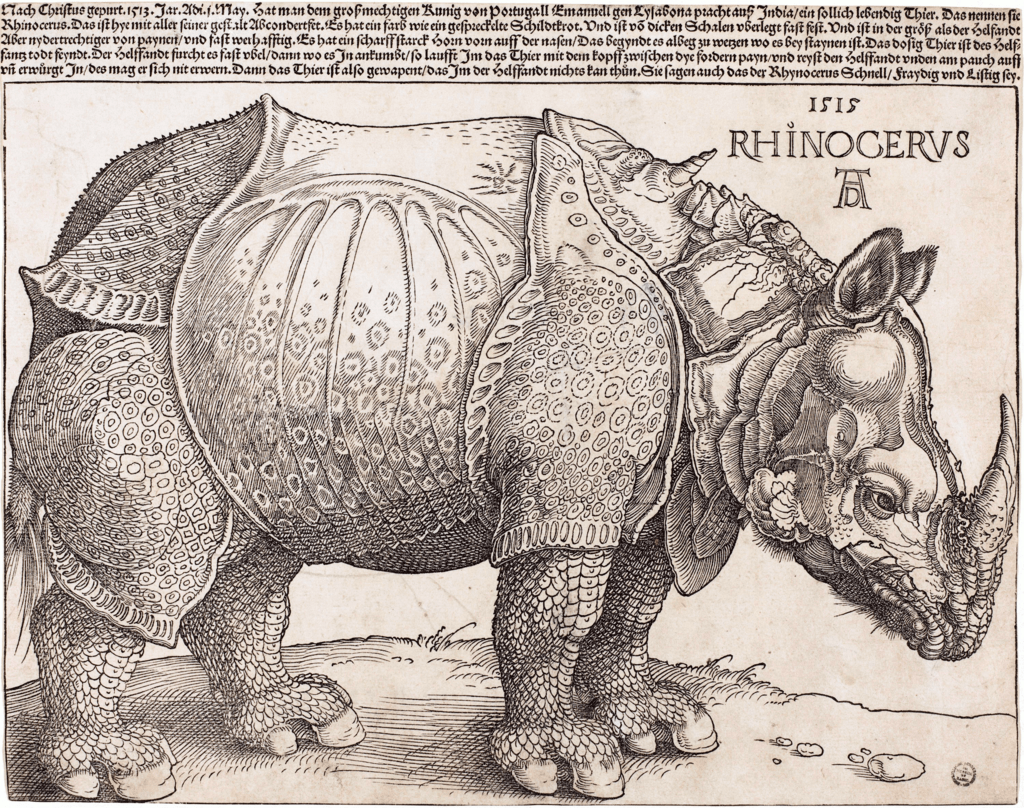
Bring me the rhinoceros fan

Rhinoceros, Albrecht Dürer

I began today listening to birds:

If birds sing in the morning
Why not me
Why not we

I quickly turned to a rhinoceros.* There is a famous Zen koan that has nothing to do with birds. Also everything to do with birds, even if they are not mentioned.

I thought of writing about the koan here. Funny that I haven’t before. I thought of sending friends the koan, found at Blue Cliff Record 92, without explanation or commentary. What would they think? What do you think?


Yanguan (750-843) called to his attendant, saying, “Bring me the rhinoceros fan**.”
The attendant said, “It’s broken.”
Yanguan said, “If the fan is broken, then bring me the rhinoceros.”
The attendant didn’t answer.


*I didn’t intend for that sentence to be multi-layered, but it could be. I wrote “turned to” to mean changing the subject. One of the great absurdist plays by Eugene Ionesco is Rhinoceros, in which the people of a town one-by-one turn into a rhinoceros. It is sometimes interpreted as a parable about people turning into Nazis during World War II.

**Likely an expensive item, made of rhinoceros horn or picturing a rhinoceros. Not someone who is fanatical about rhinoceros.

© 2024 by Bob Schwartz

Would the Buddha Trim the Bodhi Tree?

Back in December on Bodhi Day (the celebration of the Buddha’s enlightenment), I gave myself a present:

This Bodhi Day, I gifted myself a bodhi tree, just like the one that the Buddha was sitting under when he was enlightened. Almost just like it. This bonsai ficus religiosa is about 8 inches high, so I will not be sitting under it.

I’ve taken good care of this very hardy bonsai and it has grown well. That leaves me with a conundrum. The aesthetics of bonsai includes appropriate trimming to maintain a certain balance. But each time I consider taking scissors to growth, I stop. If it grows lush and green, let it grow.

Then I thought of the Buddha’s own Bodhi tree. There are no tales of his considering trimming that tree. That doesn’t mean he didn’t think about it—or not think about it.

So, as I continue to water this beautiful little tree, a new koan appears: Would the Buddha trim the Bodhi tree?

Star Trek Koan

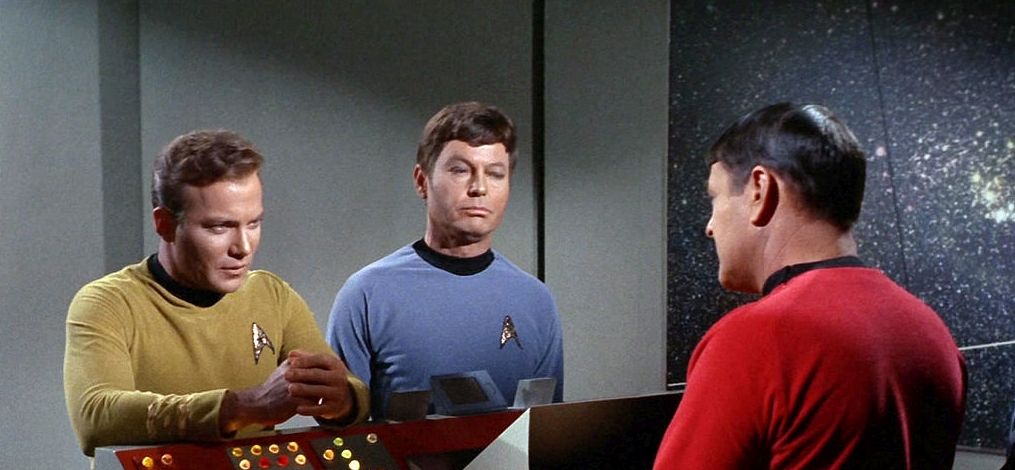
kirk-mccoy-scott

Captain Kirk faced a crisis on the Enterprise. He summoned his ship’s doctor and his ship’s engineer. Bones says, “Damn it Jim, I’m a doctor, not an engineer.” Scotty says, “I’m an engineer, Captain, not a doctor.” Who is right?

Outsmarting a Coffee Machine

Zen Tea

When I arrive at my hotel room, I find a very modern coffee machine. Very smart. It tells me to place the coffee pod in its holder. Close the lid. Another lid opens to accept water. Pour in water and close that lid. Place the cup on the pedestal, which it then knows is in place. Press the brew button. And in a matter of seconds, hot coffee.

But what if I just want hot water? Then I have to outsmart it. When it directs me to place the coffee pod in its holder, I don’t. I just pretend. I put the water in the tank, put the cup in place, and proceed as if what I want, what I am expecting, is a cup of coffee. What it gives me instead, what I want instead, is simply a cup of hot water. Which I can then use for any of the things you can do with hot water. Such as making a cup of tea with a teabag.

The machine is smart. Or I am smart. The machine is stupid. Or I am stupid.

Have a cup of tea.


Zhaozhou’s Cup of Tea
(Koan 233 of Zen Master Dogen’s Three Hundred Koans)

MAIN CASE

Zhaozhou asked a newly arrived monk, “Have you been here before?”

The monk said, “Yes, I have been here.”

Zhaozhou said, “Have a cup of tea.”

Later he asked another monk, “Have you been here before?”

The monk said, “No, I haven’t been here.”

Zhaozhou said, “Have a cup of tea.”

The monastery director then asked Zhaozhou, “Aside from the one who has been here, why did you say ‘Have a cup of tea’ to the one who had not been here?”

Zhaozhou said, “Director.”

The director responded, “Yes?”

Zhaozhou said, “Have a cup of tea.”

COMMENTARY

In the real truth, there is no other thing that is present. In worldly truth, the ten thousand things are always present. We should clearly understand that real truth and worldly truth are nondual and that this, in and of itself, is the highest meaning of the holy truths.

The monastery director was lost in the differences between the two monks, so Zhaozhou moved in all directions at once to help him see it. If you go to the words to understand this, you will miss it. If, however, you see into it directly, it will be like the bottom falling out of a bucket. Nothing remains. How do you see into it directly? Have a cup of tea.

Easter

Gnostic Bible

I am not a Christian, not in any conventional or even unconventional sense. But I have been a student of Christian religion, literature and phenomena for decades. It is part of a religious triangle—or maybe universe—with my native Judaism and my adopted Buddhism.

One of my earliest Christian experiences was reading the Gospel of Thomas, part of the Nag Hammadi Library, a trove of early Christian writings discovered in 1945. That translation of one of the so-called Gnostic Gospels was done by Dr. Marvin Meyer; I did not know that years later I would work with and become friends with him. What I did know on first reading (and on first meeting) was that the late Dr. Meyer was brilliant. (You may well have seen him on many of the History and Discovery Channel type biblical shows.)

For this Easter, I include a selection from the Gospel of Thomas. It is taken from The Gnostic Bible, edited by Dr. Meyer and by the equally-brilliant poet, translator and scholar Willis Barnstone.

The Gospel of Thomas, often called the Fifth Gospel, is a work of sayings and wisdom; there is no action. Some of the sayings are similar to those that appear in the canonical gospels. Others are more assertively cryptic and mysterious, puzzling in the same way that Zen koans are. This section, appropriately for Easter, is about life and death:

11

Yeshua (Jesus) said,
This heaven will pass away
and the one above it will pass away.
The dead are not alive
and the living will not die.
During the days when you ate what is dead
you made it alive.
When you are in the light, what will you do?
On the day when you were one
you became two.
But when you become two, what will you do?

Willis Barnstone’s most recent work is The Restored New Testament, a monumental achievement in which he single-handedly translated the entire NT (including Gnostic Gospels) and provided hundreds of pages of lucid and enlightening commentary. In that book, he offers this wisdom for a modern age:

In the end, all people are people, and no people should ever be classified for whatever reason as less than another. Any marker of sect and theology that distinguishes any people adversely is human and humane error. So the gospels and Apocalypse should not be seen for the momentary and external conflicts they may contain, but rather for their greater universality of spirit in a world desperately poor in coming to terms with human consciousness within the perishable body. Happily, the call to spirit is deep and needs no name, and no divisive emblem. The New Testament is a book of the mind; it is infused with compassion and courage and the great questions of being, death, time, and eternity. For the perceptive reader, spirit eludes name, dogma, and even word to reside in the silence of transcendence.