Bob Schwartz

Tag: Judaism

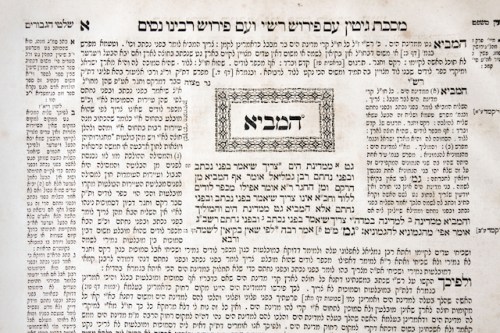
Poem: My Night with the Sages

Talmud

My Night with the Sages

I found their numbers
Six, sixty-three.
Dispensing wisdom
Demanding action
Citing authority.
Talking
And talking
And talking.
How could they possibly
Help with the night?
Lost in loud logic
Where is the comfort or distraction?
But I called anyway
And they came.
To uneasy free floating
In the bleak
They added gravity
And light
Not quite
In reach
But there.
To sleep.

The Whole Wheat of Spirit and the Millstone of Reason

Encyclopedia of Jewish Myth

Going beyond pure reason is a trip too far for many, to a place where the possible and the impossible seem to coexist on equal terms.

But why not go beyond, at least for a visit or vacation? You never know what you will find or learn there.

Mama always told me not to look into the sights of the sun
Oh but mama that’s where the fun is
Bruce Springsteen, Blinded by the Light

To the pious man God is as real as life, and as nobody would be satisfied with mere knowing or reading about life, so he is not content to suppose or to prove logically that there is a God; he wants to feel and to give himself to Him; not only to obey but to approach Him. His desire is to taste the whole wheat of spirit before it is ground by the millstone of reason. He would rather be overwhelmed by the symbols of the inconceivable than wield the definitions of the superficial.
Abraham Joshua Heschel, Man Is Not Alone

Recommended:

The Encyclopedia of Jewish Myth, Magic and Mysticism: Second Edition, Geoffrey W. Dennis

The new edition of a thoroughly readable and accessible compendium of information and insights. Fun for the casually curious, valuable for the interested reader and researcher.

From the Introduction:

Judaism is one of the oldest living esoteric traditions in the world. Virtually every form of Western mysticism and spiritualism known today draws upon Jewish mythic and occult teachings—magic, prayer, angelology, alchemy, numerology, astral projection, dream interpretation, astrology, amulets, divination, altered states of consciousness, alternative, and rituals of power—all have roots in the Jewish occult….

Modern Jews like to imagine that magic has been swept into the dustbin of history by the long, inexorable progress of rationalism. More than that, Jews have been taught from our youth that Judaism has always possessed an essentially naturalistic worldview and that magic, merely a marginal Jewish preoccupation at most, was just an anomaly resulting from our being situated (and corrupted) by the superstitions of our neighbors. But that’s not entirely accurate. It is only in the last two centuries that Jews have fully embraced science, but we have always been looking for ways to change the world for the better, whether it be through science, medicine, or “practical Kabbalah.”

Even today, rationalism has not completely displaced our sense that there is a mystical potential at work in the world; Occam’s razor has never been able to fully overpower the Sixteen-Sided Sword of the Almighty. Millions of people, both Jews and gentiles, continue to believe that the stars influence our lives. Most Americans believe in the reality of angels. Jewish techniques of dream interpretation and for combating the evil eye are still widely practiced today. When you read the entries of this book on topics such as these, you will realize that magical thinking and enchanting deeds have always had a place in Judaism and, however much some might want to dismiss Judaism’s miraculous and wondrous traditions, the presence of Jewish magic in Jewish life has merely been eclipsed, never uprooted; it still has the potential to empower us.

Matzo: Dealing with Eating the Bread of Affliction

Organic Spelt Matzo

Matzo is referred to as “the bread of affliction,” symbolizing the exodus of the Jews from Egypt, who didn’t have time to allow the bread to rise as they fled through the wilderness. Talk about flatbread, this is the ultimate.

If you are observing the Passover and avoiding bread for the next week, or even if you’re not, some thoughts about eating matzo.

  1. Put away the toaster. Save the counter space. You won’t need it for bread. And you can’t toast matzo. Even if you could, it would slip through the slot.
  1. Make matzo brei for breakfast. Matzo brei is kind of a cross between pancakes and French toast, made by soaking matzo in water, mixing it with eggs, and cooking it in a frying pan. Delicious all year round. You don’t have to Jewish and it doesn’t have to be Passover.
  1. Try all the varieties of matzo, or at least the ones that don’t seem a little extreme (Organic Spelt, I’m looking at you). Once upon a time there was only plain matzo, just like there used to be plain white bread. Now everything is mixed in: Egg, Yolk-Free, Egg and Onion, Spelt, Mediterranean, Whole Wheat, Garlic and Rosemary, and Everything (which actually doesn’t have everything, just garlic, onion and poppy seeds. Go figure.)
  1. Don’t try to make sandwiches. At the seder, the tradition is to eat a tiny sandwich of horseradish and haroset (a sweet paste representing the mortar of the building the Jews slaved on) between two pieces of matzo. The great sage Hillel supposedly created this sandwich, and his name is attached to it. Even this tiny sandwich throws matzo crumbs all over the place. A full-size matzo sandwich is not a good idea. No matter how wise Hillel was.

Happy Passover.

A Heschel Haggadah


Heschel Stamp

Each Passover is an opportunity to craft a special theme and text for the seder meal and celebration. The haggadah is the guide to the seder. It always incorporates the traditional order and elements that have been a part of the seder for centuries—most especially the retelling of the exodus story. Beyond that, one can follow the same exact text year after year, or can get creative. In recent years, creativity has been a hallmark of Passover and the haggadah.

It is a happy struggle for me to determine which haggadah to use for seder. Happy because it is a way to deeply consider Passover, the seder, and the group of guests joining us at the table. Our library has haggadot from years past, both those in published book form and those made up of pages printed and compiled ourselves. (I am a little partial to the one that includes scenes from The Ten Commandments movie.)

After weeks of study, and with a previous suggestion about using FDR’s Four Freedoms as a possible theme, I’ve decided to make this a seder featuring the words of Abraham Joshua Heschel. I’ve mentioned Heschel a few times in this blog (and mentioned his daughter, Professor Susannah Heschel, too). I’ve run out of superlatives to recommend his work. So as I’ve said before, he is the great Jewish thinker and writer of the 20th century, and that is only the start. He is also a model of enlightened religious thought in action. He marched with Dr. King in Selma—as can be seen in the famous photo, Heschel looking every bit the bearded biblical figure. And it was to Heschel’s seder that Dr. King planned to go in April 1968, when he was gunned down in Memphis.

In that same vein, here is a message that Heschel sent to President Kennedy in 1963:

To President John F. Kennedy, The White House, June 16, 1963

I look forward to privilege of being present at meeting tomorrow at 4 p.m. Likelihood exists that Negro problem will be like the weather. Everybody talks about it but nobody does anything about it. Please demand of religious leaders personal involvement not just solemn declaration. We forfeit the right to worship God as long as we continue to humiliate Negroes. Church synagogues have failed. They must repent. Ask of religious leaders to call for national repentance and personal sacrifice. Let religious leaders donate one month’s salary toward fund for Negro housing and education. I propose that you Mr. President declare state of moral emergency. A Marshall Plan for aid to Negroes is becoming a necessity. The hour calls for high moral grandeur and spiritual audacity.

Now begins my review of Heschel’s volumes, looking for small excerpts that will convey the essence of Heschel and the holiday, but won’t make the seder too long. For me, if we just took part in the seder, ate a great meal, and read Heschel aloud all night, it would be fine. Let’s see how that goes.

For an introduction to the words and works of Abraham Joshua Heschel:

The Wisdom of Heschel

Abraham Joshua Heschel: Essential Writings

I Asked For Wonder: A Spiritual Anthology

“Never once in my life did I ask God for success or wisdom or power or fame. I asked for wonder, and he gave it to me.”

Bernie Sanders and Pope Francis

Bernie Sanders at the Vatican

This kind-of-cute headline from Politico sort of says it all.

Bernie’s fanboy moment: A meeting with Pope Francis

As you may know, Bernie Sanders was invited to a conference at the Vatican on issues related to economic justice. He interrupted his New York campaign to attend, gave an excellent speech that frequently cited the Pope’s own writings, but was told that the Pope would not be able to meet with him and others at the conference.

Then, at the last minute, the Pope was able to meet for five minutes with Bernie and his wife Jane. It was thrilling to hear that. It is unimaginable to conceive what it must have been like for Bernie, who as the headline suggests, is a huge fan of the Pope and his thinking on economic issues.

In case you think this is all about electoral politics, think again.

A major American politician has met with the Pope, based on a shared vision of economic justice. That vision comes from a background of Jewish fairness and compassion in one case and from the deepest, most Jesus-based tenets of the Catholic Church in the other. This doesn’t happen every day, or month, or year.

It is a unique and sweet moment for those who care about the future of America and the world. If that sounds a little grandiose, maybe believing big is exactly what we need.

Four Freedoms Passover

Four Freedoms - Norman Rockwell

Passover is coming. The first seder meal will be held on the evening of Friday, April 22. Even for non-observant Jews, this holiday is frequently a time for participation. One estimate says that 80% of Jews attend some sort of seder.

This year I suggest we go way back for a Passover theme. Back to FDR’s Four Freedoms from 1941.

The overall order of the seder (“seder” actually means order) has been standardized for centuries—the blessings, the rituals, the symbolic food and drink, the songs, and most of all, the recitation of the events of the exodus from Egypt. But the text and the form and the meaning have been subject to remixing, some of it pretty adventurous.

In the modern era, the freedom embedded in Passover has been extended to all sorts of concerns. During the time of the civil rights movement, the obvious connection was made between ancient and modern oppression, and the struggle to end that oppression.

In 1969 Rabbi Arthur Waskow created a Freedom Seder, making this connection more direct. He explains:

One of my earliest and warmest memories is that of my father reciting the Dayenu, the chant of rebellion, liberation, travail, and the creation of a new law that is the story of Passover. One of my latest and warmest memories is that of working with my wife and children to make of our own Passover Seder something that would speak to our deep concerns about our selves and our world.

Our efforts became sharper and more urgent in 1968, when the Passover came one bare week after the murder of Martin Luther King, the April uprising of black Washington against the blank-eyed pyramid-builders of our own time, and the military occupation of our city. Who in
those days could forget that the prophet King had remembered Moses?– had spoken of how he had been to the mountain-top, had seen the promised land, but might never enter. … And then we realized that in 1969, the third night of Passover, April 4, would be the first anniversary of King’s death.

Since then, Passover has become the platform for seders centered around all kinds of affliction, oppression, aspiration and freedom. Women. LGBT. Poverty. Peace. The Earth. And so on.

One example of this concerns a new tradition that is widely practiced. The seder plate contains a number of foods symbolizing the story of the Egyptian captivity and the fight for freedom. Susannah Heschel conceived of one more thing to add:

So how was it that the orange found its place on the seder plate as a Passover symbol of feminism and women’s rights?

Susannah Heschel, daughter of Abraham Joshua Heschel and a scholar in her own right, says that at the height of the Jewish feminist movement of the 1980s, she was inspired by the abundant new customs expressing women’s viewpoints and experiences and started placing an orange on the seder plate.

At an early point in the seder, she asked each person to take a segment of the orange, make the blessing over fruit and eat the segment in recognition of gay and lesbian Jews and of widows, orphans, Jews who are adopted and all others who sometimes feel marginalized in the Jewish community. She encouraged each guest to spit out the seeds in their orange segment to reject homophobia and hatred. The orange suggests the fruitfulness for all Jews when everyone in our community is a contributing and active member of Jewish life. (From The Wandering Is Over Haggadah, JewishBoston.com)

On January 6, 1941 President Franklin D. Roosevelt delivered an historic State of the Union Address. The world was increasingly gripped by brutal tyranny. On top of that, America was still recovering from the effects of the Great Depression. And it seemed almost impossible for the U.S. to stay out of the global fight for freedom.

In the address, FDR summarized what freedom meant—and why we would fight for it, here and abroad. That statement became known as the Four Freedoms–Freedom of Speech, Freedom of Worship, Freedom from Want, Freedom from Fear:

In the future days, which we seek to make secure, we look forward to a world founded upon four essential human freedoms.

The first is freedom of speech and expression—everywhere in the world.

The second is freedom of every person to worship God in his own way—everywhere in the world.

The third is freedom from want—which, translated into world terms, means economic understandings which will secure to every nation a healthy peacetime life for its inhabitants—everywhere in the world.

The fourth is freedom from fear—which, translated into world terms, means a world-wide reduction of armaments to such a point and in such a thorough fashion that no nation will be in a position to commit an act of physical aggression against any neighbor—anywhere in the world.

That is no vision of a distant millennium. It is a definite basis for a kind of world attainable in our own time and generation. That kind of world is the very antithesis of the so-called new order of tyranny which the dictators seek to create with the crash of a bomb.

Some will point out the hypocrisies and ironies of the statement. At that point in American history, millions were not free and were under attack because of their race, religion, and economic circumstances. Maybe the biggest irony of all is that the final call for disarmament and the final phrase “crash of a bomb” ultimately faced the reality of a horrific war and an unthinkable bomb to end it.

But as a goal and aspiration, the Four Freedoms still ring out. Maybe we can ring them this Passover.

The posters above are by Norman Rockwell. Maybe more famous than FDR’s speech are the propaganda posters that Rockwell painted based on the Four Freedoms. As with the speech, some complain that Rockwell’s America was over-idealized and far too white. Probably so, and the images themselves may look quaint and, from today’s perspective, backward looking.

To counter that, following are a couple of works from Ben Shahn, an illustrator who was contemporary with Rockwell, artistically his equal, culturally his opposite:

Ben Shahn was born in Kovno, Russia on September 12, 1898 to Joshua Hessel and Gittel (Lieberman) Shahn and died on March 14, 1969. A Jewish-born artist, muralist, social activist, photographer and teacher, he is best known for his works of Social realism…From May to June of 1933, Shahn served as an assistant to Diego Rivera while the artist executed the infamous Rockefeller Center mural. By circulating a petition among the workers to keep the mural on display, Shahn played an important role in fanning the controversy.

Among his many famous works, in 1930 Shahn created a series of watercolor drawings for a Passover Haggadah. In 1965 these drawings were incorporated into a complete haggadah. Here, in an illustration called The Bread of Affliction, the hand of God leads the people out Egypt:

Bread of Affliction 2 - Ben Shahn

And here is a bit of Shahn’s later work, part of a series of union posters urging people to register and vote:

M25958-1 001
Happy Passover! Let freedom ring!

The Revival of Enlightened and Transformative Politics

Talking about the revival of enlightened and transformative politics is bound to be imprecise.

That concept has never actually been dead. Looking at Christianity, a recent post about Jim Wallis and Sojourners highlights just one instance. A bigger and much more famous current example is Pope Francis. And it is nothing new. The Social Gospel movement, which is still represented (though not always appreciated), aimed to see the realization of the highest Christian principles in everyday practical society.

Keeping with the Christian theme, this is not about what Jesus would say about abortion or gay marriage or prayer in schools or any of these specific arguments—though all have a certain significance. It is about politics as a tool of overall transformation, beyond sectarian concerns.

This is not limited to Christianity. Every one of the traditions has a core of enlightenment and large scale transformation. But each of those traditions has found a way to occasionally devolve that mission into movements and policies and tactics that diverge and even contradict the higher principles and aspirations. It isn’t necessary to point out the wrong turns that, for example, Judaism and Islam have taken along the way to supposedly establish heaven on earth.

In the era of what was affectionately, or for some derisively, known as the New Age movement, this concept of politics as a transformative tool was central. There was the idea that if we kept our eyes on the prize—not just a country but a world elevated above our baser selves—we could together create something better. Politics was one of the tools that would serve that end, instead of enabling smaller personal ambitions and selfish, possibly pernicious, goals.

So here we are. Enlightened and transformative politics is not dead. But it may be missing in action. Each political choice we make—each donation, each tweet, each vote and, yes, each post—might help us find it. Or kill it. It’s up to us.

Hasidic Tales of the Holocaust

Hasidic Tales of the Holocaust

For International Holocaust Remembrance Day, this story from Hasidic Tales of the Holocaust by Yaffa Eliach.


Good Morning, Herr Müller

Near the city of Danzig lived a well-to-do Hasidic rabbi, scion of prominent Hasidic dynasties. Dressed in a tailored black suit, wearing a top hat, and carrying a silver walking cane, the rabbi would take his daily morning stroll, accompanied by his tall, handsome son-in-law. During his morning walk it was the rabbi’s custom to greet every man, woman, and child whom he met on his way with a warm smile and a cordial “Good morning.” Over the years the rabbi became acquainted with many of his fellow townspeople this way and would always greet them by their proper title and name.

Near the outskirts of town, in the fields, he would exchange greetings with Herr Müller, a Polish Volksdeutsche (ethnic German). “Good morning, Herr Müller!” the rabbi would hasten to greet the man who worked in the fields. “Good morning, Herr Rabbiner!” would come the response with a good-natured smile.

Then the war began. The rabbi’s strolls stopped abruptly. Herr Müller donned an S.S. uniform and disappeared from the fields. The fate of the rabbi was like that of much of the rest of Polish Jewry. He lost his family in the death camp of Treblinka and, after great suffering, was deported to Auschwitz.

One day, during a selection at Auschwitz, the rabbi stood on line with hundreds of other Jews awaiting the moment when their fates would be decided, for life or death. Dressed in a striped camp uniform, head and beard shaven and eyes feverish from starvation and disease, the rabbi looked like a walking skeleton. “Right! Left, left, left!” The voice in the distance drew nearer. Suddenly the rabbi had a great urge to see the face of the man with the snow-white gloves, small baton, and steely voice who played God and decided who should live and who should die. He lifted his eyes and heard his own voice speaking:

“Good morning, Herr Müller!”

“Good morning, Herr Rabbiner!” responded a human voice beneath the S.S. cap adorned with skull and bones. “What are you doing here?” A faint smile appeared on the rabbi’s lips. The baton moved to the right—to life. The following day, the rabbi was transferred to a safer camp.

The rabbi, now in his eighties, told me in his gentle voice, “This is the power of a good-morning greeting. A man must always greet his fellow man.”

Based on my conversation with an elderly Hasidic personality.


In the literature of the Holocaust, Hassidic Tales of the Holocaust stands alone. As the publisher describes it, “Derived by the author from interviews and oral histories, these eighty-nine original Hasidic tales about the Holocaust provide unprecedented witness, in a traditional idiom, to the victims’ inner experience of “unspeakable” suffering. This volume constitutes the first collection of original Hasidic tales to be published in a century.”

As the author writes in her Foreword:

The Hasidic tale of the Holocaust is rooted in the Auschwitz reality, yet it soars to heaven and higher. It can carry the faithful above pits filled with bodies. Despite Auschwitz, the tale still expresses belief that man is good and capable of improvement; it can restore order to a chaotic world and offer unlimited freedom to the creative mind attempting to come to terms with the Holocaust. Its rich Jewish heritage and European tradition make it a unique genre of modern literature. The tales in this collection completed a full cycle from documentation to art to documentation and back to art. For in the beginning there was a tale.

There are many other books that will tell you about the history of the Holocaust. There are few other books that so deeply and creatively offer its soul.

One God Two God

One Fish Two Fish

One God
Two God
Red God
Blue God
(apologies to Dr. Seuss)

A professor at Wheaton College may be dismissed for saying that Christian and Muslims worship the same God.

There is so much that could be said about this.

About the history of American evangelicalism, of which Wheaton is a part. How it began as an open and activist socially liberal Christian movement and has ended up in some instances a radically conservative and strictly exclusivist movement.

About theology as complex as any machine ever built, and just as incomprehensible to those who are not religion mechanics and engineers. How even though the God of the Jews was absolutely the God of Jesus, and the God of the Jews and Jesus was absolutely the God of Muhammed, that isn’t so according to people who may think themselves smarter and more important than Jesus or Muhammed.

The concept of one God was a revolution in civilization. The earlier belief in an entourage of gods, greater and lesser, has been mostly replaced by the one. (Whether that one might be three-in-one goes back to the theology complexities mentioned above, so let’s leave that for now.)

It is no wonder that after thousands of years with religion as a standard way of life, more people are rejecting it than ever. Because if there is a God, and if religions have sprung up on his behalf (with or without his blessing), that God and those religions can look spectacularly ridiculous in the eyes of good people who want nothing but good for people. And because if God really cares about all this very human nonsense, a growing number of people want nothing to do with him or his religions. And who can blame them?

Hanukkah as Game of Thrones

The Hanukkah story of the Maccabees and the Hasmonean dynasty they founded is not for children. The aftermath of the overthrow of the Seleucid overlords is for grown-ups, a history of empire, guerilla wars, massacres, alliances made and betrayed, power marriages, expansionism, hegemony, and subjugation. And of course faith—the right kind, the wrong kind, and none at all.

It is the sort of story that belongs in Game of Thrones. You won’t see that series on HBO. We want simple tales of faith and miracles, for ourselves and especially for the kids. And why not? In troubled times and a troubled world, no one can begrudge any injection of light or miracles we can find or conjure up.

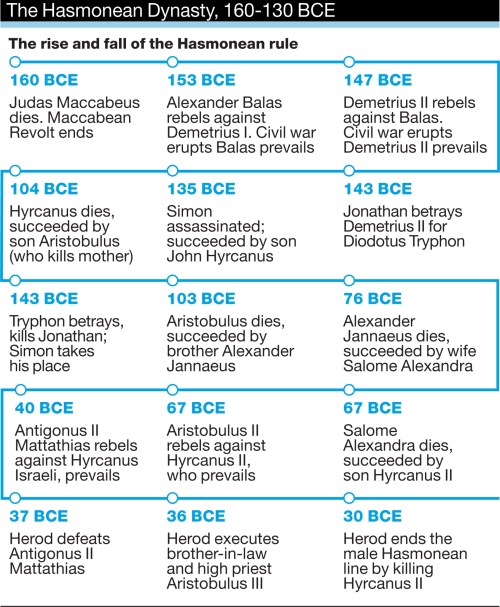
For a summary of this history, see this from the Israeli newspaper Haaretz: A Brief History of a Violent Epoch: Judas Maccabeus’ death would mark the end of the Maccabean revolt against the Greeks – and the start of the extremely unstable Hasmonean dynasty.

Here is a chart that outlines the chronology of the Hasmonean Dynasty:

Hasmonean Dynasty

Hanukkah has never been a major Jewish religious holiday, not on a par with Yom Kippur, Rosh Hashanah, Passover, and the rest. The events celebrated on Hanukkah do not appear in the Jewish bible. The canon of the Tanakh was closed before the Books of Maccabees could be included. Some of those books, though, can be found in Christian versions of the Old Testament.

Hanukkah was elevated, especially in America, as a seasonal companion to Christmas, for Jews living in decidedly Christian cultures. For a complete treatment of this phenomenon, see the book Hanukkah in America: A History.

The comparison to Christmas does suggest why we don’t have an epic series devoted to the Maccabees and their historical legacy.

The Christmas story has an even bigger and more significant and spectacular sequel. The newly born Jesus grows up to become the foundation of the faith and one of the great teachers in world history. The next part of his mission is told in the story of Easter. Sequels don’t get any bigger, clearer or cleaner than that.

The historical follow-up to the story of the Maccabees is more equivocal. It puts that era in Jewish history in a very real, human, political light that may clash with the simple idealized version of candles and dreidels.

This doesn’t mean we shouldn’t light the candles, eat the latkes, spin the dreidels, and commemorate the victory of God’s rule over the rule of the less godly. It’s just that sometime during the holiday, we might leave behind childish things and look at the history with eyes open. Not because it takes away from the holiday, but because it adds to it a fuller sense and understanding.

And because for two millennia, the exact same complexity has been unfolding in the exact same place. Not a children’s game. More like Game of Thrones. Only much more real.