Bob Schwartz

Tag: Jesus

Cherishing Trump as your spiritual friend

When I see ill-natured people,
Overwhelmed by wrong deeds and pain,
May I cherish them as something rare,
As though I had found a treasure-trove.
Eight Verses for Training the Mind

“You have heard that it was said, ‘Love your neighbor and hate your enemy.’ But I tell you, love your enemies and pray for those who persecute you, that you may be children of your Father in heaven. He causes his sun to rise on the evil and the good, and sends rain on the righteous and the unrighteous. If you love those who love you, what reward will you get? Are not even the tax collectors doing that? And if you greet only your own people, what are you doing more than others? Do not even pagans do that? Be perfect, therefore, as your heavenly Father is perfect.
Matthew 5:43-48

It’s hard. Exercise is hard. Training for any discipline is hard. Mind training and transformation are hard. Treasuring adversity and loving our enemy are hard.

There is so much and so many we find to reject and resist and oppose. So much anger and disgust and dislike, just at the sight of a face and the sound of a voice.

How can we cherish that? As a treasure trove? As a spiritual friend?

There must be a reason that our traditions teach us to treasure adversity and love our enemy.

Maybe think of it as weight lifting or resistance training. Heavier weights and increased resistance are how we build strength.

Looking in the public realm, many of us can quickly identify those who are “ill-natured people, overwhelmed by wrong deeds and pain.” Trump would probably be at the top of most lists.

Keep in mind that there is no being undeserving of our compassion—yes, even Trump and his minions. In that situation, with those people, exercising that compassion will make it stronger, more constant, more universal. If it was good enough for the Buddha and Jesus, it might be good enough for us.

© 2025 Bob Schwartz

We are passersby (says Jesus) and tourists (says the Dalai Lama)

Whenever we can connect the Dalai Lama and Jesus, we know we are in the right place.

The Gospel of Thomas, sometimes called the Fifth Gospel, is a collection of sayings of Jesus that parallel and supplement the canonical gospels.

It contains this short and simple direction:

  1. Be passersby

This enigmatic saying for me has the depth of any words in scripture.

Today I came across related wisdom from the Dalai Lama, who makes the same point. Just as Jesus is not offering a limited Christian perspective, the Dalai Lama is not offering a limited Buddhist perspective. It is a fact of human life.

Here the Dalai Lama comments on verses from Shantideva’s The Way of the Bodhisattva.


We are all here on this planet, as it were, as tourists. None of us can live here forever. The longest we might live is a hundred years. So while we are here we should try to have a good heart and to make something positive and useful of our lives. Whether we live just a few years or a whole century, it would be truly regrettable and sad if we were to spend that time aggravating the problems that afflict other people, animals, and the environment. The most important thing is to be a good human being.

Dalai Lama, For the Benefit of All Beings: A Commentary on The Way of the Bodhisattva


Passersby. Tourists. Together.

Note: By coincidence—or is it?—this was created spontaneously today on the 90th birthday of the Dalai Lama.

Mr. Jesus Goes to Washington

Republicans in Congress seem to have lost their way. They could use a more altruistic, less self-serving vision of Americans and their lives.

Many of those members identify as religiously faithful, the majority faithful Christians.

What if some famous religious figures visit Congress and talk about its role in helping to make American lives better?

Mr. Smith Goes to Washington was made by legendary director Frank Capra, himself a faithful Christian. His movies, including It’s A Wonderful Life, reflect open-hearted idealism.

In the movie, small-town good guy Jefferson Smith, who leads a group of local boys, ends up in the U.S. Senate. There he finds himself among a group of much less innocent men. They reject his ideals, sure he will change or be distracted. He is advised to be pragmatic. When he won’t play along, forces try to stop him. In the end, it is the same group of boys who help good triumph.

What if Jesus visited Congress right now? Would Christian members believe him? Would they question whether he is the real Jesus? Would they argue that his interpretation of the Christian mission is wrong, even though it is his own words at issue?

Not for the first time, Jesus will still preach to these naysayers. Maybe he will filibuster, as Mr. Smith did until he collapsed in exhaustion. Jesus is no stranger to extreme public sacrifice in service of the greater good.

Will Mr. Jesus go to Washington? Many Republicans think he is already there. But is he really?

Jesus says: Be passersby

Buland Darwaza gate to Jami Masjid mosque, Fatehpur Sikri, India, inscribed: “This world is a bridge. Pass over it, but do not build your dwelling there.”

The Gospel of Thomas is a record of the sayings of Jesus. It is a Coptic text, discovered in the twentieth century, and generally regarded as authentic as the sayings included in the synoptic gospels of Matthew, Mark and Luke. A number of the sayings in Thomas have parallels with sayings in those canonical gospels, though many of sayings in Thomas appear nowhere else. The Gospel of Thomas is sometimes referred to as the fifth gospel.

Professor Marvin Meyer was acknowledged as expert on Thomas, along with expertise on other so-called gnostic gospels. (See The Gnostic Bible edited by Willis Barnstone and Marvin Meyer.) The following is from his translation and commentary on one of the deepest and most enigmatic of the sayings. (Note: The numbering is a scholarly convention not in the text.)


(42)
Yeshua said,
Be passersby.*

*Or, “Be wanderers,” or, much less likely, “Come into being as you pass away” (Coptic shope etetenerparage). A parallel to this saying appears in an inscription from a mosque at Fatehpur Sikri, India: “Jesus said, ‘This world is a bridge. Pass over it, but do not build your dwelling there.’”

The Gospel of Thomas: The Hidden Sayings of Jesus by Marvin W. Meyer


This is not only the shortest saying attributed to Jesus, but one of the shortest attributed to any wisdom master. Yet it is open to so much meaning. To begin with, ‘passersby” or “wanderers” might mean different things. And if it is “passersby”, as in the Muslim inscription on that mosque, a bridge is only one way to understand this.

Whether we are advised by Jesus, in just two words, to be passersby or wanderers, how exactly are we to be?

Mad Gods by the sea

Palestine Sunbird in Gaza

Mad Gods by the sea

God of Moses
God of Jesus
God of Mohammed
God of infinite names
Sitting by the desert sea
Pained and grieved.
This is madness.
These people
Every inclination
Is only evil
All the time.*
They take our names
In vile vain.**
There is the water
Let us drive them in
And start again
Just like days of old
Do better next time.
But how would they learn?
Hard hearts may soften
Dissolved in blood and tears.
We won’t abandon
We don’t approve.

*Genesis 6.5-7
**Exodus 20.6

© 2023 by Bob Schwartz

Schrödinger’s Jesus

We begin with the physics concept of superposition, which is the ability of a quantum system to be in multiple states at the same time until it is measured.

In 1935 Nobel Prize physicist Erwin Schrödinger devised a thought experiment to illustrate what he believed was a flaw in one interpretation of this concept. Schrödinger’s cat, also known as Schrödinger’s cat paradox, is one of the most referenced, debated and misunderstood thought experiments in modern science.

In simple form:

A cat, a bit of radioactive material, a Geiger counter, a hammer, and a glass flask of poison are in a sealed box. During the next hour, there is an equal chance that the radioactive substance might emit a particle and an equal chance it might not. If it is emitted, the Geiger counter will measure it, cause the connected hammer to shatter the flask, releasing the gas and killing the cat. During that hour, there is equal probability of the cat being alive or dead. Only when an observer opens the box is the cat alive or dead. Until then the cat is simultaneously alive and dead, according to quantum superposition. Schrödinger devised this “ridiculous case” to demonstrate its absurdity.

Easter is a powerful example of an alive or dead paradox, and not the only one in the Bible. Elijah, we are told, did not die, but was taken alive to heaven in a fiery chariot.

Billions of people live in a state of faith. Billions more (I hope) in a state of reason. It is an appropriate time to ask whether we can live in a simultaneous state of reason and a state of faith, or if we must choose between the two.

On Easter some ask whether and how it is possible that there is life after death. On Passover some ask whether the story of an impossible journey actually took place. I am one of those questioners.

Reason is powerful and has its limits. Faith is powerful and has its limits. Schrödinger was, from a certain perspective, wrong in thinking that his cat could not be both dead and alive, that it was a ridiculous absurdity.

“There are more things in heaven and Earth, Horatio, / Than are dreamt of in your philosophy.” (Hamlet). Don’t you think?

© 2023 by Bob Schwartz

“My God, my God, why have you forsaken me?”: The last words of Moses?

Robert Hawke Dowling (1827–1886)

Then Moses went up to Mount Nebo and God showed him the whole land. God said to him, “This is the land of which I swore to Abraham, to Isaac, and to Jacob, saying, ‘I will give it to your descendants’ I have let you see it with your eyes, but you shall not cross over there.”* Moses cried with a loud voice, “אֵלִי, אֵלִי, לָמָה עֲזַבְתָּנִי?” (“Eli, Eli, lema sabachthani?”), that is, “My God, my God, why have you forsaken me?”**

*Deuteronomy 34:1-4
**Matthew 27:46 (with revision)


Passover is mostly about Moses. Easter is all about Jesus.

Passover is about the life of Moses. Easter is about the death of Jesus.

Yet with all the drama of the Exodus story, the moment of greatest pathos in the life of Moses—maybe in the Torah—is his death. All that trouble (the Yiddish word is tzuris), and God denies him entry to the promised land.

Moses had complained to God before, as do others in the Tanakh, but at that moment not a word from him. Jesus had an equally understandable reason to talk back, hanging on the cross. He does, with a question that has sounded down the millennia: “My God, my God, why have you forsaken me?”

The denial of Moses on Mount Nebo is heartbreaking. We are not told whether Moses himself was heartbroken, angry or bitter. Or maybe accepting and understanding. He stays silent. The next thing we are told is that Moses is dead and honored.

Which doesn’t stop us from imagining. In my imagining, the last words Moses speaks are the last words Jesus speaks.

Happy Passover. Happy Easter.

© 2023 by Bob Schwartz

The ultimate Opening Day match up: Moses v Jesus

It happens every spring. The Major League Baseball season begins, then the major holy days of Passover and Easter arrive.

There are some serious explanations of the coincidence between these two holidays. But let’s set those aside.

Instead, let’s talk about the Opening Day pitching match up between Moses and Jesus. Both are known for their seemingly miraculous powers with a baseball (and with all kinds of other things, including big and little bodies of water). They’ve got great stuff. When either is on the mound, it hardly seems fair to batters. But as in religion and life, in baseball some are just more gifted than others.

Who would win? Both have great teams behind them. Moses has his prophets and rabbis. Jesus has his saints. All of them five-tool players: hitting, hitting for power, running, fielding and throwing. But it always comes down to pitching. Moses and Jesus have been described as “magicians on the mound” and they are. (Some batters facing Moses have claimed that sometimes their bats turn into snakes, though it’s never been proven).

Moses v Jesus? Even though it’s baseball, of course it’s a tie. Happy Passover. Happy Easter. Play ball!

© 2023 by Bob Schwartz

The Miracle of the Palm Tree (The Journey of Baby Jesus Continues)

More from The Gospel of Pseudo-Matthew (see previous post Baby Jesus Is Worshiped by Dragons and Other Wild Beasts)

20
The Miracle of the Palm Tree

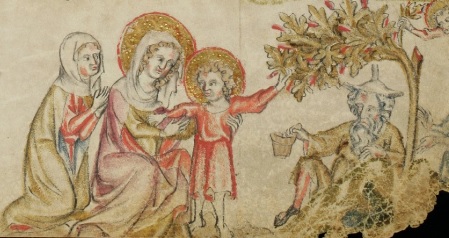
1 Then, after these things, on the third day after they had started out, Mary was weary from too much sun in the wilderness, and seeing a palm tree she wanted to rest awhile in its shade. Joseph hastened to lead her to the palm and he had her descend from the donkey. When Mary sat down, she looked to the foliage on the palm and saw that it was full of fruit, and she said, “If only I could get some of that fruit from the palm!” Joseph said to her, “I am surprised that you’re saying this, when you can see how high the palm is. You are thinking of the fruit of the palm; but I am thinking about the water that we no longer have in our water skins; we have nowhere to replenish them to quench our thirst.”

2 Then the young child Jesus, sitting in the lap of his mother, the virgin, cried out to the palm tree and said, “Bend down, O tree, and refresh my mother from your fruit.” Immediately when he spoke, the palm tree bent its top down to Mary’s feet. Everyone gathered the fruit in it and was refreshed. After all its fruit had been gathered, the tree remained bent, expecting that it would rise up at the command of the one who had ordered it to bend over. Then Jesus said to it, “Stand erect, O palm, and be strong, and become a companion of my trees that are in the paradise of my Father. And open up from your roots the hidden springs, that water may flow from them to quench our thirst.” Immediately the palm stood erect, and from its roots springs of water began to come forth, clear, cold, and very sweet. When they saw the springs of water flowing, they all rejoiced with a great joy and drank, together with their beasts and companions, giving thanks to God.

The image above is taken from a 14th century manuscript of the Gospel of Pseudo-Matthew.

Baby Jesus Is Worshiped by Dragons and Other Wild Beasts

From The Gospel of Pseudo-Matthew
The Other Gospels: Accounts of Jesus from Outside the New Testament
Edited and Translated by Bart D. Ehrman and Zlatko Pleše

The Gospel of Pseudo-Matthew

17
The Wrath of Herod and the Flight to Egypt

1 When King Herod saw that he had been deceived by the magi, his heart was inflamed and he sent his soldiers out on every path, wishing to capture them. When he was not able to find a trace of them, he sent soldiers to Bethlehem and killed every infant from two years and under, according to the time that he had solicited from the magi.

2 One day before Herod had done this, Joseph was warned by an angel of the Lord, “Take Mary and the child and go, take the desert route to Egypt.”

18
Baby Jesus Is Worshiped by Dragons and Other Wild Beasts

1 When they arrived at a certain cave where they wanted to cool themselves off, Mary came off the donkey and sat down, and held Jesus on her lap. There were three male servants with them on the road, and one female servant with Mary. And behold, suddenly many dragons came out of the cave. When the servants saw them they cried out. Then the Lord, even though he was not yet two years old, roused himself, got to his feet, and stood in front of them. And the dragons worshiped him. When they finished worshiping him, they went away. Then was fulfilled what was spoken by the prophet in the Psalms, who said, “Praise the Lord from the earth, O dragons and all the places of the abyss.”

2 The Lord Jesus Christ, though just a small child, walked along with them so that he might not be a burden to anyone. Mary and Joseph were saying to one another, “It would be better for those dragons to kill us than to harm the child.” Jesus said to them, “Do not think of me as a young child, for I have always been the perfect man, and am now; and it is necessary for me to tame every kind of wild beast.”

19

1 So too both lions and leopards were worshiping him and accompanying him in the desert, wherever Mary went with Joseph. They went before them showing them the way and being subject to them; and bowing their heads with great reverence they showed their servitude by wagging their tails. But on the first day that Mary saw lions, leopards, and various other wild beasts surrounding them, she was terrified. The young child Jesus smiled in her face and spoke to her with a consoling word, saying, “Do not fear, Mother, for they are hastening along, not to hurt you but to serve you.” With these words he removed the fear from their hearts.

2 And so lions, asses, oxen, and beasts of burden carrying their baggage were all walking together with them, and whenever they made a stop, they would graze. There were also tame goats who came out with them and followed them from Judah; these were walking among the wolves with no fear. One was not afraid of another, and none of them was harmed by another in any way. Then was fulfilled what Isaiah said, “Wolves will pasture with sheep and the lion and ox will eat straw together.” There were two oxen used as pack animals with them on the way; lions guided them on the way of our Lord Jesus Christ, whose baggage they were carrying.


Notes from The Other Gospels: Accounts of Jesus from Outside the New Testament:

The book is a Latin reworking of the (Greek) Proto-Gospel of James, based probably on one or more Latin editions of that work that have long since been lost. There are numerous differences from the Proto-Gospel, in both contents and emphases….Pseudo-Matthew tells of the holy family’s flight to Egypt, during which the infant Jesus performs numerous miracles—taming dragons, lions, and leopards; making a palm tree bend down to deliver its fruit to a famished Mary; causing idols in an Egyptian pagan temple to bow down in worship before him. These were some of the most familiar stories of the Christ child throughout the Middle Ages….

There continue to be debates concerning when the Gospel itself was composed….Pseudo-Matthew must obviously date to some time in the mid-seventh century, at the earliest.

In the most thorough analysis to date, Gijsel has maintained that even though direct literary dependence on the Rule of Benedict cannot be demonstrated, there are enough general similarities to suggest that the book was written when monastic orders were beginning to expand in the West, by someone invested in them. Largely on these grounds he makes a convincing argument that the text was produced in the first quarter of the seventh century, by a monk in the Latin-speaking West who was enchanted by the account of the Proto-Gospel and its potential for conveying homage to Mary as a model virgin embracing the monastic ideal.

Not only was Pseudo-Matthew itself popular in such circles for nearly a millenium, its message was spread even further abroad as its reworked stories were themselves edited for incorporation in the eleventh-century book, Libellus de nativitate sanctae Mariae (“Book on the Birth of Saint Mary”) and by Jacob of Voragine in The Golden Legend (written 1260 CE), which was the most widely read and influential book of the late middle ages, down to the Reformation.