Bob Schwartz

Tag: Indra’s Net

Pairs of atoms observed existing in two places at once for the first time

Quantum entanglement is a phenomenon where two or more particles become correlated such that measuring one instantly determines the state of the other, regardless of the distance between them.

“There are more things in heaven and earth, Horatio,
Than are dreamt of in your philosophy [science]”
Hamlet, Act 1, Scene 5


Pairs of atoms observed existing in two places at once for the first time
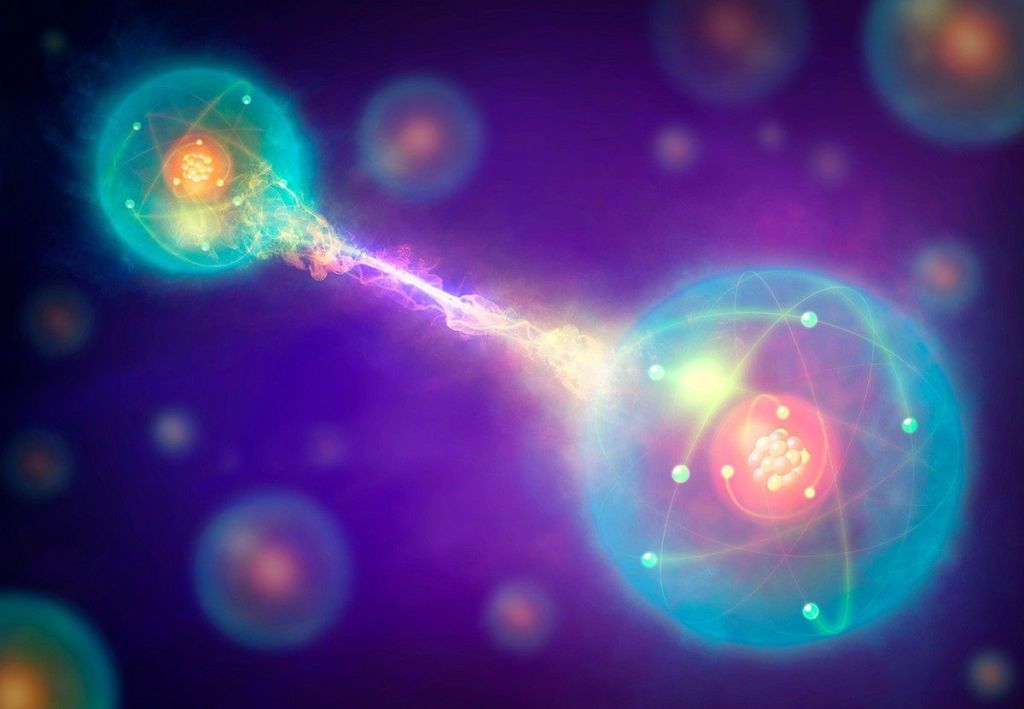
by Australian National University

Quantum physicists at ANU have observed atoms entangled in motion. “It’s really weird for us to think that this is how the universe works,” says Dr. Sean Hodgman from the ANU Research School of Physics. “You can read about it in a textbook, but it’s really weird to think that a particle can be in two places at once.”

Their experiment using helium atoms represents a major advancement over similar experiments using photons, which are particles of light. Unlike photons, helium atoms are massive particles that can be held, cooled, and manipulated in gravitational fields. The research is published in Nature Communications.

“Experimentally, it’s extremely hard to demonstrate this,” says lead author and Ph.D. researcher, Yogesh Sridhar Arthreya. “Several people have tried in the past to show these effects, and they have always come short.”

The development enables new ways to examine one of the biggest unanswered questions about the universe: How does the small-scale physics of quantum mechanics interact with gravity and general relativity at the universal scale?

“This result confirms the predictions of over a century ago that matter can be in two locations at once, and it can interfere with itself even in those locations,” says Dr. Sean Hodgman.

By observing quantum entanglement in atoms for the first time, are we one small step closer to finding out whether the “theory of everything” is not just hot air?


You may be familiar with the concept of interdependence represented by Indra’s Net:


“In the heaven of the great god Indra is said to be a vast and shimmering net, finer than a spider’s web, stretching to the outermost reaches of space. Strung at each intersection of its diaphanous threads is a reflecting pearl. Since the net is infinite in extent, the pearls are infinite in number. In the glistening surface of each pearl are reflected all the other pearls, even those in the furthest corners of the heavens. In each reflection, again are reflected all the infinitely many other pearls, so that by this process, reflections of reflections continue without end.”


Is everything possible, such that the answer to every claim can be yes or no or possibly? Is a Buddhist claim that everything is empty of existence and is also existent unreasonable? Can we be open to everything without endorsing everything?

The claim “that matter can be in two locations at once, and it can interfere with itself even in those locations” would for most of history have been categorized as metaphysics, not physics, yet here we are.
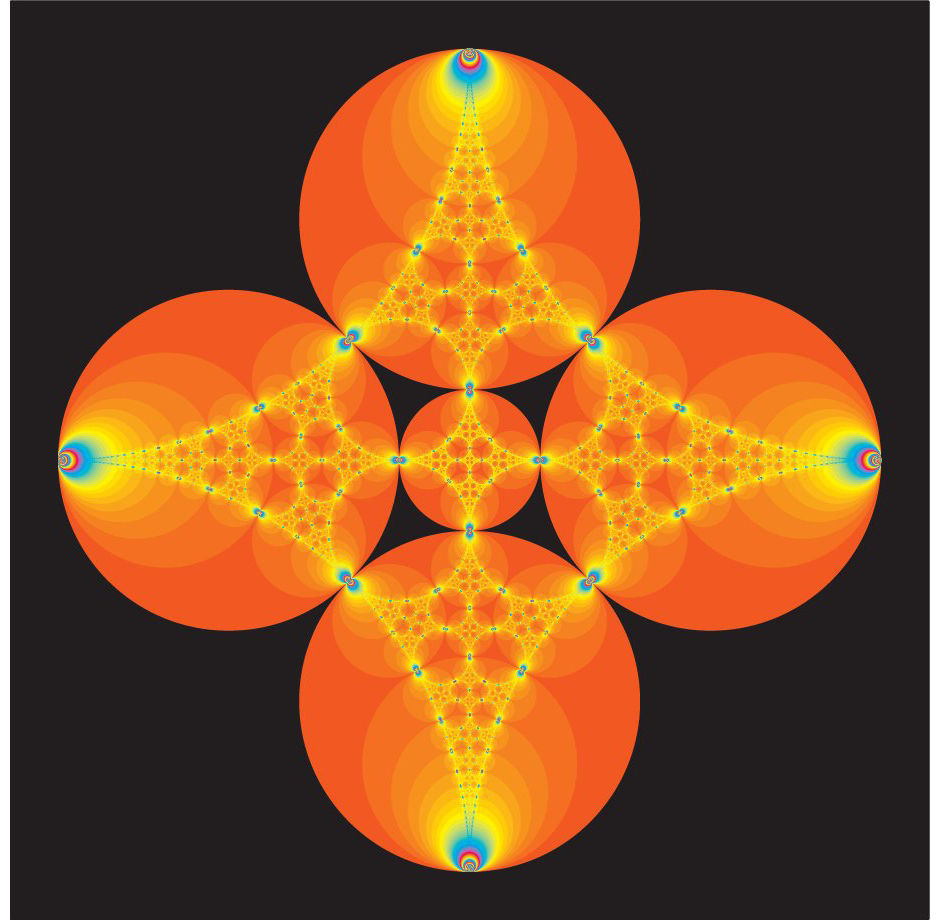
Indra’s Net

The Glowing Limit. This illustration follows the mantra of Indra’s Pearls ad infinitum (at least in so far as a computer will allow). The glowing yellow lacework manifests entirely of its own accord out of our initial arrangement of just five touching red circles.

From Indra’s Pearls: The Vision of Felix Klein by David Mumford, Caroline Series and David Wright:

The ancient Buddhist dream of Indra’s Net

In the heaven of the great god Indra is said to be a vast and shimmering net, finer than a spider’s web, stretching to the outermost reaches of space. Strung at the each intersection of its diaphanous threads is a reflecting pearl. Since the net is infinite in extent, the pearls are infinite in number. In the glistening surface of each pearl are reflected all the other pearls, even those in the furthest corners of the heavens. In each reflection, again are reflected all the infinitely many other pearls, so that by this process, reflections of reflections continue without end.

***

Towards the end of the century, Felix Klein, one of the great mathematicians his age and the hero of our book, presented in a famous lecture at Erlangen University a unified conception of geometry which incorporated both Bolyai’s brave new world and Möbius’ relationships into a wider conception of symmetry than had ever been formulated before. Further work showed that his symmetries could be used to understand many of the special functions which had proved so powerful in unravelling the physical properties of the world (see Chapter 12 for an example). He was led to the discovery of symmetrical patterns in which more and more distortions cause shrinking so rapid that an infinite number of tiles can be fitted into an enclosed finite area, clustering together as they shrink down to infinite depth.

It was a remarkable synthesis, in which ideas from the most diverse areas of mathematics revealed startling connections. Moreover the work had other ramifications which were not to be understood for almost another century. Klein’s books (written with his former student Robert Fricke) contain many beautiful illustrations, all laboriously calculated and drafted by hand. These pictures set the highest standard, occasionally still illustrating mathematical articles even today. However many of the objects they imagined were so intricate that Klein could only say:

The question is … what will be the position of the limiting points. There is no difficulty in answering these questions by purely logical reasoning; but the imagination seems to fail utterly when we try to form a mental image of the result.

The wider ramifications of Klein’s ideas did not become apparent until two vital new and intimately linked developments occurred in the 1970’s. The first was the growing power and accessibility of high speed computers and computer graphics. The second was the dawning realization that chaotic phenomena, observed previously in isolated situations (such as theories of planetary motion and some electronic circuits), were ubiquitous, and moreover provided better models for many physical phenomena than the classical special functions. Now one of the hallmarks of chaotic phenomena is that structures which are seen in the large repeat themselves indefinitely on smaller and smaller scales. This is called self-similarity. Many schools of mathematics came together in working out this new vision but, arguably, the computer was the sine qua non of the advance, making possible as it did computations on a previously inconceivable scale. For those who knew Klein’s theory, the possibility of using modern computer graphics to actually see his ‘utterly unimaginable’ tilings was irresistible….

Klein’s tilings were now seen to have intimate connections with modern ideas about self-similar scaling behaviour, ideas which had their origin in statistical mechanics, phase transitions and the study of turbulence. There, the self-similarity involved random perturbations, but in Klein’s work, one finds self-similarity obeying precise and simple laws.

Strangely, this exact self-similarity evokes another link, this time with the ancient metaphor of Indra’s net which pervades the Avatamsaka or Hua-yen Sutra, called in English the Flower Garland Scripture, one of the most rich and elaborate texts of East Asian Buddhism. We are indirectly indebted to Michael Berry for making this connection: it was in one his papers about chaos that we first found the reference from the Sutra to Indra’s pearls. Just as in our frontispiece, the pearls in the net reflect each other, the reflections themselves containing not merely the other pearls but also the reflections of the other pearls. In fact the entire universe is to be found not only in each pearl, but also in each reflection in each pearl, and so ad infinitum.

As we investigated further, we found that Klein’s entire mathematical set up of the same structures being repeated infinitely within each other at ever diminishing scales finds a remarkable parallel in the philosophy and imagery of the Sutra. As F. Cook says in his book Hua-yen: The Jewel Net of Indra:

The Hua-yen school has been fond of this mirage, mentioned many times in its literature, because it symbolises a cosmos in which there is an infinitely repeated interrelationship among all the members of the cosmos. This relationship is said to be one of simultaneous mutual identity and mutual intercausality.