Bob Schwartz

Tag: Christianity

Mr. Jesus Goes to Washington

Republicans in Congress seem to have lost their way. They could use a more altruistic, less self-serving vision of Americans and their lives.

Many of those members identify as religiously faithful, the majority faithful Christians.

What if some famous religious figures visit Congress and talk about its role in helping to make American lives better?

Mr. Smith Goes to Washington was made by legendary director Frank Capra, himself a faithful Christian. His movies, including It’s A Wonderful Life, reflect open-hearted idealism.

In the movie, small-town good guy Jefferson Smith, who leads a group of local boys, ends up in the U.S. Senate. There he finds himself among a group of much less innocent men. They reject his ideals, sure he will change or be distracted. He is advised to be pragmatic. When he won’t play along, forces try to stop him. In the end, it is the same group of boys who help good triumph.

What if Jesus visited Congress right now? Would Christian members believe him? Would they question whether he is the real Jesus? Would they argue that his interpretation of the Christian mission is wrong, even though it is his own words at issue?

Not for the first time, Jesus will still preach to these naysayers. Maybe he will filibuster, as Mr. Smith did until he collapsed in exhaustion. Jesus is no stranger to extreme public sacrifice in service of the greater good.

Will Mr. Jesus go to Washington? Many Republicans think he is already there. But is he really?

Why compassion?

There is a notable lack of compassion in some of the public initiatives in America and in other nations. These are nations that officially or unofficially identify as Judaeo-Christian.

For some time I’ve focused on that lack of compassion and considered how it might be improved.

But here I move to a predicate question. Why do those traditions or society value and promote compassion at all?

The question particularly arises for students of Buddhism. It may be an overbroad characterization, but it is not imprecise to say that compassion is at the center of Buddhism.

Which leads to the question of whether and how much compassion is at the center of other traditions.

So why compassion at all?

Here a few of the possible answers.

It is the right thing to do.

God wants it and expects it.

The Golden Rule advises it, because we will be treated as we treat others.

It will get us into heaven or keep us out of hell.

It makes us feel good.

Unlike those and other explanations, Buddhism reaches compassion not as an assigned transactional value but as an unavoidable conclusion. To simplify in my own substandard understanding, if there is absolute equality among us, there can be nothing but compassion. If we don’t recognize that absolute equality—and we so often don’t, instead putting ourselves in an unequal position—how can we be genuinely compassionate?

With that, back to the events of the day, and the open question of how, once we have advanced our own compassion, we can find ways to advance it in our traditions and in our nations.

Jesus says: Be passersby

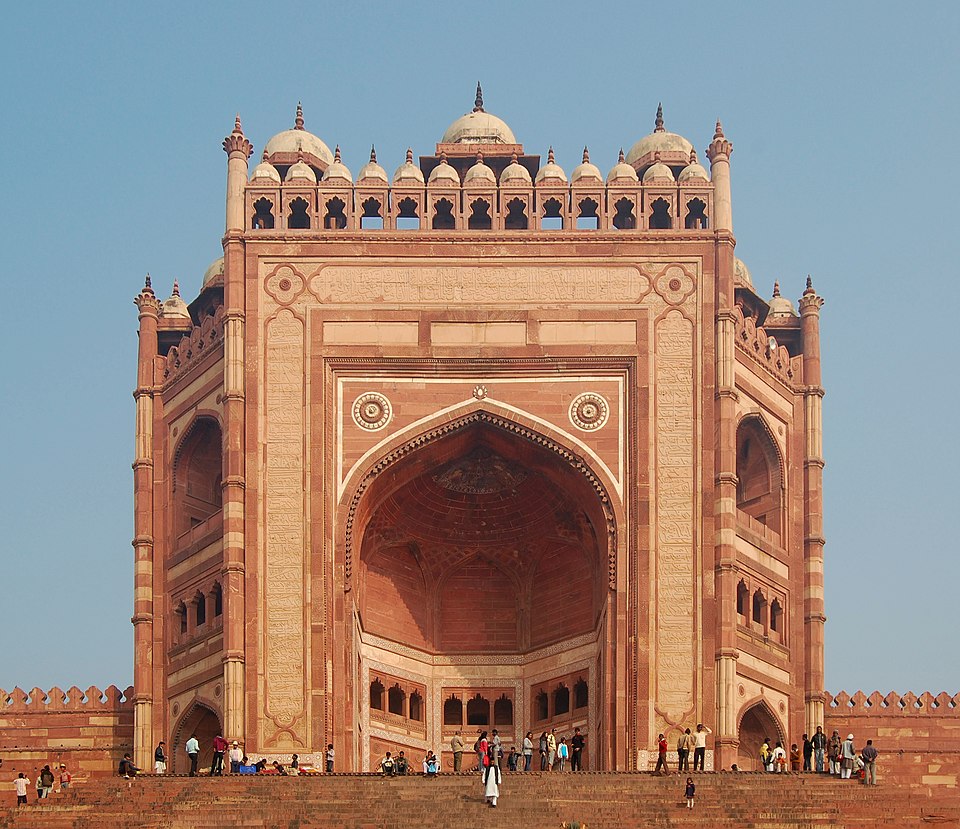
Buland Darwaza gate to Jami Masjid mosque, Fatehpur Sikri, India, inscribed: “This world is a bridge. Pass over it, but do not build your dwelling there.”

The Gospel of Thomas is a record of the sayings of Jesus. It is a Coptic text, discovered in the twentieth century, and generally regarded as authentic as the sayings included in the synoptic gospels of Matthew, Mark and Luke. A number of the sayings in Thomas have parallels with sayings in those canonical gospels, though many of sayings in Thomas appear nowhere else. The Gospel of Thomas is sometimes referred to as the fifth gospel.

Professor Marvin Meyer was acknowledged as expert on Thomas, along with expertise on other so-called gnostic gospels. (See The Gnostic Bible edited by Willis Barnstone and Marvin Meyer.) The following is from his translation and commentary on one of the deepest and most enigmatic of the sayings. (Note: The numbering is a scholarly convention not in the text.)


(42)
Yeshua said,
Be passersby.*

*Or, “Be wanderers,” or, much less likely, “Come into being as you pass away” (Coptic shope etetenerparage). A parallel to this saying appears in an inscription from a mosque at Fatehpur Sikri, India: “Jesus said, ‘This world is a bridge. Pass over it, but do not build your dwelling there.’”

The Gospel of Thomas: The Hidden Sayings of Jesus by Marvin W. Meyer


This is not only the shortest saying attributed to Jesus, but one of the shortest attributed to any wisdom master. Yet it is open to so much meaning. To begin with, ‘passersby” or “wanderers” might mean different things. And if it is “passersby”, as in the Muslim inscription on that mosque, a bridge is only one way to understand this.

Whether we are advised by Jesus, in just two words, to be passersby or wanderers, how exactly are we to be?

Gaza war: Loss of mysticism means embrace of tragic materialism

Gaza Sefirot

What is mysticism? One of many words that can mean many things. As Humpty Dumpty said, “When I use a word, it means just what I choose it to mean — neither more nor less.”

In The Encyclopedia of Jewish Myth, Magic and Mysticism, Rabbi Geoffrey Dennis tries to define it:


The term “mysticism” is one commonly applied, but imperfectly defined….

Scholars have struggled to give a precise definition to what constitutes mysticism within the Western religious traditions. Most regard it to be the impulse, ideology, and discipline to experience the unmediated presence of God or, more radically, union with divinity or a more broadly defined “Absolute.” Evelyn Underhill calls it, “… the expression of the innate tendency of the human spirit towards complete harmony with the transcendental order; whatever be the theological formula under which that order is understood.” Others see mysticism as a project of human transformation, the radical revision of human nature in relationship to the divine.


There is a substantial body of mysticism in Judaism, as there is in its younger siblings Christianity and Islam. The place of mysticism in these religions is complex and varied over time and circumstances. While mysticism might lead to fierce conflicts (“my enlightened vision is better than your enlightened vision”), the “radical revision of human nature” can also lead to followers experiencing other people and things in a more humane, open and divine way.

I don’t know of research measuring the study and adoption of mysticism among contemporary Jews. My anecdotal observation is that it might be small.

To a certain extent, materialism is the opposite of mysticism. Things are things but also transcendentally more than things. Land is land but transcendentally more than land. As religionists say, the phenomenal and the noumenal. We need and can’t avoid having and using the things, but that leads to attaching to the things, which inevitably leads to trouble, within ourselves and in the world. Mysticism, easily lost in the everyday of religions, including Judaism, and certainly lost in the turmoil, could be helpful right now.

© 2024 by Bob Schwartz

Mad Gods by the sea

Palestine Sunbird in Gaza

Mad Gods by the sea

God of Moses
God of Jesus
God of Mohammed
God of infinite names
Sitting by the desert sea
Pained and grieved.
This is madness.
These people
Every inclination
Is only evil
All the time.*
They take our names
In vile vain.**
There is the water
Let us drive them in
And start again
Just like days of old
Do better next time.
But how would they learn?
Hard hearts may soften
Dissolved in blood and tears.
We won’t abandon
We don’t approve.

*Genesis 6.5-7
**Exodus 20.6

© 2023 by Bob Schwartz

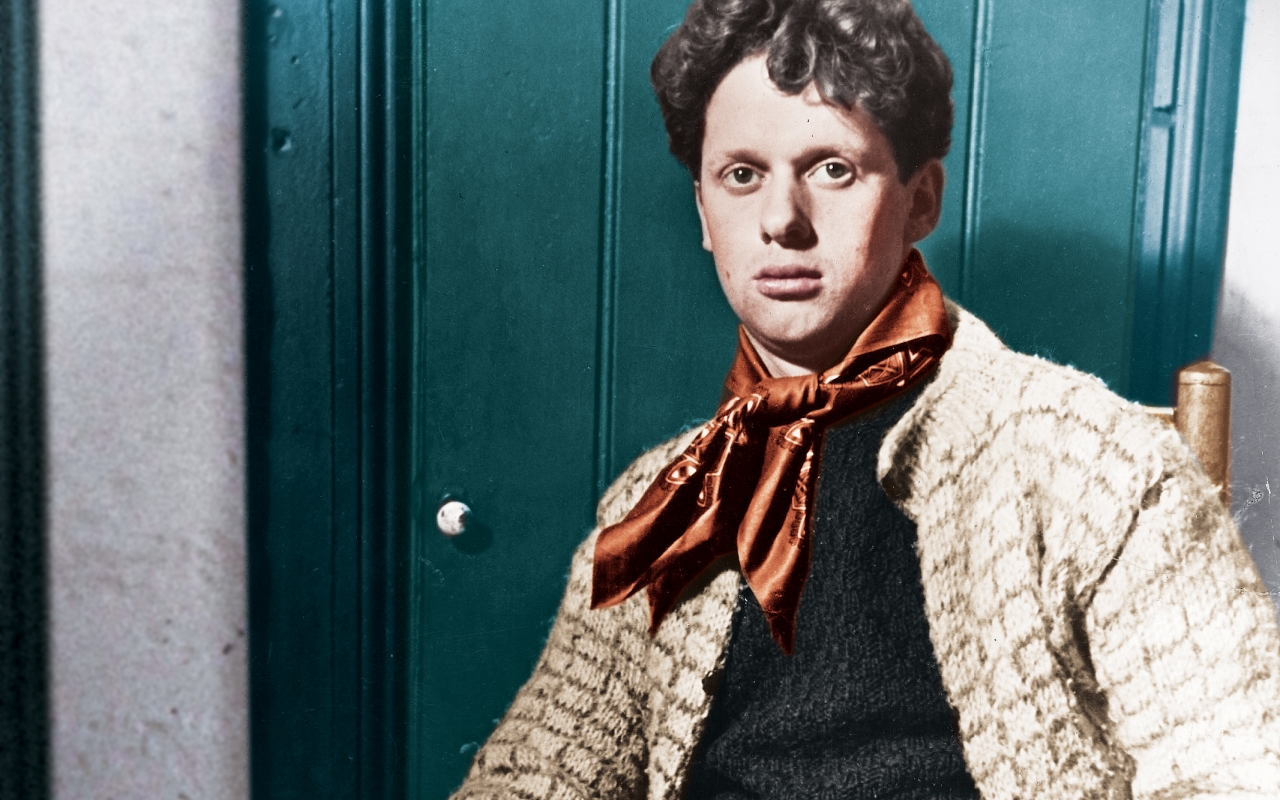
Easter Poem: This Bread I Break by Dylan Thomas

This Bread I Break

This bread I break was once the oat,
This wine upon a foreign tree
Plunged in its fruit;
Man in the day or wine at night
Laid the crops low, broke the grape’s joy.

Once in this time wine the summer blood
Knocked in the flesh that decked the vine,
Once in this bread
The oat was merry in the wind;
Man broke the sun, pulled the wind down.

This flesh you break, this blood you let
Make desolation in the vein,
Were oat and grape
Born of the sensual root and sap;
My wine you drink, my bread you snap.

Dylan Thomas


Pandemic Passover and Easter: Faith without form

Our religious traditions, from their beginnings, have been about form. Practices, beliefs, texts, communities. These are all forms that are required, recommended, unifying.

It is unavoidable to see an identity between the traditions and forms. That is, the point of the traditions seems to be the forms themselves.

There is a Zen thought that the finger pointing at the moon is not the moon itself. We point because the finger shows us which way to go and where something may be found. But the finger is not the way or the thing. The form is not the way or the thing.

There is unique value in gathering around the Passover table, following the order (seder) of together retelling a central story. There is unique value in gathering in church on Easter Sunday and retelling another central story.

The Passover seder is important but not essential. The Easter service is important but not essential. These are forms, the finger pointing at the moon.

What exactly is the moon of Passover and the moon of Easter? To be transformed and to transform the world and all the people in it. If you need examples of that, just look at the central stories of the two holidays and the teachings that surround them. You and the world start off one way and, by the time you are done wandering, you and the world are better. The dark places are a little bit lighter.

How do you get there? You take part in a seder, in person or virtually, or maybe you don’t. You attend a church service, in person or virtually, or maybe you don’t. You wander in a wilderness and find yourself and something new. You die and are reborn spiritually. The seder and the service are forms, valuable but not necessary. You can wander and arrive without them.

Apart but not alone, happy Passover and happy Easter.

We are all hermits now: Song of the Grass Roof Hut

Thomas Merton hermitage in Kentucky

Though the hut is small, it includes the entire world.

Hermit—one who lives in solitude—is from Greek erēmia desert, which is from erēmos desolate. In the fourth century, Christians dissatisfied with the artificial complexities of the Church fled to the Egyptian desert to be alone and closer to God. Thus began Christian monasticism. On the other side of the world, Buddhists in China went to the mountains, also to be alone.

Both the Christian desert fathers and mothers and the Buddhist hermits left behind a treasury of wisdom. Centuries later, in another part of the world Thomas Merton fled the chaos of civilization to build a hermitage of his own in Kentucky, and similarly provided an inspiring record of his experiences.

The following Song of the Grass Roof Hut is the work of Shitou Xiqian [Japanese: Sekitō Kisen] (700–790, China).

Song of the Grass Roof Hut

I’ve built a grass hut where there’s nothing of value.
After eating, I relax and enjoy a nap.
When it was completed, fresh weeds appeared.
Now it’s been lived in – covered by weeds.

The person in the hut lives here calmly,
Not stuck to inside, outside, or in between.
Places worldly people live, he doesn’t live.
Realms worldly people love, he doesn’t love.

Though the hut is small, it includes the entire world.
In ten square feet, an old man illumines forms and their nature.
A Great Vehicle bodhisattva trusts without doubt.
The middling or lowly can’t help wondering;
Will this hut perish or not?

Perishable or not, the original master is present,
not dwelling south or north, east or west.
Firmly based on steadiness, it can’t be surpassed.
A shining window below the green pines –
Jade palaces or vermilion towers can’t compare with it.

Just sitting with head covered, all things are at rest.
Thus, this mountain monk doesn’t understand at all.
Living here he no longer works to get free.
Who would proudly arrange seats, trying to entice guests?

Turn around the light to shine within, then just return.
The vast inconceivable source can’t be faced or turned away from.
Meet the ancestral teachers, be familiar with their instruction,
Bind grasses to build a hut, and don’t give up.

Let go of hundreds of years and relax completely.
Open your hands and walk, innocent.
Thousands of words, myriad interpretations,
Are only to free you from obstructions.
If you want to know the undying person in the hut,
Don’t separate from this skin bag here and now.

Shitou Xiqian

(translation by Taigen Daniel Leighton)

The Miracle of the Palm Tree (The Journey of Baby Jesus Continues)

More from The Gospel of Pseudo-Matthew (see previous post Baby Jesus Is Worshiped by Dragons and Other Wild Beasts)

20
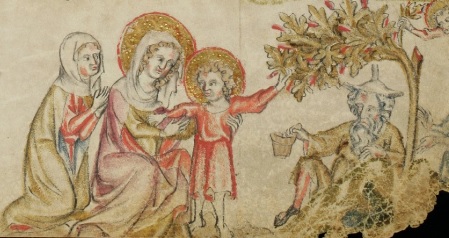
The Miracle of the Palm Tree

1 Then, after these things, on the third day after they had started out, Mary was weary from too much sun in the wilderness, and seeing a palm tree she wanted to rest awhile in its shade. Joseph hastened to lead her to the palm and he had her descend from the donkey. When Mary sat down, she looked to the foliage on the palm and saw that it was full of fruit, and she said, “If only I could get some of that fruit from the palm!” Joseph said to her, “I am surprised that you’re saying this, when you can see how high the palm is. You are thinking of the fruit of the palm; but I am thinking about the water that we no longer have in our water skins; we have nowhere to replenish them to quench our thirst.”

2 Then the young child Jesus, sitting in the lap of his mother, the virgin, cried out to the palm tree and said, “Bend down, O tree, and refresh my mother from your fruit.” Immediately when he spoke, the palm tree bent its top down to Mary’s feet. Everyone gathered the fruit in it and was refreshed. After all its fruit had been gathered, the tree remained bent, expecting that it would rise up at the command of the one who had ordered it to bend over. Then Jesus said to it, “Stand erect, O palm, and be strong, and become a companion of my trees that are in the paradise of my Father. And open up from your roots the hidden springs, that water may flow from them to quench our thirst.” Immediately the palm stood erect, and from its roots springs of water began to come forth, clear, cold, and very sweet. When they saw the springs of water flowing, they all rejoiced with a great joy and drank, together with their beasts and companions, giving thanks to God.

The image above is taken from a 14th century manuscript of the Gospel of Pseudo-Matthew.

Baby Jesus Is Worshiped by Dragons and Other Wild Beasts

From The Gospel of Pseudo-Matthew
The Other Gospels: Accounts of Jesus from Outside the New Testament
Edited and Translated by Bart D. Ehrman and Zlatko Pleše

The Gospel of Pseudo-Matthew

17
The Wrath of Herod and the Flight to Egypt

1 When King Herod saw that he had been deceived by the magi, his heart was inflamed and he sent his soldiers out on every path, wishing to capture them. When he was not able to find a trace of them, he sent soldiers to Bethlehem and killed every infant from two years and under, according to the time that he had solicited from the magi.

2 One day before Herod had done this, Joseph was warned by an angel of the Lord, “Take Mary and the child and go, take the desert route to Egypt.”

18
Baby Jesus Is Worshiped by Dragons and Other Wild Beasts

1 When they arrived at a certain cave where they wanted to cool themselves off, Mary came off the donkey and sat down, and held Jesus on her lap. There were three male servants with them on the road, and one female servant with Mary. And behold, suddenly many dragons came out of the cave. When the servants saw them they cried out. Then the Lord, even though he was not yet two years old, roused himself, got to his feet, and stood in front of them. And the dragons worshiped him. When they finished worshiping him, they went away. Then was fulfilled what was spoken by the prophet in the Psalms, who said, “Praise the Lord from the earth, O dragons and all the places of the abyss.”

2 The Lord Jesus Christ, though just a small child, walked along with them so that he might not be a burden to anyone. Mary and Joseph were saying to one another, “It would be better for those dragons to kill us than to harm the child.” Jesus said to them, “Do not think of me as a young child, for I have always been the perfect man, and am now; and it is necessary for me to tame every kind of wild beast.”

19

1 So too both lions and leopards were worshiping him and accompanying him in the desert, wherever Mary went with Joseph. They went before them showing them the way and being subject to them; and bowing their heads with great reverence they showed their servitude by wagging their tails. But on the first day that Mary saw lions, leopards, and various other wild beasts surrounding them, she was terrified. The young child Jesus smiled in her face and spoke to her with a consoling word, saying, “Do not fear, Mother, for they are hastening along, not to hurt you but to serve you.” With these words he removed the fear from their hearts.

2 And so lions, asses, oxen, and beasts of burden carrying their baggage were all walking together with them, and whenever they made a stop, they would graze. There were also tame goats who came out with them and followed them from Judah; these were walking among the wolves with no fear. One was not afraid of another, and none of them was harmed by another in any way. Then was fulfilled what Isaiah said, “Wolves will pasture with sheep and the lion and ox will eat straw together.” There were two oxen used as pack animals with them on the way; lions guided them on the way of our Lord Jesus Christ, whose baggage they were carrying.


Notes from The Other Gospels: Accounts of Jesus from Outside the New Testament:

The book is a Latin reworking of the (Greek) Proto-Gospel of James, based probably on one or more Latin editions of that work that have long since been lost. There are numerous differences from the Proto-Gospel, in both contents and emphases….Pseudo-Matthew tells of the holy family’s flight to Egypt, during which the infant Jesus performs numerous miracles—taming dragons, lions, and leopards; making a palm tree bend down to deliver its fruit to a famished Mary; causing idols in an Egyptian pagan temple to bow down in worship before him. These were some of the most familiar stories of the Christ child throughout the Middle Ages….

There continue to be debates concerning when the Gospel itself was composed….Pseudo-Matthew must obviously date to some time in the mid-seventh century, at the earliest.

In the most thorough analysis to date, Gijsel has maintained that even though direct literary dependence on the Rule of Benedict cannot be demonstrated, there are enough general similarities to suggest that the book was written when monastic orders were beginning to expand in the West, by someone invested in them. Largely on these grounds he makes a convincing argument that the text was produced in the first quarter of the seventh century, by a monk in the Latin-speaking West who was enchanted by the account of the Proto-Gospel and its potential for conveying homage to Mary as a model virgin embracing the monastic ideal.

Not only was Pseudo-Matthew itself popular in such circles for nearly a millenium, its message was spread even further abroad as its reworked stories were themselves edited for incorporation in the eleventh-century book, Libellus de nativitate sanctae Mariae (“Book on the Birth of Saint Mary”) and by Jacob of Voragine in The Golden Legend (written 1260 CE), which was the most widely read and influential book of the late middle ages, down to the Reformation.