Mission Our mission is to promote and cultivate the principle of compassion and the Compassionate Way of Life as articulated by the Charter for Compassion so that the principle characterizes all human society and all relationships.
Vision We envision a world in which the darkness of suffering is healed by the light of compassionate action; in which children and adults are literate and skilled in the transformative nature and power of compassion; and in which we treat ourselves, each other, and the natural world with dignity and respect, manifesting the Golden Rule in all relationships.
Our religious traditions include essential teachings about compassion. In some traditions like Buddhism, compassion is #1. In others, a more nuanced balancing may take place. Compassion is a stated ideal, but circumstances and situations raise other considerations: Sure compassion is important. But that is too absolutist, idealistic and simplistic in a complicated world.
When compassion moves out front and to the top for us, extraordinary things can and will happen.
Thirteen years ago, a North Carolina minister, Bishop William Barber II, began the Moral Mondays movement. I posted about here.
Join us for Moral Mondays: A Southern Call to Conscience as we engage in a season of nonviolent moral resistance against extremism in government. Founded in 2013 in North Carolina by Bishop William J. Barber, II, Moral Mondays is a protest movement that centers impacted people, people of faith, and moral leaders who hold elected leaders and government accountable to enact a moral agenda that responds to the urgent needs of the poor.
We are calling on people of moral conscience to join us for Moral Mondays throughout the summer and fall as we work to enact a moral budget and moral public policies for the nation.
Though this was 2013, a few years before the Trump era, there has never been a time when regressive movements in America tried to take us back to a less humane, democratic and moral time. Fortunately, there has never been a time when progressive, humane and moral movements have not pushed back and forward. Moral Mondays was one of those.
Why do I emphasize that progressive Christians can save America now and restore humane and moral democracy? There are of course millions of non-Christians and non-religious citizens who have gotten behind that work in the past and millions are doing that today. Our efforts are worthy and necessary.
Progressive Christians are in a unique position. There have been and are a large number of Christians who believe as a matter of faith that America is a Christian nation and that their faith demands that much of our 21st century progress, like much of the 19th and 20th century progress, is not what God or Jesus wants. It is fine for Jews, Muslims, Buddhists, and those of other faiths or no faith to argue otherwise. But other Christians who believe differently are not so easily dismissed, although dismissed they have been and will be. We can look to the most prominent Christian in the world, Pope Leo (who happens to be American), as an example of what can be said and done.
This is a call that progressive Christians stand up and stand out together for an alternative vision of America—a humane, democratic and above all moral America. Moral Mondays was and is such a movement.
It wasn’t and isn’t easy. Christian churches supported slavery, using the Bible as proof text. Opposing Christians tried to explain that as a matter of Christian principle and as a matter of humane morality, they were wrong and it was wrong.
It is Monday. Moral Monday. We would like to think of every day of the week—including the sacred days for our various faiths—as Moral days. But if one day a week is all we can handle, it’s a start.
Jesus, Dogen and Donovan each have something to say about mountains. In some ways the same thing.
Jesus says that faith can move mountains, by which he may mean that understanding the nature of things, including mountains, will allow us to see that mountains are always moving, if we will see it. Jesus is all about what we don’t see that is right in front of us.
Dogen says that mountains are mountains and mountains are walking. If you can walk, mountains can walk. Those without eyes to see mountains cannot notice, understand, see, or hear this reality.
Donovan sings about this reality of mountains appearing, disappearing, appearing.
Jesus
He answered, ‘Because you have so little faith. In truth I tell you, if your faith is the size of a mustard seed you will say to this mountain, “Move from here to there,” and it will move; nothing will be impossible for you.’ (Matthew 17:20, New Jerusalem Bible)
Dogen Zenji
Priest Daokai of Mount Furong said to the assembly, “The green mountains are always walking; a stone woman gives birth to a child at night.”
Mountains do not lack the characteristics of mountains. Therefore, they always abide in ease and always walk. Examine in detail the characteristic of the mountains’ walking.
Mountains’ walking is just like human walking. Accordingly, do not doubt mountains’ walking even though it does not look the same as human walking. The buddha ancestor’s words point to walking. This is fundamental understanding. Penetrate these words.
Because green mountains walk, they are permanent. Although they walk more swiftly than the wind, someone in the mountains does not notice or understand it. “In the mountains” means the blossoming of the entire world. People outside the mountains do not notice or understand the mountains’ walking. Those without eyes to see mountains cannot notice, understand, see, or hear this reality.
If you doubt mountains’ walking, you do not know your own walking; it is not that you do not walk, but that you do not know or understand your own walking. Since you do know your own walking, you should fully know the green mountains’ walking.
Green mountains are neither sentient nor insentient. You are neither sentient nor insentient. At this moment, you cannot doubt the green mountains’ walking.
From Mountains and Waters Sutra, Shobo Genzo, Fascicle 15 (1240)
Donovan
The caterpillar sheds his skin to find a butterfly within
Caterpillar sheds his skin to find a butterfly within
First there is a mountain, then there is no mountain, then there is
First there is a mountain, then there is no mountain, then there is
In 1948, as much of the world was recovering from World War II, the world also felt guilty and ashamed at not having intervened sooner to save 6 million Jews from Hitler.
A Jewish haven was established in Israel. There was widespread, though not universal, support for this. Whether this “worked” is a matter of perspective. It was bound from the inception to be a source of conflict, which continues to this moment.
What might have been more broadly acceptable and peace-inducing would have been an Abrahamic state, rather than just a Jewish one. It could have been a democracy where human rights were guaranteed for all people—Jews, Christians, Muslims, other believers, non-believers. It could have been an official home for all three traditions that honor Israel/Palestine as a foundational sacred space. Differences in beliefs, some not insubstantial, could be subsumed to common principles. The Abrahamic religions are literally siblings. Like all siblings there are conflicts, but like children of the same father, they are also family.
Write that speculative history. You will find it is not perfect—what history is?—but you will also find less enmity and more comity. What could be wrong with that?
US military commanders have been invoking extremist Christian rhetoric about biblical “end times” to justify involvement in the Iran war to troops, according to complaints made to a watchdog group.
The Military Religious Freedom Foundation (MRFF) says it has received more than 200 complaints from service members across all branches of the armed forces, including the marines, air force and space force.
One complainant, identified as a noncommissioned officer (NCO) in a unit that could be deployed “at any moment to join” operations against Iran, told MRFF in a complaint viewed by the Guardian that their commander had “urged us to tell our troops that this was ‘all part of God’s divine plan’ and he specifically referenced numerous citations out of the Book of Revelation referring to Armageddon and the imminent return of Jesus Christ”.
“He said that ‘President Trump has been anointed by Jesus to light the signal fire in Iran to cause Armageddon and mark his return to Earth’”, the NCO added.
The NCO’s complaint was filed on behalf of 15 troops, including 11 Christians, one Muslim person and one Jewish person.
“Although mechanical changes have been great since Biblical times…modern workers still have the basic job of providing for their families….organizing together has helped them achieve brotherhood and gain the fruits of their toil…it has helped build the communities and the nation in which they live, for 25 years…most religious denominations have recognized this and declared themselves in support of unionization and collective bargaining…there should be no gap between the working man and his church!”
The Congress of Industrial Organizations (CIO) was one of the two umbrella organizations representing American unions. The other was the American Federation of Labor (AFL), which merged with the CIO, forming the AFL-CIO.
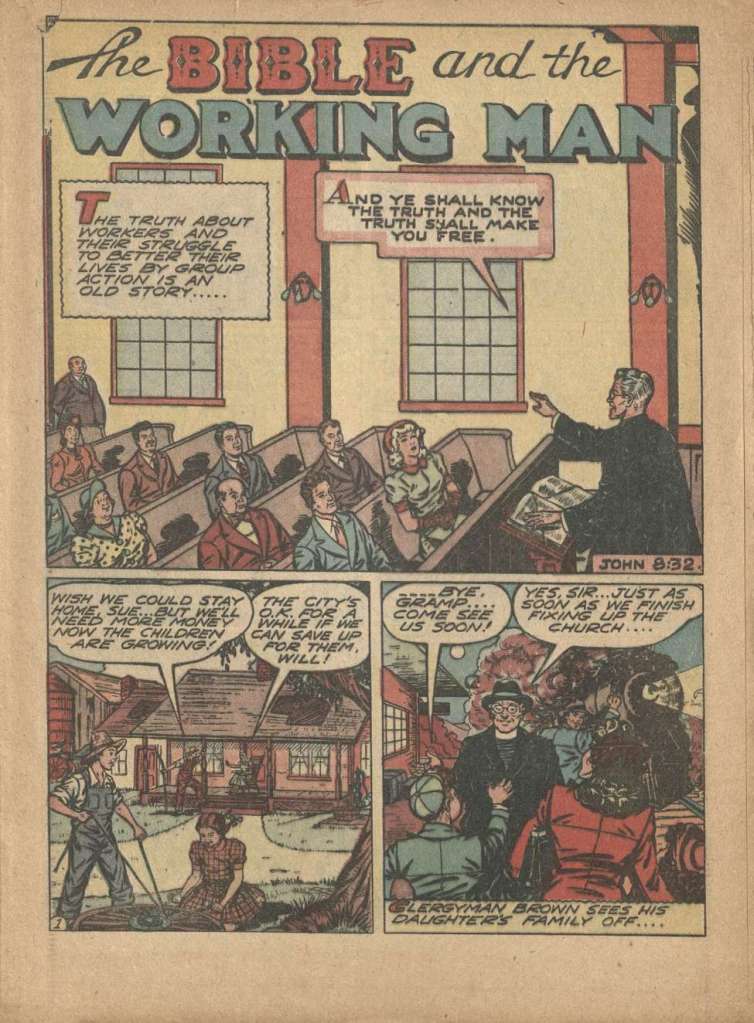
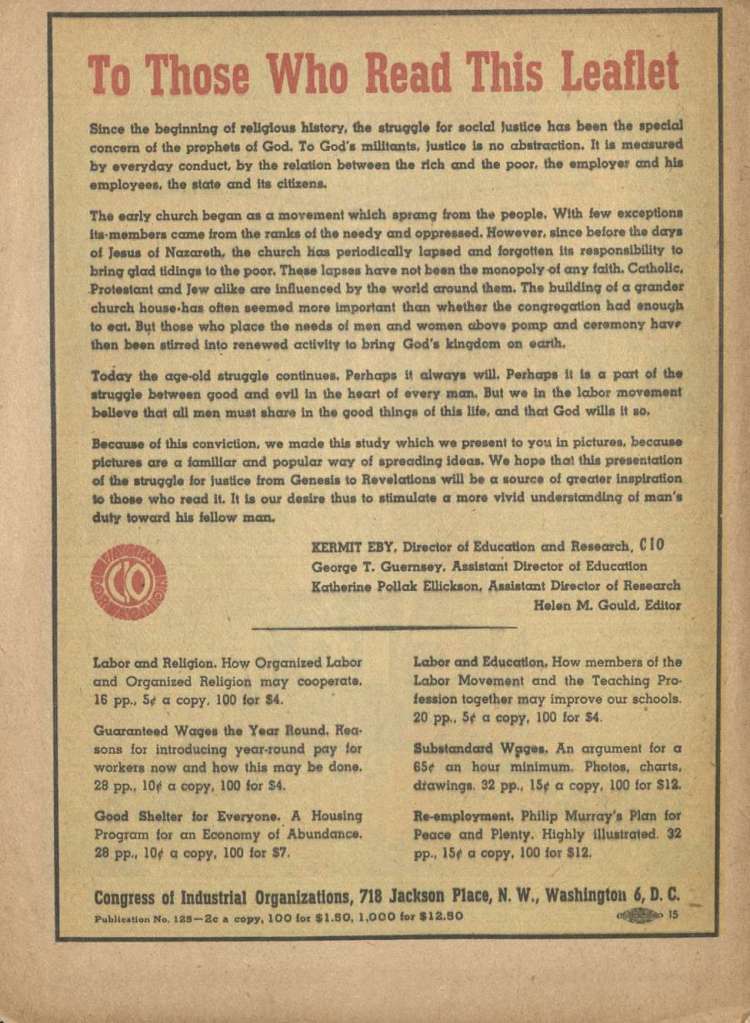
In 1946 the CIO created a comic book leaflet, making the case that unionization was promoted by the Bible and by Christianity. The CIO explains:
“Since the beginning of religious history, the struggle for social justice has been the special concern of the prophets of God. To God’s militants, justice is no abstraction. It is measured by everyday conduct, by the relation between the rich and the poor, the employer and his employees, the state and its citizens.
“The early church began as a movement which sprang from the people. With few exceptions its members came from the ranks of the needy and oppressed. However, since before the days of Jesus of Nazareth, the church has periodically lapsed and forgotten its responsibility to bring glad tidings to the poor. These lapses have not been the monopoly of any faith. Catholic, Protestant and Jew alike are influenced by the world around them. The building of a grander church house has often seemed more important than whether the congregation had enough to eat. But those who place the needs of men and women above pomp and ceremony have then been stirred into renewed activity to bring God’s kingdom on earth.
“Today the age-old struggle continues. Perhaps it always will. Perhaps it is a part of the struggle between good and evil in the heart of every man. But we in the labor movement believe that all men must share in the good things of this life, and that God wills it so.
“Because of this conviction, we made this study which we present to you in pictures, because pictures are a familiar and popular way of spreading ideas. We hope that this presentation of the struggle for justice from Genesis to Revelations will be a source of greater inspiration to those who read it. It is our desire thus to stimulate a more vivid understanding of man’s duty toward his fellow man.”
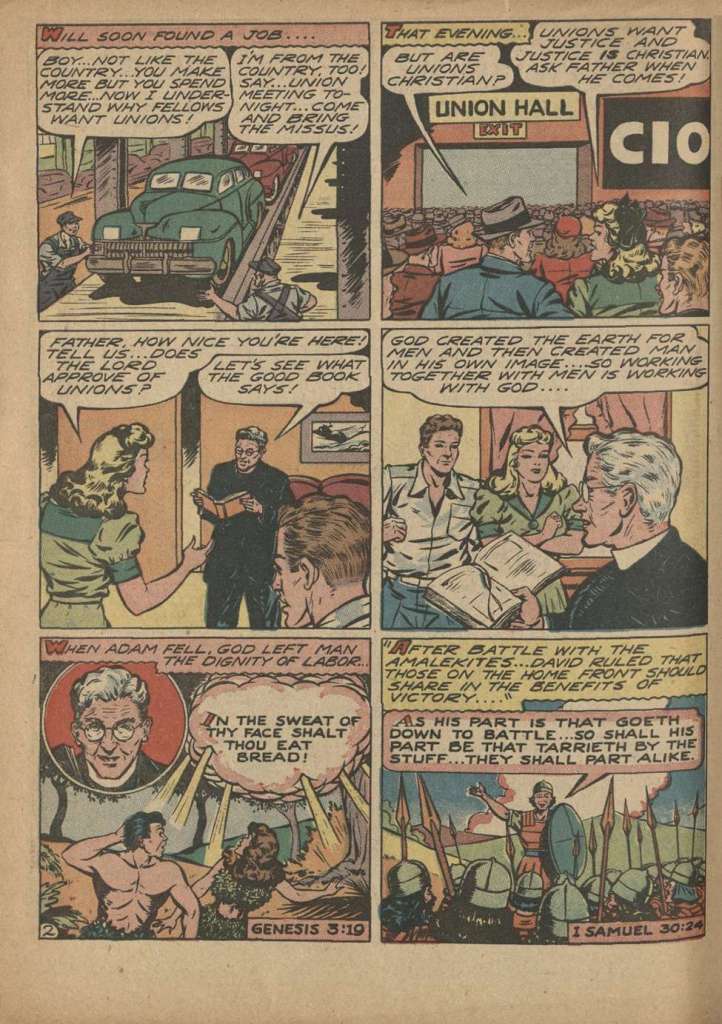
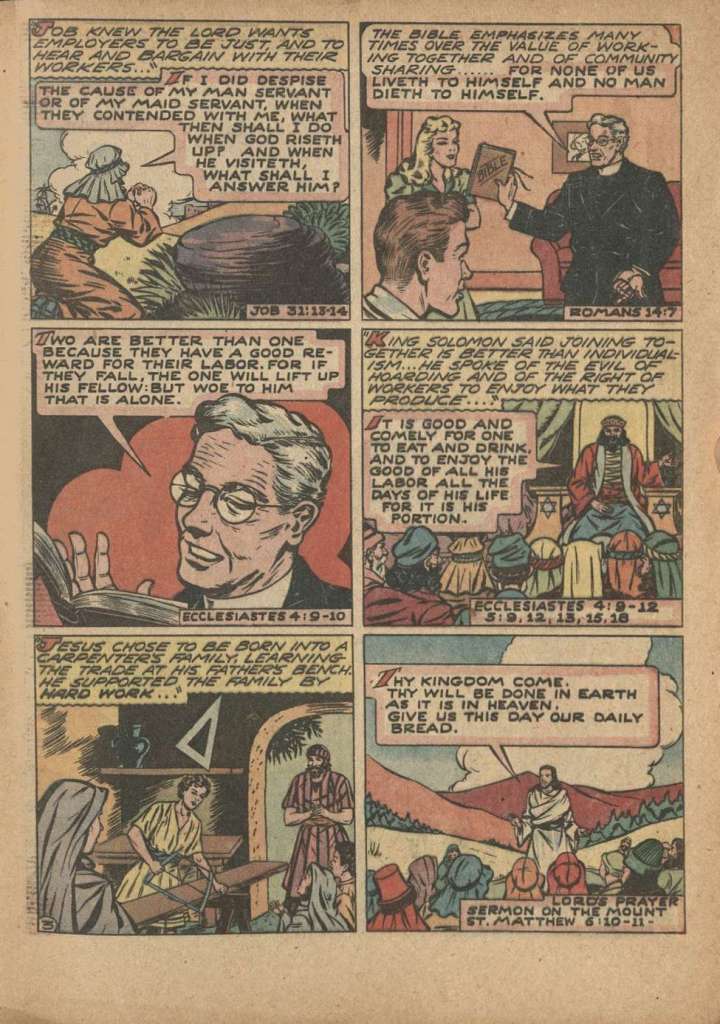
The comic book leaflet can be found here. The pages are included below. Since it is not easy to read all of the text on those pages, excerpts of text are also included below.
Page 1
THE BIBLE AND THE WORKING MAN
“The truth about workers and their struggle to better their lives by group action is an old story…”
“And ye shall know the truth and the truth shall make you free.” — John 8:32
Page 2
“But are unions Christian?”
“Unions want justice and justice is Christian. Ask father when he comes!”
“Father, how nice you’re here! Tell us…does the Lord approve of unions?”
“Let’s see what the Good Book says!”
“God created the earth for men and then created man in his own image…so working together with men is working with God…”
“When Adam fell, God left man the dignity of labor…”
“In the sweat of thy face shalt thou eat bread!” — Genesis 3:19
“After battle with the Amalekites…David ruled that those on the home front should share in the benefits of victory….”
“As his part is that goeth down to battle…so shall his part be that tarrieth by the stuff…they shall part alike.” — I Samuel 30:24
Page 3
“Job knew the Lord wants employers to be just, and to hear and bargain with their workers…”
“If I did despise the cause of my man servant or of my maid servant, when they contended with me, what then shall I do when God riseth up? And when he visiteth, what shall I answer him?” — Job 31:13-14
“The Bible emphasizes many times over the value of working together and of community sharing…for none of us liveth to himself and no man dieth to himself.” — Romans 14:7
“Two are better than one because they have a good reward for their labor. For if they fall, the one will lift up his fellow: but woe to him that is alone.” — Ecclesiastes 4:9-10
“King Solomon said joining together is better than individualism…he spoke of the evil of hoarding and of the right of workers to enjoy what they produce…”
“It is good and comely for one to eat and drink, and to enjoy the good of all his labor all the days of his life for it is his portion.” — Ecclesiastes 4:9-12; 5:9,12,13,15,18
“Jesus chose to be born into a carpenter’s family, learning the trade at his father’s bench. He supported the family by hard work…”
“Thy kingdom come, thy will be done in earth as it is in heaven. Give us this day our daily bread.” — Lord’s Prayer, Sermon on the Mount, St. Matthew 6:10-11
Page 4
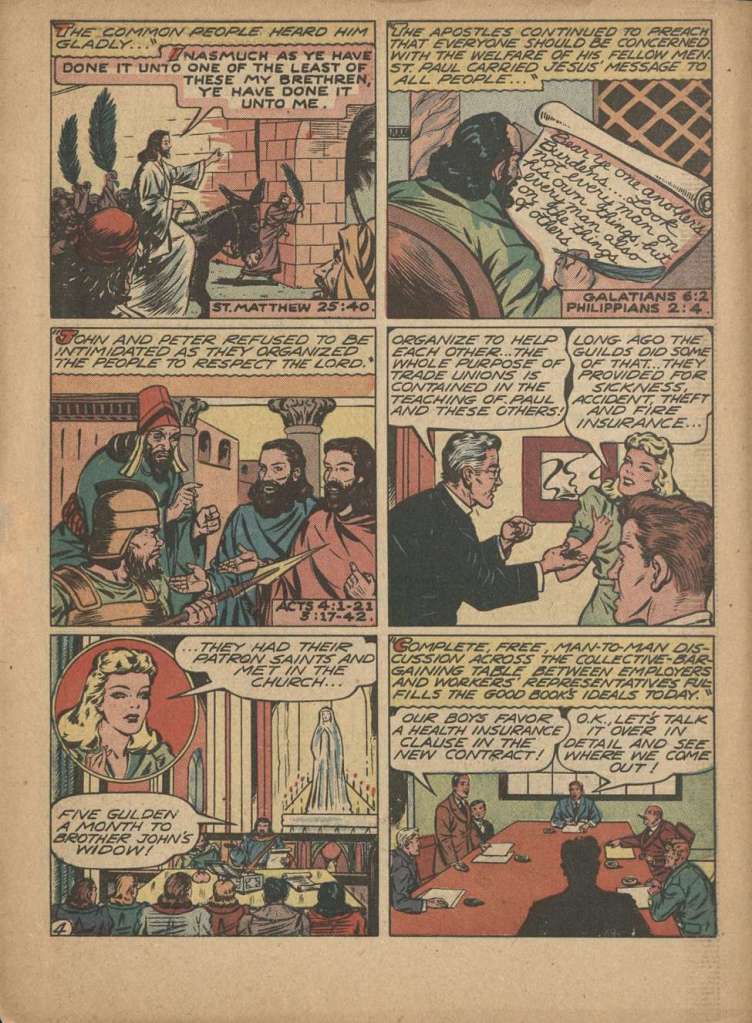
“Inasmuch as ye have done it unto one of the least of these my brethren, ye have done it unto me.” — St. Matthew 25:40
“The Apostles continued to preach that everyone should be concerned with the welfare of his fellow men. St. Paul carried Jesus’ message to all people…”
“Bear ye one another’s burdens…look not every man on his own things, but every man also on the things of others.” — Galatians 6:2 / Philippians 2:4
“John and Peter refused to be intimidated as they organized the people to respect the Lord.” — Acts 4:1-21; 5:17-42
“Organize to help each other…the whole purpose of trade unions is contained in the teaching of Paul and these others!”
“Long ago the guilds did some of that…they provided for sickness, accident, theft and fire insurance…”
“Complete, free, man-to-man discussion across the collective-bargaining table between employers and workers’ representatives fulfills the Good Book’s ideals today.”
Page 5
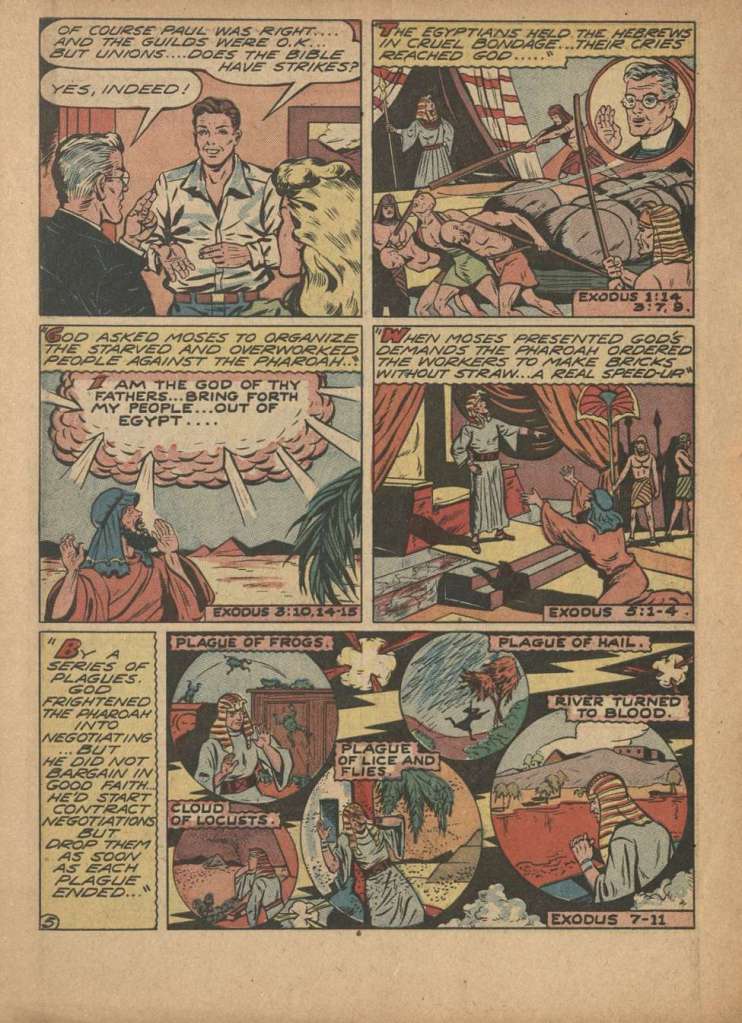
“Of course Paul was right…and the guilds were O.K….but unions….does the Bible have strikes?”
“Yes, indeed!”
“The Egyptians held the Hebrews in cruel bondage…their cries reached God….” — Exodus 1:14; 3:7,9
“God asked Moses to organize the starved and overworked people against the Pharaoh…”
“I am the God of thy fathers…bring forth my people…out of Egypt….” — Exodus 3:10, 14-15
“When Moses presented God’s demands the Pharaoh ordered the workers to make bricks without straw…a real speed-up.” — Exodus 5:1-4
“By a series of plagues, God frightened the Pharaoh into negotiating…but he did not bargain in good faith…he’d start contract negotiations but drop them as soon as each plague ended…”
Page 6
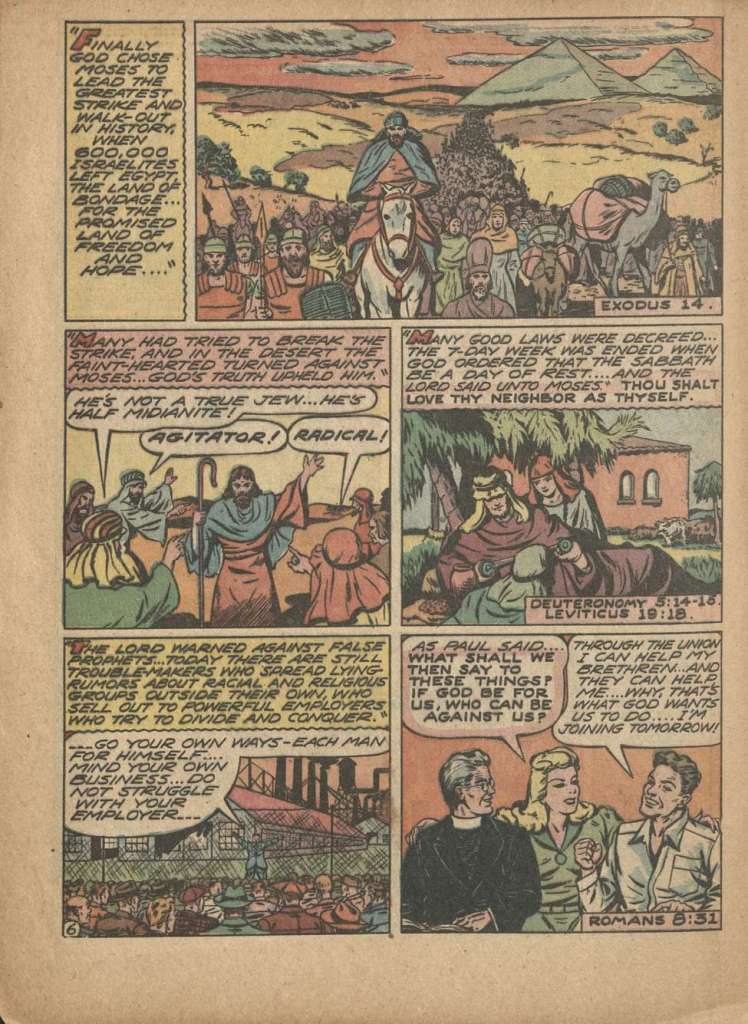
“Finally God chose Moses to lead the greatest strike and walk-out in history, when 600,000 Israelites left Egypt, the land of bondage…for the promised land of freedom and hope….” — Exodus 14
“Many had tried to break the strike, and in the desert the faint-hearted turned against Moses…God’s truth upheld him.”
“Through the union I can help my brethren…and they can help me….why, that’s what God wants us to do….I’m joining tomorrow!” — Romans 8:31
Page 7
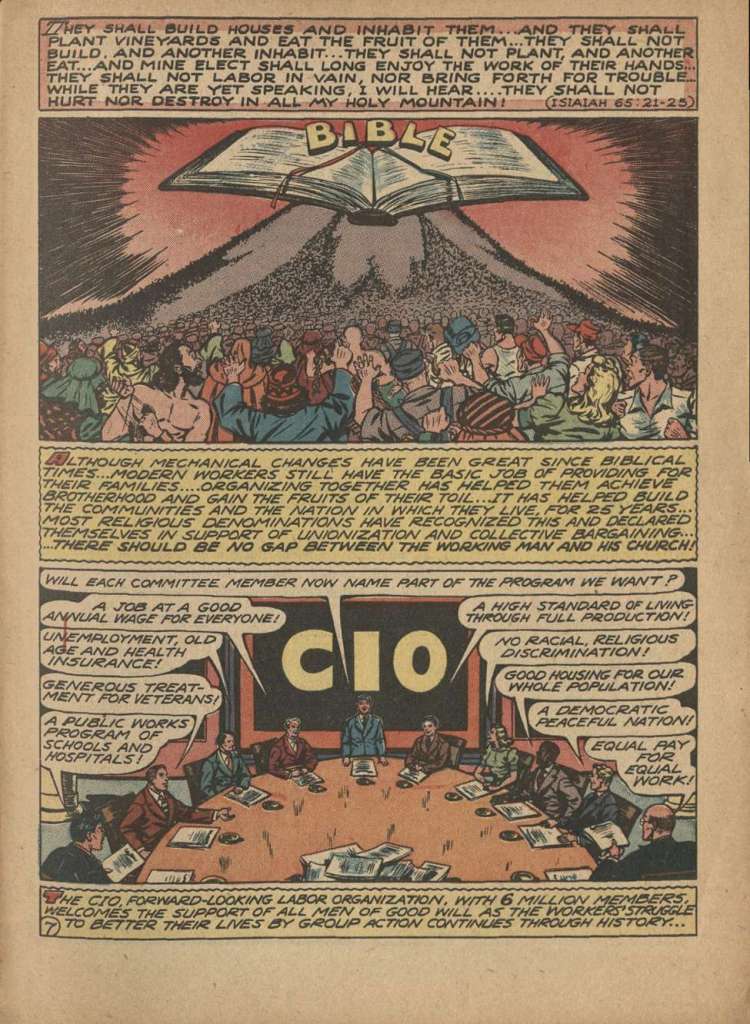
Although mechanical changes have been great since Biblical times…modern workers still have the basic job of providing for their families….organizing together has helped them achieve brotherhood and gain the fruits of their toil…it has helped build the communities and the nation in which they live, for 25 years…most religious denominations have recognized this and declared themselves in support of unionization and collective bargaining…there should be no gap between the working man and his church!
“Will each committee member now name part of the program we want?”
A job at a good annual wage for everyone!
Unemployment, old age and health insurance!
Generous treatment for veterans!
A public works program of schools and hospitals!
A high standard of living through full production!
No racial, religious discrimination!
Good housing for our whole population!
A democratic peaceful nation!
Equal pay for equal work!
Page 8
Since the beginning of religious history, the struggle for social justice has been the special concern of the prophets of God. To God’s militants, justice is no abstraction. It is measured by everyday conduct, by the relation between the rich and the poor, the employer and his employees, the state and its citizens.
The early church began as a movement which sprang from the people. With few exceptions its members came from the ranks of the needy and oppressed. However, since before the days of Jesus of Nazareth, the church has periodically lapsed and forgotten its responsibility to bring glad tidings to the poor. These lapses have not been the monopoly of any faith. Catholic, Protestant and Jew alike are influenced by the world around them. The building of a grander church house has often seemed more important than whether the congregation had enough to eat. But those who place the needs of men and women above pomp and ceremony have then been stirred into renewed activity to bring God’s kingdom on earth.
Today the age-old struggle continues. Perhaps it always will. Perhaps it is a part of the struggle between good and evil in the heart of every man. But we in the labor movement believe that all men must share in the good things of this life, and that God wills it so.
Because of this conviction, we made this study which we present to you in pictures, because pictures are a familiar and popular way of spreading ideas. We hope that this presentation of the struggle for justice from Genesis to Revelations will be a source of greater inspiration to those who read it. It is our desire thus to stimulate a more vivid understanding of man’s duty toward his fellow man.
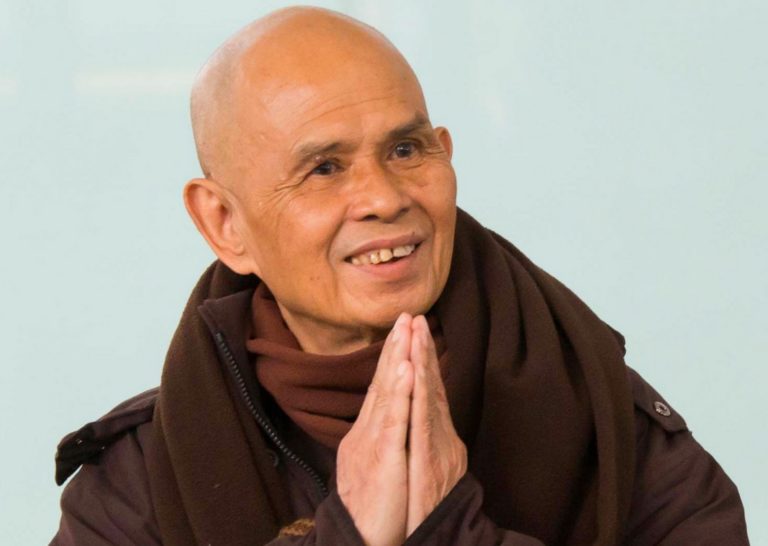
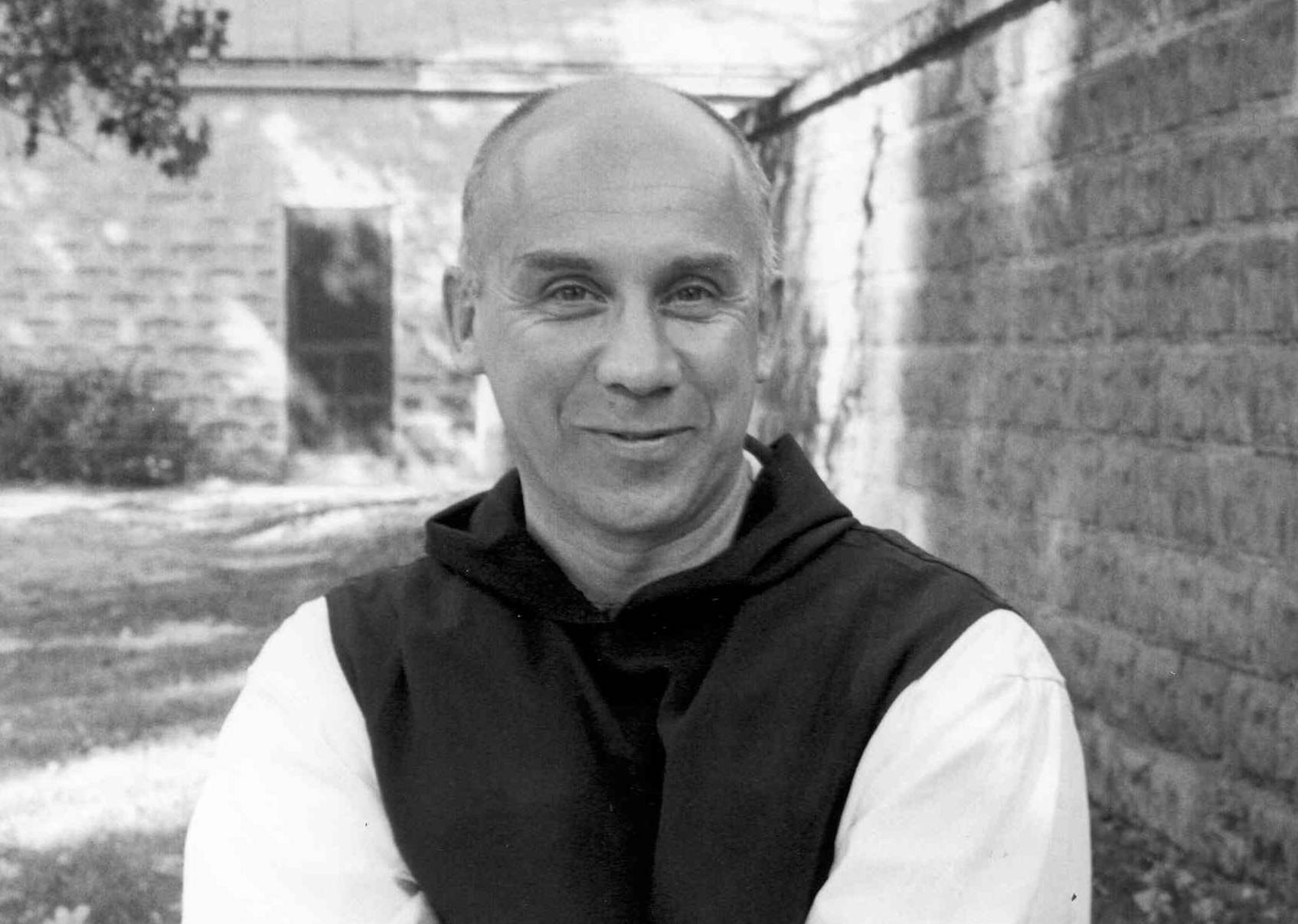
Thomas Merton’s final book, Contemplative Prayer, was published in 1969, a year after his accidental death. In 1995, Vietnamese Zen master Thich Nhat Hanh added an introduction. He wrote about his admiration for Merton and about distinctions between Christian and Buddhist prayer:
“I first met Thomas Merton in 1966. It is hard to describe his face in words, to write down exactly what he was like. He was filled with human warmth. Conversation with him was so easy. When we talked, I told him a few things, and he immediately understood the things I didn’t tell him as well. He was open to everything, constantly asking questions and listening deeply. I told him about my life as a Buddhist novice in Vietnam, and he wanted to know more and more.
Our approach to prayer in Buddhism is a little different from that of Christianity. We practice silent meditation, and we try to practice mindfulness in everything we do, to awaken to what is going on inside us and all around us in each moment. The Buddha taught: “If you are standing on one shore and want to cross over to the other shore, you have to use a boat or swim across. You cannot just pray, ‘Oh, other shore, please come over here for me to step across!’” To a Buddhist, praying without also practicing is not real prayer.”
At the end of his Introduction, Thich Nhat Hanh offers a set of nine prayers—prayers beyond any sectarian tradition.
Nine Prayers Thich Nhat Hanh From Contemplative Prayer by Thomas Merton
1. May I be peaceful, happy, and light in body and spirit. May he/she be peaceful, happy, and light in body and spirit. May they be peaceful, happy, and light in body and spirit.
2. May I be free from injury. May I live in safety. May he/she be free from injury. May he/she live in safety. May they be free from injury. May they live in safety.
3. May I be free from disturbance, fear, anxiety, and worry. May he/she be free from disturbance, fear, anxiety, and worry. May they be free from disturbance, fear, anxiety, and worry.
4. May I learn to look at myself with the eyes of understanding and love. May he/she learn to look at him/herself with the eyes of understanding and love. May they learn to look at themselves with the eyes of understanding and love.
5. May I be able to recognize and touch the seeds of joy and happiness in myself. May he/she be able to recognize and touch the seeds of joy and happiness in him/herself. May they be able to recognize and touch the seeds of joy and happiness in themselves.
6. May I learn to identify and see the sources of anger, craving, and delusion in myself. May he/she learn to identify and see the sources of anger, craving, and delusion in him/herself. May they learn to identify and see the sources of anger, craving, and delusion in themselves.
7. May I know how to nourish the seeds of joy in myself every day. May he/she know how to nourish the seeds of joy in him/herself every day. May they know how to nourish the seeds of joy in themselves every day.
8. May I be able to live fresh, solid, and free. May he/she be able to live fresh, solid, and free. May they be able to live fresh, solid, and free.
9. May I be free from attachment and aversion, but not be indifferent. May he/she be free from attachment and aversion, but not be indifferent. May they be free from attachment and aversion, but not be indifferent.
He/she: First the person we like, then the person we love, then the person who is neutral to us, and finally the person we suffer when we think of.
They: The group, the people, the nation, or the species we like, then the one we love, then the one that is neutral to us, and finally the one we suffer when we think of.
Greenland. Venezuela. Minneapolis. It is easy to forget any particular crisis. Or put another way, it is impossible to pay attention to all the crises. Not to mention all the non-critical items that crop up in our lives and our vision, some pleasant, some not.
So when one crisis gets mentioned or covered, there may be a tendency to say “well, what about…?”
So here I am saying, “What about Gaza?” That is, despite all the other headlines, don’t forget Gaza.
As I’ve implied before, in posts and conversations, Israel, including the Gaza situation, is all about theology, particularly Old Testament theology.
Walter Brueggemann (1933-2025) was one of the most prolific and influential theologians of the 20th and 21st centuries. Much of his work focused on the Old Testament, in which he found radical guidance for modern people of faith—a Bible that does not demand, justify or accept damaging political ideologies and nationalism.
In 2015 Brueggemann published Chosen?: Reading the Bible Amid the Israeli-Palestinian Conflict. He wrote:
INTRODUCTION
The seemingly insolvable conflict between the state of Israel and the Palestinian people requires our best thinking, our steadfast courage, and a deep honesty about the politically possible. The conflict is only “seemingly” beyond solution, because all historical-political problems have solutions if there is enough courage, honesty, and steadfastness.
The conflict is not a fixed, unchanging situation; rather, it is a dynamic historical reality that is dramatically changing and being redefined over time. As a result, it is imperative that our thinking not be settled in a fixed position but that it be regularly reevaluated in response to the changed and changing realities on the ground. If we should settle for a fixed solution, then we will have arrived at an ideology, which is quite unhelpful for real problems on the ground.
In my own thinking, which is much influenced by my work as a Scripture scholar, I begin with a focus on the claim of Israel as God’s chosen people. That conviction is not in doubt in the Bible. It is a theological claim, moreover, that fits with compelling persuasiveness with the reality of Jews in the wake of World War II and the Shoah. Jews were indeed a vulnerable people whose requirement of a homeland was an overriding urgency. Like many Christians, progressive and evangelical, I was grateful (and continue to be so) for the founding and prospering of the state of Israel as an embodiment of God’s chosen people. That much is expressed in my earlier book entitled The Land. I took “the holy land” to be the appropriate place for the chosen people of the Bible which anticipates the well-being of Israel that takes land and people together.
Of course, much has changed since then in the linkage between the state of Israel and the destiny of the chosen people of God.
–The state of Israel has evolved into an immense military power, presumably with a nuclear capacity. There is no doubt that such an insistence on military power has been in part evoked by a hostile environment in which the state of Israel lives, including periodic attacks by neighboring states.
–The state of Israel has escalated (and continues to escalate) its occupation of the West Bank by an aggressive development of new settlements.
–The state of Israel has exhibited a massive indifference to the human rights of Palestinians.
Thus, it seems to me that the state of Israel, in its present inclination and strategy, cannot expect much “positive play” from its identity as “God’s chosen people.” As a consequence, my own judgment is that important initiatives must be taken to secure the human rights of Palestinians. This changed stance on my part is reflected in the new edition of my book on the land. It is a change, moreover, that is featured in the thinking of many critics who have been and continue to be fully committed to the security of the state of Israel, as am I.
This rethinking is important both for political reasons and for more fundamental interpretive issues. A change in attitude and policy is important to help resolve the conflict. It is clear enough that the state of Israel will continue to show little restraint in its actions toward Palestinians as long as U.S. policy gives it a “blank check” along with commensurate financial backing. Such one-sided and unconditional support for the state of Israel is not finally in the interest of any party, for peace will come only with the legitimation of the political reality of both Israelis and Palestinians. As long as this issue remains unaddressed, destabilization will continue to be a threat to the larger region.
It will not do for Christian readers of the Bible to reduce the Bible to an ideological prop for the state of Israel, as though support for Israel were a final outcome of biblical testimony. The dynamism of the Bible, with its complex interactions of the chosen people and other peoples, is fully attested, and we do well to see what is going on in the Bible itself that is complex and cannot be reduced to a simplistic defense of chosenness. The Bible itself knows better than that!
It is my hope that the Christian community in the United States will cease to appeal to the Bible as a direct support for the state of Israel and will have the courage to deal with the political realities without being cowed by accusations of anti-Semitism.
It is my further hope that U.S. Christians will become more vigorous advocates for human rights and will urge the U.S. government to back away from a one-dimensional ideology for the sake of political realism. It seems to many of us that the so-called two-state solution is a dead possibility, as Israel in its present stance will never permit a viable Palestinian state. We are required to do fresh thinking about human rights in the face of the capacity for power coupled with indifference and cynicism in the policies of the state of Israel, which is regularly immune to any concern for human rights.
I have not changed my mind an iota about the status of Israel as God’s chosen people or about urgency for the security and well-being of the state of Israel. Certainly the Christian West continues to have much to answer for with its history of anti-Semitic attitudes and policies. None of that legacy, however, ought to cause blindness or indifference to political reality and the way in which uncriticized ideology does enormous damage to prospects for peace and for the hopes and historical possibilities of the vulnerable. The attempt to frame the Israeli-Palestinian conflict in terms of anti-Semitism is unpersuasive. More courage and honesty are required amid the realities of human domination and human suffering. As the hymn writer James Russell Lowell wrote in reference to the U.S. Civil War, “New occasions teach new duties.” The current conflict, with its escalation of cynical violence, is a new occasion. New duties are now required.
“We realize, hey, our churches and the people in our churches have been duped by this guy and so rather than hope someone else will clean up the problem, what we’ve seen is a lot of pastors respond with, you know what, I’m going to jump in and I’m going to be a part of the solution.” Robb Ryerse in Arkansas, Christian pastor and former Republican, one of 30 Christian white clergy so far running as Democrats in the midterm elections.
Churches in America have taken different positions regarding Trump.
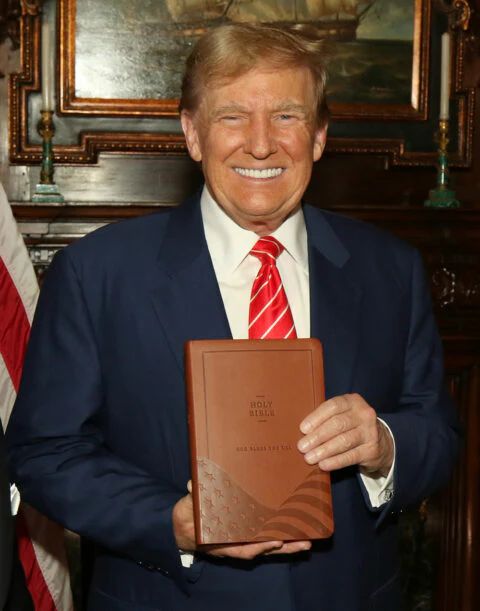
Some have vigorously supported him, going so far as to say he is an anointed savior for the nation. Trump does, after all, sell his own God Bless the USA Bible.
Some, particularly black churches, have vigorously opposed him.
Most churches have stayed on the sidelines. The main reason is that in this divided society, congregations often include supporters and opponents. In those congregations, the position is that the church serves as an elevated neutral ground, not a battlefield, interested in promoting and effectuating the highest principles of Jesus and the Gospels. Whether or not those principles are being advanced or decimated in the public sphere by the chief public executive. Whether or not the tax dollars of congregants are being used to help or hurt people. Besides, a divisive message might send some congregants running away.
He grew up on a farm in Indiana, the son of a factory worker and eldest of five children. He studied at Liberty, a Christian university founded by the conservative pastor and televangelist Jerry Falwell, and recalls wearing a T-shirt expressing opposition to Democratic presidential candidate John Kerry.
Two decades later, Justin Douglas is running for the US Congress – as a Democrat.
He is among around 30 Christian white clergy – pastors, seminary students and other faith leaders – known to be potential Democratic candidates in next year’s midterm elections, including a dozen who are already in the race. While stressing the separation of church and state, many say that on a personal level their faith is calling them into the political arena….
In Arkansas, Robb Ryerse, a Christian pastor and former Republican, is mounting a challenge to representative Steve Womack, adopting the slogan “Faith, Family & Freedom” – rhetoric more commonly found in Republican campaign literature.
Ryerse, 50, from Springdale, Arkansas, said: “I joke sometimes that the two people who have changed my life more than any others are Jesus and Donald Trump, for very different reasons. Donald Trump is absolutely inconsistent with Christian principles of love and compassion, justice, looking out for the poor, meeting the needs of the marginalized.
“But Donald Trump has also used and been used by so many evangelical leaders who want political power. He has used them to validate him to their followers and they have used him to further their agenda, which has been a Christian nationalist culture war on the United States, which I think is bad for both the church and for the country.”
White clergy are deciding to run for office, Ryerse believes, in part as a response to the rise of Christian nationalism and the reality that, according to a Public Religion Research Institute (PRRI) survey, Trump won 85% of the white evangelical vote in last year’s presidential election.
Ryerse said: “We realize, hey, our churches and the people in our churches have been duped by this guy and so rather than hope someone else will clean up the problem, what we’ve seen is a lot of pastors respond with, you know what, I’m going to jump in and I’m going to be a part of the solution.
“On a more positive note, there’s also that notion we need to do something for the common good. There’s so much alignment between what I believe personally is good for my neighbor, what it means to love my neighbor, and how that aligns with what public policy ought to be.”
One of the most famous quotes about judging is from the Gospels:
Do not judge, so that you may not be judged. Matthew 7:1
Despite that wisdom, Christians and others often tend to forget or ignore it. A lot of judging goes on.
Another similar perspective is taken in Buddhism, which is not to say that Buddhists don’t indulge in judging also.
A maxim from the classic 59 maxims of mind-training (lojong):
Don’t reflect on others’ shortcomings.
We should train our minds to see others as pure by thinking that when we see a fault in someone, it’s because we project imaginary faults onto others due to things appearing to be impure from our own side. Practicing in this way, we will be able to protect ourselves from the tendency to judge others. Gomo Tulku (1922-1985), Seven Steps to Train Your Mind
This goes farther than the Christian message that we shouldn’t judge others because we might get judged back. We don’t judge because whatever the other is doing, we are looking in a mirror. We are pure, though our self-importance keeps us from knowing it. The other is pure, but is also kept from knowing it. Our role is not to judge, but to help them see it and help ourselves see it.
Note that no one suggests that we put our critical thinking in neutral. If we find that what we or others do, say or think might be better, we can point it out, provided our motivation is making things better, and not proving ourselves better and smarter.