Bob Schwartz

Tag: Bible

Kafka’s Parable (No answer to all questions, no solutions to all mysteries)

Note: This is the first day of Sukkot, the Jewish harvest festival that includes reading Ecclesiastes/Kohelet, one of my favorite books of the Hebrew Bible. Before writing a new post about Ecclesiastes, I reviewed my earlier posts that referenced it. It turns out the following was drafted but never published.


Kafka’s Parable (No answer to all questions, no solutions to all mysteries)

Kafka’s parable
Is a sounding of a bell
That half sickens me.
So obvious that
All searches do not succeed
Still hopeful that
Some do
Mine will.
Why embed the futility of Ecclesiastes
In a treasure map
That might as well say
Not here
Not here
Not anywhere.
Frustration is one thing
The waste of a life another.

© 2025 Bob Schwartz


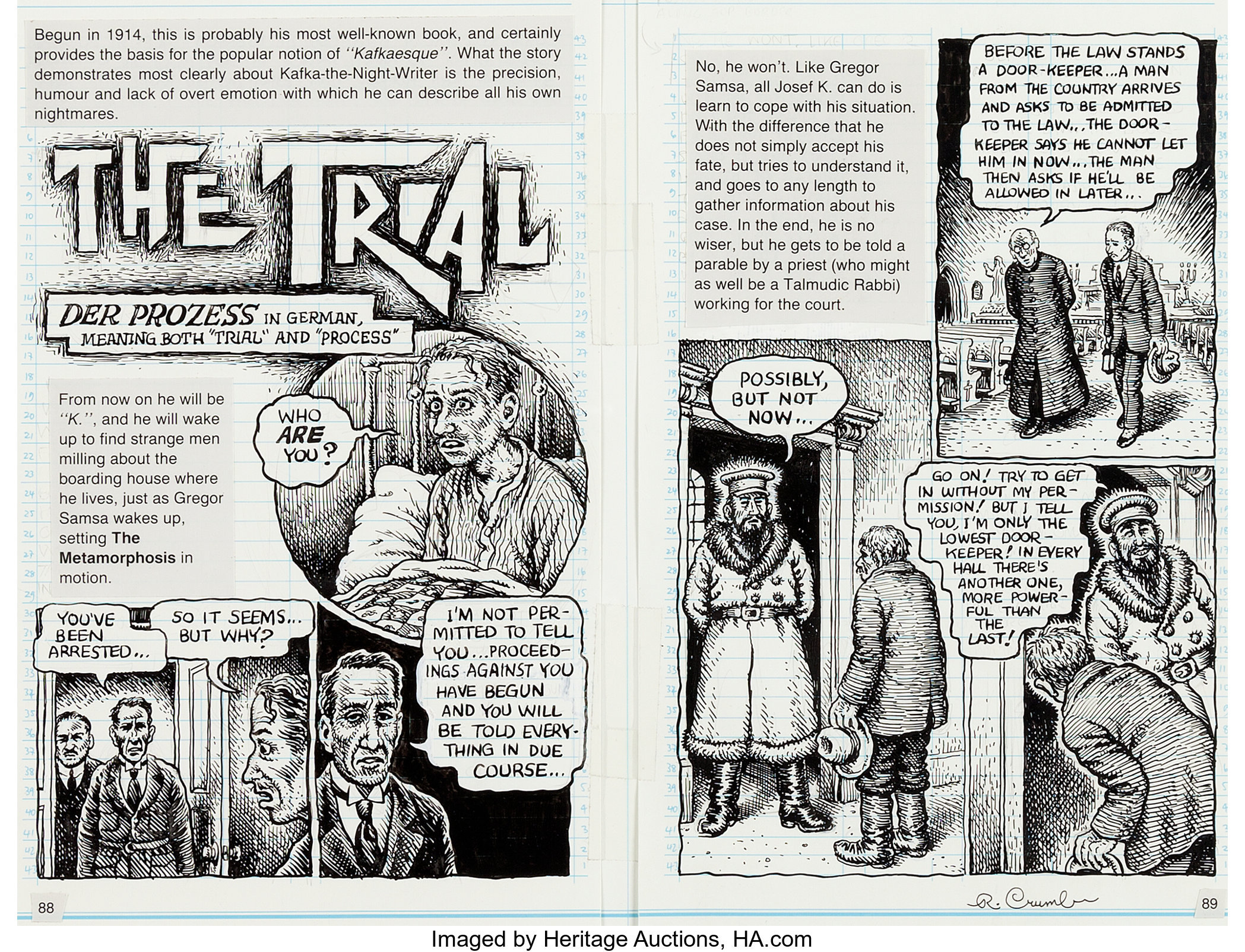
Kafka’s parable, found in his novel The Trial, “can be read as a religious allegory or as an allegory of human justice.” (see below).

The futility found in Ecclesiastes (entitled in Hebrew Kohelet) refers to a repeated theme of the biblical book, starting with its famous opening passage. While there is much disagreement about the English translation of the biblical Hebrew word hevel—air, vapor, breath, mist, smoke, futility, meaningless, absurd, pointless or useless—the line “hevel hevelim, kol hevel” it is best known in English this way:

Futility, futility, all is futility.


From Tree of Souls:The Mythology of Judaism by Howard Schwartz

BEFORE THE LAW

Before the Law stands a man guarding the door. To this doorkeeper comes a man from the country who asks to be admitted to the Law. But the doorkeeper says that he cannot grant him entry. The man thinks about it and asks if, in that case, he will be permitted to enter later. “Possibly,” says the doorkeeper, “but not now.”

As the gateway to the Law is, as always, open, and the doorkeeper steps aside, the man stoops to look within. When the doorkeeper sees this, he laughs and says, “If it tempts you that much, just try to get in. But be aware that I am mighty. And I am only the lowliest doorkeeper. From hall to hall there are doorkeepers, each mightier than the one before. Even I can no longer bear the sight of the third of these.”

The man from the country has not expected such difficulties. Surely, he thinks, the Law ought to be accessible to everybody, always, but now as he looks more carefully at the doorkeeper, with his big pointed nose and long, thin, black Tatar beard, he decides he’d rather wait for permission to enter. The doorkeeper gives him a stool and has him sit down beside the door. There he sits for days and for years. He often tries to be admitted, and wearies the doorkeeper with his pleas. The doorkeeper frequently questions him, asks him about where he comes from and many other things, but they are distant inquiries, the sort great men make, and in the end he always says that he cannot let him in yet. The man, who has equipped himself for his journey with many things, employs everything, however valuable, to bribe the doorkeeper. He takes it all, saying however, “I accept this only so you won’t think you’ve failed to do anything.”

All these long years the man watches the doorkeeper unceasingly. He forgets the other doorkeepers, and this first one seems to be the only obstacle between him and the Law. He curses his miserable luck, at first recklessly and loudly; later, as he grows old, he only grumbles to himself. He becomes childish, and since his years of scrutiny of the doorkeeper have enabled him to recognize even the fleas in his fur collar, he asks even the fleas to help change the doorkeeper’s mind. Finally his eyes grow feeble, and he doesn’t know if it’s really getting darker around him or if his eyes are only tricking him. But in the darkness he now observes an inextinguishable radiance streaming out of the door of the Law.

Now he will not live much longer. Before he dies all he has been through converges in his mind into one question that he has never yet asked the doorkeeper. He signals to him, as he can no longer raise his stiffening body. The doorkeeper has to bend down low to him, as their difference in size has altered, much to the man’s disadvantage. “What do you want to know now?” asks the doorkeeper. “There’s no satisfying you.” “Everyone struggles to reach the Law,” says the man. “How can it be that in all these years no one but me has asked to get in?” The doorkeeper recognizes that the man’s life is almost over and, because his hearing is failing, he roars at him, “No one else could be allowed in here. This entrance was intended only for you. I am now going to close it.”

* * *

This famous parable by Kafka from The Trial can be read as a religious allegory or as an allegory of human justice. Although it is generally thought of more in terms of the latter, it has the distinct elements of a religious allegory. The key image is that “of an inextinguishable radiance streaming out of the door of the Law.” This clearly suggests the eternal nature of the Law, which, of course, draws this eternal quality from God. This shifts the focus of the parable from human justice to the need for divine justice, and hints at the remoteness of God.

The doorkeeper guarding the gate to the Law is reminiscent of the angel placed at the gate of the Garden of Eden, with the flaming sword that turned every way, to guard the way to the tree of life (Gen. 3:24). Also echoed is the popular Christian conception of St. Peter serving as the doorkeeper at the Gates of Heaven.

Gershom Scholem has said that there are three pillars of Jewish mystical thought: the Bible, the Zohar, and the writings of Kafka. Thus he viewed Kafka’s writings, which have been interpreted in a multitude of ways, as mystical texts. Scholem pointed out parallels between “Before the Law” and passages in the Hekhalot texts about angels guarding the gates of the palaces of heaven. For a description of these angels, see “The Entrance of the Sixth Heavenly Palace,” p. 178. Compare this description with Kafka’s description of the doorkeeper in “Before the Law.” The parallels are striking, but since this Hekhalot text was little known during Kafka’s lifetime, it is not likely that he had direct knowledge of it. Moshe Idel also identifies the quest in this tale as the remnant of a mystical one. See Kabbalah: New Perspectives, p. 271.

Another perspective is suggested by Zohar 1:7b: Open the gates of righteousness for me . . . . This is the gateway to the Lord (Ps. 68:19-20). Assuredly, without entering through that gate one will never gain access to the most high King. Imagine a king greatly exalted who screens himself from the common view behind gate upon gate, and at the end, one special gate, locked and barred. Said the king: “He who wishes to enter into my presence must first of all pass through that gate.”

Another parallel is found in Ibn Gabirol’s eleventh century treatise, The Book of the Selection of Pearls (ch. 8): “The following laconic observations are said to have been addressed to a king, by one who stood by the gate of the royal palace, but who failed to obtain access. First: Necessity and hope prompted me to approach your throne. Second: My dire distress admits of no delay. Third: My disappointment would gratify the malice of my enemies. Fourth: Your acquiescence would confer advantages, and even your refusal would relieve me from anxiety and suspense.”

Max Brod, Kafka’s close friend and biographer, comments about this parable: “Kafka’s deeply ironic legend ‘Before the Law’ is not the reminiscence or retelling of this ancient lore, as it would seem at first glance, but an original creation drawn deeply from his archaic soul. It is yet another proof of his profound roots in Judaism, whose potency and creative images rose to new activities in his unconscious.” (Johannes Reuchlin und sein Kampf, Stuttgart: 1965, pp. 274-275).

Of course, “Before the Law” can also be read as a personal statement of the kind of obstruction Kafka experienced at the hands of his father. The role of the gatekeeper can also be identified with Kafka’s mother, for Kafka gave his mother the epic letter he wrote to his father, to pass on to him, but she decided not to do so. In such a reading Kafka’s father represents the Law, the strict, godlike figure. See Kafka’s Letter to His Father.

Also, Kafka’s parable is relevant to human justice, where, on many occasions, people have been denied justice by the very ones who were supposed to provide it for them. In doing so they perform the obstructive role of the gatekeeper, who was supposed to welcome the man from the country at the gate intended only for him, but instead prevented him from entering at all.

Readers may wonder why a modern parable by Franz Kafka has been included in a book of Jewish mythology. There are several reasons for this. Kafka’s fiction possesses a strong mythic element, and scholars have become increasingly aware of the strong influence on it of Jewish tradition; Kafka’s writing in general, and this parable in particular, has taken on the qualities of a sacred text in our time; and there are strong parallels between this parable and traditional Jewish myths about the quest to reach God, but also a strong element of doubt in Kafka’s parable that reflects the modern era. Just as the evolution of Jewish mythology did not end with the canonization of the Bible or the Talmud, and continued to flourish in the kabbalistic and hasidic era, so too it can be seen to continue in the modern era in the writings of Kafka. It also can be found in other seminal Jewish authors, such as I. L. Peretz, S. Y. Agnon, Bruno Schulz, and I. B. Singer.



Passover message: “No stranger shall you oppress, for you know the stranger’s heart, having yourselves been strangers in the land of Egypt.”

גֵ֖ר לֹ֣א תִלְחָ֑ץ וְאַתֶּ֗ם יְדַעְתֶּם֙ אֶת־נֶ֣פֶשׁ הַגֵּ֔ר כִּֽי־גֵרִ֥ים הֱיִיתֶ֖ם בְּאֶ֥רֶץ מִצְרָֽיִם׃
Exodus 23:9

One line from the Book of Exodus crystallizes our moment.

As with all biblical Hebrew, the translation is challenging and varied.


Exodus 23:9

You shall not oppress a stranger, for you know the feelings of the stranger, having yourselves been strangers in the land of Egypt. (NJPS)

You shall not oppress a resident alien; you know the heart of an alien, for you were aliens in the land of Egypt. (NRSV)

No sojourner shall you oppress, for you know the sojourner’s heart, since you were sojourners in the land of Egypt. (Robert Alter)


Alter addresses one of the translation challenges, the Hebrew word nefesh/נֶ֣פֶשׁ:

“The Hebrew is nefesh, “heart”, “life,” “inner nature,” “essential being,” “breath.””

Another word needing expansion is the Hebrew ger/גֵּ֔ר. Scholars Mark Allen Powell and Dennis R. Bratcher explain in the HarperCollins Bible Dictionary:


alien (ger): In the Bible, one who is not a member of a particular social group. Accordingly, Abraham was an alien (NRSV: “stranger”) among the Hittites at Hebron (Gen. 23:4), as were Moses in Midian (Exod. 2:22) and the Israelites in Egypt (Deut. 23:7; cf. Ruth 1:1). The Hebrew word is ger, and it has often been translated “sojourner” in English Bibles. The NRSV is inconsistent, translating it “alien” in some instances and “stranger” in others. After the settlement in Canaan, the term not only designated a temporary guest but also acquired the more specialized meaning of “resident alien,” one who lived permanently within Israel (Exod. 22:21; 23:9). No doubt because the Israelites were keenly aware of their own heritage as aliens without rights in a foreign land, they developed specific laws governing the treatment of aliens. Strangers or aliens were to be treated with kindness and generosity (Lev. 19:10, 33–34; 23:22; Deut. 14:29). The basic principle was, “You shall also love the stranger, for you were strangers in the land of Egypt” (Deut. 10:19). And, again, “You shall love the alien as yourself, for you were aliens in the land of Egypt” (Lev. 19:34)….

“Alien” or “stranger” also appears in a figurative sense, usually in appealing to the generosity and mercy of God in dealing with undeserving people (Pss. 39:12; 119:19; 1 Chron. 29:15). The idea of dwelling in a land owned by someone else is also applied theologically to the relationship of the Israelites to the land; it belonged to God and they were the strangers in it (Lev. 25:23). (emphasis added)


This Passover, we give a thought to the nefesh—heart, life, inner nature, essential being, breath—of the ger—stranger, sojourner, resident alien. As the Bible reminds us, we were strangers too.

Hag Pesach sameach.

This

This

You say this is what God wants
God told you
Or told someone who heard
And told you
Told someone
Who wrote it down
Figured out
That this is what God wants.
I am no more than Moses or others
But no less.
Here is what I read and heard
And write.
Bereshit bara elohim et hashamayim v’et ha’aretz. V’ha’aretz hatah tohu v’bohu.”*
In the beginning was tohu and bohu, a formless wasteland.
All the rest is commentary
For us not God to write create destroy.
Write we did
Create we did
Destroy we did
And do.
This is what we want.

*Genesis 1:1-2

© 2024 by Bob Schwartz

Ani Shalom – I am peace – אֲֽנִי־שָׁ֭לוֹם

Too long have I dwelt with those who hate peace.
I am all peace;
but when I speak,
they are for war.

Psalm 120:6-7

I am not a pacifist.

There are many definitions of pacifist, including:

A person who opposes war or violence as a means of settling disputes.
A person who believes that war and violence are unjustifiable.

Up until now, I hadn’t thought about whether I would classify myself as or be considered a pacifist. The short answer is ‘no”. During the wars I’ve lived through or for those I know from recent or ancient history, I can say that some of the wars and violence pursued were justified. Others were not, or were pursued in ways that were not justified, or for objectives that were not justified, or were pursued without trying other means, or were just stupid or evil.

But I am for peace. Peace should never be a secondary or tertiary objective once the other objectives have been achieved or not, once all the destructive and deadly means have been tried. Peace should have co-equal status at the top of the list.

During the ongoing war in Gaza, I’ve discovered that all the divergent thinking and rhetoric, from me and so many others, from just plain folks up to world leaders, is having little effect on the course of hostilities. Wars are about action, well-chosen or ill-chosen, and stubborn actors convinced of their rightness can be deaf.

Then I realized that if I am going to be using my words to little practical effect, I might as well use them to promote the possibility of peace.

Which is how I came to find a verse in Psalm 120. The standout Hebrew phrase is “Ani shalom”, literally the words are “I” and “peace”. Lacking a verb, it is variously translated as “I am peace”, “I am all peace”, “I am for peace”.

I am peace and I hope you are too.


רַ֭בַּת שָֽׁכְנָה־לָּ֣הּ נַפְשִׁ֑י עִ֝֗ם שׂוֹנֵ֥א שָׁלֽוֹם׃
אֲֽנִי־שָׁ֭לוֹם וְכִ֣י אֲדַבֵּ֑ר הֵ֝֗מָּה לַמִּלְחָמָֽה׃

Rabat shachna la nafshi
Ani shalom v’chi adaber hama lamilchama

Too long have I dwelt with those who hate peace.
I am all peace;
but when I speak,
they are for war.

Psalm 120:6-7

Mad Gods by the sea

Palestine Sunbird in Gaza

Mad Gods by the sea

God of Moses
God of Jesus
God of Mohammed
God of infinite names
Sitting by the desert sea
Pained and grieved.
This is madness.
These people
Every inclination
Is only evil
All the time.*
They take our names
In vile vain.**
There is the water
Let us drive them in
And start again
Just like days of old
Do better next time.
But how would they learn?
Hard hearts may soften
Dissolved in blood and tears.
We won’t abandon
We don’t approve.

*Genesis 6.5-7
**Exodus 20.6

© 2023 by Bob Schwartz

Passover 2020: With stay-at-home seders, Elijah will be making many more wine stops

The tradition of Elijah at the seder is common in many Jewish communities. The practice of pouring a fifth cup of wine and opening the door for Elijah has a complex history. The theme is the prophet as a harbinger of redemption. The scholarship on this is voluminous, and it is generally concluded that the practice is not ancient, only coming into use after the Crusades.

Setting aside the fascinating history of the cup of Elijah, this much is clear: at Passover 2020, Elijah will be visiting a lot more seders. Instead of big groups, single family seders—many of them virtually connected—will be pouring that extra cup for Elijah to drink. Not to mention all the other extra cups that will be poured and drunk on this Passover, different than all other Passovers.

According to the Bible story, Elijah, like Moses before him, fled to the wilderness. Pursued by Ahab and Jezebel, Elijah wanted to give up. Instead, he found water and food to sustain him, ending up at the very same mountain where Moses stood:

And He said, “Go and stand on the mountain before the LORD, and, look, the LORD is about to pass over, with a great and strong wind tearing apart mountains and smashing rocks before the LORD. Not in the wind is the LORD. And after the wind an earthquake. Not in the earthquake is the LORD. And after the earthquake—fire. Not in the fire is the LORD. And after the fire, a sound of minute stillness.” (1 Kings 19:10-12, Robert Alter translation)

Wilderness, food, wine, a sound of minute stillness. Happy Passover.

The binary and the infinite: What we learn from computers, the I Ching, the Bible and breathing.

We live today and have long lived in what seems to us, at first glance, a binary world. So it seems.

At their most basic, computers are binary machines. Countless combinations of yes/no, on/off decision circuits, adding up, as speed and the number of decisions increase exponentially, to processes that mimic (or exceed) human thought.

The I Ching begins its panoramic presentation of world with a simple binary calculation: either a solid yang line or a broken yin line, combined into eight trigrams and sixty-four hexagrams, from which the entire nature of life and time is profiled, if not actually predicted.

Traditions, such as Taoism, Zen and others, suggest non-duality. That reality exists between those choices we are so attached to. That it is not either/or, not neither/nor. Computers agree. Reduced to each of the billions of digital decisions, binary means nothing. The I Ching reduced to a single line means little. The meanings, all of them, are in the matrix of combinations.

The Bible agrees. It would seem, in its rules and lists, to promote binary behavior. The Ten Commandments are a prime example. But at the literal first moment, if we immerse ourselves in the question of what is between existence and non-existence at creation (contemplation that according to one legendary interpretation drove the Talmudist Ben Zoma crazy), the answer may be everything. The Book of Ecclesiastes, famous for saying that all is ephemeral vapor and listing the binary poles (a time to laugh, a time to weep…), is telling us we live now and ever in the changes in between. Not unlike the I Ching.

Physics has also given up on the binary. Simplistic analysis has given way to acknowledgement that as much as we would like to hold on to a concept of this or that, now or then, the physical world at a foundational level exists in simultaneous multiple states.

Not everything about our organic human lives is binary, but plenty of it is. Ten has its place (fingers, toes), but a distinct second place to two. Two arms and hands, legs and feet, eyes, ears, lungs.

Lungs bring us to breathing, the penultimate binary. Inhale, exhale. There is nothing in between. The failure of that binary leads to the ultimate: life, death. Some do posit an alternative to that binary, a third option. But if we just stick to life/death, what do we learn about either one from this discussion of binary?

Things as they are are not exactly binary, except we make them so. This doesn’t mean that one can think away breathing or death. No inhale/exhale, no life happens. But the values in between—the digital fabric, the I Ching, the space between existence and non-existence, the time between laughing and weeping, the quantum states—are where it is at.

The Miracle of the Palm Tree (The Journey of Baby Jesus Continues)

More from The Gospel of Pseudo-Matthew (see previous post Baby Jesus Is Worshiped by Dragons and Other Wild Beasts)

20
The Miracle of the Palm Tree

1 Then, after these things, on the third day after they had started out, Mary was weary from too much sun in the wilderness, and seeing a palm tree she wanted to rest awhile in its shade. Joseph hastened to lead her to the palm and he had her descend from the donkey. When Mary sat down, she looked to the foliage on the palm and saw that it was full of fruit, and she said, “If only I could get some of that fruit from the palm!” Joseph said to her, “I am surprised that you’re saying this, when you can see how high the palm is. You are thinking of the fruit of the palm; but I am thinking about the water that we no longer have in our water skins; we have nowhere to replenish them to quench our thirst.”

2 Then the young child Jesus, sitting in the lap of his mother, the virgin, cried out to the palm tree and said, “Bend down, O tree, and refresh my mother from your fruit.” Immediately when he spoke, the palm tree bent its top down to Mary’s feet. Everyone gathered the fruit in it and was refreshed. After all its fruit had been gathered, the tree remained bent, expecting that it would rise up at the command of the one who had ordered it to bend over. Then Jesus said to it, “Stand erect, O palm, and be strong, and become a companion of my trees that are in the paradise of my Father. And open up from your roots the hidden springs, that water may flow from them to quench our thirst.” Immediately the palm stood erect, and from its roots springs of water began to come forth, clear, cold, and very sweet. When they saw the springs of water flowing, they all rejoiced with a great joy and drank, together with their beasts and companions, giving thanks to God.

The image above is taken from a 14th century manuscript of the Gospel of Pseudo-Matthew.

Baby Jesus Is Worshiped by Dragons and Other Wild Beasts

From The Gospel of Pseudo-Matthew
The Other Gospels: Accounts of Jesus from Outside the New Testament
Edited and Translated by Bart D. Ehrman and Zlatko Pleše

The Gospel of Pseudo-Matthew

17
The Wrath of Herod and the Flight to Egypt

1 When King Herod saw that he had been deceived by the magi, his heart was inflamed and he sent his soldiers out on every path, wishing to capture them. When he was not able to find a trace of them, he sent soldiers to Bethlehem and killed every infant from two years and under, according to the time that he had solicited from the magi.

2 One day before Herod had done this, Joseph was warned by an angel of the Lord, “Take Mary and the child and go, take the desert route to Egypt.”

18
Baby Jesus Is Worshiped by Dragons and Other Wild Beasts

1 When they arrived at a certain cave where they wanted to cool themselves off, Mary came off the donkey and sat down, and held Jesus on her lap. There were three male servants with them on the road, and one female servant with Mary. And behold, suddenly many dragons came out of the cave. When the servants saw them they cried out. Then the Lord, even though he was not yet two years old, roused himself, got to his feet, and stood in front of them. And the dragons worshiped him. When they finished worshiping him, they went away. Then was fulfilled what was spoken by the prophet in the Psalms, who said, “Praise the Lord from the earth, O dragons and all the places of the abyss.”

2 The Lord Jesus Christ, though just a small child, walked along with them so that he might not be a burden to anyone. Mary and Joseph were saying to one another, “It would be better for those dragons to kill us than to harm the child.” Jesus said to them, “Do not think of me as a young child, for I have always been the perfect man, and am now; and it is necessary for me to tame every kind of wild beast.”

19

1 So too both lions and leopards were worshiping him and accompanying him in the desert, wherever Mary went with Joseph. They went before them showing them the way and being subject to them; and bowing their heads with great reverence they showed their servitude by wagging their tails. But on the first day that Mary saw lions, leopards, and various other wild beasts surrounding them, she was terrified. The young child Jesus smiled in her face and spoke to her with a consoling word, saying, “Do not fear, Mother, for they are hastening along, not to hurt you but to serve you.” With these words he removed the fear from their hearts.

2 And so lions, asses, oxen, and beasts of burden carrying their baggage were all walking together with them, and whenever they made a stop, they would graze. There were also tame goats who came out with them and followed them from Judah; these were walking among the wolves with no fear. One was not afraid of another, and none of them was harmed by another in any way. Then was fulfilled what Isaiah said, “Wolves will pasture with sheep and the lion and ox will eat straw together.” There were two oxen used as pack animals with them on the way; lions guided them on the way of our Lord Jesus Christ, whose baggage they were carrying.


Notes from The Other Gospels: Accounts of Jesus from Outside the New Testament:

The book is a Latin reworking of the (Greek) Proto-Gospel of James, based probably on one or more Latin editions of that work that have long since been lost. There are numerous differences from the Proto-Gospel, in both contents and emphases….Pseudo-Matthew tells of the holy family’s flight to Egypt, during which the infant Jesus performs numerous miracles—taming dragons, lions, and leopards; making a palm tree bend down to deliver its fruit to a famished Mary; causing idols in an Egyptian pagan temple to bow down in worship before him. These were some of the most familiar stories of the Christ child throughout the Middle Ages….

There continue to be debates concerning when the Gospel itself was composed….Pseudo-Matthew must obviously date to some time in the mid-seventh century, at the earliest.

In the most thorough analysis to date, Gijsel has maintained that even though direct literary dependence on the Rule of Benedict cannot be demonstrated, there are enough general similarities to suggest that the book was written when monastic orders were beginning to expand in the West, by someone invested in them. Largely on these grounds he makes a convincing argument that the text was produced in the first quarter of the seventh century, by a monk in the Latin-speaking West who was enchanted by the account of the Proto-Gospel and its potential for conveying homage to Mary as a model virgin embracing the monastic ideal.

Not only was Pseudo-Matthew itself popular in such circles for nearly a millenium, its message was spread even further abroad as its reworked stories were themselves edited for incorporation in the eleventh-century book, Libellus de nativitate sanctae Mariae (“Book on the Birth of Saint Mary”) and by Jacob of Voragine in The Golden Legend (written 1260 CE), which was the most widely read and influential book of the late middle ages, down to the Reformation.

Hanukkah: Joy Comes with the Morning

Reading Psalm 30 is a Hanukkah tradition. Not nearly as well-known or widely practiced as lighting the Hanukkah candles, eating fried foods (latkes and donuts) and playing dreidel, but just as essential.

Psalm 30 contains one of the most uplifting of all biblical verses. The sometimes perplexing Hebrew leads to a variety of English translations, but it is best known this way:

Weeping may linger for the night,
but joy comes with the morning.
Psalm 30:5

Prof. Marc Zvi Brettler explains the connection between Psalm 30 and Hanukkah:

Jewish custom mandates that a psalm be recited for each weekday, and a special psalm for each festival. This custom goes back at least to late rabbinic times, as recorded in the post-Talmudic Tractate Soferim (ch. 18), where Psalm 30 is associated with Chanukah. Ostensibly, the psalm was chosen because the superscription, מזמור שיר חנכת הבית לדוד, refers to the dedication (chanukah) of the temple.

Traditionally, the superscription refers to the dedication of the First Temple, Solomon’s Temple, though some scholars connect it to the dedication of the Second Temple (some psalms are clearly Second Temple in origin). Thus, the connection between Psalm 30 and Chanukah would be a loose one, but the best the rabbis could find—after all, Chanukah occurred in 164 B.C.E., hundreds of years after the dedication of the Second Temple in 515 BCE. Thus, the psalm cannot be referring to Chanukah … or can it?

In fact, I, along with many other biblical scholars, believe that the superscription to Psalm 30 does not refer to the dedication of the Temple (first or second) but literally refers to Chanukah….

A number of points connect this psalm and the Maccabean uprising. First, the psalm describes overcoming, at great odds, enemies—an apt description of the Maccabean experience and the exact situation that led up to Chanukah. In addition, the psalm mentions chasidim (v. 5). The NJPS translates this phrase properly as the “faithful,” the typical meaning of this term in early psalms. Yet we know from both 1 and 2 Maccabees that in the second century B.C.E. a group or party developed, associated with the Maccabees, who called themselves Chasidim, as reflected in the Greek term asidaioi.

In other words, it is possible that someone (on the winning side) after the Hasmonean victory in 164 BCE could have read Psalm 30 and imagined: “David prophesized this about us!” The psalm, for that very reason, may even have been recited as part of the dedication ceremony on Chanukah in 164 BCE since it was seen as broadly appropriate—or even prophetic—to what had happened.

What does Psalm 30 say? In The Jewish Study Bible translation:

Psalm 30

1 A psalm of David. A song for the dedication of the House.
2 I extol You, O Lord,
for You have lifted me up,
and not let my enemies rejoice over me.
3 O Lord, my God,
I cried out to You,
and You healed me.
4 O Lord, You brought me up from Sheol,
preserved me from going down into the Pit.

5 O you faithful of the Lord, sing to Him,
and praise His holy name.
6 For He is angry but a moment,
and when He is pleased there is life.
One may lie down weeping at nightfall;
but at dawn there are shouts of joy.

7 When I was untroubled,
I thought, “I shall never be shaken,”
8 for You, O Lord, when You were pleased,
made [me] firm as a mighty mountain.
When You hid Your face,
I was terrified.
9 I called to You, O Lord;
to my Lord I made appeal,
10 “What is to be gained from my death,
from my descent into the Pit?
Can dust praise You?
Can it declare Your faithfulness?
11 Hear, O Lord, and have mercy on me;
O Lord, be my help!”
12 You turned my lament into dancing,
you undid my sackcloth and girded me with joy,
13 that [my] whole being might sing hymns to You endlessly;
O Lord my God, I will praise You forever.

Whether you celebrate Hanukkah or Christmas or nothing, light candles or tree lights, believe in God or gods or none, this is a message for all seasons and all time. Especially this season and these times.

When we are troubled, with a desecrated temple, death or illness, heartbreak, we can find a path to turn our lament and mourning into dancing. Weeping may linger for the night (many nights), but joy and light come with the morning.

Hanukkah begins on the evening of December 22. Chag urim sameach (Happy Festival of Lights).