Mindfulness is a popular practice of spiritual and psychological progress. That is a good thing. Transformation and evolution are more needed and valuable than ever.
Being aware of mind is a step towards full presence. As is no mind:
140 Dayi’s “No Mind”
MAIN CASE
Dayi Daoxin asked his teacher Jianzhi Sengcan, the Third Ancestor, “What is the mind of the ancient buddhas?”
Sengcan said, “What kind of mind do you have now?”
Dayi said, “I have no mind.”
Sengcan said, “Since you have no mind, why would you think buddhas have mind?”
Dayi immediately ceased to have doubt.
COMMENTARY
It is clear that Dayi is an adept and has investigated the Way. He has to a certain degree eliminated conceptual thought and intellectual defilement. But still, there is this “What is the mind of the ancient buddha?” Indeed, what is the mind—any mind, your mind? How big is it? Where does it reside? Does it really exist or not? The answers to these questions require that each one of us plummet the depths of our own mind.
When pressed by his teacher, Dayi, like his dharma grandfather Huike before him, has to admit that mind is ultimately ungraspable. Do you understand? Because the mind has no form, it pervades the whole universe, existing right here now. This truth comes from the direct experience of plunging into another dimension of consciousness. It is not a matter of understanding or knowing.
Sengcan presses again, saying, “Since you have no mind, why would you think buddhas have mind?” The ice begins to melt, the waters begin to flow, and no further communication is possible.
But say, since Dayi has no mind, where was he holding the doubt that he ceased to have?
CAPPING VERSE
When thoughts disappear, the thinker disappears, and all things manifest as they are. In this reality, all intentional efforts vanish. In this world of suchness, nothing is excluded.
The True Dharma Eye: Zen Master Dōgen’s Three Hundred Kōans With Commentary and Verse by John Daido Loori Translated by Kazuaki Tanahashi And John Daido Loori
No mind, not just full mind. There is not a popular term no-mindedness. Maybe there should be.
It is Day 6 of Passover. The holiday is seven days long in Israel and Reform communities, mostly eight days in Orthodox and Conservative communities. The extra day for this and some other holidays is traditionally based on the reach from Israel to diaspora communities. So Passover may be over tomorrow, maybe the next day. We can, should and will debate it.
By Day 6 we appreciate that we can soon make a sandwich or put a hot dog in a bun. Not that it isn’t fun to devise workarounds: this morning’s breakfast was whole wheat matzo topped with cream cheese and lox. Back to bagels will be fun, but creative cooking is fun too.
Speaking of matzo, one challenge before Passover is to estimate how much matzo you will actually use. You don’t want to run out, especially if you don’t have easy access to it. This year, as most years, there is going to be leftover matzo, maybe a box or more. The good news, I just learned, is that properly stored, matzo will last 24 months or more. It’s not going to dry out or get moldy, is it?
For those with biblical interests, portions of the Torah are designated to be read during the days of Passover. Day 7 includes possibly the most famous and dramatic scene in the Exodus story:
And the LORD said to Moses, “Why do you cry out to me? Speak to the Israelites, that they journey onward. As for you, raise your staff and stretch out your hand over the sea and split it apart, that the Israelites may come into the midst of the sea on dry land. As for me, look, I am about to toughen the heart of the Egyptians, that they come after them, and I shall gain glory through Pharaoh and through all his force, through his chariots and through his riders. And the Egyptians shall know that I am the LORD when I gain glory through Pharaoh, through his chariots and through his riders. And the messenger of God that was going before the camp of Israel moved and went behind them, and the pillar of cloud moved from before them and stood behind them. And it came between the camp of Egypt and the camp of Israel, and there was the cloud and the dark, and it lit up the night, and they did not draw near each other all night. And Moses stretched out his hand over the sea, and the LORD led the sea with a mighty east wind all night, and He made the sea dry ground, and the waters were split apart. And the Israelites came into the sea on dry land, the waters a wall to them on their right and on their left. And the Egyptians pursued and came after them, all Pharaoh’s horses, his chariots, and his riders, into the sea.
We begin with the physics concept of superposition, which is the ability of a quantum system to be in multiple states at the same time until it is measured.
In 1935 Nobel Prize physicist Erwin Schrödinger devised a thought experiment to illustrate what he believed was a flaw in one interpretation of this concept. Schrödinger’s cat, also known as Schrödinger’s cat paradox, is one of the most referenced, debated and misunderstood thought experiments in modern science.
In simple form:
A cat, a bit of radioactive material, a Geiger counter, a hammer, and a glass flask of poison are in a sealed box. During the next hour, there is an equal chance that the radioactive substance might emit a particle and an equal chance it might not. If it is emitted, the Geiger counter will measure it, cause the connected hammer to shatter the flask, releasing the gas and killing the cat. During that hour, there is equal probability of the cat being alive or dead. Only when an observer opens the box is the cat alive or dead. Until then the cat is simultaneously alive and dead, according to quantum superposition. Schrödinger devised this “ridiculous case” to demonstrate its absurdity.
Easter is a powerful example of an alive or dead paradox, and not the only one in the Bible. Elijah, we are told, did not die, but was taken alive to heaven in a fiery chariot.
Billions of people live in a state of faith. Billions more (I hope) in a state of reason. It is an appropriate time to ask whether we can live in a simultaneous state of reason and a state of faith, or if we must choose between the two.
On Easter some ask whether and how it is possible that there is life after death. On Passover some ask whether the story of an impossible journey actually took place. I am one of those questioners.
Reason is powerful and has its limits. Faith is powerful and has its limits. Schrödinger was, from a certain perspective, wrong in thinking that his cat could not be both dead and alive, that it was a ridiculous absurdity.
“There are more things in heaven and Earth, Horatio, / Than are dreamt of in your philosophy.” (Hamlet). Don’t you think?
As memorable and long (3 hours and 40 minutes) as The Ten Commandments movie is, you don’t want to be dealing with Charlton Heston first thing the morning after seder. Instead, listen to the exceptional musical score by legendary film composer Elmer Bernstein.
Once you get past the obvious connection between the Exodus and freedom, there’s no real reason to listen to this for Passover, except it is a great pop track and one of the best videos of the Golden Age of music videos. Also, the album is called Faith, so there’s that.
Then Moses went up to Mount Nebo and God showed him the whole land. God said to him, “This is the land of which I swore to Abraham, to Isaac, and to Jacob, saying, ‘I will give it to your descendants’ I have let you see it with your eyes, but you shall not cross over there.”* Moses cried with a loud voice, “אֵלִי, אֵלִי, לָמָה עֲזַבְתָּנִי?” (“Eli, Eli, lema sabachthani?”), that is, “My God, my God, why have you forsaken me?”**
Passover is mostly about Moses. Easter is all about Jesus.
Passover is about the life of Moses. Easter is about the death of Jesus.
Yet with all the drama of the Exodus story, the moment of greatest pathos in the life of Moses—maybe in the Torah—is his death. All that trouble (the Yiddish word is tzuris), and God denies him entry to the promised land.
Moses had complained to God before, as do others in the Tanakh, but at that moment not a word from him. Jesus had an equally understandable reason to talk back, hanging on the cross. He does, with a question that has sounded down the millennia: “My God, my God, why have you forsaken me?”
The denial of Moses on Mount Nebo is heartbreaking. We are not told whether Moses himself was heartbroken, angry or bitter. Or maybe accepting and understanding. He stays silent. The next thing we are told is that Moses is dead and honored.
Which doesn’t stop us from imagining. In my imagining, the last words Moses speaks are the last words Jesus speaks.
In baseball the object is to go home! George Carlin
Football is now more popular than baseball in America.
It wasn’t always that way. For perspective, in professional baseball the National League was founded in 1876. The National Football League didn’t begin until 1920. For decades, in terms of interest, commerce and culture, this was a baseball nation. It was America’s game.
George Carlin famously summarized the many differences (see below for the full bit):
Baseball is different from any other sport, very different. For instance, in most sports you score points or goals; in baseball you score runs. In most sports the ball, or object, is put in play by the offensive team; in baseball the defensive team puts the ball in play, and only the defense is allowed to touch the ball….
And finally, the objectives of the two games are completely different:
In football the object is for the quarterback, also known as the field general, to be on target with his aerial assault, riddling the defense by hitting his receivers with deadly accuracy in spite of the blitz, even if he has to use shotgun. With short bullet passes and long bombs, he marches his troops into enemy territory, balancing this aerial assault with a sustained ground attack that punches holes in the forward wall of the enemy’s defensive line.
In baseball the object is to go home!
It is not the relative rise of football that somehow changed America. These sports are mirrors. Reflectors. Effects not causes.
This season, Major League Baseball introduced rules to help speed up games. The last years have seen games growing longer, up to a 3-hour average, which tried the patience of some old and new fans. But even with reducing the average game by almost a half-four, baseball still has a lot of standing around and waiting. There is also no time limit on the whole game: maybe it’s a quick nine innings, maybe a tie stretches it to 11, 12, 13 innings or more. You never know.
American life and culture is filled with action, action, action, more than ever. We mostly can’t and won’t retreat to the woods like Thoreau or to a mountain hermitage like some masters and monks. There is though the idea of wu wei—the Taoist principle of non-action—that could benefit us. In baseball there is a good measure of wu wei. We could use it.
Baseball is different from any other sport, very different. For instance, in most sports you score points or goals; in baseball you score runs. In most sports the ball, or object, is put in play by the offensive team; in baseball the defensive team puts the ball in play, and only the defense is allowed to touch the ball. In fact, in baseball if an offensive player touches the ball intentionally, he’s out; sometimes unintentionally, he’s out.
Also: in football, basketball, soccer, volleyball, and all sports played with a ball, you score with the ball and in baseball the ball prevents you from scoring.
In most sports the team is run by a coach; in baseball the team is run by a manager. And only in baseball does the manager or coach wear the same clothing the players do. If you’d ever seen John Madden in his Oakland Raiders uniform, you’d know the reason for this custom.
Now, I’ve mentioned football. Baseball & football are the two most popular spectator sports in this country. And as such, it seems they ought to be able to tell us something about ourselves and our values.
I enjoy comparing baseball and football:
Baseball is a nineteenth-century pastoral game. Football is a twentieth-century technological struggle.
Baseball is played on a diamond, in a park.The baseball park! Football is played on a gridiron, in a stadium, sometimes called Soldier Field or War Memorial Stadium.
Baseball begins in the spring, the season of new life. Football begins in the fall, when everything’s dying.
In football you wear a helmet. In baseball you wear a cap.
Football is concerned with downs – what down is it? Baseball is concerned with ups – who’s up?
In football you receive a penalty. In baseball you make an error.
In football the specialist comes in to kick. In baseball the specialist comes in to relieve somebody.
Football has hitting, clipping, spearing, piling on, personal fouls, late hitting and unnecessary roughness. Baseball has the sacrifice.
Football is played in any kind of weather: rain, snow, sleet, hail, fog… In baseball, if it rains, we don’t go out to play.
Baseball has the seventh inning stretch. Football has the two minute warning.
Baseball has no time limit: we don’t know when it’s gonna end – might have extra innings. Football is rigidly timed, and it will end even if we’ve got to go to sudden death.
In baseball, during the game, in the stands, there’s kind of a picnic feeling; emotions may run high or low, but there’s not too much unpleasantness. In football, during the game in the stands, you can be sure that at least twenty-seven times you’re capable of taking the life of a fellow human being.
And finally, the objectives of the two games are completely different:
In football the object is for the quarterback, also known as the field general, to be on target with his aerial assault, riddling the defense by hitting his receivers with deadly accuracy in spite of the blitz, even if he has to use shotgun. With short bullet passes and long bombs, he marches his troops into enemy territory, balancing this aerial assault with a sustained ground attack that punches holes in the forward wall of the enemy’s defensive line.
In baseball the object is to go home! And to be safe! – I hope I’ll be safe at home!
It happens every spring. The Major League Baseball season begins, then the major holy days of Passover and Easter arrive.
There are some serious explanations of the coincidence between these two holidays. But let’s set those aside.
Instead, let’s talk about the Opening Day pitching match up between Moses and Jesus. Both are known for their seemingly miraculous powers with a baseball (and with all kinds of other things, including big and little bodies of water). They’ve got great stuff. When either is on the mound, it hardly seems fair to batters. But as in religion and life, in baseball some are just more gifted than others.
Who would win? Both have great teams behind them. Moses has his prophets and rabbis. Jesus has his saints. All of them five-tool players: hitting, hitting for power, running, fielding and throwing. But it always comes down to pitching. Moses and Jesus have been described as “magicians on the mound” and they are. (Some batters facing Moses have claimed that sometimes their bats turn into snakes, though it’s never been proven).
Moses v Jesus? Even though it’s baseball, of course it’s a tie. Happy Passover. Happy Easter. Play ball!
I prefer to begin my mornings with music. But in a shared environment, that isn’t always possible. Some mornings, by the time of breakfast, the news is on TV.
I’ve lately tried to go on a bit of a news diet. Not an absolutely strict one, but certainly reduced.
Listening to morning music today, getting ready to turn it off and turn on CNN, I devised a solution:
What if the CNN anchors and reporters sang the news rather than just speaking it?
The best of both worlds. Well, maybe not the best, given that I don’t know if CNN has musical writing, arranging and performing talent worthy of Broadway. Still, it would add another dimension to a variety of stories, the most serious and tragic and the most inconsequential and featherweight. The songs could reflect the character, mood and importance of the stories.
Until that happens, we’ll just have to imagine Anderson Cooper and the rest of the CNN crew crooning. And while we’re at it, how about the same over at Fox News. Tucker Carlson sings?
“While the poem belongs chronologically to a simpler, pre-modern world, its sentiments speak clearly to one basic human longing: a wish to be at ease in the world.”
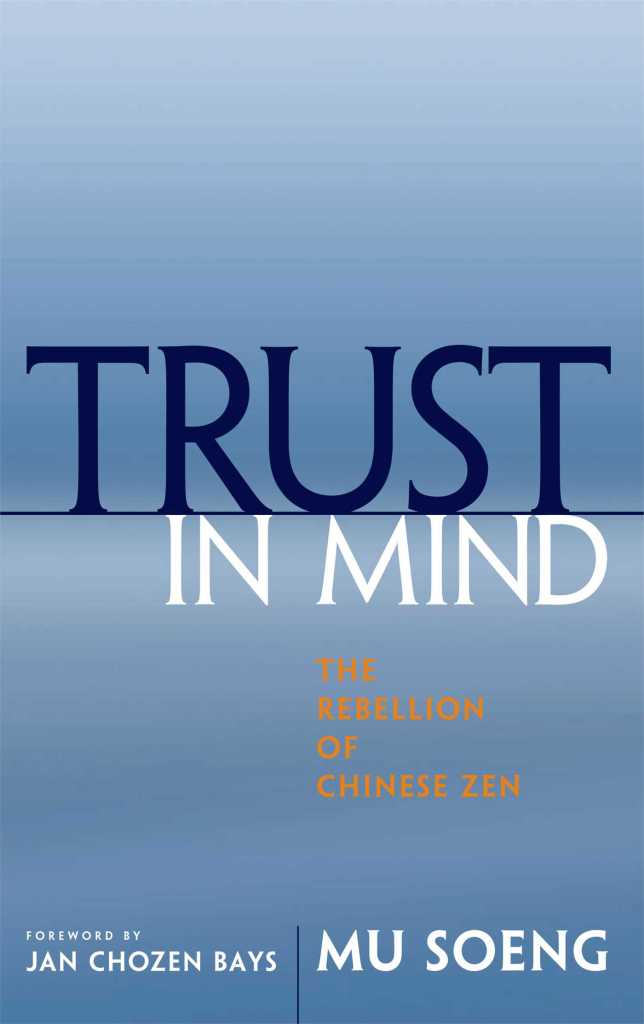
I have been reading Trust in Mind: The Rebellion of Chinese Zen by Mu Soeng. The book is about the poem Xinxinming (Trust in Mind) attributed to Sengcan (d. 606), the third ancestor of Chan/Zen.
The expression the author uses, “a wish to be at ease in the world”, struck me hard. It is as good a way as any at saying what we wish for.
From Trust in Mind: The Rebellion of Chinese Zen by Mu Soeng:
This commentary is written out of the conviction that the basic teachings of the Buddha are as relevant to us today as they were in Buddha’s own time, and that the admonitions made in Xinxinming speak eloquently to those teachings and affirm them for us much as they did for people in medieval China.
While the poem belongs chronologically to a simpler, pre-modern world, its sentiments speak clearly to one basic human longing: a wish to be at ease in the world….This wish to be at ease may be felt much more deeply as a longing to completeness. Buddha’s teachings offer nirvana as a synonym for completeness, a closure on the working of dukkha, the sense of incompleteness, in our lives. Sengcan’s poem provides a highly nuanced understanding of Buddha’s nirvana and in its contexts provides us with a template for life without grasping. Today we live distressed and fragmented lives in a complex world, but our wish to be at ease with ourselves and with the world around us, to be complete, is no different in its longing than that of all the generations who have gone before us. Perhaps our need for that ease is even greater today with all the stresses brought about by our membership in a technologized society that lives at hyperspeed.
Xinxinming (Trust in Mind) Attributed to Sengcan (d. 606), the third ancestor of Chan/Zen Translated by Richard B. Clarke
The Great Way is not difficult for those who have no preferences. When love and hate are both absent everything becomes clear and undisguised. Make the smallest distinction, however, and heaven and earth are set infinitely apart. If you wish to see the truth, then hold no opinions for or against anything. To set up what you like against what you dislike is the disease of the mind. When the deep meaning of things is not understood, the mind’s essential peace is disturbed to no avail. The Way is perfect like vast space where nothing is lacking and nothing is in excess. Indeed, it is due to our choosing to accept or reject that we do not see the true nature of things. Live neither in the entanglements of outer things, nor in inner feelings of emptiness. Be serene in the oneness of things and such erroneous views will disappear by themselves. When you try to stop activity to achieve passivity, your very effort fills you with activity. As long as you remain in one extreme or the other, you will never know Oneness. Those who do not live in the single Way fail in both activity and passivity, assertion and denial. To deny the reality of things is to miss their reality; to assert the emptiness of things is to miss their reality. The more you talk and think about it, the further astray you wander from the truth. Stop talking and thinking, and there is nothing you will not be able to know. To return to the root is to find the meaning, but to pursue appearances is to miss the source. At the moment of inner enlightenment, there is a going beyond appearance and emptiness. The changes that appear to occur in the empty world we call real only because of our ignorance. Do not search for the truth; only cease to cherish opinions. Do not remain in the dualistic state; avoid such pursuits carefully. If there is even a trace of this and that, of right and wrong, the Mind-essence will be lost in confusion. Although all dualities come from the One, do not be attached even to this One. When the mind exists undisturbed in the Way, nothing in the world can offend, and when a thing can no longer offend, it ceases to exist in the old way. When no discriminating thoughts arise, the old mind ceases to exist. When thought objects vanish, the thinking subject vanishes, as when the mind vanishes, objects vanish. Things are objects because of the subject (mind); the mind (subject) is such because of things (objects). Understand the relativity of these two and the basic reality: the unity of emptiness. In this Emptiness the two are indistinguishable, and each contains in itself the whole world. If you do not discriminate between coarse and fine, you will not be tempted to prejudice and opinion. To live in the Great Way is neither easy nor difficult, but those with limited views are fearful and irresolute: the faster they hurry, the slower they go, and clinging cannot be limited; and even to be attached to the idea of enlightenment is to go astray. Just let things be in their own way, and there will be neither coming nor going. Obey the nature of things (your own nature), and you will walk freely and undisturbed. When thought is in bondage the truth is hidden, for everything is murky and unclear, and the burdensome practice of judging brings annoyance and weariness. What benefit can be derived from distinctions and separations? If you wish to move in the One Way do not dislike even the world of senses and ideas. Indeed, to accept them fully is identical with true Enlightenment. The wise person strives to no goals but the foolish person fetters himself. This is one Dharma, not many; distinctions arise from the clinging needs of the ignorant. To seek Mind with the (discriminating) mind is the greatest of all mistakes. Rest and unrest derive from illusion; with enlightenment there is no liking or disliking. All dualities come from ignorant inference; they are like dreams of flowers in the air: foolish to try to grasp them. Gain and loss, right and wrong: such thoughts must finally be abolished at once. If the eye never sleeps, all dreams will naturally cease. If the mind makes no discriminations, the ten thousand things are as they are, of single essence. To understand the mystery of this One-essence is to be released from all entanglements. When all things are seen equally the timeless Self-essence is reached. No comparisons or analogies are possible in this causeless, relationless state. Consider movement stationary and the stationary in motion, both movement and rest disappear. When such dualities cease to exist Oneness itself cannot exist. To this ultimate finality no law or description applies. For the unified mind in accord with the Way all self-centered straining ceases. Doubts and irresolutions vanish and life in true faith is possible. With a single stroke we are freed from bondage; nothing clings to us and we hold to nothing. All is empty, clear, self-illuminating, with no exertion of the mind’s power. Here thought, feeling, knowledge, and imagination are of no value. In this world of suchness there is neither self nor other-than-self. To come directly into harmony with this reality, just simply say when doubt arises, “Not two.” In this “not two” nothing is separate, nothing excluded. No matter when or where, enlightenment means entering this truth. And this truth is beyond extension or diminution in time or space; in it a single thought is ten thousand years. Emptiness here, emptiness there, but the infinite universe stands always before your eyes. Infinitely large and infinitely small; no difference, for definitions have vanished and no boundaries are seen. So too with Being and non-Being. Don’t waste time in doubts and arguments that have nothing to do with this. One thing, all things: move among and intermingle, without distinction. To live in this realization is to be without anxiety about non-perfection. To live in this faith is the road to nonduality, because the nondual is one with the trusting mind. Words! The Way is beyond language, for in it there is no yesterday, no tomorrow, no today.
If form is empty Then the haiku syllables Don’t count
The writers of haiku in English generally followed the Japanese tradition of seventeen syllables, dividing these into three lines of 5-7-5.
But as Billy Collins, former Poet Laureate of the US, points out, a syllable debate has resulted in a majority of English language writers ignoring the strict form:
Along with the outbreak of haiku in America in the 1950s came the Great Seventeen-Syllable Debate, which continues to simmer in the haiku community to this day….These days, many haiku poets—in fact, the large majority—ignore the syllable count. They stand by the linguistic fact that a “syllable” does not have the same meaning or weight in Japanese as it does in English….The Japanese Haiku is strictly disciplined to seventeen syllables but since the language structure is different I don’t think American Haikus (short three-line poems intended to be completely packed with Void of Whole) should worry about syllables because American speech is something again . . . bursting to pop.
I based the above haiku is on one of the essential texts of Zen, the Heart Sutra. There you find:
Form is emptiness Emptiness is form
Countless commentaries have been spent on these words. Countless hours of silence have been devoted to these words.
Here and now is a haiku of 5-7-2 syllables that is less of a haiku if you are counting. More or less of a haiku if you are not counting. And of no account if form is emptiness.



 Bob Schwartz