For a long time, America has been involved in wars of shades of gray. Not that right and wrong weren’t involved, but that the equities weren’t always so clear. Vietnam was a glaring example: an unachievable outcome, corruption and inhumanity on both sides, lies and lies, and so much death for what? A glaring example, but just one.
Ukraine is not that. A powerful and sinister leader, driven by demons, whatever they are, is determined to roll over an innocent nation and its people. “Justified” by lies so obvious that they match the Master of Lies who once led America. Not the first and only example of brutality in recent years (China has forced citizens into ethnic concentration camps, right now), but one that shakes us differently.
What weighs on us, at least on me, is the absolute impotence of genuinely concerned nations. Sanctions and isolation do indeed inflict pain on Russia, pain which won’t be soon (or ever) relieved, but pain that will not stop the onslaught and slaughter. The tools exist to stop Russia in its tracks, but the realities of military back-and-forth, and the formalities of international law, prevent using them. Plainly, just one direct confrontation between Russia and the West will lead to escalation, and no one—not the smartest statesmen or generals—can know where that leads. In a crude calculation of better the devil you know, better to allow Russia to have Ukraine and work it out later than to take actions that have the potential for another European-wide war, knowing that the last two European-wide wars are grotesquely infamous, and those without nuclear.
A: Sanctions won’t work to deter Putin from continuing his taking Ukraine, which will take another day or two. Sanctions won’t work to force Putin to withdraw, which would be a massive embarrassment for him.
Q: Will sanctions backfire?
A. Very possibly. Removing Russia from the global banking system, for example, means that European nations who buy gas from Russia can’t pay their bills. Russia would then be in a legitimate position to cut off that gas.
Q: What is Putin’s plan?
A: Putin will occupy Ukraine, put a puppet government in place, and then claim it is once again a part of Russia. He will then continue his request that bordering European NATO nations stand down their military readiness, which is a security threat to Russian Ukraine. NATO will again refuse, setting the scene for possible—though not anytime soon—Russian action to demilitarize those nations.
Q: What did Putin mean by his threat against any nation that intervenes?
A: Not a nuclear threat. Instead, he can initiate massive crippling cyberattacks.
Q: Does it matter that this war may not be popular in Russia?
A: Not at all. Russia is a dictatorship. Putin’s hold on power is virtually absolute. Even those in his leadership who have long been close to him are frightened by him and, in some cases, want to be his successor in 2024 (not wholly unlike the American case of Trump).
Q: What about American cyber warfare against Russia?
A: Russia will regard this as an attack, no different than a military attack. For Putin, this will justify whatever he subsequently chooses to do.
Q: Putin is now regularly called an irrational actor or, sometimes, a madman. Is he?
A: This matters and it doesn’t. Yes, if his calculations are recognizably rational, it might be a better situation. But if he is following some personal agenda, this is just name-calling. The best surmise, from his talks, is that he is driven by fierce retro-nationalism, willing to do anything to reconstitute the “glory days” of the Soviet Union. Given that a number of Americans, at the highest levels, are driven by fierce retro-nationalism, we have to determine if this is madness.
Q: What about Trump (former Republican President) and Pompeo (his former Secretary of State) now praising Putin as a strategic genius?
A: Giving aid and comfort to the enemy is the definition of treason.
By 1955, publisher William M. (Bill) Gaines was already revolutionizing the comic book industry. His line of EC (Entertaining Comics) books took on all sorts of mature themes and genres. So much so that he had been called before the U.S. Senate, which was on a high-profile crusade to control a medium that it believed was corrupting American youth, in fact, Americans of any age.
(Speaking of corruption, Gaines went on to publish Mad Magazine for forty years, which influenced a generation to believe that American culture was basically absurd, stupid and funny. What me worry?)
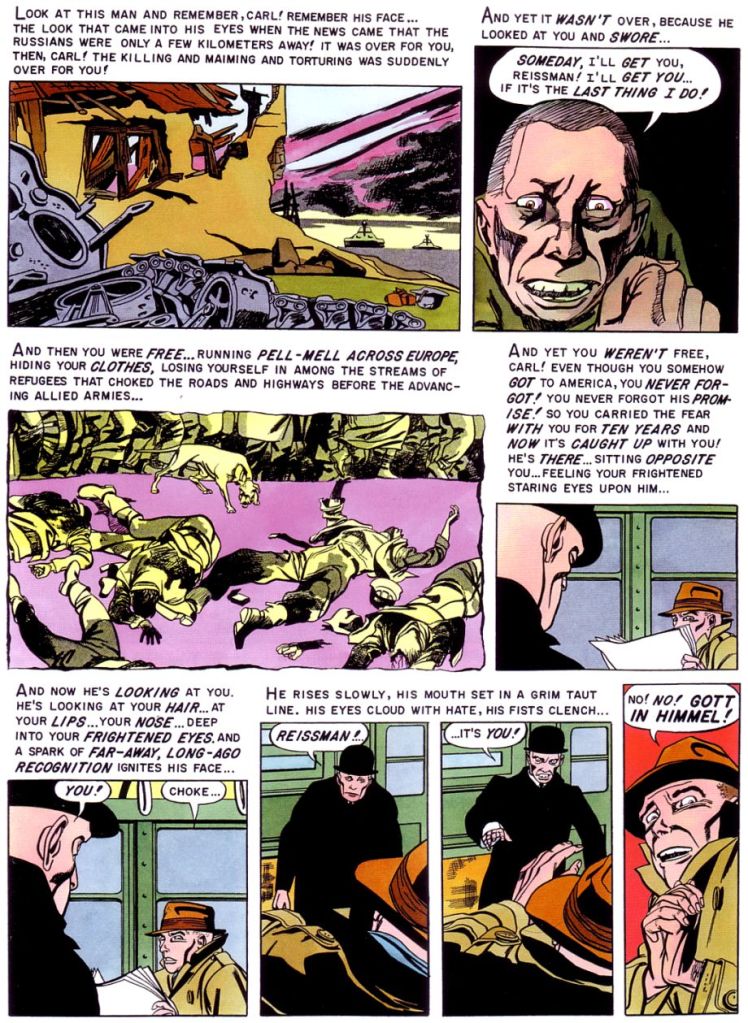
Among the talents that Gaines featured was an artist named Bernard Krigstein. In 1955, as the cover story for the first issue of EC’s new publication Impact, Krigstein illustrated the eight-page story Master Race. It is a stark tale of a former concentration camp prisoner who sees a former Nazi camp commandant on a New York subway—and who pushes that tormentor to his death.
There is deserved attention recently to Art Spiegelman’s celebrated Holocaust graphic novel Maus. After the benighted school board of McMinn County Tennessee banned the book, it once again became a bestseller. Though it was not noted in any of the news, more than twenty years before Maus, Master Race had taken on the Holocaust in comic form.
Spiegelman is no stranger to Krigstein or Master Race. In a 2002 New Yorker article, he writes about Krigstein’s being one of his teachers and about the artist’s complex life and career:
Anyone interested in crossing the ever-narrowing divide between High and Low culture ought to contemplate the work and troubled career of Bernard Krigstein (1919-90), a postwar comic-book illustrator who had the privilege and the misfortune of being an Artist with a capital “A” working in an Art Form that considered itself only a Business. Krigstein was never associated with a specific character (the most sure ticket to comics success), and he never wrote his own stories (a handicap in a narrative medium). He wasn’t beloved by publishers, editors, or readers. What reputation he has rests on a handful of short stories he illustrated in 1954 and 1955 for EC comics (the folks who brought you Tales from the Crypt and Mad), but one of those stories, “Master Race,” was an accomplishment of the highest order—a masterpiece. Art Spiegelman
Read Master Raceonline or find one of the many books featuring this and other EC comics.
1Q84 by Haruki Murakami was given to me. I had never heard of or read Murakami. I don’t read as much fiction as once I did, and so don’t keep up with the most popular writers.
I have now learned that Murakami is not just a popular and critically appreciated writer but a global phenomenon. Millions of copies sold. Frequently mentioned in Nobel Prize conversations. And 1Q84 is not just any Murakami book. When it was published after years of anticipation, it was seen as a remarkable moment in his already prolific career. At over 900 pages, with 79 chapters, divided into 3 volumes, it could only be remarkable.
It took me weeks, a few chapters a day, to finish. Since I don’t have the frame of reference, as critics and fans do, of his work before this, I took it at face value, reading without prejudice.
It is stuffed with cultural allusions, which I now understand is a Murakami trademark. None more telling than a character in forced isolation working her way through Proust’s Remembrance of Things Past. Not that this was necessarily Murakami’s attempt at a Proustian magnum opus. But any reader, veteran of Murakami or new to him, compelled to keep reading, may hit a point when you ask: what am I doing here and what is Murakami (or Proust) doing here?
Which, strangely or appropriately, is central to 1Q84. Along with related questions such as: where am I (are you) and when am I (are you) and who am I (are you)?
On the day I finished reading it, I unrelatedly came across a 1963 essay by Susan Sontag about the philosopher Simone Weil. Far removed at first glance from 1Q84 and yet:
Perhaps there are certain ages which do not need truth as much as they need a deepening of the sense of reality, a widening of the imagination. I, for one, do not doubt that the sane view of the world is the true one. But is that what is always wanted, truth? The need for truth is not constant; no more than is the need for repose. An idea which is a distortion may have a greater intellectual thrust than the truth; it may better serve the needs of the spirit, which vary. The truth is balance, but the opposite of truth, which is unbalance, may not be a lie.
Susan Sontag, New York Review of Books, February 1, 1963
This might be the justification for all who create what we call fiction, whether in writing or painting or any medium. So instead of an attempt at insightful critique or analysis of 1Q84, of which one more isn’t needed, I leave you with that quote. If you have read 1Q84, you will understand the connection. If you haven’t read it, you will be the better for doing so. “The truth is balance, but the opposite of truth, which is unbalance, may not be a lie.”
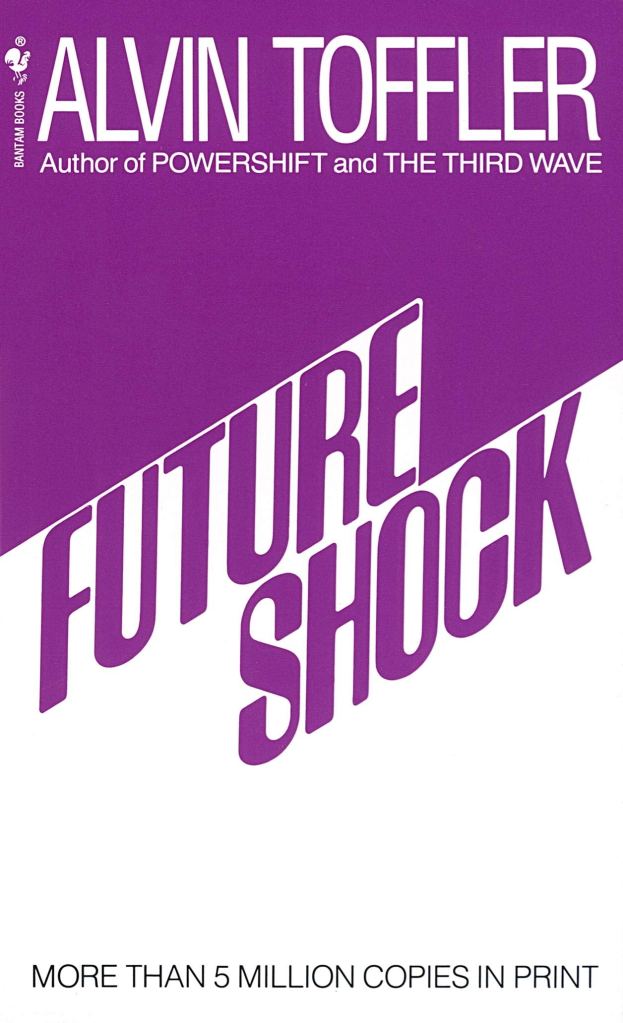
In 1970, Alvin Toffler published the book Future Shock. It was an immediate and long-time bestseller, with substantial influence on public conversations. Less so on action.
The premise, in my oversimplified summary: The rate of technological change is accelerating at an uncontrolled pace. But there are limits to our adaptability to change. The outcome is what he called “future shock.” There may be something we can do about it. Maybe if we study, learn and try:
This is a book about what happens to people when they are overwhelmed by change. It is about the ways in which we adapt—or fail to adapt—to the future. Much has been written about the future. Yet, for the most part, books about the world to come sound a harsh metallic note. These pages, by contrast, concern themselves with the “soft” or human side of tomorrow. Moreover, they concern themselves with the steps by which we are likely to reach tomorrow. They deal with common, everyday matters—the products we buy and discard, the places we leave behind, the corporations we inhabit, the people who pass at an ever faster clip through our lives. The future of friendship and family life is probed. Strange new subcultures and life styles are investigated, along with an array of other subjects from politics and playgrounds to skydiving and sex.
What joins all these—in the book as in life—is the roaring current of change, a current so powerful today that it overturns institutions, shifts our values and shrivels our roots. Change is the process by which the future invades our lives, and it is important to look at it closely, not merely from the grand perspectives of history, but also from the vantage point of the living, breathing individuals who experience it.
The acceleration of change in our time is, itself, an elemental force. This accelerative thrust has personal and psychological, as well as sociological, consequences. In the pages ahead, these effects of acceleration are, for the first time, systematically explored. The book argues forcefully, I hope, that, unless man quickly learns to control the rate of change in his personal affairs as well as in society at large, we are doomed to a massive adaptational breakdown.
Alvin Toffler, Future Shock
Is this relevant, more than fifty years later? Have you heard the news? Have you lived life in 2022? Read or reread Future Shock.
I don’t pay attention to Whoopi Goldberg or The View or ABC Television. Then came this week’s development.
Whoopi Goldberg has been suspended by ABC for saying that the Holocaust was not about race but about man’s inhumanity to man.
What the ADL and other worthy and well-meaning enemies of hate essentially expressed: The Holocaust was about race. She is spreading antisemitic disinformation. That disinformation must be refuted and she must be corrected and punished appropriately.
What ABC did: They corrected and punished Whoopi Goldberg by suspending her.
What ABC might have said and done instead:
Whoopi Goldberg was historically wrong, as she has admitted. But rather than suspension, since we are in the business of information and education (?) we will be producing a program exploring not only the racial motivation of Nazi antisemitism and the Holocaust but also featuring the important studies about the distinctly different types of antisemitism, including racial and religious antisemitism, all of them pernicious. Many people, Jews and non-Jews, aren’t fully aware of that distinction. This should be of great interest to all our audiences, especially the audience of The View (?). We believe this is a more thoughtful, comprehensive, constructive and valuable response.
For those interested in exploring the topic, in 2019 the Hannah Arendt Center at Bard College held an extraordinary two-day event about Racism and Antisemitism.
What do we know? What can we know? What should we know? Is it worse to know too much than to know too little? Is the way of knowledge madness?
Ben Zoma
Ben Zoma was one of the tannaim, teachers recorded in the Misnah, a part of the Talmud.
The story is told that Ben Zoma was seen staring into space, lost in thought. When asked about it, he said he was contemplating creation, when the waters above were separated from the waters below. What, Ben Zoma wondered, was in between? It was then said about Ben Zoma that he was “still outside”, that is, out of his mind.
The Tower of Babel
In the Hebrew Bible (Genesis 11), a tower reaching to heaven is planned by ambitious and presumptuous people. God thwarts the plan, believing that if they continued, there was nothing they could not know or do. Their infinite power would rival God’s. They had all been together, speaking one language. God separates them and their languages, baffles them so they will no longer understand each other.
The Library of Babel
In his story The Library of Babel, Jorge Luis Borges conceives a library containing all books. It does not turn out well:
When it was proclaimed that the Library contained all books, the first impression was one of extravagant happiness. All men felt themselves to be the masters of an intact and secret treasure. There was no personal or world problem whose eloquent solution did not exist in some hexagon. The universe was justified, the universe suddenly usurped the unlimited dimensions of hope. At that time a great deal was said about the Vindications: books of apology and prophecy which vindicated for all time the acts of every man in the universe and retained prodigious arcana for his future. Thousands of the greedy abandoned their sweet native hexagons and rushed up the stairways, urged on by the vain intention of finding their Vindication. These pilgrims disputed in the narrow corridors, proffered dark curses, strangled each other on the divine stairways, flung the deceptive books into the air shafts, met their death cast down in a similar fashion by the inhabitants of remote regions. Others went mad…
“The question that imposed itself was: Could the activity of thinking as such, the habit of examining whatever happens to come to pass or to attract attention, regardless of results and specific content, could this activity be among the conditions that make men abstain from evil-doing or even actually “condition” them against it?”
I am sadly not above occasionally calling some of our leaders and neighbors during these political and public health crises “idiots” and the like. At the same time, I have also been heard to say that some of them are just “bad people.” So: are they evil or simply thoughtless?
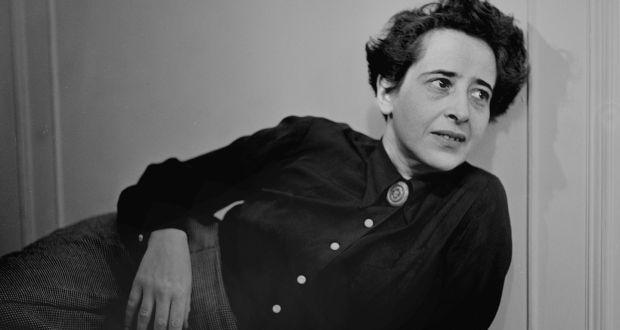
This week I turned to Hannah Arendt, one of the most influential political philosophers of the twentieth century.
Initially, I was exploring her writings about antisemitism and totalitarianism. The Origins of Totalitarianism (1951) remains a seminal work in this area. It had been a career-long topic for her. In fact, during her studies at the University of Marburg under Martin Heidegger, the Gestapo in 1933 arrested and jailed her for researching antisemitism. After this, she fled Germany.
Her most famous (in some quarters infamous) work is her coverage of the Eichmann trial, Eichmann in Jerusalem: A Report on the Banality of Evil. She refused to categorize Eichmann and some others as demonic monsters, instead seeing what they did as the outcome of their ordinary thoughtless lives. This incensed Jewish communities, who saw her as an apologist for atrocity. The controversy continues to this day. She was of course no apologist, but a brilliant analyst intent on going deeper than our reflexive, if well-meaning, condemnation. (Note: Her regard in Jewish communities has also been influenced by her views on Zionism.)
She died in 1975, having completed two volumes of her three-volume work on thinking, The Life of the Mind. In it, she explains how the Eichmann trial and the banality of evil prompted her work:
Factually, my preoccupation with mental activities has two rather different origins. The immediate impulse came from my attending the Eichmann trial in Jerusalem. In my report of it I spoke of “the banality of evil.” Behind that phrase, I held no thesis or doctrine, although I was dimly aware of the fact that it went counter to our tradition of thought—literary, theological, or philosophic—about the phenomenon of evil. Evil, we have learned, is something demonic; its incarnation is Satan, a “lightning fall from heaven” (Luke 10:18), or Lucifer, the fallen angel (“The devil is an angel too”—Unamuno) whose sin is pride (“proud as Lucifer”), namely, that superbia of which only the best are capable: they don’t want to serve God but to be like Him. Evil men, we are told, act out of envy; this may be resentment at not having turned out well through no fault of their own (Richard III) or the envy of Cain, who slew Abel because “the Lord had regard for Abel and his offering, but for Cain and his offering he had no regard.” Or they may be prompted by weakness (Macbeth). Or, on the contrary, by the powerful hatred wickedness feels for sheer goodness (Iago’s “I hate the Moor: my cause is hearted”; Claggart’s hatred for Billy Budd’s “barbarian” innocence, a hatred considered by Melville a “depravity according to nature”), or by covetousness, “the root of all evil” (Radix omnium malorum cupiditas). However, what I was confronted with was utterly different and still undeniably factual. I was struck by a manifest shallowness in the doer that made it impossible to trace the uncontestable evil of his deeds to any deeper level of roots or motives. The deeds were monstrous, but the doer—at least the very effective one now on trial—was quite ordinary, commonplace, and neither demonic nor monstrous. There was no sign in him of firm ideological convictions or of specific evil motives, and the only notable characteristic one could detect in his past behavior as well as in his behavior during the trial and throughout the pre-trial police examination was something entirely negative: it was not stupidity but thoughtlessness. In the setting of Israeli court and prison procedures he functioned as well as he had functioned under the Nazi regime but, when confronted with situations for which such routine procedures did not exist, he was helpless, and his cliché-ridden language produced on the stand, as it had evidently done in his official life, a kind of macabre comedy. Clichés, stock phrases, adherence to conventional, standardized codes of expression and conduct have the socially recognized function of protecting us against reality, that is, against the claim on our thinking attention that all events and facts make by virtue of their existence. If we were responsive to this claim all the time, we would soon be exhausted; Eichmann differed from the rest of us only in that he clearly knew of no such claim at all.
It was this absence of thinking—which is so ordinary an experience in our everyday life, where we have hardly the time, let alone the inclination, to stop and think—that awakened my interest. Is evil-doing (the sins of omission, as well as the sins of commission) possible in default of not just “base motives” (as the law calls them) but of any motives whatever, of any particular prompting of interest or volition? Is wickedness, however we may define it, this being “determined to prove a villain,” not a necessary condition for evil-doing? Might the problem of good and evil, our faculty for telling right from wrong, be connected with our faculty of thought? To be sure, not in the sense that thinking would ever be able to produce the good deed as its result, as though “virtue could be taught” and learned—only habits and customs can be taught, and we know only too well the alarming speed with which they are unlearned and forgotten when new circumstances demand a change in manners and patterns of behavior. (The fact that we usually treat matters of good and evil in courses in “morals” or “ethics” may indicate how little we know about them, for morals comes from mores and ethics from ethos, the Latin and the Greek words for customs and habit, the Latin word being associated with rules of behavior, whereas the Greek is derived from habitat, like our “habits”) The absence of thought I was confronted with sprang neither from forgetfulness of former, presumably good manners and habits nor from stupidity in the sense of inability to comprehend—not even in the sense of “moral insanity,” for it was just as noticeable in instances that had nothing to do with so-called ethical decisions or matters of conscience.
The question that imposed itself was: Could the activity of thinking as such, the habit of examining whatever happens to come to pass or to attract attention, regardless of results and specific content, could this activity be among the conditions that make men abstain from evil-doing or even actually “condition” them against it? (The very word “con-science,” at any rate, points in this direction insofar as it means “to know with and by myself,” a kind of knowledge that is actualized in every thinking process.) And is not this hypothesis enforced by everything we know about conscience, namely, that a “good conscience” is enjoyed as a rule only by really bad people, criminals and such, while only “good people” are capable of having a bad conscience? To put it differently and use Kantian language: after having been struck by a fact that, willy-nilly, “put me in possession of a concept” (the banality of evil), I could not help raising the quaestio juris and asking myself “by what right I possessed and used it.”
From The Life of the Mind: The Groundbreaking Investigation on How We Think by Hannah Arendt
It profanes talking about her by starting with Phil Spector, but it is an unavoidable preface.
Phil Spector was a genius record producer who changed pop music. He helped turn Ronnie’s extraordinary talent into memorable hits with the Ronettes. He was also a very strange man who abused women, including Ronnie after marrying her, and including another woman he murdered.
Adolescent boys (boys of any age) loved Ronnie Spector. Crush love. It was the pure voice, strong but soft, kittenish but grown cat. It was the songs, tuneful and romantic, about how she wanted you (Be My Baby) or was looking for someone like you (Walking in the Rain) or knew that after you split up it would be better than ever (Best Part of Breaking Up).
Just as much, it was the look. There was and are plenty of beautiful sexy women around, some in your real life, more in the world of entertainment. But none of them looked like Ronnie Spector. Maybe the beauty was a bonus on top of the voice, maybe the other way round. Either way, it is a gift that is cherished.
In November 2020 I was frustrated about the American response to covid. There was a hopeful prospect of a vaccine, but in the meantime, some leaders and citizens were not at all helping. So I posted this, headlined with the above photo of 1,000 matchsticks for those who think better with pictures:
“Right now there at least 240,000 Covid deaths and 10 million Covid cases counted in America. Without major behavioral and policy interventions, there may be 400,000 deaths and 1 million cases a week by the end of year. Yet some governors insist on staying the course, and some people think that even the current restrictions are too much.”
By the end of the following year (2021), even with vaccines, there were about 1 million deaths, and we are on our way to 1 million cases a day, not a week. And, since some things never change, “some governors insist on staying the course, and some people think that even the current restrictions are too much.”
Please feel free to pass this picture on for those who understandably have trouble conceiving big numbers: