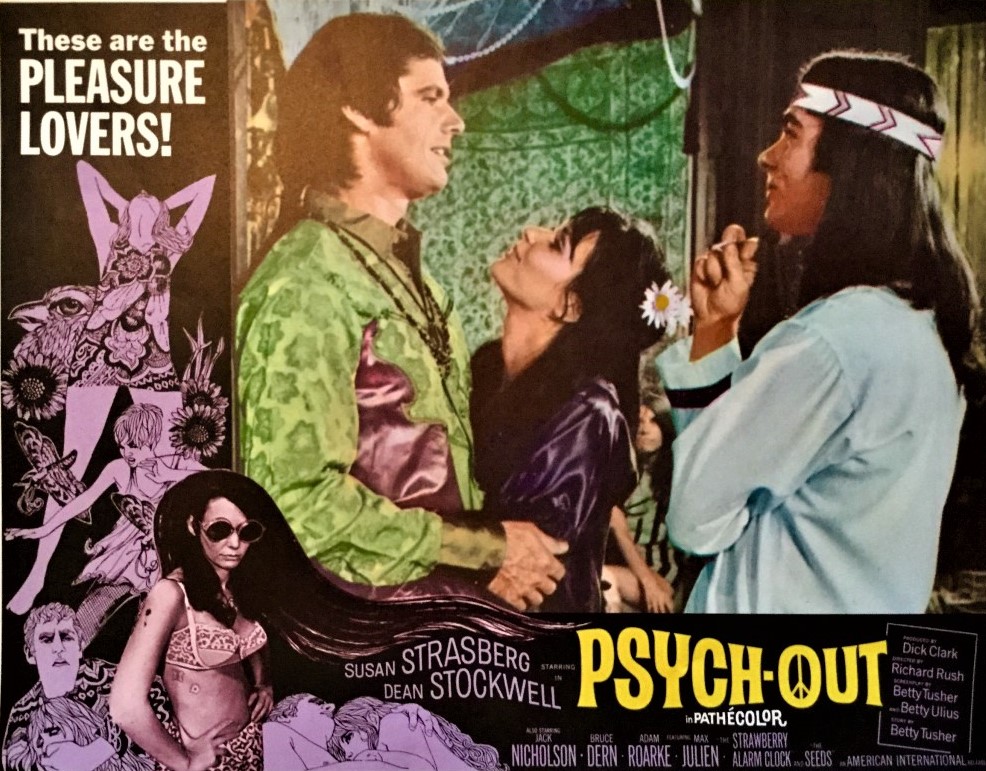
Dick Clark is known as an entertainment impresario, from American Bandstand to Rockin’ New Year’s Eve. Less known is his brief career as an actor and movie producer. One of the three movies he produced in 1968 is Psych-Out.
Psych-Out is a great dramatized on-location non-documentary about the last days of love in San Francisco. The plot is ridiculous, and ridiculously complex and fevered. It begins with Jenny (Susan Strasberg), a deaf runaway, who comes to Haight-Ashbury looking for her brother The Seeker (Bruce Dern), falls in love with musician Stoney (Jack Nicholson), and ends up standing in traffic on the Golden Gate Bridge, her hearing miraculously restored.
Following is the trailer and the entire movie online.
Note: As outrageously over-the-top as this is, know that in countercultural moments aiming for better, which many times fall down and flat, this kind of mockery and ridicule is a standard weapon. Like accusing well-meaning people you hate of eating pets. So many things went wrong so fast with the Summer of Love phenomenon. But like the song goes, What’s So Funny ‘Bout Peace, Love and Understanding?
Dean Chamberlain is an extraordinary photographic artist. He works in a technique known as light painting, using hand-held lights to illuminate and color a scene photographed in long exposure. While versions of the technique have been known and used since the early days of photography, Dean was the first artist to work exclusively in the medium.
Dean Chamberlain is the father of light painting photography and has been capturing photographs since 1967. It was his passion for photography that led him to the Rochester Institute of Technology in 1974 to pursue a fine art degree. During Dean’s time at Rochester in 1977 he discovered light painting photography. Dean was the first person to coin the term “Light Painting” for his open shutter long exposure photographic technique. He has worked with his unique art form ever since in his various works. Dean has created stunning portraits of well-known individuals such as David Bowie and Paul McCartney. He has also directed numerous music videos. Chamberlain’s work has appeared in publications such as Esquire, Vanity Fair and the Washington Post. He has received an MTV breakthrough award for directing music videos for Arcadia (Missing), Paul McCartney (This One) and Duran Duran (All She Wants Is).
Along with light painting rock stars, landscapes and other subjects, Dean created a unique series called Elder Psychedelic Pioneers. This includes Timothy Leary, Albert Hofmann, Alexander Shulgin, and others—many of whom have now passed on.
Coronavirus in N.Y.: Toll Soars to Nearly 3,000 as State Pleads for Aid, April 3, 2020
Covid was a virulent virus—and still with us—that spread across America and the world.
In America, the response was mixed. Scientists worked tirelessly to develop an effective vaccine, though some questioned the science. Some citizens responded by changing their behavior and taking the vaccine. Other citizens refused to change behavior and rejected the vaccine. As a result, we got through it, but millions died, many needlessly, and millions were left with lasting Covid effects, many needlessly.
If today we are subject to a damaging and deadly virus of a different kind, how are Americans responding? Acting as if there is no virus, not acting vigorously against it, questioning science and rationality, hoping it will “just go away eventually” is not a plan. As with Covid, that is a path to millions suffering or dying, and our ways of life being changed forever.
Don’t wanna be an American idiot Don’t want a nation under the new mania And can you hear the sound of hysteria? The subliminal mindfuck America Green Day, American Idiot
Whether or not you are an NFL fan, we have to give it credit for Trump resistance.
First, if money is power, the NFL is very powerful. It is valued at hundreds of billions of dollars, making it the richest sports league in the world. Which means that unlike FIFA, the global football/soccer organization that gave Trump a made-up peace prize, the NFL doesn’t have to bend a knee, kiss an ass, or give a shit.
To prove it, the NFL gave the iconic half-time show to Bad Bunny, a massive star from Puerto Rico (yes, he is American) who sings only in Spanish. Now the transgressive punk band Green Day will play at the opening ceremony.
Super Bowl LX Green Day to Kick Off Game, Another Trump Dig!!!
Published January 19, 2026
Donald Trump’s haters are absolutely thriving right now … Green Day frontman Billie Joe Armstrong has been outspoken about his disdain for the present administration … and the band has just been tapped to open the Super Bowl!
The punk rock band — which hails from Rodeo, California, in the Bay Area — will kick off Super Bowl LV at Levi’s Stadium in Santa Clara, California, February 8.
Billie Joe released a statement … “We are super hyped to open Super Bowl 60 right in our backyard! We are honored to welcome the MVPs who’ve shaped the game and open the night for fans all over the world. Let’s have fun! Let’s get loud!”
This comes after the singer led a crowd at Download Festival last summer in a chant calling Trump a “fat bastard.”
Remember … Trump had a lot to say about Bad Bunny — another known Trump critic — headlining this year’s Super Bowl Halftime Show, calling the decision “absolutely ridiculous.”
He complained … “I’ve never heard of him. I don’t know who he is,” in an interview with Newsmax’s Greg Kelly in October.
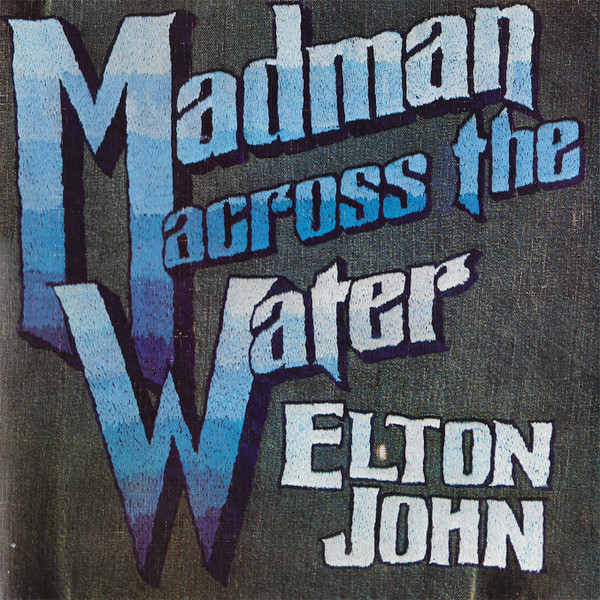
It’s quite peculiar in a funny sort of way They think it’s very funny everything I say Get a load of him, he’s so insane… But is it in your conscience that you’re after Another glimpse of a madman across the water Madman Across the Water, Elton John and Bernie Taupin
Critics and fans have believed the song is talking about either the thirty-seventh president of the United States of America Richard Nixon or German dictator Adolf Hitler. Although most people believe that it is about Nixon, Bernie Taupin denied it, stating “Back in the seventies, when people were saying that ‘Madman Across the Water’ was about Richard Nixon, I thought, ‘that is genius’. I could never have thought of that.”
We can believe Bernie Taupin, lyricist for so many Elton John hits. But these days, more than fifty years later, the song again resonates. Do we think that Europeans looking across the Atlantic Ocean see a “madman across the water”? Do we think that Americans here see a “madman on this side of the water”?
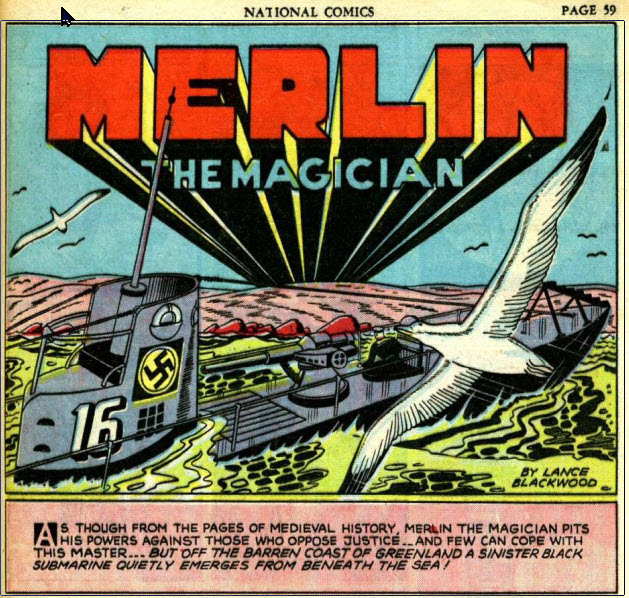
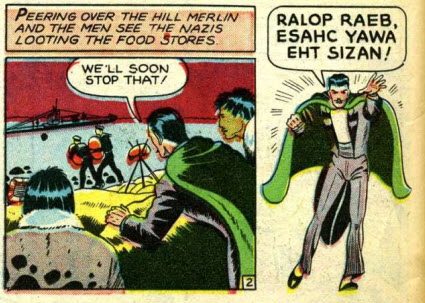
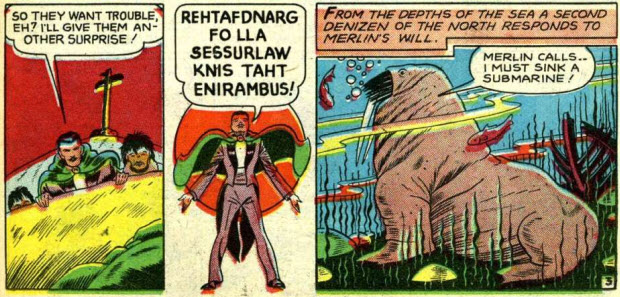
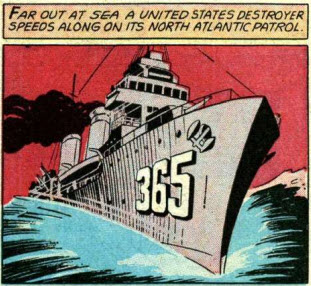
When it seems the Germans are getting away in their submarine, he invokes another magic spell, “Rehtafdnarg Fo Lla Sessurlaw Knis Taht Enirambus!”, to call for the help of a local walrus.
The walrus stops the submarine and the U.S. Navy arrives!
All is well in Greenland!
So if you hear the President of the United States saying something that sounds like “Ralop Raeb Esahc Yawa Eht Sizan!” or “Rehtafdnarg Fo Lla Sessurlaw Knis Taht Enirambus!”, you’ll know what it’s about.
America and the world are paying a high price for attempted distraction from three outsized issues: the Russian invasion of Ukraine, the Israeli decimation of Gaza, and the relationship of Trump to sexual predators Jeffrey Epstein and Ghislaine Maxwell.
It may be hard to tell whether Venezuela, Greenland, Iran, Minneapolis, etc. are primary evils, with distraction just a bonus, or whether those unprecedented global and national disasters are intended to distract attention.
In some ways it doesn’t matter. Venezuela, Greenland, Iran, Minneapolis, etc. are just going to be made worse and will not go away.
We need to make sure that we do not forget Ukraine, Gaza and Epstein-Trump, which should not and with our attention will not go away.
Greenland. Venezuela. Minneapolis. It is easy to forget any particular crisis. Or put another way, it is impossible to pay attention to all the crises. Not to mention all the non-critical items that crop up in our lives and our vision, some pleasant, some not.
So when one crisis gets mentioned or covered, there may be a tendency to say “well, what about…?”
So here I am saying, “What about Gaza?” That is, despite all the other headlines, don’t forget Gaza.
As I’ve implied before, in posts and conversations, Israel, including the Gaza situation, is all about theology, particularly Old Testament theology.
Walter Brueggemann (1933-2025) was one of the most prolific and influential theologians of the 20th and 21st centuries. Much of his work focused on the Old Testament, in which he found radical guidance for modern people of faith—a Bible that does not demand, justify or accept damaging political ideologies and nationalism.
In 2015 Brueggemann published Chosen?: Reading the Bible Amid the Israeli-Palestinian Conflict. He wrote:
INTRODUCTION
The seemingly insolvable conflict between the state of Israel and the Palestinian people requires our best thinking, our steadfast courage, and a deep honesty about the politically possible. The conflict is only “seemingly” beyond solution, because all historical-political problems have solutions if there is enough courage, honesty, and steadfastness.
The conflict is not a fixed, unchanging situation; rather, it is a dynamic historical reality that is dramatically changing and being redefined over time. As a result, it is imperative that our thinking not be settled in a fixed position but that it be regularly reevaluated in response to the changed and changing realities on the ground. If we should settle for a fixed solution, then we will have arrived at an ideology, which is quite unhelpful for real problems on the ground.
In my own thinking, which is much influenced by my work as a Scripture scholar, I begin with a focus on the claim of Israel as God’s chosen people. That conviction is not in doubt in the Bible. It is a theological claim, moreover, that fits with compelling persuasiveness with the reality of Jews in the wake of World War II and the Shoah. Jews were indeed a vulnerable people whose requirement of a homeland was an overriding urgency. Like many Christians, progressive and evangelical, I was grateful (and continue to be so) for the founding and prospering of the state of Israel as an embodiment of God’s chosen people. That much is expressed in my earlier book entitled The Land. I took “the holy land” to be the appropriate place for the chosen people of the Bible which anticipates the well-being of Israel that takes land and people together.
Of course, much has changed since then in the linkage between the state of Israel and the destiny of the chosen people of God.
–The state of Israel has evolved into an immense military power, presumably with a nuclear capacity. There is no doubt that such an insistence on military power has been in part evoked by a hostile environment in which the state of Israel lives, including periodic attacks by neighboring states.
–The state of Israel has escalated (and continues to escalate) its occupation of the West Bank by an aggressive development of new settlements.
–The state of Israel has exhibited a massive indifference to the human rights of Palestinians.
Thus, it seems to me that the state of Israel, in its present inclination and strategy, cannot expect much “positive play” from its identity as “God’s chosen people.” As a consequence, my own judgment is that important initiatives must be taken to secure the human rights of Palestinians. This changed stance on my part is reflected in the new edition of my book on the land. It is a change, moreover, that is featured in the thinking of many critics who have been and continue to be fully committed to the security of the state of Israel, as am I.
This rethinking is important both for political reasons and for more fundamental interpretive issues. A change in attitude and policy is important to help resolve the conflict. It is clear enough that the state of Israel will continue to show little restraint in its actions toward Palestinians as long as U.S. policy gives it a “blank check” along with commensurate financial backing. Such one-sided and unconditional support for the state of Israel is not finally in the interest of any party, for peace will come only with the legitimation of the political reality of both Israelis and Palestinians. As long as this issue remains unaddressed, destabilization will continue to be a threat to the larger region.
It will not do for Christian readers of the Bible to reduce the Bible to an ideological prop for the state of Israel, as though support for Israel were a final outcome of biblical testimony. The dynamism of the Bible, with its complex interactions of the chosen people and other peoples, is fully attested, and we do well to see what is going on in the Bible itself that is complex and cannot be reduced to a simplistic defense of chosenness. The Bible itself knows better than that!
It is my hope that the Christian community in the United States will cease to appeal to the Bible as a direct support for the state of Israel and will have the courage to deal with the political realities without being cowed by accusations of anti-Semitism.
It is my further hope that U.S. Christians will become more vigorous advocates for human rights and will urge the U.S. government to back away from a one-dimensional ideology for the sake of political realism. It seems to many of us that the so-called two-state solution is a dead possibility, as Israel in its present stance will never permit a viable Palestinian state. We are required to do fresh thinking about human rights in the face of the capacity for power coupled with indifference and cynicism in the policies of the state of Israel, which is regularly immune to any concern for human rights.
I have not changed my mind an iota about the status of Israel as God’s chosen people or about urgency for the security and well-being of the state of Israel. Certainly the Christian West continues to have much to answer for with its history of anti-Semitic attitudes and policies. None of that legacy, however, ought to cause blindness or indifference to political reality and the way in which uncriticized ideology does enormous damage to prospects for peace and for the hopes and historical possibilities of the vulnerable. The attempt to frame the Israeli-Palestinian conflict in terms of anti-Semitism is unpersuasive. More courage and honesty are required amid the realities of human domination and human suffering. As the hymn writer James Russell Lowell wrote in reference to the U.S. Civil War, “New occasions teach new duties.” The current conflict, with its escalation of cynical violence, is a new occasion. New duties are now required.
This year we celebrate the 250th anniversary of the Declaration of Independence and the American Revolution. This week we see the U.S. invasion of Venezuela, a sovereign nation, to capture that nation’s leader—however malevolent he may be—contrary to principles of international and American justice.
The only principle of that invasion and capture: Might makes right.
A primary principle of the American Revolution and of the next 250 years of America: Might does not make right.
As much talk as we hear and action we witness, including extending similar invasions to other nations, keep this motto in mind: Might does not make right.
The flag above, designed in 1775 by Christopher Gadsden, a delegate to the Continental Congress, is a symbol of that principle. The Gadsden flag was an inspiration then and remains essential. To put it in contemporary terms: No Kings.
Alfred Nobel invented dynamite, among his other profitable and world-changing achievements.
In his will, he bequeathed part of his fortune to the establishment of five Prizes, including the Peace Prize. According to his will, it is to be awarded to the person who “shall have done the most or the best work for fraternity between nations, for the abolition or reduction of standing armies and for the holding and promotion of peace congresses”.
We know two things about the current state of Peace Prizes. One is that the current president of the U.S. really wants the Nobel Peace Prize. Two is that his supplicants are now creating new Peace Prizes for him to win.
In this spirit of new Peace Prizes, proposed is the Putin Peace Prize. Apparently, you can now win (admittedly fake) Peace Prizes, such as the FIFA football Peace Prize, even if you are a leading war maker who does not “work for fraternity between nations”. So we might consider going all the way, actually naming the prize itself in honor of a distinctly unpeaceful leader.
Who should be awarded the first Putin Peace Prize?










 Bob Schwartz