Above is the Penn Quaker mascot. That isn’t Trump in that costume, though we don’t know what other cosplay he dabbles in. You can tell it isn’t him because however silly this costume is, that Quaker is in good shape.
Trump brags about his successful student career at the Wharton School, claiming to have finished first in his class, though the University of Pennsylvania will neither confirm nor deny anything about his time there. What we know is that he arrived at Penn for his junior year, after two undistinguished years at Fordham, and is remembered for not being engaged in class and leaving for New York every weekend.
He is, however, a Quaker, as in the nickname for Penn students. William Penn was famously a Quaker, while Benjamin Franklin, credited as founder of the university, was famously not. The curious thing is that Trump loves Ben Franklin, recently putting up a statue of him in the former Rose Garden, probably because it is supposed to remind us that he is a stellar Penn grad (“the best student ever at Wharton”) and because Franklin is pictured on the $100 bill. However, Trump never mentions that he is a Quaker, perhaps because he doesn’t actually know that is the Penn nickname or because he really, really doesn’t like oatmeal. Or peace.
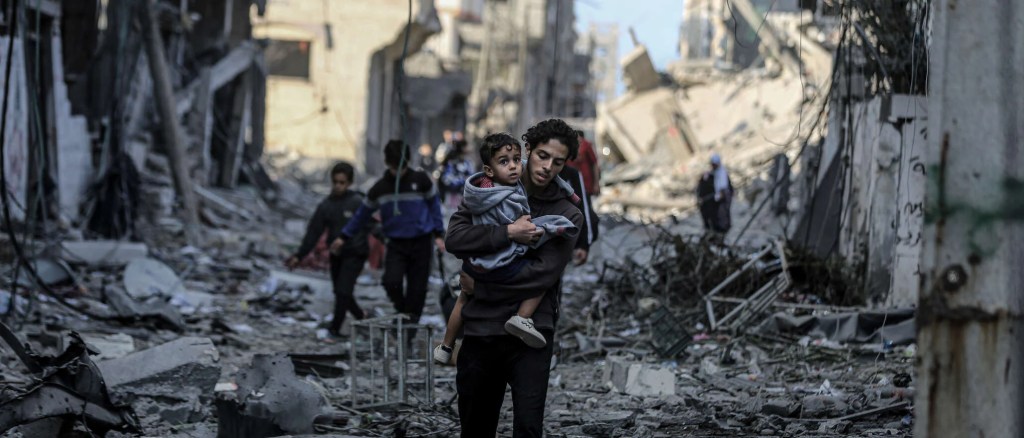
When people, especially children, suffer, it is our duty to help relieve that suffering in any way we can. People of all religious traditions or none can agree on this.
The International Rescue Committee is one of the most respected and responsible organizations in the world working on this:
The International Rescue Committee (IRC) helps people affected by humanitarian crises—including the climate crisis—to survive, recover and rebuild their lives.
Founded at the call of Albert Einstein in 1933, the IRC is now at work in over 50 crisis-affected countries as well as communities throughout Europe and the Americas.
As Jews, on Passover we recall how our storied ancestors suffered—under the hand of a wicked ruler, wandering in a desolate desert. As we have suffered and suffer still, how can we deny the suffering of others and fail to relieve it?
When the Israelites were starving in the desert, we are told that God provided manna:
In the desert the whole community grumbled against Moses and Aaron. The Israelites said to them, “If only we had died by the Lord’s hand in Egypt! There we sat around pots of meat and ate all the food we wanted, but you have brought us out into this desert to starve this entire assembly to death.” Then the Lord said to Moses, “I will rain down bread from heaven for you. The people are to go out each day and gather enough for that day. (Exodus 16:2-4)
Q: Based on leadership across nations, strategies, distribution of national power and resources, ideologies and politics, how do we end the current war on Iran by the U.S. and Israel?
Claude:
This is a very serious, rapidly evolving conflict with enormous humanitarian stakes. Let me lay out the current situation honestly and then walk through what a realistic pathway to ending it looks like — across diplomacy, power dynamics, ideology, and leadership.
The War as It Stands Today (Day 32 — March 31, 2026)
The 2026 Iran war was initiated by the United States and Israel on February 28, 2026. The opening strikes killed Supreme Leader Ali Khamenei and triggered hundreds of retaliatory missiles and thousands of drones from Iran across the region, leaving thousands dead and millions displaced.
The war came despite a near-breakthrough: just before strikes began, Oman’s foreign minister reported that Iran had agreed to never stockpile enriched uranium and to full IAEA verification. Peace was described as “within reach.” The US and Israel attacked anyway.
As of today, Secretary of State Rubio says US objectives will be achieved “in weeks, not months,” while Netanyahu says the war has achieved “more than half its aims.” Simultaneously, Trump has threatened to destroy Iran’s oil infrastructure if no deal is reached.
What Each Party Actually Wants
Understanding the war’s end requires understanding each actor’s real goals — which are not always stated honestly.
The United States (Trump administration): Stated objectives have shifted repeatedly — from pre-empting Iranian retaliation, to destroying missile capabilities, to preventing nuclear weapons, to securing oil resources, to regime change. The multiplicity of goals is itself a diplomatic obstacle; it’s hard to negotiate an end when the goalposts keep moving.
Israel: Israel’s UN Ambassador has said military operations will continue until Iran’s nuclear and missile capabilities are eliminated — a goal that goes well beyond what’s achievable by air power alone, and one that Israel explicitly says is separate from any US-Iran talks.
Iran: Analysts say Tehran wants to end the war on its own terms and establish enough deterrence to ensure the conflict does not resume once it ends. Many Iranians feel they are being “bombed toward a negotiation table” and are relying on missiles, drones, and military resolve rather than promises from Washington.
The Key Pathways to Ending It
Diplomacy Through Neutral Intermediaries — The Most Viable Track The Oman channel that nearly produced a deal in February remains the most credible model. Foreign ministers from Pakistan, Turkey, Egypt, and Saudi Arabia have now held talks in Islamabad aimed at ending the war, with Pakistan offering to host meaningful negotiations in the coming days.
China’s top diplomat urged Iran that “talking is always better than fighting,” while French President Macron has urged Tehran to engage in good-faith negotiations.
For this to succeed: • The US must present consistent, achievable terms — the current shifting of goalposts is the biggest structural obstacle to a deal. • Iran needs a face-saving exit — any deal where Iran appears to have simply surrendered will be politically unsustainable for Tehran’s new leadership. • Pakistan and Oman are the most trusted intermediaries and should be the primary conduit, not direct US-Iran talks, given the deep mutual distrust.
The Leadership Variable — Iran’s New Supreme Leader Khamenei’s death has created a leadership vacuum that is both a risk and an opportunity. Iran’s new supreme leader is reportedly Khamenei’s son. A new leader, not personally invested in decades of confrontation, could be more pragmatic — but only if the US gives him political space to negotiate without looking like he’s capitulating to the country that killed his father.
Reza Pahlavi (the exiled former crown prince) has publicly called for sparing civilian infrastructure, but his political legitimacy inside Iran is minimal. Backing him openly, as some US officials favor, would almost certainly unite Iranians against the US rather than fracture them.
Economic and Energy Leverage — A Double-Edged Sword The war has halted flights in and out of the Middle East, led to massive shipping reroutes, and effectively closed the Strait of Hormuz. Gas prices in the US have eclipsed $4 a gallon, the highest since 2022.
This creates domestic US pressure on Trump to end the war quickly — which is actually one of the strongest levers for peace. The longer the Strait of Hormuz remains disrupted, the harder the economic pain becomes globally, including for US allies whose cooperation Washington needs.
Trump’s stated desire to “take the oil in Iran” is not a peace strategy — it is an escalation trigger that would require a full ground invasion and occupation with no historical precedent for success.
Decoupling the US and Israeli Tracks One of the most important structural fixes: Israel has explicitly said it is not part of US-Iran talks and will continue strikes until nuclear and missile capabilities are eliminated — essentially an unlimited war aim. As long as Israel can veto any ceasefire by continuing to bomb independently, no US-Iran deal can hold.
A durable ceasefire requires the US to condition its own military support to Israel on Israeli participation in ceasefire terms. This is politically difficult for the Trump administration but is the most decisive lever Washington actually holds.
The Lebanon/Hezbollah Dimension Iran has asserted that Lebanon must be included as part of a ceasefire deal, making any ceasefire conditional on an end to the 2026 Lebanon war against Hezbollah. This linkage is strategically significant — Iran is trying to prevent Israel from ending the Iran war while continuing a separate war against Hezbollah. Any comprehensive peace framework must address Lebanon simultaneously, not sequentially.
The Role of China and Russia Russia is not a neutral party — Iran is reportedly receiving satellite intelligence from Russia’s spy satellite system to track US military assets. But Russia and China together represent the one coalition that could put serious pressure on both Iran (to accept terms) and the US (through economic and diplomatic costs). Neither country wants a destabilized Middle East that collapses oil markets or draws them into a wider conflict.
China in particular has enormous leverage: it is Iran’s largest oil customer, has deep Gulf Arab relationships, and has strong trade interests in keeping the Strait of Hormuz open. A Chinese-brokered framework — perhaps alongside Oman and Pakistan — is probably the most realistic path to a multilateral ceasefire architecture.
What a Realistic End Looks Like
A negotiated ceasefire — not a decisive military victory for either side — is the only realistic outcome. Here’s what it would likely need to include: • Nuclear framework: A return to something like the IAEA verification deal Iran had agreed to in February, with robust inspections and enrichment caps. Iran gets sanctions relief in exchange. • Missile limits: Some verifiable caps on long-range ballistic missile development — Iran’s biggest concession. • Ceasefire in Lebanon: A simultaneous halt to Israel-Hezbollah fighting with international monitors. • No regime change as a condition: Any deal that requires Iran to overthrow its own government is a non-starter and will prolong the war indefinitely. • Iran’s sovereignty and reconstruction: International reconstruction support for Iran’s civilian infrastructure would be a necessary inducement and would also counter the narrative that the West only destroys. • US forces posture: A credible US commitment not to pursue a ground invasion, which Iran fears even more than airstrikes.
The Hardest Truth
The war began after a near-deal was in hand. The Omani foreign minister had stated significant progress, with Iran willing to make concessions, but President Trump said he was “not thrilled” with the talks. That suggests the obstacle to peace is not Iranian intransigence — it is the gap between stated US war aims (nuclear deal) and unstated ones (regime change, oil access, political signaling).
Until the US clarifies and limits its own war objectives, no intermediary, no matter how skilled, can broker an end. The diplomatic machinery — Pakistan, Oman, China, France — is ready and willing. The political will in Washington is the missing variable.
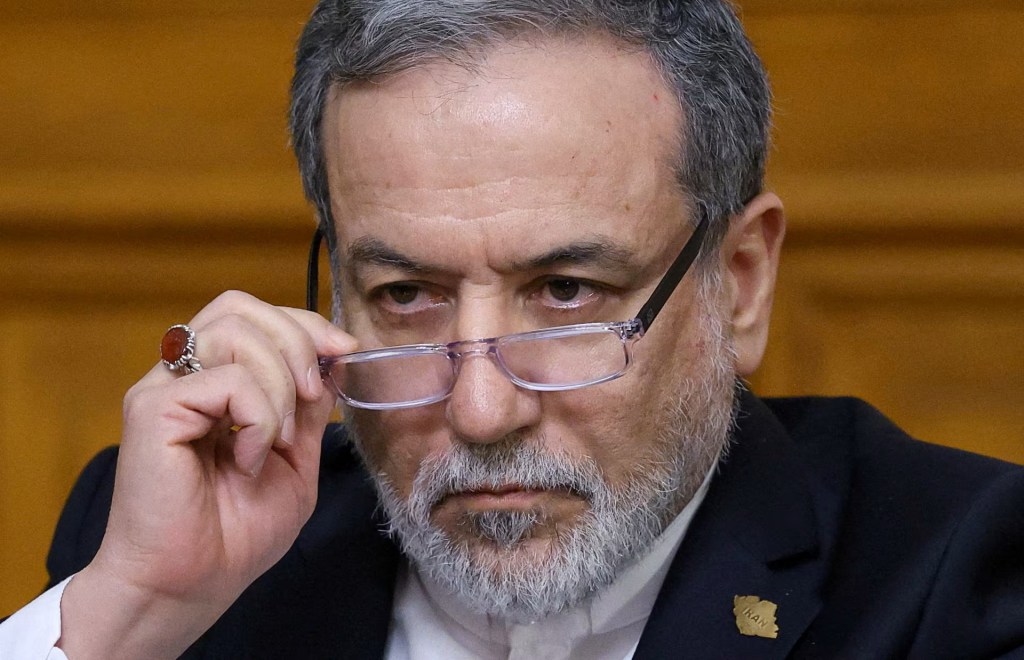
In an attempt to explain why nothing is going well and everything is going wrong with his Iran War, including negotiations with Iran that aren’t actually happening, Trump wrote on Truth Social that the Iranian negotiators are “very different and ‘strange’”.
Even for an absurdist yet deadly powerful comic like Trump, this is a statement worth analyzing.
“Different” than whom?
“Strange” in what way?
Different than other Iranians he knows? Different than other negotiators, real or pretend, he has dealt with?
Stranger than what or whom? It is safe to say that nothing and no one around Trump is anything but strange.
Of course, it is possible that in Trump’s mind, which is already challenged and now more challenged by a war he started but can’t control, everything is different and strange. Which might be acceptable and survivable, except if it is the mind of someone capable of setting the world on fire. That would be different and strange.
Juan Peron became the strongman dictator of Argentina. The driving force that got him there was Eva Peron, a political and cultural figure unlike any in modern history. This inspired one of the great contemporary musicals.
Melania seems to lack many of the characteristics that made Evita so compelling and successful. But what if we have gotten this all wrong? What if Melania is the power behind the throne?
Something to think about as we await the next Melania movie. A New America? Maybe a musical?
Here is a sample of lyrics from A New Argentina, the showstopping number from Evita:
PERÓN It’s annoying that we have to fight elections for our cause The inconvenience, having to get a majority If normal methods of persuasion fail to win us applause There are other ways of establishing authority…
Then again, I could be foolish not to quit while I’m ahead I can see me many miles away, inactive Sipping cocktails on a terrace Taking breakfast in bed Sleeping easy Doing crosswords It’s attractive
EVA Don’t think I don’t think like you I often get those nightmares too They always take some swallowing Sometimes it’s very difficult to keep momentum If it’s you that you are following Don’t close doors Keep an escape clause Because we might lose the Big Apple But would I have done what I did If I hadn’t thought If I hadn’t known, we would take the country
I’ve been looking through boxes of old photos. Not just from our lifetime, but back to the days when our grandparents were younger, and their parents and families too.
I shared a photo with a friend I’ve known a long time. He appreciated it and wished me luck with the photo “rabbit hole”.
He’s right. It is easy to get lost in these images from the past.
One view of the philosophy of time comes from various Buddhist perspectives. From the eighth century Zen text, Xin Xin Ming/Trust in Mind:
Words! The Way is beyond language for in it there is no yesterday no tomorrow no today
There is no yesterday, tomorrow, today. There is apparently yesterday, tomorrow, today. Are we attached to any of them? Are we liberated from any of them?
The TV series Mad Men is about a charming and successful man, advertising executive Don Draper, who is lost in time. He has adopted the identity of a dead man, buries his true past, is in the business of fooling people, including himself.
The final episode of the first season is called “The Wheel”. The client is Kodak, who has asked the firm to advertise their new slide projector, then called the Wheel, but ultimately becomes known, in the story and in the real world, as the Carousel.
The episode is considered one the greatest in TV history. The following scene is the penultimate moment.
Don comes up with a client pitch that involves slides from his own early family life, and a story that is clearly made up about his first boss in advertising. Do the photos represent the actual past, or just some elements of a more whole and complex past? Which is an illusion? Is there yesterday? Is there tomorrow?
This morning, like some other mornings, the bird songs are so plentiful and overwhelming that I try to identify the birds singing. Above is this morning’s roster.
What I learned was this: The birds remind us when we upset the grace of living. They do this by being in their own ways with their own songs the grace of living. As we are and can be.
I was very close to my grandparents. Literally, since we lived all together until I was eight. The three-generation living situation is still common in lots of places and circumstances, though not for many the ideal. For me it was so positively formative that I can’t imagine missing it. But that’s just me.
When I knew my Grandpa Harry, it was decades later than this photo, which I guess was taken in the 1930s when he was in his thirties. By that time he was older and a little grizzled, though as loving and lovable as a bear. But this Harry was someone else. Sharp dressed man doesn’t begin to cover it.
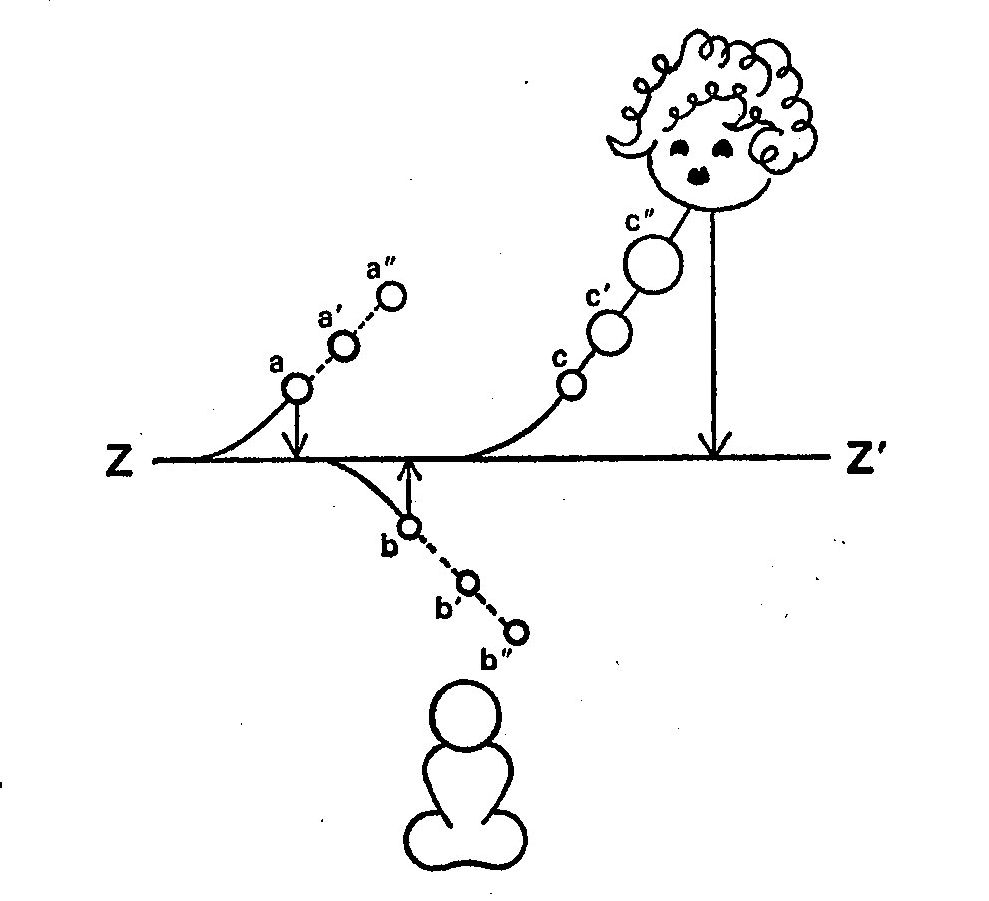
I’ve previously posted this illustration about meditation drawn by Zen master Kōshō Uchiyama. Whatever type of meditation you practice or are thinking about practicing, Zen or otherwise, this says it all.
Actually, zazen is not just being somehow glued to line ZZ’. Doing zazen is a continuation of this kind of returning up from sleepiness and down from chasing after thoughts. That is, the posture of waking up and returning to ZZ’ at any time is itself zazen. This is one of the most vital points regarding zazen. When we are doing zazen line ZZ‘, or just doing zazen, represents our reality, so it is essential to maintain that line. Actually, ZZ’ represents the reality of the posture of zazen, but the reality of our life is not just ZZ’. If it were only ZZ’, we would be as unchanging and lifeless as a rock! Although we aim at the line ZZ’, we can never actually adhere to it, because it (ZZ’) does not exist by itself. Nevertheless, we keep aiming at ZZ‘, because it is through clinging to thoughts that we keep veering away from it. The very power to wake up to ZZ’ and return to it is the reality of the life of zazen.
Meditation looks like this sometimes, and that’s fine. My humble annotation to Kōshō Uchiyama is that when you return from a or b or c, like thinking about some person or breakfast or “I’ve got to write this down now!”, you may realize that what you are thinking about is an illusion. Not that the floor and the cushion and all the situations that await you after meditation are illusions, but if they are illusions, maybe you can return from them just as you returned from a or b or c.
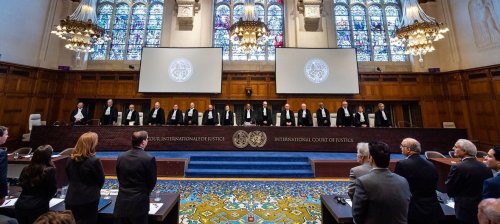
Nobody said or wrote that. At least it hasn’t been reported. But it would not be surprising if that was thought or said by some U.S. leaders. Two of the closest American allies, Russia and Israel, have regularly committed war crimes in recent years, yet the U.S. has stood by silent or supportive.
The U.S. has made clear that it doesn’t support the concept or fact of international law. Just as it doesn’t support the concept or fact of American law when it comes to judges who try to stop its illegal or unconstitutional actions.
“Woke” is the overall characterization of anything that seems too tolerant, sensitive or soft, weak initiatives that get in the way of exercising real muscular strength and power. So just because something like international law says that destroying civilian power plants—Trump’s latest in an incoherent series of threats to Iran—is a war crime, that is no reason not to do it. Because those so-called international laws are just too WOKE.
Next up: More pardons for war criminals and genocidal leaders, contemporary and historic. He can do that, he thinks.