Bob Schwartz

Category: Uncategorized

The Revival of Enlightened and Transformative Politics

Talking about the revival of enlightened and transformative politics is bound to be imprecise.

That concept has never actually been dead. Looking at Christianity, a recent post about Jim Wallis and Sojourners highlights just one instance. A bigger and much more famous current example is Pope Francis. And it is nothing new. The Social Gospel movement, which is still represented (though not always appreciated), aimed to see the realization of the highest Christian principles in everyday practical society.

Keeping with the Christian theme, this is not about what Jesus would say about abortion or gay marriage or prayer in schools or any of these specific arguments—though all have a certain significance. It is about politics as a tool of overall transformation, beyond sectarian concerns.

This is not limited to Christianity. Every one of the traditions has a core of enlightenment and large scale transformation. But each of those traditions has found a way to occasionally devolve that mission into movements and policies and tactics that diverge and even contradict the higher principles and aspirations. It isn’t necessary to point out the wrong turns that, for example, Judaism and Islam have taken along the way to supposedly establish heaven on earth.

In the era of what was affectionately, or for some derisively, known as the New Age movement, this concept of politics as a transformative tool was central. There was the idea that if we kept our eyes on the prize—not just a country but a world elevated above our baser selves—we could together create something better. Politics was one of the tools that would serve that end, instead of enabling smaller personal ambitions and selfish, possibly pernicious, goals.

So here we are. Enlightened and transformative politics is not dead. But it may be missing in action. Each political choice we make—each donation, each tweet, each vote and, yes, each post—might help us find it. Or kill it. It’s up to us.

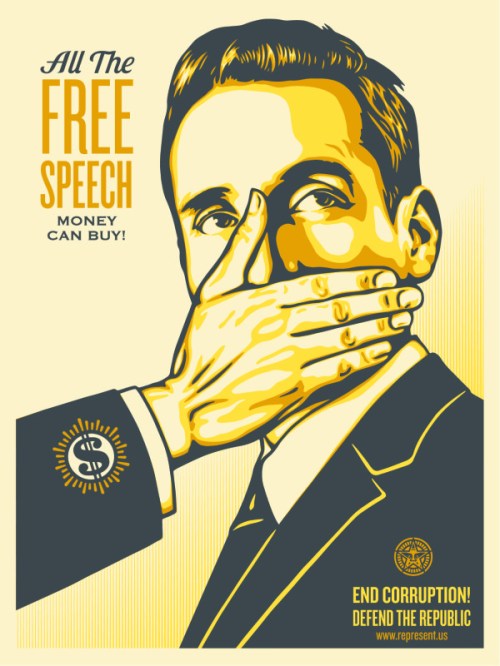
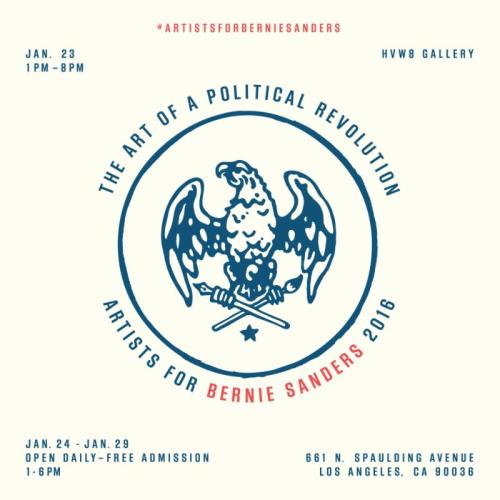
Shepard Fairey: The Art of Political Revolution

Shepard Fairey - Bernie Sanders Concert

Not many people had heard of the artist Shepard Fairey (“Manufacturing Quality Dissent Since 1989”) until he created the Obama “Hope” poster, one of the most famous pieces of art in modern American politics.

Since then, he has been spending his time creating, exhibiting and selling all sorts of provocative and eminently viewable art/propaganda on the beneficial edge of society, politics and culture.

He created the poster above for today’s Bernie Sanders benefit concert in Los Angeles. For those who haven’t looked for a while, or don’t know Shepard’s work, here is a sampling:

End Corruption

Make Art Not War

3fe6ad0d-98bd-49f4-b2d3-851ef7c7a746


Chicago homicides are symptoms and not just in Chicago

Chicago reported the most January homicides since 2000. This is a symptom and not just in Chicago. A number of American cities are seeing similar increases.

This is a symptom of a socio-economic underclass with little hope of moving up on any significant scale. And now for the first time in the post-World War 2 era, we have a socio-economic middle class also seeing and believing that upward movement is beyond expectations and aspirations. This is expressed in the current level of nonpartisan political dissatisfaction.

These symptoms require hard and unsparing self-awareness as a nation. Whatever the underlying conditions are, the treatments being prescribed have not worked. It is dangerous folly to think that just because a person has been relatively healthy over a pretty long time, with the occasional ups and downs, the standard remedies are bound to work for any conditions. Not to mention that some treatments once lauded turned out to be ignorant and deadly. Consider that bloodletting—cutting blood vessels or attaching leeches to extract the disease—was once the height of medicine (and why barber poles are striped red and white).

According to some experts, there is a tiny chance we may fall back into a 2008-style recession. There is also a chance that in some cities we might see a summer of 2016 that looks a little like the hot summers of the 1960s. However small those chances are, we might not want to be waiting around to see if these and other symptoms go away on their own. Sometimes they do. And sometimes they don’t.

First Music of the Morning

Penguin Cafe Orchestra

I don’t listen to music very first thing in the morning. There’s quiet, until I start making breakfast.

And then, in the kitchen, it’s finding the right music, le musique juste. Here is a very small sample from the list. All are very short, all without words or voices.

Penguin Cafe Orchestra, Perpetuum Mobile

This is what joy sounds like. Who doesn’t need a little unconditional unmitigated joy? Top of the list.

Bill Evans, Peace Piece

This may seem a little too laid back for trying to get energized. It is low-key and lovely, until Evans throws in some equally low-key jazz dissonance. Just enough to remind us that if we are able, the day can have plenty of the peace we want, but there’s bound to be a few strident notes—all of which can be resolved.

Aaron Copland, Fanfare for the Common Man

If you believe you are about to conquer your day, or conquer the world, this is your anthem—whether you are a common or uncommon person. You can take on anything. Caustion: Do not mix with too much espresso.

Erik Satie, Trois Gymnopedies: Gymnopedie No. 1

Erik Satie called what he wrote “furniture music,” meaning it was just there, but not at all unuseful, unstyled, unformed or uncreative. Minimalist music and ambient music are its descendants (not to be confused with elevator music, which is unuseful, unstyled, unformed and uncreative). This is about two minutes of the finest furniture you can sit on to start your day.

Balls of Power

Powerball

She had a dream.

I played my first Powerball lottery yesterday. In fact, it was the first lottery I’d ever played, though I’d been given tickets before.

I played because someone had a dream, not just that I had played, but had used the I Ching to determine the winning numbers.

I didn’t mind using the I Ching for the purpose. After three thousand years, it has been used for purposes profound (war and statecraft) and frivolous. Like all great scriptures and texts, it stands ready to be put to work as the user sees fit. The wisdom and efficacy of doing that is a different matter, but there it is. I am positive that some very faithful people who hold the Bible sacred were nonetheless happy to use it to pick their Powerball numbers. A billion dollars is a billion dollars.

I faced three challenges.

First, I had no idea how Powerball worked. It didn’t take long to study up. The current version asks players for five white ball numbers between 1 and 69, another red ball number between 1 and 26, and an optional choice of the Power Play, which multiplies your winnings—if any.

Second, and this one was confounding, the I Ching generates hexagrams numbered 1 to 64. A real problem, since Powerball asks for numbers 1 to 69. Rewriting the I Ching to include 69 hexagrams seemed an act of hubris beyond anyone, let alone me. So I devised a scheme to extend the I Ching, just for this purpose. I cannot reveal the method at the moment, but you can be sure that if it results in winning a billion dollars, I will comfortably share that secret with the world, being then as comfortable as a billion dollars can make me.

The third challenge was mundane and ridiculous. I arrived at the supermarket service desk, only to find a display of ten different computer cards to fill in for different lotteries, including Powerball. I felt like an alien, stupid and stupefied. Thankfully, the very nice lady behind the counter patiently answered all my questions:

Q: Why are there five sections marked A to E?
A: Each one is a different play. If you want to play five times, you fill in all five.

Q: What about this box next to Pick 5?
A: That’s if you want the computer to pick your numbers. (Which I didn’t.)

Q: Does the Power Play box mean the bonus multiplier?
A: Yes. It costs an extra dollar. (With $2 for the basic play, it cost me $3.)

The result: I matched one of the five white ball numbers. You don’t win anything unless you match three of them.

The Powerball jackpot has again rolled over. The next time it will be up to something between one billion and two billion dollars. I will probably play again and use the I Ching again. And if it rolls over yet again, I might add the Bible as a lottery oracle.

After all, I would love to make someone’s dream come true.

A Message to Americans Descended from Once Hated or Feared Groups: Stand Up and Speak Up

The majority of Americans are descended from national, ethnic or religious groups that once were—and may still be—hated and feared by other Americans. Italian-Americans. Irish-Americans. African-Americans. Chinese-Americans. Japanese-Americans. Mexican-Americans. Jewish-Americans. On and on. This means you, too, Mayflower-Americans. Your Pilgrim ancestors were refugees from religious persecution.

This is the message: Stand up and speak up in the face of a growing tide of “Americanism” that translates to hate and fear of “the other.” You and your ancestors were that “other” (ancestors may even mean your parents). Don’t do it because it is the right thing or the American thing to do, though it is. Do it because if you and your family are lucky enough to have transcended that pernicious nonsense, there but for grace go you.

There is a special part of this message for my Jewish-American brothers and sisters. If I say “how dare you!” that may sound too shrill. So let me instead say “you of all people should know better.” Those who want the Holocaust to be eternally remembered don’t seem to completely understand what “Never Again” means. It isn’t that we should never allow mass extermination of much of Jewry. It isn’t even that we should never allow the mass extermination of any group.

“Never Again” means never allowing anyone, including ourselves, to express our baser selves in ways that diminish the humanity of anyone. Because if you believe in divinity then you believe in the divinity of humanity. And if you diminish anyone with shouts and protests and politics and prohibitions, based on no more than identity, you have denied their humanity and their divinity.

And your own.

What’s in a Name: War with Daesh aka ISIS, ISIL, IS

More than a year ago, I posted twice about the different names being used at the highest levels for the current and very evil movement in the Middle East (here and here).

Rather than clearing that matter up, a new name has just been added to the list: Daesh.

The name Daesh, according to France24, is a “loose acronym” for “Islamic State of Iraq and the Levant” (al-Dawla al-Islamiya al-Iraq al-Sham). The name is commonly used by enemies of ISIS, and it also has many negative undertones, as Daesh sounds similar to the Arabic words Daes (“one who crushes something underfoot”) and Dahes (“one who sows discord”).

I first heard this new name watching the British House of Commons debate the U.K. commitment to the fight. Prime Minister David Cameron kept referring to “Daesh…Daesh”, and it became clear from the context that he was talking about ISIS/ISIL/IS. One MP thanked him for the new vocabulary, pointing out that the BBC had not yet agreed to use the new correct terminology.

This issue of a pathological movement to establish a new Muslim caliphate is a very serious matter. Especially as it involves the possibility not only of more horrific violence, but of the engagement of many nations—including the U.S.—in that fight.

But there is something just slightly ridiculous about world leaders sitting around a table, each one using a different name for the enemy (we now have seven, if you count the full names and the acronyms). Given what happened in Parliament, it is possible to envision such high level global arguments about what to call the enemy and why.

One thing we know from history. If you are having trouble agreeing on the tiniest details, such as the shape of a negotiating table, the chances of reaching some sort of sane, enlightened, and hopefully effective outcome are not that great.

So whatever else, let us plead with politicians around the world, and the media who cover them, to settle on one name. Before somebody comes up with yet another one.

Life Out of Balance

“A tormenting thought: as of a certain point, history was no longer real. Without noticing it, all mankind suddenly left reality.”
– Elias Canetti

The latest reality is a mass shooting in San Bernardino. Ridiculous people have a chance to become the most powerful leader in the world—and insist on tormenting us along the way. Then there was Chicago. And Paris. And on and on.

The world and our lives are not just one thing or one way. They are all directions and colors, in and out of our control. As simplistic as it seems, what we aim for is balance. That might take time, and under some circumstances, such as times of war or grievous loss, maybe a long time. But over time, balance is our aspiration.

Whatever your personal situation—and that is what matters most—our greater social and public life is out of balance. This isn’t the same as things being either mostly good or mostly bad. That, as noted, is the way things always are at any given moment.

What we need is not a singular center point, which is what so many traditions and ideologies peddle as an answer. If anything, running to “the one answer” can actually add to the imbalance. Instead, what we need is to have a sense of a center being available and possible. Because that goes beyond the acknowledgment that life is out of balance (most of us agree on that) to an earnest search for balance. The power of the search is not that you find a center point, but that you are active in turning towards the things that enhance balance, and away from those that don’t.

WWJDAB: What Would Jesus Do About Guns?

If Jesus returned, and found America flooded with guns, and saw so many people drowning in that flood, what would he do?

A lot of people claim to speak for Jesus, but I am not one of them. Still, I have a guess, or maybe just a hope. Jesus would make the guns disappear. He might—might—later give them back to some who were hunting to put food on their table. He might not give them back to those who use them for sport, explaining that golf is more challenging and that far fewer people are killed by golf balls and golf clubs.

Almost immediately, Jesus would be criticized for taking away a God-given freedom. God blessed the world with America, God blessed America with a Constitution, and God blessed the Constitution with a Second Amendment. Jesus might reply that he had a better idea of what God blessed and what God had in mind. And that what he didn’t have in mind was millions of people running around with deadly weapons and often wantonly shooting thousands of others. God also isn’t keen on Kindergarten teachers packing heat while shepherding five-year-old children. Jesus would close by reminding folks that it is the peacemakers who are blessed, not the gun makers.

By then, it would be too late. Nobody would be listening. As if they ever did.

Thanksgiving for Refugees

No discussion of why millions of people find themselves displaced from home and country. No discussion of where they might go or who will welcome them or who won’t. No discussion of whether there might be terrorists hiding among them or whether circumstances will transform some of them into terrorists.

It is Thanksgiving. You might be thankful that you are not one of them. You might remind yourself that whatever your position and ideology, all the political stuff, nonsense and blah-blah-blah won’t ease a moment of suffering and uncertainty for these refugees.

It is Thanksgiving. Give to the UN Refugee Agency.