Bob Schwartz

Category: Television

Money, Power & Wall Street: The Don’t-Miss Can’t-Watch Documentary
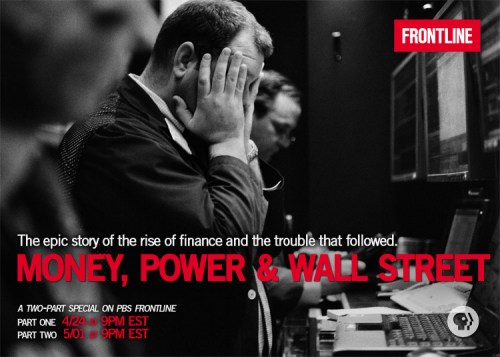
It is hard to recommend the four-part PBS Frontline documentary Money, Power & Wall Street and hard not to. Difficult as it is to watch the financial crisis unfolding, the film is superior even by Frontline’s high standard of excellence. As a history and prospectus, it is an insightful, even-handed and essential work of reporting. As a source of optimism, it is a complete failure, because the conclusion is that nothing has substantially changed, and that maybe nothing will.

It is as good as any disaster movie in pulling us in and moving us inexorably along. We see the scenes in detail, meet the cast of characters—lead and supporting actors—and have a growing sense of foreboding: this can’t end well.

It is different than most disaster movies in two ways. Most have some heroes, and with a few exceptions, there are no heroes here. And most disaster movies end with some movement toward rebuilding and reform, and with a sense of lessons learned: we will keep better watch for asteroids, we will build a system of asteroid warning and protection, we will come out this with a fundamentally better society. There is none of that here.

Yet Money Power & Wall Street has to be seen by every American. Those with political agendas will no doubt point to particular decisions or non-decisions, or particular actions or inactions, to prove a partisan point. But when they do, they will have missed the bigger point. In a world where financial forces become too big to understand or control, it is still our job as citizens and public servants to understand and control them. Because when it finally hits, ideologies and political badges are not really going to matter.
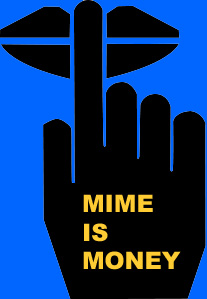

Mime Is Money


In the too-much-is-never-enough world of television, singing competitions are spawning wild speculation about what might be next. If successful, ABC’s just-premiered Duets is sure to be followed by singing groups of increasing size, leading to shows like Trios, Quartets, Quintets, and most audience-grabbing of all, Sextets.

One way to deal with too many shows is to thin out the herd. But another way is to do a 180-degree turn. That’s the idea behind a new competition show with the working title Mime Is Money, where silence will be golden.

Mime has become the object of only partly-deserved ridicule. Bad singers and dancers don’t give song and dance a bad name; they just reflect badly on their own lack of artistry. But untalented mimes have, until now, subverted any chance of the classic art of pantomime being taken seriously. This show could change all that.

Still in the concept stage, Mime Is Money will feature much more than the clichéd mime acts. For example, producers are hoping to include at least one example of mime ventriloquism, a little-known but strangely entertaining form. Mime ventriloquism is an outgrowth of the 1930s development of radio ventriloquism, pioneered by Edgar Bergen in the 1930s. Even though listeners couldn’t see Bergen performing with his dummy Charlie McCarthy, the Edgar Bergen-Charlie McCarthy Hour was on NBC radio for twenty years. In the case of Mime Is Money, the viewer can see the ventriloquist and the dummy, but can’t hear them, and so are guaranteed to experience the most perfect ventriloquism act ever.

Also being considered is the possibility of the judges remaining silent too, rendering their opinions only with motions and gestures. In addition to thumbs-up and thumbs-down, the possibilities are limited only by the creativity of the judges and producers. One hope is that if the show proves popular, some of the gestures will become like catch-phrases that will brand the show and will sweep across America.

Logo of a Lifetime


The image above is not the new Lifetime Network logo, launched on May 2 as part of the network’s rebranding. Instead, it is from the Sci-Fi Channel, which rebranded itself as Syfy in 2009. But for a brief moment, from November 1998 to March 1999, it asked to be called SF until it could decide what it wanted to be when it grew up. This is that interim logo.

Here is the new Lifetime logo, designed by Leroy+Clarkson:

Designing logos, while it may be well-compensated work, can be a thankless job. No matter how much sophisticated research goes into the process, it is art for commerce, but definitely art, and opinions vary according to taste (even when the discussion is seemingly objective, scientific and market-based). Add to that the creation and integration of a tag line and it is amazing that the process ever ends.

In 28 years, Lifetime has had 11 logos. You can see them on parade at Logopedia.

Elsewhere you can read explanations of what the new logo and the tag line mean relative to Lifetime’s strategies and its audience. Here and now, the logo can speak for itself…though it might have been worthwhile for A&E (owner of Lifetime) to consider reaching out to NBCUniversal (owner of Syfy) to see if maybe, just maybe, the old SF logo might still be available. Not nearly as subtle, Eastomystical, or feminine as the new logo, but it would be tons of fun:

Cleveland Clinic’s Power of Today Ad

The new Cleveland Clinic commercial campaign, The Power of Today, is a model of TV advertising, showing the value of good basic messaging combined with a tactical twist.

Cleveland Clinic is one of the best-known and most-respected health care providers in the nation. More than just a hospital with world-class specialty care, it operates facilities and clinics covering a range of needs, from the everyday to the most sophisticated.

The clear and appealing messages of the 60-second commercial are:

  1. Cleveland Clinic is a world-class provider.
  2. Despite being world-class, it is also approachable, accessible, and patient-centric. It is for everybody. It is for you.
  3. You don’t have to wait for that level of care. You can get an appointment with one of our doctors today.

The master commercial says this:

Today is a big day. Today we greet you, treat you, care for you. Today you can come to us for anything, everything or just to get that thing checked out. Big, small and yes. The best heart care in the nation. It’s here everyday for everyone. That’s the power of Today. Call Today. We’re here for you.

That’s where the twist comes in. To emphasize and realize this point about today, versions have been produced and are running each day of the week (“Today is Monday” and so on).

Even knowing how the magic trick is done (“How does that commercial know that today is Monday?”), the effect is arresting and supportive of the core message. With great straightforward copy (check out the number of one syllable words above) and solid but unfussy visuals, this is how it should be done.