Bob Schwartz

Category: Television

We Need a Doctor: Who Hasn’t Seen Jennifer Lawrence’s Breasts or Why We Need Social Therapy
Bohemian Paris of Today

One of the biggest stories of the weekend was the posting of nude photos of Jennifer Lawrence and other female celebs, apparently stolen from their cloud storage accounts. The search activity for these photos almost brought the Internet down.

So in the immediate aftermath, with more to be revealed, what might we learn, besides how these beautiful strangers look without their clothes?

We are no closer than ever to figuring out what we think about privacy, or even what privacy means, especially now.

Digital didn’t create the issue, just heightened it exponentially. Inquiring minds have always wanted to know, and see. Celebrities, some though not all, have used degrees of exposure for publicity—or in some cases to put curious fans off the trail of the truth. Now we have an entire industry of programs about the “real” lives of unknowns, used-to-be-knowns, just-a-little-knowns, and soon-to-be-knowns because they are on a reality show.

Then there is the willingness of many people to chronicle everything. Twitter long ago dropped its signature question, but the most important phrase of the century so far may be “What are you doing?”, which was supposed to be answered in 100 characters or less. It turns out that people are more than willing to talk about what they are doing, what they are thinking, how they are looking, and anything else.

This doesn’t mean people don’t deserve privacy, morally and legally. It’s that line-drawing is now so hard for so many, and that goes along with a certain amount of confusion or even hypocrisy. The same people who searched for these photos or others like it in the past would be fuming if anyone stole their private shots and published them. They might try to rationalize the distinction, but it would be pretty feeble. Yet, not to forgive their double-standard, it is not surprising under the circumstances.

When we are confused about anything, and have difficulty drawing a line, sex makes it worse, clouding our judgment and our actions. Private parts are signifiers of sex, and if the private parts of loved ones or of strangers are arousing, the private parts of the quasi-strangers who are celebrities are positively crazy-making. So it is understandable, if not acceptable. People are only human, or so we say. But that doesn’t mean a little help and discussion—about privacy, about the cloud, about celebrity—might not be valuable. Maybe a little social therapy is in order.

We need a doctor, call us a doctor
We need a doctor, doctor to bring us back to life

(apologies to Dr. Dre, Eminem, and Skylar Gray)
Aereo: Agreeing with Justice Scalia

Aereo

It doesn’t happen often that I agree with Justice Antonin Scalia. On the law or much else.

But his dissent in today’s Supreme Court decision in ABC v. Aereo is pretty good and pretty right. By 6-3, the Court decided to allow Aereo to be subject to violation of copyright law.

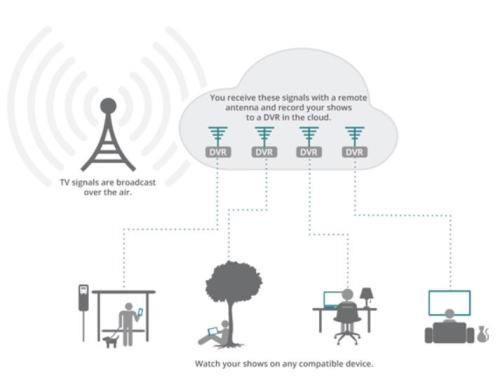
As explained in an earlier post at the time of oral arguments, Aereo has devised a complex tech scheme by which it captures over-the-air-broadcasts at the request of subscribers, using tiny antennas that subscribers essentially time-share, and then allows subscribers to watch those broadcasts online.

In the opinion, the majority agreed with the networks, finding that this is just a too-clever-by-half way of getting around copyright law and avoiding paying retransmission fees, as cable companies are required to do. Justice Scalia found the reasoning and judgment of the majority deficient in many ways, and his dissent is well worth reading.

Among the points, he notes that exploiting loopholes is not illegitimate, and is in fact one of the things that lawyers are good at and are supposed to do. Justice Scalia does not necessarily think that Aereo should go without liability or responsibility, but that trying to make the law fit to reach a desirable result is not the way to get there. If the law doesn’t fit the technology, Congress is charged with and capable of fixing it. (Note that this is the connection between his strict constructionism and his very progressive position in this particular case.)

There was a lot of apocalyptic talk at oral arguments (Aereo would destroy broadcasting as we know it), and there is apocalyptic talk today (the somewhat fuzzy majority opinion leaves all sorts of cloud-based services under legal suspicion). The earlier post repeated the maxim: hard cases make bad law. This is a hard case, and whether the law is bad or not, it sure is an irresolute path to the future. About that, Justice Scalia is right.

Honeywell Kitchen Computer and the Delights of Old Tech

Kitchen Computer - Menu Selection

Some people love old cars. Others of us delight in old digital tech.

We are not alone. The latest episode of Mad Men on AMC includes the installation of a computer at the agency. And the new AMC series Halt and Catch Fire is (coincidentally?) about the early days of personal computing. (Halt and Catch Fire is a real/apocryphal/funny code instruction that might send a computer into an endless loop, resulting in its ultimately stopping or bursting into flames.)

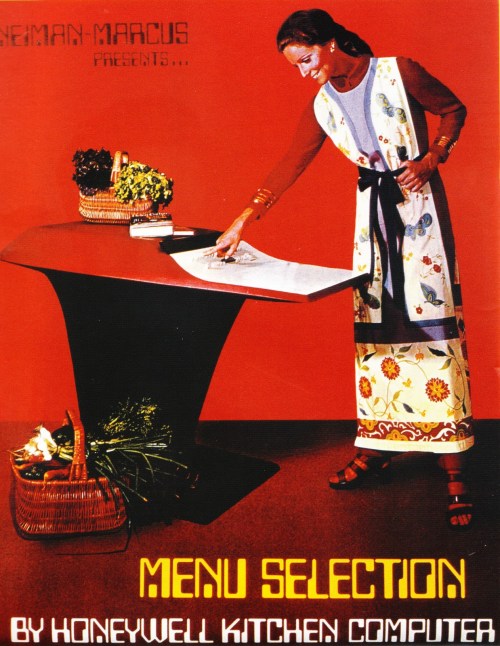
This is a page from the Neiman-Marcus Christmas 1969 catalog. The impeccably dressed N-M housewife is standing next to what appears to be an unusual table, but is actually the Honeywell Kitchen computer, which can be purchased for $10,000. (The apron will cost you another $28.) “If she can only cook as well as Honeywell can compute.” Indeed.

Kitchen Computer

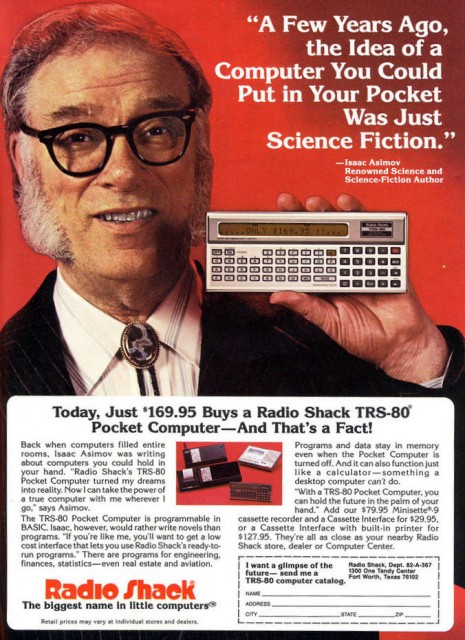
Here is something completely different from the era, prophetic rather than silly. It is Isaac Asimov, a science fiction great, advertising Radio Shack’s TRS-80.

Asimov - TRS-80

Note that in the spirit of what goes around comes around, this is a pocket computer almost exactly the size of a smartphone—or is a smartphone a pocket computer exactly the size of a TRS-80? Either way, Neiman-Marcus and Honeywell were clueless, but Asimov and Radio Shack were not.

That would be a pretty good close for this post. Except that the following ad is irresistible, telling us something else about the early days of computing.

TSP Plotter

Just as cars were, and to some extent still are, sold by using sex, sometimes so were computers. This is an ad for a plotter, possibly the least sexy of all peripherals. The copy is mostly bone-dry and technical. But then there’s the trio of the model with her dress open to her navel, the headline “New, Fast, and Efficient!”, and the lead “The TSP-212 Plotting System is a real swinger.” $3,300 COMPLETE. Well, almost complete, as the model is presumably not included. But you know, that cool plotter just might attract one.

The Aereo Case and Media Reality

Aereo

Today the Supreme Court hears arguments in the case of ABC, et al. v. Aereo. Some characterize it as the most important media case in decades, one which could destroy broadcasting as we know it.

That is both overstated and understated. The big broadcasters who claim this is the apocalypse won’t go out of business; they will continue, though they might make a little less money or have to work a little harder for it. On the other hand, nothing less than the nature of modern reality is being considered, which is what makes the case so interesting and ultimately so hard to decide.

In a nutshell, this is what Aereo does:

Aereo sets up lots of tiny (thumbnail) antennas in your locality.

The antennas pick up the same over-the-air (OTR) TV signals you would if you had an antenna at your home (but you probably don’t).

You subscribe to Aereo for as little as $8 a month.

When you want to watch something from the stations that are on the air in your locality, Aereo assigns you an antenna, collects and records the signal from that antenna in its cloud, and streams that signal the way you want to the device you want, now or later.

The question is whether Aereo is retransmitting copyrighted content to subscribers, cleverly skirting retransmission fees that cable systems and others must pay, which would be stealing. Or whether Aereo is simply enabling you to do something you are legally entitled to do: receive OTR TV and then watch it, record it, or redistribute it to your own devices for your own personal use.

The Second Circuit Court of Appeal decided in favor of Aereo, with a vigorous dissent and with other Circuit Courts disagreeing, and now the Supreme Court will decide. If you read the briefs you can get an idea of the difficulty and the possible impacts.

One can say, as the big broadcasters do, that Aereo may be trying to fit through a loophole in the law, but that isn’t quite right. Aereo is taking advantage of a reality so profoundly new and so newly understood that every medium and every media business is just barely beginning to come to grips.

When you reduce things to information and can move that information around infinitely and frictionlessly and at relatively low cost, the processes and regulations meant to handle grosser things are of limited value.

First a book was a thing made of paper, then there was a copier which could copy pages on paper, then there was a scanner that could turn paper pages into digital images and, with OCR, characters, then there were entire books that never had anything to do with paper, ever, just pure arranged information. The same goes, with slightly different details, for every medium. The solution for the producers who wanted to control things (often with legitimate interests, such as creators being compensated), was to put the information in some kind of box, which to some looked like an information jail. It was and is this simple: once it gets out of the box, catching it and catching up with it is quite a chore. Because, as Stewart Brand famously said, information wants to be free.

If you had to characterize the actors in this case as good guys or bad guys, it does look like ossified old school versus new school, mega-corporations versus insurgents, or as one of the briefs says, David versus Goliath. Any way you put it though, and wherever your opinion lies, this is a hard case, and the maxim is that hard cases make bad law. In this case, bad law would mean that even if progressive principles are maintained, more looking forward than back, we are still in an astonishing mess when it comes to dealing with all this. One case at a time won’t do, and the expectation that Congress will seize the reins and lead us boldly into an enlightened future on digital intellectual property is, at least for the moment, not in the cards or the cloud.

Mad Men and Kabbalah

Don Draper - Broken Vessel

“I keep wondering, have I broken the vessel?”
Don Draper, Mad Men, Season 7, Episode 1, Time Zones

Matthew Weiner’s Mad Men show is not about Kabbalah, or so it would seem. It has, though, frequently touched on religious and spiritual matters. In the first episode of the new Season 7, for example, Roger Sterling’s daughter appears to have had some sort of enlightenment experience that allows her to accept her father as he is and to forgive him unconditionally. And at the end of last season, Don Draper’s hitting bottom included his punching out a Christian preacher in a bar. There have been Catholics, Jews, Hindus, and all manner of beliefs in the mix.

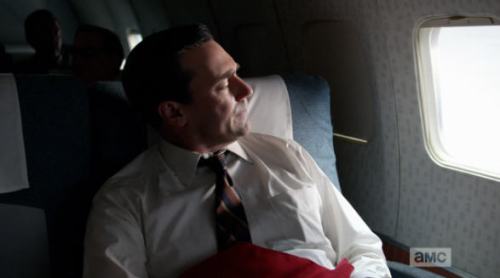
And then, in the latest episode, Don grows introspective and candid with a beautiful stranger on a plane. He admits to being a terrible husband, and then assesses his own responsibility: “I keep wondering, have I broken the vessel?”

For some, the image of the broken vessel instantly brings Kabbalah to mind. According to some traditions, God created the world by sending emanations—holy sparks—encased in ten vessels. Had all the vessels arrived intact, this would be a perfect world. But the force was so powerful and the vessels so delicate that a number of them shattered. In an imperfect world, it is our mission to gather up the holy sparks that have scattered, and thus to make the world better.

One of the first people to make Kabbalah popular and accessible in recent times was Rabbi Herbert Weiner. His book 9-1/2 Mystics: The Kabbala Today (1969)  was the introduction for many to the subject. By coincidence, Rabbi Weiner died almost exactly a year ago at the age of 93.

None of that is much to go on. There is no known connection between Matthew Weiner and Herbert Weiner. And as strange as Don’s dialogue sounds, he has said plenty of strange things before, he is an unlikely Kabbalist, and sometimes a broken vessel is just a broken vessel. Still, Mad Men has taken us places we never thought we’d go, so why not? After musing about the broken vessel, and after refusing the advances of his new friend, Don turns to the plane window and opens the shade. Bright morning sunshine washes his face. Not much to go on. But if there is some message there about Don’s awareness of a duty to gather the broken bits of light and heal his world, Kabbalah or not, that would certainly make Mad Men fans happy.

Putin’s Moldovan Invasion v. Dynasty’s Moldavian Massacre

Dynasty Royal Wedding
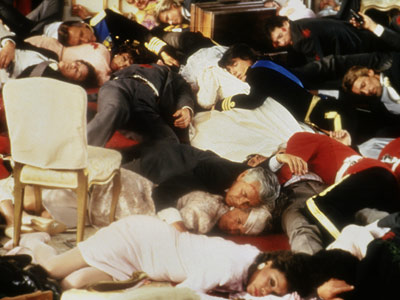
A cliffhanger is a cliffhanger. Russia may be about to invade its neighbor Moldova, based on troop buildup along the border. Almost thirty years ago, on May 15, 1985, the ABC series Dynasty ended Season 5 by leaving the world hanging, as terrorists invaded and shot up the royal wedding of Prince Michael of Moldavia and Amanda Carrington.

(Note: To clarify the Moldavia/Moldova confusion. Moldavia is a traditional region that now straddles the nations of Romania and Moldova. The language of Moldova is Romanian, and the Romanian name for Moldavia is Moldova. The producers of Dynasty may or may not have been aware of this, or that Moldova was at the time a part of the Soviet empire, or much else geographic. Dynasty was not a documentary or reality series. “Prince Michael of Moldavia” just sounded so cool and romantic, as was the fake country.)

Who would survive this now infamous Moldavian Massacre (you can watch it here)? Viewers of Dynasty, then #1 in the ratings, would have to wait all summer to find out. Meanwhile, that season-ending episode reportedly attracted 60 million viewers.

Will Putin invade Moldova, claiming that just as with Crimea, Moldovans are pleading to join up with their Russian friend and neighbor (and former ruler)? How will the world respond? How will Putin respond to that? That’s a real cliffhanger. And even though Putin seems to be playing a part in a costume epic, in which he is the royal hero, a sort of Putin’s Dynasty, this is no television series. Perhaps Czar Vladimir of Russia will wake up and see that.

Teach-in and Dope in the Senate

Teach-in
Yesterday some Senators, mostly Democrats, held an all-night “talkathon” on the Senate floor about climate change. It wasn’t any kind of filibuster, because there wasn’t any particular piece of legislation involved.

Back in the 1960s, this might have been called a teach-in, which was just this sort of session during which change-minded people would learn about the radical issues of the day. Except those people were more likely to be professors and students (or “outside agitators”), and it was more likely to take place in a college administration building than the U.S. Senate.

Two occasional hallmarks of extended teach-ins were sex and drugs. We don’t dare speculate whether any U.S. Senators were having sex during this “talkathon,” but we might just wonder if anybody snuck out to the cloakroom for a quick hit.

In the delightful and trenchant Amazon political comedy Alpha House, one of the four Republican U.S. Senators living in the eponymous D.C. house is seen relieving the tension of running for reelection by bonging it in the bathroom. (The much more serious and dangerous Netflix political series House of Cards also shows the ambitious Frank Underwood, played by Kevin Spacey, sharing joints with his Lady Macbeth of a wife. Sex of all varieties too.)

Back to the climate change teach-in. Even if no substances were involved in the event, what are the odds that any of those participants occasionally indulge, or that any of the rest of the Senate does? As a variant on the old speaker’s trick of imagining your audience without clothes, maybe it would be easier to watch the U.S. Senate if we as citizens just imagined our favorite or least favorite Senators sitting in those iconic smoke-filled rooms passing the pipe. Dope in the Senate. That would explain so much.

The Comcast-Time Warner Cable Merger

Comcast TWC
Meet the new boss
Same as the old boss
The Who, Won’t Get Fooled Again

Comcast and Time Warner Cable are not bad companies, but their proposed merger is a bad idea, for consumers and for the country. For one thing, it would put cable Internet service for the majority of the country—including 19 of 20 metros—in the hands of a single enterprise. Consumers Union among others has come out against the merger. For an excellent overview, see Free Press, which has been articulate and vocal in its opposition.

Even in these first weeks after the proposal, this should have caused more public concern than it has. Some of that diffidence may be understandable. Without impugning motives, in this 2014 election cycle, federal candidates have received $1,184,535 in contributions related to Comcast ($3,188,117 for 2012) and $351,649 related to TWC ($845,616 for 2012)—split almost evenly across party lines.

MSNBC, the chatty and progressive cable outlet, has been relatively quiet. You can determine this by searching for “merger” on the MSNBC.com site over the last month. Of the 54 hits, it looks like all but one reflect a February 14 Morning Joe joint appearance by Comcast CEO Brian Roberts and TWC CEO Robert Marcus. Their positive talk was expected. But the lack of sharp questioning is a different matter. In fact, at one point Joe Scarborough strangely prefaced his praise for Comcast this way: “It’ll sound like a softball question, but I’m genuinely intrigued: what is Comcast doing right over the past several years?” Why is that so strange? Because Joe and Mika and everyone else on Morning Joe and the network work for Brian Roberts, since Comcast owns NBCUniversal. None of that was discussed or disclosed.

But even that isn’t the solution to the puzzle of why this issue hasn’t and may never reach the level of concern it deserves. It’s this: consumers aren’t worried about living with cable monopoly because they already do, and have for a long time.

To understand that, we have to go back to the start of broadcast regulation. Radio was the beginning of over-the-air broadcasting. Just because the radio pipeline was invisible didn’t mean it couldn’t be filled to overcapacity; the radio spectrum was finite. People could build bigger and more powerful transmitters, using brute force to fight over frequencies, leaving the radio listener lost in chaos. Order had to be imposed so that some body—now the FCC—could control who was on the air, how they maintained their presence on the air, and, most controversially, what they said on the air.

Cable turned that (and cutting-edge modernity) on its head. Instead of just building bigger and more powerful transmitters to reach farther and more people invisibly, old-fashioned physical wires would be strung and laid to connect consumers to a network. Theoretically, there was no limit to how many cables you could build over mountains and across valleys, on poles and underground, all to bring broadcasts, and eventually Internet, from a source to your home. But practically, building out that infrastructure was expensive and inconvenient. To maintain, expand and improve service, cable companies wanted assurance that it would be worth it. And so local cable monopoly was born. For decades, and to this day, municipalities across the country enter into agreements with cable providers to be the sole source for particular areas, with loose oversight of rates and service. In general the place you live will be served by one particular provider.

This squeeze was a little relieved by certain technological advances. Satellite service could provide both television and Internet, though the physical requirement of line-of-sight to the sky made it sometimes impractical. DSL Internet over phone lines also offers an alternative, though as Internet needs have grown, cable has proven a much “fatter” pipeline for data. In the end, as a practical matter, the local cable provider is for many consumers the best choice.

If you can call it a choice. Those consumers may not be as concerned about whether Comcast/TWC acquires some sort of monopoly because for years those consumers have been living with a local cable monopoly. This is another of the strange moments from the Morning Joe interview with Comcast’s Brian Roberts. One of the arguments used to defend the merger is that there is practically no overlap between the Comcast and TWC markets. Of course, that is precisely the point. Roberts’s argument, though it isn’t what he meant to say, is that since consumers never had a choice in the first place, they won’t notice the difference.

And maybe, just maybe, he’s right.

An Askew Take on the Grammy Awards

Lorde - Grammy 2014
There are a few kinds of award shows. One is the kind that you’re glad you watched live, even if you can always see it in a recorded version later on, skipping the ads and the bad or worst parts, focusing only on the good or (if any) great parts. The other is the kind that, assuming you didn’t escape early, leaves you wondering whether or how you can get the two or three hours of your life back.

So which kind was Grammy 2014? Far from a CWOT (complete waste of time), with moments of validation, pathos, and brilliance. But with all the coverage and videos you can find, you don’t need one more. If you haven’t heard about Pharrell William’s hat or about Taylor Swift’s seizure-style hair whipping and mistaken belief that she won album of the year, check it out. Or not.

Here instead are a few askew points.

Lorde – Okay, this is close to mainstream coverage, but having written so much about Lorde before, I can’t skip it. She won Best Pop Solo Performance and Best Song for Royals. That’s best songwriting won by a seventeen-year-old. She also performed Royals, with a really haunting arrangement of an already haunting, what’s-that-sound track. She also has a softly herky-jerky stage presence, not quite Joe Cocker, but very cool and punk (unlike Taylor Swift’s hair whipping). Accepting an award she said, “Thank you everyone who has let this song explode. Because it’s been mental.” That’s her performing above.

Paul Williams – When Daft Punk won Album of the Year, one of their many awards, and couldn’t speak for themselves (because they are robots), a somewhat short older guy came to the mic, as one of the songwriters. That guy is Paul Williams, 72, who has been around the business so long that a recent documentary about him is called Paul Williams Still Alive. Many if not most viewers had no idea who this guy is, but he gave the final speech of the night, a funny, wonderful, inspirational few moments that put the whole Ryan Lewis and Macklemore/Same Love/mass gay marriage event in brightly positive context. For those who don’t know, Williams is a songwriter, singer, actor and, currently, president of ASCAP. His compositions include Top Ten hits for Barbara Streisand (Evergreen), Three Dog Night (Just an Old Fashioned Love), the Carpenters (We’ve Only Just Begun, Rainy Days and Mondays), and many more. Now he’s part of the Album of the Year in 2014. How f***g cool is that.

CBS and Language – And speaking about language, CBS or any broadcast network that wants to feature music awards, or for that matter movie or television awards, is going to have to figure out how to deal with language in 2014. Questions about the evolution/devolution of language norms and niceties are huge right now, but outside the scope of these notes. Kendrick Lamar’s electrifying performance with Imagine Dragons wasn’t spoiled by the bleeps (the button guy missed one, by the way), but it goes beyond silly to artistically hurtful. If you’re going to feature and exploit current art, take it and present it for what it is, or don’t. But if you want to feature universally praised nude paintings as cultural highlights, neither CBS nor the FCC should be putting black bars across the nice but naughty bits.

The Finale – And speaking about artistically hurtful, the show ran late, as awards shows will. The Grammys and CBS make a big promotional deal about all-star finales, in this case an interesting combination of Dave Grohl, Lindsey Buckingham, Nine Inch Nails and Queens of the Stone Age. For those who don’t follow music, three of these people are in the pantheon: Grohl (Nirvana), Buckingham (Fleetwood Mac) and Trent Reznor (Nine Inch Nails). Most of these big-name combinations don’t work, but this was really captivating, in a kind of dark, progressive, alt rock way. It seemed a little unusual as an ending, but artistic, edgy and vital. Before it was done, though, the cameras pulled back, and the sponsorship promos began, followed by the credits—all while the artists were still performing.

Reznor tweeted: “Music’s biggest night…to be disrespected. FUCK YOU guys.”

Led Zeppelin – In covering the nominations, I wrote about the absurdity of Led Zeppelin being nominated for Best Rock Album. In 2014. For a performance in 2007. Of songs released in 1975. They won.

TV: Love Note to Tessanne Chin

Tessanne Chin
Last night were the semifinal performances on The Voice. There are three worthy contenders left, including Cole Vosbury and James Wolpert. Then there is Tessanne Chin from Jamaica.

Tessanne sang Bridge Over Troubled Water and owned the night. Talent competitions are not meritocracies, so she may not win, and it won’t matter.

1. She is beautiful, inside and out, delightfully open-hearted, loving and modest. You can tell this by watching and listening to her and by the testimony of her coach, Adam Levine. Adam obviously has a crush on her and he isn’t alone.

2. Even with the normal lyricism of a Jamaican accent, hers is especially enrapturing. Randy Jackson, former judge on the soon-to-be-former American Idol, constantly complimented contestants by saying they could sing the phone book. Tessanne could read the phone book and people would pay for it.

3. Her performance last night was one of the great performances on a singing competition ever. There are dozens of recorded covers of the original, most famously by Aretha Franklin. Listening to some of them, there may be a few that are technically more pristine, but not a one that seems to have skipped the singer’s vocal cords and lungs and sprung directly from a beating heart. This may explain in part why her coach was tearing up, as were undoubtedly many others.

All that is why it doesn’t matter whether Tessanne wins or not. If you don’t watch The Voice, see her first performance of Pink’s Try. And consider that performances are gifts, no matter what the circumstances, and Tessanne is a very talented and generous giver.