Bob Schwartz

Category: Technology

The iBrain and gBrain Devices

My Favorite Martian

With the release of the iWatch, both Apple and Google realize a challenge they face. There has been a bit of pushback to Google Glass, and there will no doubt be a similar issue for the iWatch. Even the most avant garde people may have second thoughts about just how cool they don’t look wearing and using those devices.

Which is why Apple and Google are working on devices that are innovatively powerful but completely inconspicuous. These are brain implants that will function as smartphones—and more. Working names for these devices might be iBrain and gBrain. No one will know you are wearing them. No more pulling your smartphone out of your pocket, or putting on a pair of glasses, or bringing your wrist up to your face.

Ironically, the problem that Apple and Google have is precisely that: nobody will know you are using it. That is, there is no badge. Which is why, on a parallel track, marketers are working on an actual badge that tells the world that you are wearing an iBrain or gBrain. Another thought that marketers have is to encourage jewelry or tattoos that bring attention to the implant site. One product manager has even suggested a non-working antenna that could attach to the implant, giving the user the look of an old-fashioned Martian. Futuristic glasses and watches might not be cool, but that sure would be.

MUJI to Sleep: Minimalist Essential Wonderful Free App

MUJI Waterfall

Japanese retailer MUJI has a free gift for you. A tiny gift that will delight you and transform your phone or tablet into an instrument of wonder. MUJI for Sleep.

MUJI sells minimalist furniture, home goods, apparel, and other personal products—online and in a small number of stores in New York and California.

On their U.S. website, MUJI explains its philosophy:

MUJI is not a brand whose value rests in the frills and “extras” it adds to its products.
MUJI is simplicity – but a simplicity achieved through a complexity of thought and design.
MUJI’s streamlining is the result of the careful elimination and subtraction of gratuitous features and design unrelated to function.
MUJI, the brand, is rational, and free of agenda, doctrine, and “isms.” The MUJI concept derives from us continuously asking, “What is best from an individual’s point of view?”
MUJI aspires to modesty and plainness, the better to adapt and shape itself to the styles, preferences, and practices of as wide a group of people as possible. This is the single most important reason people embrace MUJI.

MUJI sells a successful line of sleep products for travel. Which explains the MUJI to Sleep campaign, featuring their Neck Pillow and the MUJI to Sleep app to go with it.

Simplicity and minimalism hardly describe the app. It has five screens to swipe through, each a different color, each with a brushstroke sketch of a scene, each scene with a flow of continuous sound: a river, a bird, a waterfall, a fire, a forest. There is a timer to keep it running for 30, 60, or 90 minutes. Touch on, touch pause. That’s it. As simple as a flashlight app. And more valuable.

You can fall asleep to MUJI of course, which is what it intends. Or you can play it as background for your activities or non-activities, a sort of aural incense. It will contribute to your life in ways unexpected and wonderful.

The MUJI to Sleep app currently has less than 100,000 downloads on Google Play. It should have millions.

When you have true practice, then valley sounds and colors, mountain colors and sounds, all reveal the eighty-four thousand verses. When you are free from fame, profit, body, and mind, the valleys and mountains are also free. Through the night the valley sounds and mountain colors do and do not actualize the eighty-four thousand verses. When your capacity to talk about valleys and mountains as valleys and mountains is not yet mature, who can see and hear you as valley sounds and mountain colors?

Zen Master Dogen
Treasury of the True Dharma Eye
Valley Sounds, Mountain Colors (1240)

We Need a Doctor: Who Hasn’t Seen Jennifer Lawrence’s Breasts or Why We Need Social Therapy

Bohemian Paris of Today

One of the biggest stories of the weekend was the posting of nude photos of Jennifer Lawrence and other female celebs, apparently stolen from their cloud storage accounts. The search activity for these photos almost brought the Internet down.

So in the immediate aftermath, with more to be revealed, what might we learn, besides how these beautiful strangers look without their clothes?

We are no closer than ever to figuring out what we think about privacy, or even what privacy means, especially now.

Digital didn’t create the issue, just heightened it exponentially. Inquiring minds have always wanted to know, and see. Celebrities, some though not all, have used degrees of exposure for publicity—or in some cases to put curious fans off the trail of the truth. Now we have an entire industry of programs about the “real” lives of unknowns, used-to-be-knowns, just-a-little-knowns, and soon-to-be-knowns because they are on a reality show.

Then there is the willingness of many people to chronicle everything. Twitter long ago dropped its signature question, but the most important phrase of the century so far may be “What are you doing?”, which was supposed to be answered in 100 characters or less. It turns out that people are more than willing to talk about what they are doing, what they are thinking, how they are looking, and anything else.

This doesn’t mean people don’t deserve privacy, morally and legally. It’s that line-drawing is now so hard for so many, and that goes along with a certain amount of confusion or even hypocrisy. The same people who searched for these photos or others like it in the past would be fuming if anyone stole their private shots and published them. They might try to rationalize the distinction, but it would be pretty feeble. Yet, not to forgive their double-standard, it is not surprising under the circumstances.

When we are confused about anything, and have difficulty drawing a line, sex makes it worse, clouding our judgment and our actions. Private parts are signifiers of sex, and if the private parts of loved ones or of strangers are arousing, the private parts of the quasi-strangers who are celebrities are positively crazy-making. So it is understandable, if not acceptable. People are only human, or so we say. But that doesn’t mean a little help and discussion—about privacy, about the cloud, about celebrity—might not be valuable. Maybe a little social therapy is in order.

We need a doctor, call us a doctor
We need a doctor, doctor to bring us back to life

(apologies to Dr. Dre, Eminem, and Skylar Gray)

Aereo: Agreeing with Justice Scalia

Aereo

It doesn’t happen often that I agree with Justice Antonin Scalia. On the law or much else.

But his dissent in today’s Supreme Court decision in ABC v. Aereo is pretty good and pretty right. By 6-3, the Court decided to allow Aereo to be subject to violation of copyright law.

As explained in an earlier post at the time of oral arguments, Aereo has devised a complex tech scheme by which it captures over-the-air-broadcasts at the request of subscribers, using tiny antennas that subscribers essentially time-share, and then allows subscribers to watch those broadcasts online.

In the opinion, the majority agreed with the networks, finding that this is just a too-clever-by-half way of getting around copyright law and avoiding paying retransmission fees, as cable companies are required to do. Justice Scalia found the reasoning and judgment of the majority deficient in many ways, and his dissent is well worth reading.

Among the points, he notes that exploiting loopholes is not illegitimate, and is in fact one of the things that lawyers are good at and are supposed to do. Justice Scalia does not necessarily think that Aereo should go without liability or responsibility, but that trying to make the law fit to reach a desirable result is not the way to get there. If the law doesn’t fit the technology, Congress is charged with and capable of fixing it. (Note that this is the connection between his strict constructionism and his very progressive position in this particular case.)

There was a lot of apocalyptic talk at oral arguments (Aereo would destroy broadcasting as we know it), and there is apocalyptic talk today (the somewhat fuzzy majority opinion leaves all sorts of cloud-based services under legal suspicion). The earlier post repeated the maxim: hard cases make bad law. This is a hard case, and whether the law is bad or not, it sure is an irresolute path to the future. About that, Justice Scalia is right.

Honeywell Kitchen Computer and the Delights of Old Tech

Kitchen Computer - Menu Selection

Some people love old cars. Others of us delight in old digital tech.

We are not alone. The latest episode of Mad Men on AMC includes the installation of a computer at the agency. And the new AMC series Halt and Catch Fire is (coincidentally?) about the early days of personal computing. (Halt and Catch Fire is a real/apocryphal/funny code instruction that might send a computer into an endless loop, resulting in its ultimately stopping or bursting into flames.)

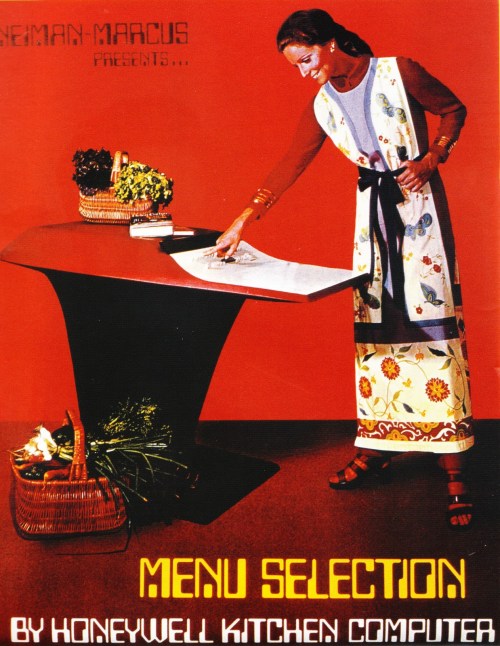
This is a page from the Neiman-Marcus Christmas 1969 catalog. The impeccably dressed N-M housewife is standing next to what appears to be an unusual table, but is actually the Honeywell Kitchen computer, which can be purchased for $10,000. (The apron will cost you another $28.) “If she can only cook as well as Honeywell can compute.” Indeed.

Kitchen Computer

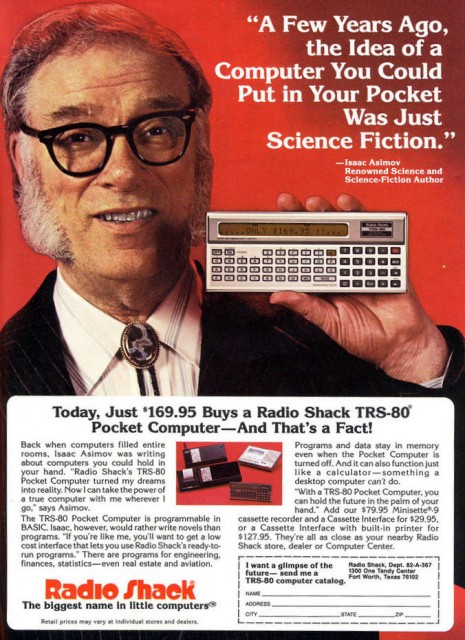
Here is something completely different from the era, prophetic rather than silly. It is Isaac Asimov, a science fiction great, advertising Radio Shack’s TRS-80.

Asimov - TRS-80

Note that in the spirit of what goes around comes around, this is a pocket computer almost exactly the size of a smartphone—or is a smartphone a pocket computer exactly the size of a TRS-80? Either way, Neiman-Marcus and Honeywell were clueless, but Asimov and Radio Shack were not.

That would be a pretty good close for this post. Except that the following ad is irresistible, telling us something else about the early days of computing.

TSP Plotter

Just as cars were, and to some extent still are, sold by using sex, sometimes so were computers. This is an ad for a plotter, possibly the least sexy of all peripherals. The copy is mostly bone-dry and technical. But then there’s the trio of the model with her dress open to her navel, the headline “New, Fast, and Efficient!”, and the lead “The TSP-212 Plotting System is a real swinger.” $3,300 COMPLETE. Well, almost complete, as the model is presumably not included. But you know, that cool plotter just might attract one.

The Aereo Case and Media Reality

Aereo

Today the Supreme Court hears arguments in the case of ABC, et al. v. Aereo. Some characterize it as the most important media case in decades, one which could destroy broadcasting as we know it.

That is both overstated and understated. The big broadcasters who claim this is the apocalypse won’t go out of business; they will continue, though they might make a little less money or have to work a little harder for it. On the other hand, nothing less than the nature of modern reality is being considered, which is what makes the case so interesting and ultimately so hard to decide.

In a nutshell, this is what Aereo does:

Aereo sets up lots of tiny (thumbnail) antennas in your locality.

The antennas pick up the same over-the-air (OTR) TV signals you would if you had an antenna at your home (but you probably don’t).

You subscribe to Aereo for as little as $8 a month.

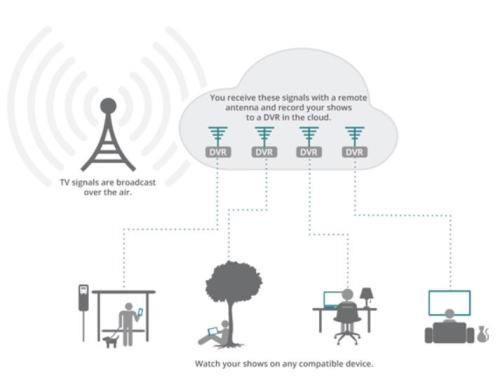
When you want to watch something from the stations that are on the air in your locality, Aereo assigns you an antenna, collects and records the signal from that antenna in its cloud, and streams that signal the way you want to the device you want, now or later.

The question is whether Aereo is retransmitting copyrighted content to subscribers, cleverly skirting retransmission fees that cable systems and others must pay, which would be stealing. Or whether Aereo is simply enabling you to do something you are legally entitled to do: receive OTR TV and then watch it, record it, or redistribute it to your own devices for your own personal use.

The Second Circuit Court of Appeal decided in favor of Aereo, with a vigorous dissent and with other Circuit Courts disagreeing, and now the Supreme Court will decide. If you read the briefs you can get an idea of the difficulty and the possible impacts.

One can say, as the big broadcasters do, that Aereo may be trying to fit through a loophole in the law, but that isn’t quite right. Aereo is taking advantage of a reality so profoundly new and so newly understood that every medium and every media business is just barely beginning to come to grips.

When you reduce things to information and can move that information around infinitely and frictionlessly and at relatively low cost, the processes and regulations meant to handle grosser things are of limited value.

First a book was a thing made of paper, then there was a copier which could copy pages on paper, then there was a scanner that could turn paper pages into digital images and, with OCR, characters, then there were entire books that never had anything to do with paper, ever, just pure arranged information. The same goes, with slightly different details, for every medium. The solution for the producers who wanted to control things (often with legitimate interests, such as creators being compensated), was to put the information in some kind of box, which to some looked like an information jail. It was and is this simple: once it gets out of the box, catching it and catching up with it is quite a chore. Because, as Stewart Brand famously said, information wants to be free.

If you had to characterize the actors in this case as good guys or bad guys, it does look like ossified old school versus new school, mega-corporations versus insurgents, or as one of the briefs says, David versus Goliath. Any way you put it though, and wherever your opinion lies, this is a hard case, and the maxim is that hard cases make bad law. In this case, bad law would mean that even if progressive principles are maintained, more looking forward than back, we are still in an astonishing mess when it comes to dealing with all this. One case at a time won’t do, and the expectation that Congress will seize the reins and lead us boldly into an enlightened future on digital intellectual property is, at least for the moment, not in the cards or the cloud.

Turkey Goes Radioactive

Erdogan and Twitter
Turkish Prime Minister Tayip Erdogan tried to close down Twitter in Turkey yesterday. Instead it exploded in his face, like a digital trick cigar.

Erdogan is miffed because Twitter is being used to disclose details about corruption, including the broadcast of phone conversations. “Twitter, mwitter,” he ranted as he blocked access.

The world noticed and, of course, tweeted. So did those in Turkey, who circumvented the ban by using an SMS text-based version.

As previous posts point out, Turkey is unlike any country in the world. Its path to modern democracy is unique and apparently unfinished. More than a bridge between east and west, it is a bridge between ancient and very modern. No nation, except perhaps for Israel, has experimented so creatively with making the past present, the past future, and the present and future past.

And, without any particular personal or filial or ancestral connection, it was for me love at first visit.

Also, even if you have no other feeling for it or reason to watch it, watch carefully. Turkey is a bellwether. If democracy and modernism proceed hand-in-hand there, there is great hope for the world, if not necessarily a replicable model. If Turkey cannot pull off that trick, we should all be concerned. Very concerned.

Erdogan has no plans to give up. But when I heard this morning’s score—Twitter 1, Erdogan 0—the song that came to mind was Radioactive by Imagine Dragons:

I’m waking up
I feel it in my bones
Enough to make my systems blow
Welcome to the new age, to the new age
I’m radioactive, radioactive

The Comcast-Time Warner Cable Merger

Comcast TWC
Meet the new boss
Same as the old boss
The Who, Won’t Get Fooled Again

Comcast and Time Warner Cable are not bad companies, but their proposed merger is a bad idea, for consumers and for the country. For one thing, it would put cable Internet service for the majority of the country—including 19 of 20 metros—in the hands of a single enterprise. Consumers Union among others has come out against the merger. For an excellent overview, see Free Press, which has been articulate and vocal in its opposition.

Even in these first weeks after the proposal, this should have caused more public concern than it has. Some of that diffidence may be understandable. Without impugning motives, in this 2014 election cycle, federal candidates have received $1,184,535 in contributions related to Comcast ($3,188,117 for 2012) and $351,649 related to TWC ($845,616 for 2012)—split almost evenly across party lines.

MSNBC, the chatty and progressive cable outlet, has been relatively quiet. You can determine this by searching for “merger” on the MSNBC.com site over the last month. Of the 54 hits, it looks like all but one reflect a February 14 Morning Joe joint appearance by Comcast CEO Brian Roberts and TWC CEO Robert Marcus. Their positive talk was expected. But the lack of sharp questioning is a different matter. In fact, at one point Joe Scarborough strangely prefaced his praise for Comcast this way: “It’ll sound like a softball question, but I’m genuinely intrigued: what is Comcast doing right over the past several years?” Why is that so strange? Because Joe and Mika and everyone else on Morning Joe and the network work for Brian Roberts, since Comcast owns NBCUniversal. None of that was discussed or disclosed.

But even that isn’t the solution to the puzzle of why this issue hasn’t and may never reach the level of concern it deserves. It’s this: consumers aren’t worried about living with cable monopoly because they already do, and have for a long time.

To understand that, we have to go back to the start of broadcast regulation. Radio was the beginning of over-the-air broadcasting. Just because the radio pipeline was invisible didn’t mean it couldn’t be filled to overcapacity; the radio spectrum was finite. People could build bigger and more powerful transmitters, using brute force to fight over frequencies, leaving the radio listener lost in chaos. Order had to be imposed so that some body—now the FCC—could control who was on the air, how they maintained their presence on the air, and, most controversially, what they said on the air.

Cable turned that (and cutting-edge modernity) on its head. Instead of just building bigger and more powerful transmitters to reach farther and more people invisibly, old-fashioned physical wires would be strung and laid to connect consumers to a network. Theoretically, there was no limit to how many cables you could build over mountains and across valleys, on poles and underground, all to bring broadcasts, and eventually Internet, from a source to your home. But practically, building out that infrastructure was expensive and inconvenient. To maintain, expand and improve service, cable companies wanted assurance that it would be worth it. And so local cable monopoly was born. For decades, and to this day, municipalities across the country enter into agreements with cable providers to be the sole source for particular areas, with loose oversight of rates and service. In general the place you live will be served by one particular provider.

This squeeze was a little relieved by certain technological advances. Satellite service could provide both television and Internet, though the physical requirement of line-of-sight to the sky made it sometimes impractical. DSL Internet over phone lines also offers an alternative, though as Internet needs have grown, cable has proven a much “fatter” pipeline for data. In the end, as a practical matter, the local cable provider is for many consumers the best choice.

If you can call it a choice. Those consumers may not be as concerned about whether Comcast/TWC acquires some sort of monopoly because for years those consumers have been living with a local cable monopoly. This is another of the strange moments from the Morning Joe interview with Comcast’s Brian Roberts. One of the arguments used to defend the merger is that there is practically no overlap between the Comcast and TWC markets. Of course, that is precisely the point. Roberts’s argument, though it isn’t what he meant to say, is that since consumers never had a choice in the first place, they won’t notice the difference.

And maybe, just maybe, he’s right.

The Strange Case of App Ops and Android Privacy

Android
Last week Google removed a privacy capability from the latest version of its Android operating system. Odd because Android is all about onward and upward. Always more and not less.

Not so odd in its being under-reported and relatively unnoticed. The capability was something that’s been called App Ops—application options—that allows users to pick and choose which permissions an application can have. It would, for example, allow you to tell that flashlight app that it could use your smartphone lights but it could not read your list of contacts (which, infamously, one flashlight app has done). App Ops was included last fall in Android 4.3, but was never officially documented and was unreachable and unusable by the non-tech oriented.

But Android fans never sleep, and so dozens of apps were developed just so that a user could access the capability and tell even the most popular apps to quit snooping around places they didn’t need to be to be functional. Then, with the release of Android 4.2.2, App Ops was gone.

You may be one of the many millions who don’t care, because all you want is for your Android device to run trouble-free, and even because you have decided that privacy is something you give to get—in this case to get some pretty awesome apps for free.

In case you do care, here’s a brief on how we got here.

Android is the most popular mobile operating system in the world, with iOS substantial for Planet Apple, and Windows insurgent. Development of Android apps has been like nothing in digital history. Anyone can do it and has, to varying degrees of technical and user success. Just as importantly, with Android apps, free is the norm. To make free work commercially, developers to varying degrees scrape your device for personal data that can be synthesized and used for marketing purposes. Permission to gather the information is requested, but on an all or nothing basis: either you agree to all the requests or you use some other app.

That is, of course, why App Ops is so radical and dangerous. Many of the permissions don’t in any way affect the functionality of any given app. They are there for collateral purposes. If users could just cut off the flow of personal information, certain commercial support would be hindered, if not collapse entirely. To put it another way, users might have to start paying for apps that they take for granted are free. Or they might look for similar apps that are actually free.

Google now says that App Ops was never intended for users. It was built for developers working on Android 4.3 as a testing and experimental capability. It was supposed to be removed before the new version was released. It was, in short, an accident.

Privacy advocates such as the Electronic Frontier Foundation are understandably upset. They have been pushing for just such a capability, and now that it appeared and just as quickly disappeared, it is defeat snatched from the jaws of victory. Even if the victory was accidental.

All is not lost, not entirely, not for everybody, not for the moment. Because of the tortuous path to Android upgrade, some of the most popular smartphones such as the Samsung Galaxy S4 just got their update to 4.3, which is App Ops capable. If you are in that cohort, please check out one of the many simple enablers on Google Play, such as Permission Manager – App Ops.

For those who like Android and privacy esoterica, here’s one last point. App Ops doesn’t just allow you to turn permissions on and off. It also allows you to see how often and how recently the app has used that permission. In that respect, it is actually kind of heartening. The assumption has been that with these permissions in hand, developers have been using our devices as open books. It turns out that a number of well-known apps have never used most of the permissions they’ve requested and been granted. This is no reason for a party, and if anything proves the contention that they didn’t need those permissions in the first place. But it does provide the tiniest bit of comfort knowing that your personal life is a little less compromised than it might have been.

Rethinking Wireless: Why AT&T CEO is Right and May Be Wrong

AT&T
AT&T is again rethinking wireless service. At an investor conference on Tuesday, AT&T CEO Randall Stephenson spoke about changes in how the company provides devices and services to its customers.

“When you’re growing the business initially, you have to do aggressive device subsidies to get people on the network. But as you approach 90 percent penetration, you move into maintenance mode. That means more device upgrades. And the model has to change. You can’t afford to subsidize devices like that.”

To unpack and analyze this, a little history, wireless and otherwise, is in order.

AT&T has been at or near the forefront of changing directions in the industry. It successfully moved large numbers of its customers away from unlimited data plans, with more than 70% now paying for a fixed amount that they can use. Without the simplicity of unlimited bundling of voice, data and text, AT&T has still tried to simplify by grouping those formats in shared plans.

But then there were the devices to deal with.

The mobile device industry is out of control, which is what you would expect in a free market for an exploding technology. Manufacturers can do more and more, more quickly, asking more or less for it, depending on the configuration and profitability demands. The upshot is that smartphones are on an annual improvement cycle (the typically-used 18-month cycle is just bandied about to make it seem a little less crazy). And those smartphones are genuinely expensive, befitting miraculous pocket-sized computers, which they are.

This is where wireless providers like AT&T came in and how it became such a mess.

As the gatekeepers of wireless service, providers find themselves playing two supposedly synergistic roles. When you get to the gate, they sell you service and devices to use the service. One of those roles is relatively simple and straightforward. The other—as a reseller of hardware—has become the problem.

Back in the day, before changes in telecomm capped by the breakup of “Ma Bell” in 1982, it was this easy for AT&T and its customers. You leased a phone from AT&T and you paid whatever regulatory bodies allowed for your service. The attempt to inject the free market into this process more or less worked to radically reform that. You could get your service elsewhere and you could get your phone elsewhere and ultimately anywhere. Pricing for service and devices dropped accordingly and precipitously. AT&T and its emancipated children did not have to be in the business of selling phones, though particularly in the business sector, they still did.

Then came wireless and all bets were off.

Networks and devices came in pairs: if you want AT&T service, these are the cell phones that work on its network. AT&T did not want to be in the device-selling business, but as Stephenson pointed out, that was how you get customers on the network, where you sell your actual moneymaker.

The evolution to smartphones and data seemed on its face an opportunity. Those devices would be hungry for exactly the sort of meal that AT&T cooked up. AT&T would make the devices relatively easy to own. It was Business 101: Give away the razors, sell the blades. Manufacturers devised really nifty devices, applications for those devices proliferated like rabbits, and all should have been right with the world for AT&T, even if it had to subsidize those devices.

But few could foresee the frenetic hyperspeed at which devices would develop. A smartphone barely two years old could become a technological and experiential antique—or so it was made to seem to consumers. AT&T and others always had appropriate upgrade paths, still predicated on the seductively-priced device model.

When the tenability of that model came into question, the industry looked over its shoulder to another industry that has long had to deal with expensive devices: automakers. While the idea of owning a telephone would have seemed strange to consumers in the 1960s, so would the idea of leasing a car. But when money became tight for car buyers, that is exactly what the auto industry turned to. And when wireless providers decided to no longer deeply subsidize $600 smartphones, they came up with the same solution. For the moment AT&T is still offering smartphones at a somewhat reduced price with a two-year contract, but not as reduced as it once was. AT&T would love to leave that model behind and it may well disappear entirely. Instead, you can pay full price for the device or bring your own (with a small monthly service discount if you do), or you can pay on installments. After 20 months, the device is yours, but as with a car lease, you will owe the entire residual amount if you end paying installments early.

Here are items that Stephenson did not account for or disclose, at least publicly at the conference.

By pulling away from its role in the device distribution chain, AT&T will not curb the device development madness or the consumer desire for the latest and greatest, which is always a few months around the corner. Stephenson’s taking a stand is completely bottom-line rational, but is likely to prompt a new dynamic, in which synergy diminishes, replaced by some still-to-be-determined forces.

In essence he has said: This is nuts and we are not playing this game anymore. But if he thinks that the other players—consumers and manufacturers—are about to adapt to AT&T’s direction, it may not be that easy.

Manufacturers have been granted extraordinary freedom by the subsidy-model, freedom which certainly contributed to the accelerated upgrade cycle. They have developed expensive devices that they knew would be discounted and therefore more accessible to consumers. But they are in the business of innovation, and they can’t and won’t just stop. Either they slow down innovation, or they make devices more affordable, or they expect people to shell out big bucks every couple of years. This may or not be what Stephenson had in mind to do: shift the onus, get out from the tight space, and put the manufacturers between the rock and the hard place.

Consumers also don’t want to be left behind. The only thing moving faster than smartphone development are expectations of user experience. A good part of that is software-based, not necessarily requiring a newer or better device. But some of the most appealing and desired features and functions are device-bound. In keeping with Stephenson’s comments, the free market conclusion is that if customers want something, they should be willing to pay for it, if they are able. People might want to drive a Lexus or BMW, but some are just going to have to settle for a reliable Chevy. But that doesn’t mean customers are going to be happy, no matter how rational it is, when they’ve been driving the best for less up to now.

That isn’t the biggest question or unspoken prospect.

Consumers may not want or need as much service as AT&T has prepared to provide and plans to sell. It is evident, from research and from the rise of non-phone tablets, that this is now a Wi-Fi device world. The expense of data drove consumers there, and once they discovered that most of the capability of their smartphones could be accessed via free or cheap, and nearly ubiquitous, Wi-Fi, data and even phone service became the sometimes necessary sidekick turned to if and only if there was no Wi-Fi available. Which other than travelling, is increasingly rare.

All of us—manufacturers, providers and consumers—are rethinking the possibilities.