Bob Schwartz

Category: Technology

Why We Should Not Give Up on Global Nuclear Disarmament

Ban the Bomb

It is picture as quaint as someone dialing a telephone: protestors in the 1950s and 1960s marching around with signs that say “Ban the Bomb.”

Quaint because so many countries now have nuclear weapons that getting rid of them all borders on the ridiculous. And it’s not just major powers; smaller nations who have developed nuclear weapons consider themselves “major” for having done so. (It sure beats the trouble of developing a sustainable, healthy economy and democracy.) Speaking of democracy, nuclear armament is all so complex that one of the bright lights of a hyperdangerous region refuses to acknowledge even having a nuclear stockpile, pretending to maintain the worst kept geopolitical secret in the world.

And yet: Blessed are the peacemakers. According to someone or other, they will be called children of God. This doesn’t mean that warmakers and hoarders of nuclear weapons aren’t children of God. It just means that the billions who live in the shadows of those bombs and missile warheads might not feel particularly blessed. That’s why we, and our children and our generations, shouldn’t give up on global nuclear disarmament, no matter how naïve or impossible it seems.

Independence Day and STEM Democracy

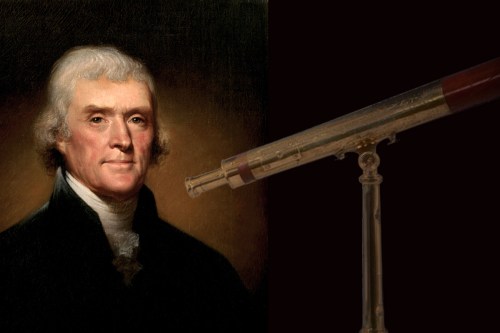
Thomas Jefferson with Telescope

Is the increasing hegemony of STEM education dangerous to the future of American democracy?

In Science and the Founding Fathers: Science in the Political Thought of Thomas Jefferson, Benjamin Franklin, John Adams, and James Madison, Professor I. Bernard Cohen might see it otherwise. As one of the most eminent historians of science, he makes the case that the familiarity of some Founding Fathers with science inspired the new nation, and that the shape of the new democracy was directly based on scientific principles.

One review notes about Professor Cohen’s theory:

The Declaration of Independence, which he [Jefferson] wrote, reverberates with echoes of Newtonian science, as when he invokes “self-evident” truths or “laws of nature.” Benjamin Franklin, far from being a mere tinkerer or inventor, pioneered the science of electricity. Franklin also developed a demographic theory that North America would become a population center of the British world; this led to the policy according to which the British annexed Canada rather than Guadeloupe as the spoils in the war against the French (1754-63). John Adams, who studied astronomy and physics at Harvard, was a founder of the American Academy of Arts and Sciences in Boston. And James Madison, a devoted amateur scientist, drew on scientific metaphors and analogies in his Federalist articles.

Maybe. But in fact, most of those in Philadelphia for the Continental Congress from which the Declaration of Independence emerged were not scientists or even science fans. And even those whose philosophy was shaped in part by science enjoyed a much broader education, one that gave complete dimension to their thinking, what we now call liberal arts. So that while the intriguing questions that Professor Cohen raises are significant, so is the parallel question: If the Continental Congress had been mostly or entirely filled with 18th century scientists, just what kind of Declaration would have been produced, and more broadly, what kind of nation would we be?

Nowhere can the nexus of Big Science and Big Political Philosophy be better seen than in Richard Rhodes’ magnificent book The Making of the Atomic Bomb. It is sort of a fun house mirror of what Cohen claims for the American founding. Rather than world-changing political thinkers with a scientific bent, we have equally historic scientists with a worldly and philosophical bent. They had been educated in the early 20th century, many in Europe, and the standard for education then and there was broad learning beyond the laboratory. In the end, their science was driven by the realities of World War II and Hitler, but that did not stop them from philosophical ponderings and quandaries about the work they were doing and its ultimate impact.

So, yes, it may be that science did help give us what by all measures is a remarkably robust and resilient democracy, starting with the rousing rhetoric of the Declaration of Independence. And we should educate scientists, to make progress and to advance the liberty, peace, and security we want. But we should also have many other thinkers, scientists or otherwise, who are capable of leading and having enlightening debates about exactly what we do need and want, and about the means we choose to get there, and about where it might lead. We do need scientists, technologists, engineers, and mathematicians. But it is never enough, not nearly enough, at least not in this democracy.

Technology Saves Us Again with Infinite Self-Tying Water Balloons

Bunch O Balloons

Just when you think that 21st century technology has served up all it can—for better or worse—along comes Bunch O Balloons .

Let them tell the story:

Bunch O Balloons is the ultimate way to make water balloons! Fill over one hundred water balloons in just seconds with this ready to go bunch of self-tying water balloons and blast the competition out of the water.

One hundred water balloons in just seconds!
Self-tying water balloons!

We barely had the audacity to wish it.
They had the inspiration and creativity to build it.

Other modern marvels will have to step aside. Even the atomic bomb—the fiercest and most significant technology of the 20th century, maybe of any century—can sit in the shadows. We now have a means of mass warfare that it is fun and relatively harmless (except to Wicked Witches and others sensitive to water). It’s true that some spoilsports will think about filling the balloons with liquids other than water. And that those who could only throw one water balloon as a symbol of protest will now have an unlimited arsenal.

But seriously, how can we not be in awe of a development so, well, awesome?

Stay dry, my friend. If you can.

Pope Francis’ Encyclical Laudato Si’

Laudato Si'

The Pope’s new encyclical, Laudato Si’, has been much in the news. Whatever you’ve heard about it, if you haven’t seen it, you really don’t know the whole story.

You’ve heard it is about the environment and climate change, which is in small part true. You’ve heard Catholic presidential hopefuls such as Jeb Bush and Bobby Jindal admonish the Pope, their spiritual father, telling him to stick to religion and stay out of politics.

The encyclical is much bigger than climate change, the environment, and certainly bigger than Bush or Jindal or dozens of politicians. It is a big statement about the moral and religious shortcomings of this modern world and us modern people. You don’t have to be Catholic or Christian or faithful or religious to read and appreciate it. You just have to read it.

It is full of inconvenient and uncomfortable truths. Which is probably why the coverage has focused on the environmental exhortations, rather than on the broader cultural, media, technological and social ones. In essence, it is nothing less than a call for radical evolution, in the spirit of the radical evolutionary upon whom the church is built. There are plenty of established institutions and powerful interests and individuals, including the media, who could be forced to change if such radical evolution came to pass. And many of them don’t want to change, and don’t even want us to listen to the Pope talking about it.

The encyclical is a long and deep but very readable work. Download it, sample it. You don’t have to read it all, or all at once. It is naturally grounded in theology, and in some particular theology, but be assured that the observations and conclusions don’t require you to hold any sectarian beliefs. It only requires that we believe that things are far from perfect, and that after we take a close look at ourselves and others, we believe that we have the power and obligation to make things better.

It is filled with so much quotable inspired thought and inspiration. Here is just one brief excerpt:

114. All of this shows the urgent need for us to move forward in a bold cultural revolution. Science and technology are not neutral; from the beginning to the end of a process, various intentions and possibilities are in play and can take on distinct shapes. Nobody is suggesting a return to the Stone Age, but we do need to slow down and look at reality in a different way, to appropriate the positive and sustainable progress which has been made, but also to recover the values and the great goals swept away by our unrestrained delusions of grandeur.

Laudato Si’ PDF

Laudato Si’ epub and Kindle

Broken Memory Card Books

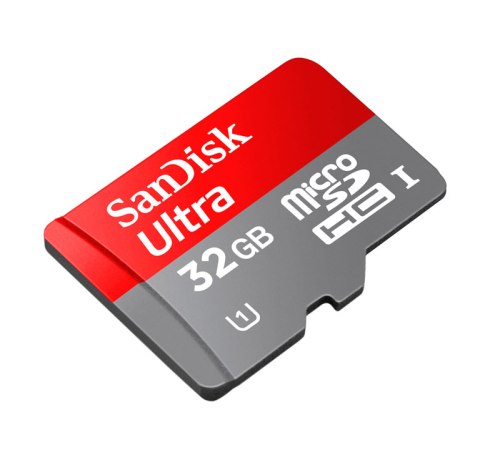
Micro SD Card

The micro SD memory card I inserted into my tablet is now broken. Literally. Bent in two places. All the books, music and movies on it cannot be accessed. (How it got that way is another story. Also, all you cloud storage lovers can please be quiet about “This is why cloud storage is so much better.” I like my local electrons.)

This is not a tragedy in so many ways: compared to the rest of the world, the rest of my life, the rest of my digital life. None of the media was lost; it is simply a matter of loading a new card with any of them.

Micro SD cards are very small and delicate, but powerful. The size of thumbnail, this one had 32 GB (gigabyte) of memory. The average book is less than 1 MB (megabyte), a music track around 5 MB. One GB is about 1,000 MB. Not that I had a thousand books on that broken card (more like a few hundred), but I could have.

This is an opportunity. Rather than ask the memory card to remember all sorts of books that I might have loaded because I liked them a little or liked them once or thought them possibly interesting, but never actually got around to any more if at all, I will load the new card slowly and carefully, one by one, starting with those books that have meaning for me that is essential or nearly so. The moment I realized I was going to be starting over, I knew almost exactly which those were. Rather than desert island books, these are my broken memory card books.

There are metaphors about memory here, some pretty interesting ones, and you might have fun playing around with them. I might have time to do that too. But right now, I have put in a new card, and I’m about to load the first book. It won’t last forever as the only book on my tablet, but for now, it will be the center of my reading universe—a status it deserves.

Notes on Interstellar

Interstellar

1

Christopher Nolan’s movie Interstellar is more interesting than it is imperfect. See it if you like space movies, sci-fi movies, intellectually curious movies, spectacular movies, etc.

It is filled with wonders. It is like the car trunk stuffed with luggage for a vacation, so much colorful and significant luggage creatively crammed in that when you open it on arrival you say: Wow, I wonder how we ever got all that stuff in there?

No spoilers here, but a couple of things.

Look for all the tiny (and not so tiny) echoes of space and sci-fi movies past. Star Wars, Close Encounters, etc., but most of all 2001. Why not? Right now, “they” are probably having a good 5th dimensional laugh watching Stanley Kubrick’s proto-human apes tossing that bone.

Interstellar has the most subtly cool robots ever. TARS doesn’t sing like HAL, but he has moves like Jagger and is great with the snappy patter.

2

The movie is much about cosmology—the origin and nature of existence. Cosmology is the domain of all kinds of people, including religionists and philosophers. But in greater part, we have handed over many of those considerations, as in this movie, to theoretical physicists—Einstein, Hawking, etc. I am a big fan of cosmology.

It is not a spoiler to mention that plenty of people, including some in this movie, believe that the Apollo 11 moon landing was faked. Which raises this way-out-there question: What if the moon landing was real but all the cosmological theoretical physics is faked? Going back before Einstein, theoretical physics spends much of its time (as we understand it) looking for physical proof of those theories. What if all the theory is so utterly astounding and enlightening that when the evidence failed to support it, all the scientists engaged in the study conspired to make it seem as if those theories are supported?

Faking the moon landing mission has never been put entirely to rest because, in fact, only three people experienced it first-hand. Everyone else was second-hand or more distanced from the actuality. But the basic elements of it are well within our understanding: astronauts, rocket, spaceship, lunar lander, moon, television pictures. The cosmological speculation and supporting discoveries are so far beyond anything that most of us can fully—or slightly—grasp that we could easily be fooled into taking it for “reality.”

By the way, for those wondering about the earnestness of all that, be assured that I am just playing. Or am I?

3

We don’t have to be space pilots to experience cosmology, or be theoretical physicists or movie directors to think about it. Cosmology is ordinary. Interstellar and other movies and thousands of works of art and literature point to this. Everybody is a cosmologist, like it or not.

Cosmology is an excellent topic that does not necessarily require specialized knowledge. You may not know a worm hole from a black hole. But you already know a ton about time, space, being, and gravity. You just have to know how to know and that you know.

This is from an essay almost 800 years old. No more or less spectacular than Interstellar, it is no more or less a non-theoretical description:

Do not think that time merely flies away. Do not see flying away as the only function of time. If time merely flies away, you would be separated from time. The reason you do not clearly understand the time being is that you think of time only as passing.

In essence, all things in the entire world are linked with one another as moments. Because all moments are the time being, they are your time being….

You may suppose that time is only passing away, and not understand that time never arrives. Although understanding itself is time, understanding does not depend on its own arrival.

People only see time’s coming and going, and do not thoroughly understand that the time being abides in each moment. Then, when can they penetrate the barrier? Even if people recognized the time being in each moment, who could give expression to this recognition? Even if they could give expression to this recognition for a long time, who could stop looking for the realization of the original face? According to an ordinary person’s view of the time being, even enlightenment and nirvana as the time being would be merely aspects of coming and going….

Mountains are time. Oceans are time. If they were not time, there would be no mountains or oceans. Do not think that mountains and oceans here and now are not time. If time is annihilated, mountains and oceans are annihilated. As time is not annihilated, mountains and oceans are not annihilated.

Dogen
The Time Being (1240)
Treasury of the True Dharma Eye

The Tower of Babel and Technological Humility

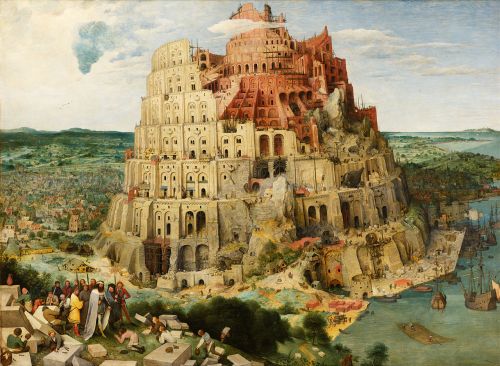
Tower of Babel - Bruegel the Elder

This week’s Torah reading, Genesis 6:9-11:32, includes two very different STEM achievements.

The first is the story of Noah, with a boat big enough to hold representatives of everything that lives (but does not swim). The ark’s purpose is to save all life in the face of an ultimate disaster. It works.

The other story is the Tower of Babel, with an immensely tall structure that has no obvious or express practical purpose. It is an early and elegant literary example of “because we can” philosophy. Think of it as a giant cosmic finger by some very arrogant builders.

Giving the finger is always rude and dangerous. Here, though, there is no violent retribution and no smiting by flood or fire. Instead, the result of that technological arrogance is eternal confusion and failure to communicate.

The Hebrew Bible has lots to say about human behavior, psychology, and spirituality. But no story may have more to tell us about life today than the Tower of Babel, especially when read in conjunction with Noah.

If we think we can build a boat big enough to save us from a particular catastrophe, maybe we can. But even then, as the rest of the post-Noah biblical stories and the rest of world history demonstrate, staying dry in the flood is just the beginning of our problems.

And if we think we can just show how smart we are by concocting a bunch of oversized technological wonders, monuments of pride, we may find ourselves, as the saying goes, too clever by half.

Consequences are inevitable. Purposes are necessary. Really big towers are awesomely cool. Just be sure you know, more or less, what you’re doing and why.


And all the earth was one language, oe set of words. And it happened as they journeyed from the east that they found a valley in the land of Shinar and settled there. And they said to each other, “Come, let us bake bricks and burn them hard.” And the brick served them as stone, and bitumen served them as mortar. And they said, “Come, let us build us a city and a tower with its top in the heavens, that we may make us a name, lest we be scattered over all the earth.” And the LORD came down to see the city and the tower that the human creatures had built. And the LORD said, “As one people with one language for all, if this is what they have begun to do, now nothing they plot to do will elude them. Come, let us go down and baffle their language there so that they will not understand each other’s language.” And the LORD scattered them from there over all the earth and they left off building the city. Therefore it is called Babel, for there the LORD made the language of all the earth babble. And from there the LORD scattered them over all the earth.

Genesis 11:1-9
The Five Books of Moses: A Translation with Commentary
Robert Alter

When Nokia Ruled the Mobile World

Nokia 1110

Microsoft is reportedly killing the Nokia brand, after having spent billions to buy the iconic company in hopes of boosting its stalled Windows Phone presence.

We are not surprised. Microsoft is the all-time tech accidental/incidental behemoth. Right place, right time, a few fortuitous decisions, strategic appropriations rather than innovations, and the next thing you know, we’re living and working in a mostly Microsoft world. Which is why Microsoft is constantly fixing what isn’t broken, and annoying and frustrating millions of users every second of every day.

The Tech Advisor article on the Nokia move led to one on the Top 10 Best Selling Mobile Phones in History.

Of those best selling mobile phones, 9 of the 10 are from Nokia (the Motorola RAZR V3 comes in at number 8). You may be used to what you think are big numbers, but at the top of the list—maybe forever—is the Nokia 1100:

The best-selling mobile phone ever is believed to be the Nokia 1100, which was released in 2003 and sold more than 250 million units. That’s more than any iPhone model. The success of the Nokia 1100 was not down to its features – it didn’t have a camera or even a colour display – but it was cheap, durable and did the jobs any mobile phone should.

Depending on your generation, you may not recognize the form factor of these Nokia phones. It was called a “candy bar” for pretty obvious reasons. If you were around for these, you also know that these were some of the most stylishly functional tech gadgets of all time: strikingly beautiful, naturally comfortable, reliably useful. Nokia did not sell over a billion and a half of the phones on the list because they were the only ones around; they sold them because they were the best and the coolest. (If that sounds like the iPhone story, it might a little, except that the Nokia phones were way cooler than any iPhone.)

Time does pass, and best is not biggest forever. Nokia’s big mistake was sticking to its proprietary operating system, Symbian, rather than adopting the then-nascent Android. If Nokia had gone Android early, it is possible we wouldn’t be talking about Samsung or Apple mobile the way we do. What later ended up happening was the marriage between a number 3 operating system, Windows, to a long past noble brand. It was a union that was never going to last.

In that box over there, though, are a couple of gorgeous Nokia phones that carried me into the mobile age and that I relinquished with great reluctance. A few years ago, when smartphones were still using the old, bigger SIM cards, I even switched SIMs and fired one of those Nokias up when a smartphone went temporarily down. Sure the Nokia seems rudimentary now. But I could still talk and listen, and still caress that Scandinavian beauty in my hand. Something Microsoft would never understand.

The Sabbath: To Have and To Do Without

Abraham Joshua Heschel

“To set apart one day a week for freedom, a day on which we would not use the instruments which have been so easily turned into weapons of destruction, a day for being with ourselves, a day of detachment from the vulgar, of independence of external obligations, a day on which we stop worshiping the idols of technical civilization, a day on which we use no money, a day of armistice in the economic struggle with our fellow men and the forces of nature—is there any institution that holds out a greater hope for man’s progress than the Sabbath?

“The solution of mankind’s most vexing problem will not be found in renouncing technical civilization, but in attaining some degree of independence of it.

“In regard to external gifts, to outward possessions, there is only one proper attitude—to have them and to be able to do without them. On the Sabbath we live, as it were, independent of technical civilization: we abstain primarily from any activity that aims at remaking or reshaping the things of space. Man’s royal privilege to conquer nature is suspended on the seventh day.”

The Sabbath
Abraham Joshua Heschel

The News and the Wheel

The Wheel - Jerry Garcia

The wheel is turning
and you can’t slow down
You can’t let go
and you can’t hold on
You can’t go back
and you can’t stand still
If the thunder don’t get you
then the lightning will

The Wheel
Jerry Garcia

If you are still listening to, watching, or reading the news, oh boy. If the world seems out of balance, that’s not just the news talking. That’s the way it is.

Thousands of U.S. troops sent to fight Ebola. No troops but planes and bombs to fight thuggish madmen disguised as religious fanatics whose organizational name we can’t keep straight. Honored gladiators beating their wives and children. Police shooting the people they are sworn to protect. The most powerful legislature in the world doing nothing when something is called for, something when nothing is called for, and blabbering on when silence is golden. Rampant use of destructive drugs, demonizing of less destructive drugs. Speaking of drugs, powerful pharmaceuticals interrupting your entertainment with the news that they can cure you, but may also kill you, harshly and slowly. And that’s just for starters.

Every time that wheel turn round
bound to cover just a little more ground

Won’t you try just a little bit harder
Couldn’t you try just a little bit more?
Won’t you try just a little bit harder?
Couldn’t you try just a little bit more?

Breathe. If it seems like madness, that’s because it is. But it’s our madness and we just have to live with it. Being strong and smart will move us forward, but it’s never enough. Being strong and smart will not, for example, cure our madness, and like those very high-tech pharmaceutical drugs, can do more harm than good. Misplaced confidence in our strength and our brains is like putting a thumb on the scale. Which is no way to get in balance.