Bob Schwartz

Category: Society

The NFL and Ferguson

Roger Goodell NFL

NFL player Ray Rice beat his then-fiancée/now-wife unconscious inside an elevator in Atlantic City. Police officer Darren Wilson shot dead an unarmed teenager in the middle of a street in Ferguson, Missouri.

(To Rice’s credit, he had the courtesy to drag her body out of the elevator, while the Ferguson police left Michael Brown’s body on that street for hours.)

These two incidents are so much the same and so different. They tell us things we don’t want to hear, know, or think about. They also tell us one surprisingly good thing. The establishment interests can be just as committed to privileging a black American as killing him ruthlessly, under the right circumstances. Especially if there’s big money at stake. So we learn that ignominy is race neutral at last.

Until yesterday there was no publicly available video of the beating, though it was apparently available and seen by various authorities. The only public video until then was from the outside of the elevator, merely showing Rice dragging the body, not beating it. As one journalist now explains his defense of Rice’s mere two-game NFL suspension and not being charged with a felony:

The inside-the-elevator video shows Rice, a running back for the Baltimore Ravens, provoking, brutally assaulting and then casually and callously standing over his knocked-out fiancée (who is now his wife). His actions are sickening in their depravity and confirm a worst-case-scenario narrative I was reluctant to believe after seeing only the previously released, outside-the-elevator video.

I thought the full video would explain why: Why police originally charged Ray and Janay with simple assault. Why the prosecutor allowed Ray to enter a diversion program. Why Janay apologized for her role. Why Janay chose to marry Ray. Why the Ravens enthusiastically supported Rice and used their facilities in helping him rehabilitate his image. Why Goodell suspended Rice for only two games.

I wrongly and naively thought that she was the aggressor in the attack, that Rice reflexively shoved her to fend her off and she slipped, fell and hit her head [emphasis added]. I did not think a man could sucker-punch a woman on tape and have the police, a prosecutor, the victim and the image-conscious NFL all work to treat the assaulter in a sympathetic fashion.

Fell and hit her head. That reminds us of nothing so much as the stories reported by battered children (and wives and girlfriends) who “run into doors.” Except this is a journalist using his best investigative and inferential skills to draw an “obvious” circumstantial conclusion. He could be forgiven for drawing the same ridiculous conclusion as law enforcement, the NFL, and the Baltimore Ravens. Except that some or all of them had the inside the elevator video or at least more detail, and still came to the same conclusion, at least publicly.

There is no video of exactly what happened to Michael Brown in Ferguson, though there are witnesses to pieces of it, an audio recording, and more than one autopsy. There the instinct on the part of vested interests and the establishment was to wait and see, but really to stonewall, cover up, and put the best light on the situation. That turned out to be a disastrous approach, but at least it got people talking about former unmentionables. Small consolation.

How is this any different than what is going on with Ray Rice? The vested interests tried to put the best light on his situation, and despite outrage, almost got away with it. How are the people who up until yesterday circled the wagons around Ray Rice, giving him the benefit of the doubt and a slap on the wrist, any different than those who have been circling the wagons around Darren Wilson, giving him the benefit of the doubt?

One difference is that Ferguson is a small predominantly black town with a small almost entirely white police force that appears to have some race issues, while the NFL is a huge enterprise predominantly owned and run by white people with a pro game substantially played by black men that appears to have some race issues. It’s those issues, along with other social, legal and moral ones, that have us all talking. About policing. About the NFL. About race.

The victims were both black, one a kid possibly involved in petty crime (there’s a video of that), the other a woman engaged to a professional warrior who could have easily killed her, rather than just beating her senseless after she “provoked” him (there’s now video of that).

Maybe from the first, Ray Rice should have taken the approach that will certainly be at the center of Darren Wilson’s defense, assuming he is charged: I was in fear for my life. Up until yesterday, lots of people would apparently have been willing to accept a story like that, if it served their interests. Thankfully, they now all have to stop pretending, and we can start asking what it all means.
We Need a Doctor: Who Hasn’t Seen Jennifer Lawrence’s Breasts or Why We Need Social Therapy

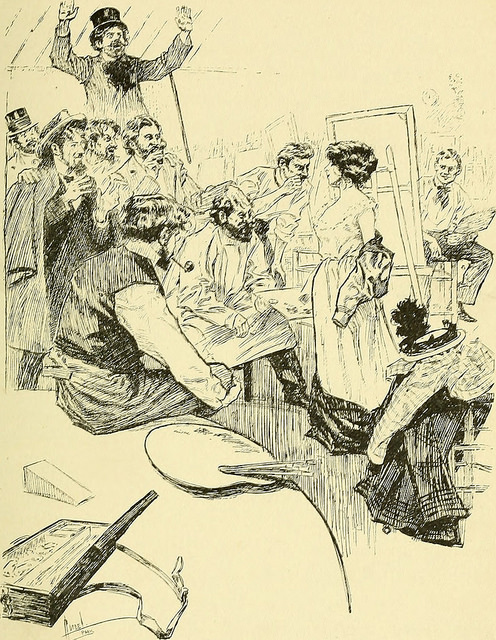
Bohemian Paris of Today

One of the biggest stories of the weekend was the posting of nude photos of Jennifer Lawrence and other female celebs, apparently stolen from their cloud storage accounts. The search activity for these photos almost brought the Internet down.

So in the immediate aftermath, with more to be revealed, what might we learn, besides how these beautiful strangers look without their clothes?

We are no closer than ever to figuring out what we think about privacy, or even what privacy means, especially now.

Digital didn’t create the issue, just heightened it exponentially. Inquiring minds have always wanted to know, and see. Celebrities, some though not all, have used degrees of exposure for publicity—or in some cases to put curious fans off the trail of the truth. Now we have an entire industry of programs about the “real” lives of unknowns, used-to-be-knowns, just-a-little-knowns, and soon-to-be-knowns because they are on a reality show.

Then there is the willingness of many people to chronicle everything. Twitter long ago dropped its signature question, but the most important phrase of the century so far may be “What are you doing?”, which was supposed to be answered in 100 characters or less. It turns out that people are more than willing to talk about what they are doing, what they are thinking, how they are looking, and anything else.

This doesn’t mean people don’t deserve privacy, morally and legally. It’s that line-drawing is now so hard for so many, and that goes along with a certain amount of confusion or even hypocrisy. The same people who searched for these photos or others like it in the past would be fuming if anyone stole their private shots and published them. They might try to rationalize the distinction, but it would be pretty feeble. Yet, not to forgive their double-standard, it is not surprising under the circumstances.

When we are confused about anything, and have difficulty drawing a line, sex makes it worse, clouding our judgment and our actions. Private parts are signifiers of sex, and if the private parts of loved ones or of strangers are arousing, the private parts of the quasi-strangers who are celebrities are positively crazy-making. So it is understandable, if not acceptable. People are only human, or so we say. But that doesn’t mean a little help and discussion—about privacy, about the cloud, about celebrity—might not be valuable. Maybe a little social therapy is in order.

We need a doctor, call us a doctor
We need a doctor, doctor to bring us back to life

(apologies to Dr. Dre, Eminem, and Skylar Gray)

Newark and Detroit: The Long Hot Summer of 1967

Newark 1967

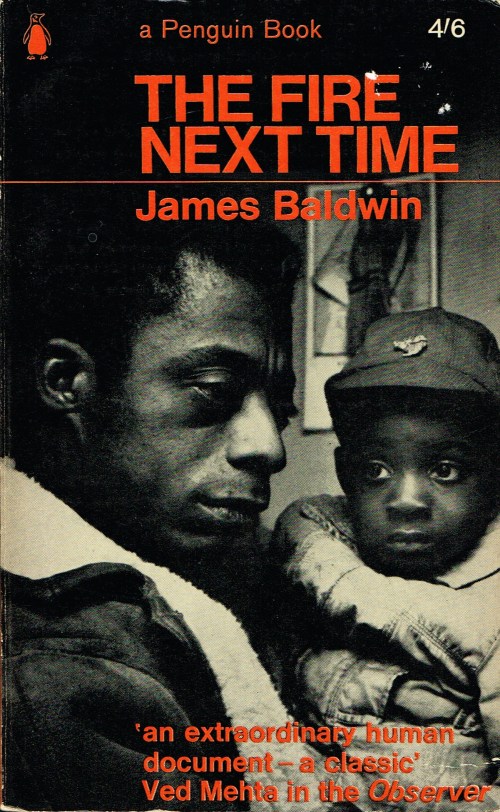
The last post about James Baldwin’s The Fire Next Time (1963) skipped a beat about what happened next. What happened in America was the race riots between 1964 and 1966 (including Watts in Los Angeles), culminating with the so-called Long Hot Summer of 1967. During that summer, among the many cities affected, the two disturbances that stand out are Newark and Detroit.

Baldwin did not overstate any prophetic intention in his book. Instead, he simply opened with this epigraph, from which he took the book’s title:

God gave Noah the rainbow sign,
No more water, the fire next time!

Newark, July 12-17, began with the arrest of a black cabdriver for passing a police car. The riots left 26 dead and hundreds injured.

Detroit, July 23-27, began with a police raid of a black drinking club. The riots left 43 dead, 1,189 injured, over 7,200 arrests, and more than 2,000 buildings destroyed.

There are at least three reasons we don’t hear much or talk much about that summer in the context of Ferguson.

We are abysmally ahistorical. If it isn’t in the latest Twitter feed, it may already be old news. Things that happened forty or fifty years ago might as well be from the Middle Ages.

We want to highlight and not overshadow the clear progress that has been made. Progress to be sure, as reflected in the photo of a black President talking to a black Attorney General about the events in Ferguson.

We are afraid. Afraid that the progress we have made may be as illusory as it is real. Afraid that we solved the easier problems, leaving us with stubborn, intractable ones that are beyond comfortable solutions. Afraid that we may not be as good as we think we are. Mostly afraid that history is TMI, telling us way more than we want to know, showing us images not from the distant past but from tomorrow.

Ferguson and The Fire Next Time

James Baldwin - The Fire Next Time

James Baldwin’s The Fire Next Time may be the best and most eloquent statement of relations between whites and blacks in America ever written. From the publisher:

The appearance of The Fire Next Time in 1963, just as the civil rights movement was exploding across the American South, galvanized the nation and continues to reverberate as perhaps the most prophetic and defining statement ever written of the continuing costs of Americans’ refusal to face their own history. It became a national bestseller, and Baldwin was featured on the cover of Time magazine. Critic Irving Howe said that The Fire Next Time achieved “heights of passionate exhortation unmatched in modern American writing.”

Baldwin was one of the great writers of his or any other American generation. He shouldered the burden of being a triple threat to America of the 1960s—a black man, a brilliant and outspoken intellectual, and gay. This he did with unequaled prose grace, and this work and others are required reading for anyone who wants or claims to be a writer.

The first of the two essays is My Dungeon Shook: Letter to My Nephew on the One Hundredth Anniversary of the Emancipation. Brief and unforgettable, it is a summary of how things are and why his teenage namesake cannot give up and in. It does no justice to this book to excerpt it; it stands as a whole that must be read—not the least of all because with the real progress we have made, we are foolish and destructive to over-measure how far we have come. But here is how the essay closes:

And if the word integration means anything, this is what it means: that we, with love, shall force our brothers to see themselves as they are, to cease fleeing from reality and begin to change it. For this is your home, my friend, do not be driven from it; great men have done great things here, and will again, and we can make America what America must become. It will be hard, James, but you come from sturdy, peasant stock, men who picked cotton and dammed rivers and built railroads, and, in the teeth of the most terrifying odds, achieved an unassailable and monumental dignity. You come from a long line of great poets, some of the greatest poets since Homer. One of them said, “The very time I thought I was lost, My dungeon shook and my chains fell off.”

You know, and I know, that the country is celebrating one hundred years of freedom one hundred years too soon. We cannot be free until they are free. God bless you, James, and Godspeed.

Your uncle,
James

Fortune Magazine Pleads: Heed the Authentic Cry of Our Youth

Youth in Turmoil Cover

It is January 1969. Fortune, one of the world’s most conservative business magazines, publishes a special issue about Youth in Turmoil. It then adapts the issue into a book, with an image of a flame on the cover.

The message is not, as you might expect, about how these ungrateful long-haired drug-addled rebels are destroying the country. On the contrary, the message is that these young people are trying to tell us something important and we should listen—before it’s too late.

Here is the introduction:

American youth is trying to tell us something important. The brightest of our young men and women are telling us that as far as they are concerned the choices for our society are narrowing rapidly. We can, at worst, look ahead to a future, very near, in which they lose all heart for our national effort, thus robbing it of its nerve, vitality, and point—a state of affairs in which they range themselves against us either in violence or in withdrawal. Or we can heed the cry of these young adults. Though often marred by shrillness, arrogance, and negativism, that cry is authentic and valid in its central message. It tells us that in our rush to well-being we have left much undone at the same time we have made so much more do-able. It tells us that we should rechannel our enormous energies to deal with the lengthening list of environmental and social grievances. If we can enlist these young idealists and they can enlist us, the nation will evolve toward a life style that once again sets a new standard for the world. I hope that this book, adapted from the January, 1969, special issue of FORTUNE, will contribute to that mutual enlistment.

LOUIS BANKS,
MANAGING EDITOR, FORTUNE

Please read this word-for-word. It is extraordinary. This is a bible of the establishment, during one of our most anti-establishment times, acknowledging that many things are wrong—including environmental and social problems—and admitting that young people are trying to remind us of our responsibilities to make it right. If the establishment fails, Fortune says, “We can, at worst, look ahead to a future, very near, in which they lose all heart for our national effort, thus robbing it of its nerve, vitality, and point—a state of affairs in which they range themselves against us either in violence or in withdrawal.”

Consider how far we have come. Youth seems to be somewhat disaffected, maybe even having lost heart and been robbed of its nerve—but not exactly in turmoil. Much of the conservative establishment would now never dream of agreeing that we have justifiable environmental and social grievances, let alone that these should be aggressively addressed.

The Sixties are variously celebrated, trivialized, and even laughed at. Maybe it’s funny to see a Big Business publication like Fortune willing to open its eyes, look around, and decide that these kids just might have a point and we can do a whole lot better. Or maybe it’s a little sad that we don’t see more of that today.

Project One America from the Human Rights Campaign

poa_maingraphic_1

The new Project One America from the Human Rights Campaign is extraordinary for two reasons. As HRC describes it:

HRC’s Project One America is a comprehensive, multi-year campaign to dramatically expand LGBT equality in the South through permanent campaigns in Mississippi, Alabama and Arkansas.

That this is aimed at these three Southern states is extraordinary because of the special circumstances and needs it addresses. These states have enjoyed the presence of gay men and women for generations, including some of the very famous: Tennessee Williams, for example, was not from Tennessee but from Columbus, Mississippi. “Enjoyed” is probably not the right word, since until recently—and still in some parts of these states—gay people had the choice of invisibility, damnation, lack of legal protection, or just leaving (which is precisely what many gay Southerners did).

The second extraordinary thing about Project One America is its strategy. Rather than confrontation, part of the approach is one of the front porch—conversations and discussions among family, friends, neighbors, citizens. This doesn’t mean that legal restrictions and inequities won’t continue to be addressed. It means that the South, some historical and present-day evidence to the contrary, does have a tradition of civility and caring. Caricatures are one part truth, one part projection of our own prejudices, one part wanting to feel morally superior, and the Southern caricature is all of these. Gently opening people’s eyes to the realities and humanity of LGBT life—including the lives of those close to them—is a valuable tactic. The lessons of loving and fairness and tolerance, in a place that tightly embraces its faith, should fall of fertile soil.

The Other Poverty: The Poverty of Ideas

mining_lg
The other poverty is the poverty of ideas.

Let us ask each of our leaders and politicians for just one relatively new and interesting idea to solve a pressing problem. Just one. It doesn’t have to be an idea that has won substantial support or that has achieved broad consensus. In fact it can’t be that. Instead it should be something that is just a little bit out there, the kind that might elicit a “you must be kidding” or “that will never pass” or “that will never work.”

What we mostly have is problem solving that borders on archival monomania, the single idea with ancient lineage that fits a particular purpose or ideology—but has not really demonstrated an ability to solve particular problems.

This morning Sen. Dean Heller of Nevada explained why he is one of the few Republicans supporting an extension of unemployment benefits. In the course of the interview, he said that the biggest problem was jobs. He then ticked off the number one conservative solution—tax reform—but when he got to the second idea, it came out sounding like “something else” without a single detail. That’s because leaders and politicians on both sides of the aisle are stumped, which they admittedly should be by the unique and unprecedented economic moment we are living through.

During the 2012 presidential campaign, Newt Gingrich was roundly derided for his suggestion that we mine the Moon and colonize Mars. There are plenty of reasons that Newt wasn’t and isn’t a good choice for President, but that isn’t one of them. Sure it’s a bit science fictionish, but then so is practically all of the current tech that is one of the only bright spots in the global economy. Can you imagine a U.S. Senator in the 1950s coming to the floor of the Senate brandishing a copy of that weekend’s Sunday funnies, pointing to Dick Tracy and saying “That wrist radio, gentlemen, is where we should be heading.”? China and India are racing to the Moon, and it is not for the view.

Politics and political leadership are inherently conservative, in the sense that maintaining the institution and its support seems to demand modest, slow, incremental change—if any change at all. That’s where party lines and sticking to scripts come from. An intolerance for innovation and fringe philosophy go with that. We shouldn’t be asking parties or politicians to give up core principles and precepts. But if we actually want to solve problems, and not just hear tired old nostrums that won’t do any good, then we have to make a safe place for innovation, one where thinkers who happen to be in office are not committing political suicide by offering something interesting and maybe even eccentric. Because until we ask our politicians to enrich us with new ideas and not empty platitudes and happy talk, more of us will be unhappy with increasingly empty pockets.

Philip K. Dick’s Birthday

Philip K. Dick color
Yesterday was the birthday of writer Philip K. Dick (1928-1982).

If we measure creative success by the dollars generated through adaptation and exploitation, PKD was a monumental success, though he didn’t live to see most of it. His work was the source material for Blade Runner, Total Recall, Minority Report and other films.

If the measure of creativity is being creative, PKD is more than just the most adventurous science fiction/speculative fiction writer of his generation. Maybe no other writer of his century, or even now, has so masterfully taken readers to the edge, and then taken them a little further. In their view of the world, many of those readers never quite come back.

PKD lived, at least in his mind, beyond that edge. His mental instability is a matter of record, though there is still and will be questions about exactly what the clinical profile was.

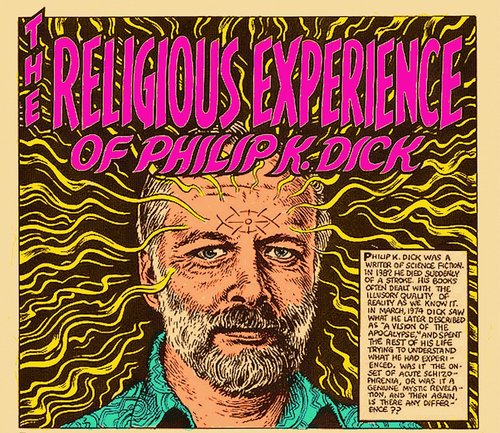
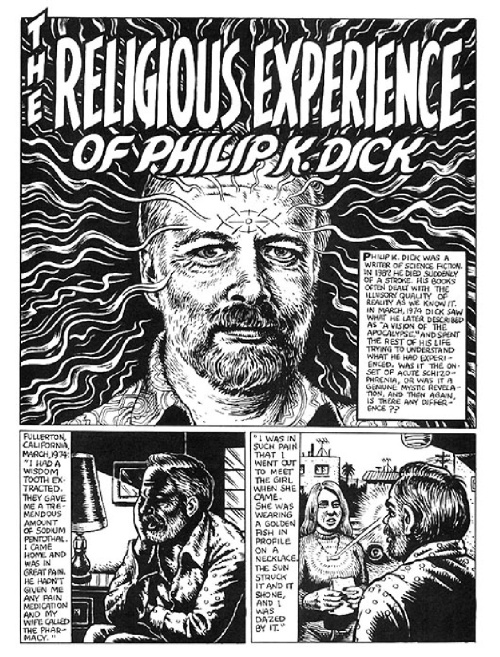
In 1974 PKD had what can be called a religious experience. The comic artist R. Crumb illustrated some of that experience, as related by PKD. You can view the entire comic here.

PKD Crumb 1

“There will come a time when it isn’t ‘They’re spying on me through my phone’ anymore. Eventually, it will be ‘My phone is spying on me’.” ― Philip K. Dick

Is Pope Francis the Leader of the World?

Pope Francis
The Dalai Lama is the most famous Buddhist in the world. His message is powerful, positive and universal. Even with the huge platform he has, his brand of Tibetan Buddhism is a bit exotic for many people, so still somewhat limited. He is also one of the coolest people on the planet. So as much as a basic Buddhist message would be great for the world at large to take to heart, it isn’t about to happen.

Pope Francis is also an outsized moral leader. He is the head of a church with more than a billion followers. And while there are hundreds of millions of Protestant Christians who question whether that church and its Pope can claim Christian legitimacy—and who find the Catholic Church plenty exotic too—you can’t deny the size and scope of the Pope’s Christian community. And if the Dalai Lama is cool, so is Pope Francis; he was once a bar bouncer, which is something the Dalai Lama can never claim.

The biggest argument for the supreme leadership role of Pope Francis is that he is exactly the right person for the right time, acting and speaking on a very big stage. Two of the major characteristics of the moment are that materialism seems to be failing or failing us and that our changing social universe requires some tricky balance between the old and the new, the absolute and the relative.

Pope Francis gets this and sells this from the very foundations of his faith. He has just had to deny that his is a not a Marxist, but proceeded in the same breath to appreciate the work of those who sincerely act in the name of Marxist ideals. It is not just that he seems to have a vision that synthesizes the original Christian communities with the complicated world two millennia later. He sees in the very institution he is charged with running the embodiment of the problems. If the institutional church, the church membership and the world have lost their way, it is not his job to order them around. Instead he just points to a playbook that is to be taken seriously, not selectively and strategically, and advises to live by and as its example. It’s a choice, one he has made, one he hopes others, from the church hierarchy on out, will make.

Whether the Catholic Church straightens out its affairs, whether disaffected Catholics return, whether new Catholics arrive, whether we are Catholic or Protestant or Jewish or Buddhist is beside the point and beside the Pope’s point. It is about being better and getting better. Pope Francis is not the first to say that, not even the first Pope to say it. But his walking the walk in the world of 2013 is different. These are the times that try people’s souls. We seem to have a world leader willing to make that reality both an ancient and modern quest, a quest that may, in the real and not theological sense, save us all.

The Strange Case of App Ops and Android Privacy

Android
Last week Google removed a privacy capability from the latest version of its Android operating system. Odd because Android is all about onward and upward. Always more and not less.

Not so odd in its being under-reported and relatively unnoticed. The capability was something that’s been called App Ops—application options—that allows users to pick and choose which permissions an application can have. It would, for example, allow you to tell that flashlight app that it could use your smartphone lights but it could not read your list of contacts (which, infamously, one flashlight app has done). App Ops was included last fall in Android 4.3, but was never officially documented and was unreachable and unusable by the non-tech oriented.

But Android fans never sleep, and so dozens of apps were developed just so that a user could access the capability and tell even the most popular apps to quit snooping around places they didn’t need to be to be functional. Then, with the release of Android 4.2.2, App Ops was gone.

You may be one of the many millions who don’t care, because all you want is for your Android device to run trouble-free, and even because you have decided that privacy is something you give to get—in this case to get some pretty awesome apps for free.

In case you do care, here’s a brief on how we got here.

Android is the most popular mobile operating system in the world, with iOS substantial for Planet Apple, and Windows insurgent. Development of Android apps has been like nothing in digital history. Anyone can do it and has, to varying degrees of technical and user success. Just as importantly, with Android apps, free is the norm. To make free work commercially, developers to varying degrees scrape your device for personal data that can be synthesized and used for marketing purposes. Permission to gather the information is requested, but on an all or nothing basis: either you agree to all the requests or you use some other app.

That is, of course, why App Ops is so radical and dangerous. Many of the permissions don’t in any way affect the functionality of any given app. They are there for collateral purposes. If users could just cut off the flow of personal information, certain commercial support would be hindered, if not collapse entirely. To put it another way, users might have to start paying for apps that they take for granted are free. Or they might look for similar apps that are actually free.

Google now says that App Ops was never intended for users. It was built for developers working on Android 4.3 as a testing and experimental capability. It was supposed to be removed before the new version was released. It was, in short, an accident.

Privacy advocates such as the Electronic Frontier Foundation are understandably upset. They have been pushing for just such a capability, and now that it appeared and just as quickly disappeared, it is defeat snatched from the jaws of victory. Even if the victory was accidental.

All is not lost, not entirely, not for everybody, not for the moment. Because of the tortuous path to Android upgrade, some of the most popular smartphones such as the Samsung Galaxy S4 just got their update to 4.3, which is App Ops capable. If you are in that cohort, please check out one of the many simple enablers on Google Play, such as Permission Manager – App Ops.

For those who like Android and privacy esoterica, here’s one last point. App Ops doesn’t just allow you to turn permissions on and off. It also allows you to see how often and how recently the app has used that permission. In that respect, it is actually kind of heartening. The assumption has been that with these permissions in hand, developers have been using our devices as open books. It turns out that a number of well-known apps have never used most of the permissions they’ve requested and been granted. This is no reason for a party, and if anything proves the contention that they didn’t need those permissions in the first place. But it does provide the tiniest bit of comfort knowing that your personal life is a little less compromised than it might have been.