Bob Schwartz

Category: Science

Pope Francis’ Encyclical Laudato Si’

Laudato Si'

The Pope’s new encyclical, Laudato Si’, has been much in the news. Whatever you’ve heard about it, if you haven’t seen it, you really don’t know the whole story.

You’ve heard it is about the environment and climate change, which is in small part true. You’ve heard Catholic presidential hopefuls such as Jeb Bush and Bobby Jindal admonish the Pope, their spiritual father, telling him to stick to religion and stay out of politics.

The encyclical is much bigger than climate change, the environment, and certainly bigger than Bush or Jindal or dozens of politicians. It is a big statement about the moral and religious shortcomings of this modern world and us modern people. You don’t have to be Catholic or Christian or faithful or religious to read and appreciate it. You just have to read it.

It is full of inconvenient and uncomfortable truths. Which is probably why the coverage has focused on the environmental exhortations, rather than on the broader cultural, media, technological and social ones. In essence, it is nothing less than a call for radical evolution, in the spirit of the radical evolutionary upon whom the church is built. There are plenty of established institutions and powerful interests and individuals, including the media, who could be forced to change if such radical evolution came to pass. And many of them don’t want to change, and don’t even want us to listen to the Pope talking about it.

The encyclical is a long and deep but very readable work. Download it, sample it. You don’t have to read it all, or all at once. It is naturally grounded in theology, and in some particular theology, but be assured that the observations and conclusions don’t require you to hold any sectarian beliefs. It only requires that we believe that things are far from perfect, and that after we take a close look at ourselves and others, we believe that we have the power and obligation to make things better.

It is filled with so much quotable inspired thought and inspiration. Here is just one brief excerpt:

114. All of this shows the urgent need for us to move forward in a bold cultural revolution. Science and technology are not neutral; from the beginning to the end of a process, various intentions and possibilities are in play and can take on distinct shapes. Nobody is suggesting a return to the Stone Age, but we do need to slow down and look at reality in a different way, to appropriate the positive and sustainable progress which has been made, but also to recover the values and the great goals swept away by our unrestrained delusions of grandeur.
Laudato Si’ PDF

Laudato Si’ epub and Kindle

Interstellar: Not thinking is the best way to travel

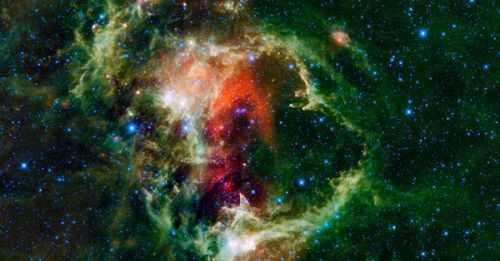
Soul Nebula

The new movie Interstellar takes on big questions and concepts. About the nature of everything. It is more like an invitation than a text, more like an appetizer than a feast. How much of that can you pack into a movie anyway?

Whether or not you’ve seen it, or liked it, or tried to understand it, here is something to consider.

What available paths are there to addressing these issues?

Being one of the travelers who journeys to the far reaches of time, space, and the other numberless dimensions.

Being a scientist who theorizes about that.

Being a director who makes a movie about that.

Being a viewer who watches a movie about that.

Being someone who thinks about that.

Being someone who stops thinking about that and journeys to those far reaches.

The list isn’t comprehensive, none of these is exclusive of the others, none of these may be best. But if you did see Interstellar, or have seen the dozens of movies that address this, or read any of the thousands of texts that address this, or are just curious, do investigate that last possibility. You may discover that the place beyond thinking looks like all the wonders of Interstellar. With fewer movie stars and special effects. But much more real.

Notes on Interstellar

Interstellar

1

Christopher Nolan’s movie Interstellar is more interesting than it is imperfect. See it if you like space movies, sci-fi movies, intellectually curious movies, spectacular movies, etc.

It is filled with wonders. It is like the car trunk stuffed with luggage for a vacation, so much colorful and significant luggage creatively crammed in that when you open it on arrival you say: Wow, I wonder how we ever got all that stuff in there?

No spoilers here, but a couple of things.

Look for all the tiny (and not so tiny) echoes of space and sci-fi movies past. Star Wars, Close Encounters, etc., but most of all 2001. Why not? Right now, “they” are probably having a good 5th dimensional laugh watching Stanley Kubrick’s proto-human apes tossing that bone.

Interstellar has the most subtly cool robots ever. TARS doesn’t sing like HAL, but he has moves like Jagger and is great with the snappy patter.

2

The movie is much about cosmology—the origin and nature of existence. Cosmology is the domain of all kinds of people, including religionists and philosophers. But in greater part, we have handed over many of those considerations, as in this movie, to theoretical physicists—Einstein, Hawking, etc. I am a big fan of cosmology.

It is not a spoiler to mention that plenty of people, including some in this movie, believe that the Apollo 11 moon landing was faked. Which raises this way-out-there question: What if the moon landing was real but all the cosmological theoretical physics is faked? Going back before Einstein, theoretical physics spends much of its time (as we understand it) looking for physical proof of those theories. What if all the theory is so utterly astounding and enlightening that when the evidence failed to support it, all the scientists engaged in the study conspired to make it seem as if those theories are supported?

Faking the moon landing mission has never been put entirely to rest because, in fact, only three people experienced it first-hand. Everyone else was second-hand or more distanced from the actuality. But the basic elements of it are well within our understanding: astronauts, rocket, spaceship, lunar lander, moon, television pictures. The cosmological speculation and supporting discoveries are so far beyond anything that most of us can fully—or slightly—grasp that we could easily be fooled into taking it for “reality.”

By the way, for those wondering about the earnestness of all that, be assured that I am just playing. Or am I?

3

We don’t have to be space pilots to experience cosmology, or be theoretical physicists or movie directors to think about it. Cosmology is ordinary. Interstellar and other movies and thousands of works of art and literature point to this. Everybody is a cosmologist, like it or not.

Cosmology is an excellent topic that does not necessarily require specialized knowledge. You may not know a worm hole from a black hole. But you already know a ton about time, space, being, and gravity. You just have to know how to know and that you know.

This is from an essay almost 800 years old. No more or less spectacular than Interstellar, it is no more or less a non-theoretical description:

Do not think that time merely flies away. Do not see flying away as the only function of time. If time merely flies away, you would be separated from time. The reason you do not clearly understand the time being is that you think of time only as passing.

In essence, all things in the entire world are linked with one another as moments. Because all moments are the time being, they are your time being….

You may suppose that time is only passing away, and not understand that time never arrives. Although understanding itself is time, understanding does not depend on its own arrival.

People only see time’s coming and going, and do not thoroughly understand that the time being abides in each moment. Then, when can they penetrate the barrier? Even if people recognized the time being in each moment, who could give expression to this recognition? Even if they could give expression to this recognition for a long time, who could stop looking for the realization of the original face? According to an ordinary person’s view of the time being, even enlightenment and nirvana as the time being would be merely aspects of coming and going….

Mountains are time. Oceans are time. If they were not time, there would be no mountains or oceans. Do not think that mountains and oceans here and now are not time. If time is annihilated, mountains and oceans are annihilated. As time is not annihilated, mountains and oceans are not annihilated.

Dogen
The Time Being (1240)
Treasury of the True Dharma Eye

Making No Sense

NASA - Stars

I looked at the stars
Like an astrologer
Saw constellations
Like an astronomer
Saw suns and planets.
I looked again
And saw stars.

The Other Poverty: The Poverty of Ideas

mining_lg
The other poverty is the poverty of ideas.

Let us ask each of our leaders and politicians for just one relatively new and interesting idea to solve a pressing problem. Just one. It doesn’t have to be an idea that has won substantial support or that has achieved broad consensus. In fact it can’t be that. Instead it should be something that is just a little bit out there, the kind that might elicit a “you must be kidding” or “that will never pass” or “that will never work.”

What we mostly have is problem solving that borders on archival monomania, the single idea with ancient lineage that fits a particular purpose or ideology—but has not really demonstrated an ability to solve particular problems.

This morning Sen. Dean Heller of Nevada explained why he is one of the few Republicans supporting an extension of unemployment benefits. In the course of the interview, he said that the biggest problem was jobs. He then ticked off the number one conservative solution—tax reform—but when he got to the second idea, it came out sounding like “something else” without a single detail. That’s because leaders and politicians on both sides of the aisle are stumped, which they admittedly should be by the unique and unprecedented economic moment we are living through.

During the 2012 presidential campaign, Newt Gingrich was roundly derided for his suggestion that we mine the Moon and colonize Mars. There are plenty of reasons that Newt wasn’t and isn’t a good choice for President, but that isn’t one of them. Sure it’s a bit science fictionish, but then so is practically all of the current tech that is one of the only bright spots in the global economy. Can you imagine a U.S. Senator in the 1950s coming to the floor of the Senate brandishing a copy of that weekend’s Sunday funnies, pointing to Dick Tracy and saying “That wrist radio, gentlemen, is where we should be heading.”? China and India are racing to the Moon, and it is not for the view.

Politics and political leadership are inherently conservative, in the sense that maintaining the institution and its support seems to demand modest, slow, incremental change—if any change at all. That’s where party lines and sticking to scripts come from. An intolerance for innovation and fringe philosophy go with that. We shouldn’t be asking parties or politicians to give up core principles and precepts. But if we actually want to solve problems, and not just hear tired old nostrums that won’t do any good, then we have to make a safe place for innovation, one where thinkers who happen to be in office are not committing political suicide by offering something interesting and maybe even eccentric. Because until we ask our politicians to enrich us with new ideas and not empty platitudes and happy talk, more of us will be unhappy with increasingly empty pockets.

Philip K. Dick’s Birthday

Philip K. Dick color
Yesterday was the birthday of writer Philip K. Dick (1928-1982).

If we measure creative success by the dollars generated through adaptation and exploitation, PKD was a monumental success, though he didn’t live to see most of it. His work was the source material for Blade Runner, Total Recall, Minority Report and other films.

If the measure of creativity is being creative, PKD is more than just the most adventurous science fiction/speculative fiction writer of his generation. Maybe no other writer of his century, or even now, has so masterfully taken readers to the edge, and then taken them a little further. In their view of the world, many of those readers never quite come back.

PKD lived, at least in his mind, beyond that edge. His mental instability is a matter of record, though there is still and will be questions about exactly what the clinical profile was.

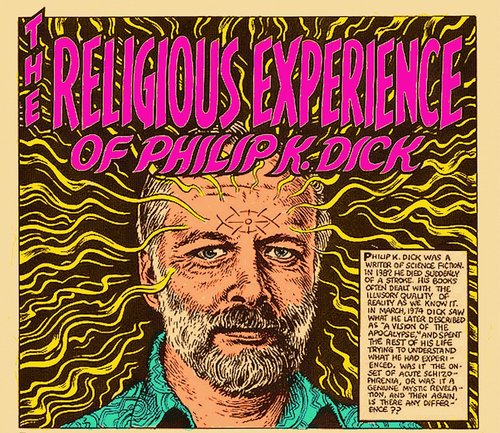
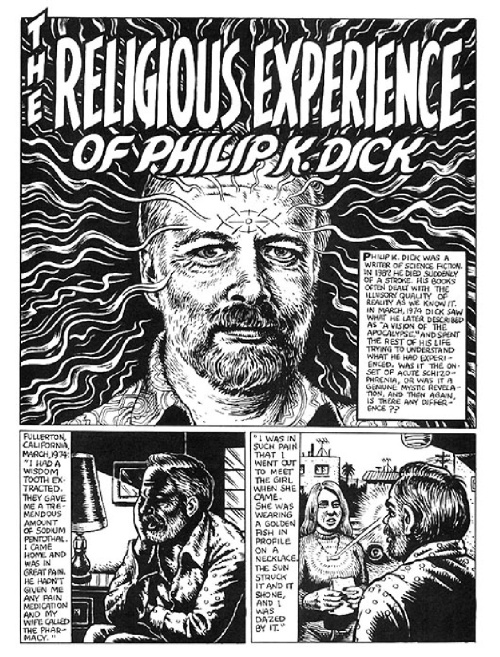
In 1974 PKD had what can be called a religious experience. The comic artist R. Crumb illustrated some of that experience, as related by PKD. You can view the entire comic here.

PKD Crumb 1

“There will come a time when it isn’t ‘They’re spying on me through my phone’ anymore. Eventually, it will be ‘My phone is spying on me’.” ― Philip K. Dick

Celebrity Colony on the Moon

Melies - A Trip to the Moon
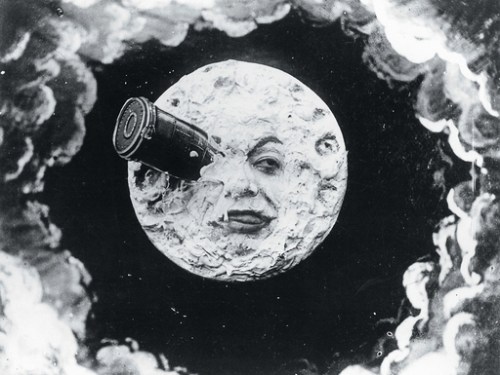
The success of Celebrity Colony on the Moon, a follow-up to NBC’s Celebrity Apprentice, is guaranteed, based on a few premises:

Celebrities are the only people able to take advantage of private space travel.
Celebrities like to increase their celebrity and to do things other people can’t.
People want to see some celebrities sent far away—even to the moon.

In Celebrity Colony on the Moon, celebrities will demonstrate their knowledge of space and science, and their ability to settle a frontier colony. People will vote based on these and other factors—including the desire to see particular celebrities housed in a lunar outpost.

Donald Trump will of course host the show. While he will not be official commander of the mission, he will travel along with the colonists. The demand to see him 238,900 miles away will be overwhelming.

It is expected that NBC will soon begin considering which celebrities might be sent to the moon, in the name of exploration and ratings. Nominations are now open.

DNA and the Supreme Court Reading Program

DNA Court
Today’s Supreme Court decision on the patentability of genetic material, Association for Molecular Pathology v. Myriad Genetics, Inc.  is another example of just how informative and fun these opinions can be, as opposed to just hearing the media summaries. This leads to a suggestion for a Supreme Court Reading Program.

Earlier posts have covered the value—in knowledge and entertainment—of reading current Supreme Court opinions, even if you are not a lawyer. This also includes reading the briefs in support of various positions, from a range of people and organizations. When the marriage equality cases were argued back in March, a post was devoted to The Briefs on Marriage Equality.

In this complex and significant gene case, the unanimous opinion of the Court (Justice Scalia concurred in a very short comment of his own) is that particular genetic material that isolated and identified (here, the site of mutations leading to breast and ovarian cancer) is not patentable, but that a new synthesized version of that same material, with the deletion of some parts, is.

Among the things that makes the opinion so interesting is its cogent explanation of a technical area. Genetics isn’t easy, and the opinion is really an understandable primer on a difficult topic.

Even more interesting are the array of briefs submitted in the case. Along with companies that want to be able to hold lucrative proprietary interest in genes, there are scientists and health care advocates who want nothing to stand in the way of free and open development and application. (The Humane Genome Project, for example, from the first offered all the work on the mapping the human genome to humanity.) Lawyers and intellectual property activists also chimed in, with intense interest in how patent law is a mess in these hyper-advancing times, having fallen so far behind the realities of digital and bio innovation. Also interesting is a brief from the Southern Baptist Convention, which taken from their church perspective makes a pretty good argument that, to put it bluntly, you can’t patent God.

So when you hear mention of an interesting Supreme Court case, either when it is argued or decided, step away from the media reports, even when those are reliable from experts you trust. Instead, visit the Supreme Court site to read or download the opinion (the opinion is published on the site almost immediately). Then visit the American Bar Association site that collects all the amicus briefs for each case that is argued. There will be a lot of those briefs—more than a hundred in the case of marriage equality—so you will want to pick and choose. Sometimes the name of the person or organization submitting the brief will catch your interest, just by who or what they are.

That certainly applies to the gene patent case. There among the many briefs is one identified as Brief for James D. Watson, Ph.D. in Support of Neither Party. Just in case the name isn’t familiar, James Watson, Ph.D. is the co-discoverer of the double helix structure of DNA, for which he and Frances Crick were awarded the Nobel Prize in Physiology in 1963. Even if he wasn’t one of the most important scientists in history, his delightful and erudite 26-page brief would be worth reading. It’s just one more example of how a Supreme Court Reading Program can be an enlightening and surprising addition to whatever else you’re currently paying attention to.

Beautiful Quantum Scribbles


In Robert Wise’s classic sci-fi movie The Day The Earth Stood Still, Klaatu (Michael Rennie), a visitor from distant space, has come to earth to warn world leaders that their conflicts endanger universal order and must end. To enlist the help of the smartest scientist, Dr. Barnhardt (a fictionalized Albert Einstein played by Sam Jaffe), Klaatu visits the professor’s house. He finds an unsolved problem in celestial mechanics on the blackboard, and quickly corrects the equations. He is interrupted by the housekeeper Hilda:

HILDA
How dare you write on that blackboard! Do you realize the Professor has been working on that problem for weeks?

KLAATU
He’ll catch on to it in no time now.

HILDA
How did you get in here? And what do you want?

KLAATU
We came to see Professor Barnhardt.

HILDA
Well, he’s not here. And he won’t be back till this evening.
(Klaatu scribbles a note and hands it to Hilda.)

KLAATU
You might keep this. I think the professor will want to get in touch with me.

Hilda’s glance wanders to the blackboard and she picks up an eraser, debating whether to erase Klaatu’s corrections.

KLAATU
I wouldn’t erase that. The Professor needs it very badly.

Even if you are not a physicist, and are simply intrigued by the arcana that only geniuses and space aliens understand, this is a memorable moment.

People who are comfortable living in the old high school classroom picture of a determinate universe full of atoms and their constituent protons, neutrons and electrons have another think coming. In the quantum world beyond simple particles, anything is possible and nothing is certain, if certainty itself exists. In the view of some, in quantum physics are hints of rough sketches of the face of God, as well solutions to practical matters such as how to teleport information across the universe beyond light speed. Those of us of lesser minds struggle to grasp even the most basic concepts, while the greater minds solve puzzles beautiful in their incomprehensibility.

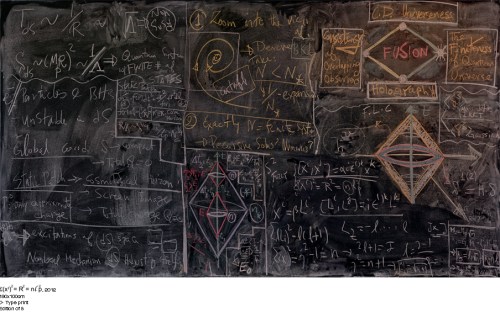
Spanish artist Alejandro Guijarro has combined two things at polar ends of research and education. On one end he has taken detailed photos of blackboards, a thinking and teaching tool so primitive that some are surprised to find them still around, and others have never seen one. On the far end, these particular blackboards belong to some of the world’s leading quantum thinkers. Guijarro traveled to institutes and laboratories around the world to record the smudged, chalk-streaked evidence of some of the world’s most sublime calculations…and erasures.

Soylent Green, My Friend, Is People


Mother Jones has already changed the trajectory of the Presidential campaign with the “47%” video. It’s latest video find may not have the same effect, but it is still revealing.

It comes from a promotional Bain Capital CD-ROM from 1998. Along with other artifacts of the Bain culture at the time, it includes a video of Mitt Romney from 1985 explaining the Bain business model:

Bain Capital is an investment partnership which was formed to invest in startup companies and ongoing companies, then to take an active hand in managing them and hopefully, five to eight years later, to harvest them at a significant profit…The fund was formed on September 30th of last year. It’s been about 10 months then. It was formed with $37 million in invested cash. An additional $50 million or so of what I’ll call a call pool, which is money that we can call upon if the deals are large enough that they require more than a $2 or $3 million dollar initial investment. Why in the world did Bain and Company get involved in this kind of a business? We’re not particularly noted for having years and years of experience in financing. Three reasons. We recognized that we had the potential to develop a significant and proprietary flow of business opportunities. Secondly, we had concepts and experience which would allow us to identify potential value and hidden value in a particular investment candidate. And third, we had the consulting resources and management skills and management resources to become actively involved in the companies we invested in to help them realize their potential value.

It’s the “harvest” line that is getting the most attention, presumably because it suggests to some that the companies are viewed primarily as abstract opportunities that are optimized for profit, rather than enterprises that make particular things and where particular people work and build their lives.

Fans of sci-fi movies are burdened by seeing the “real” world through the lens of those films. So this line flashed two iconic and unforgettable scenes.

One is from The Matrix (1999), when we first see the humans being used as living batteries to power the world of the Matrix.

The other is from Soylent Green (1973). In 2022, the desperate population of overcrowded New York City is being kept alive by the nutritional drink Soylent Green. At the end, we learn the dark secret of Soylent Corporation, as screamed by Charlton Heston (spoiler alert): “Soylent Green is people!” Yes, it is processed from the oversupply of corpses.

All this probably has nothing to do with Bain Capital harvesting companies. Somehow, though, “Corporations, my friend, are people!” just got mixed up with “Soylent Green is people!”, Charleston Heston got mixed up with Clint Eastwood and Mitt Romney.

As noted in a post a few days ago, this campaign may not just be threatening to drive us—candidates and voters—mad. It may have done that already.