Bob Schwartz

Category: Religion

You Kippur and Job


The days from Rosh Hashanah (“Head of the Year”, the New Year) and Yom Kippur (“Day of Atonement”) are the ten holiest on the Jewish calendar. Known as the Days of Awe or Days of Repentance, they are a time for reflection on the year past and the year to come, and a time to make amends—not by asking God for forgiveness, but by asking it from those who have been wronged, and through the practice of repentance (literally, “turning”), prayer and charity.

During these days, the Book of Life is metaphorically open, and on its pages your life is weighed: “On Rosh Hashanah it is written, on Yom Kippur it is sealed.”

The liturgy for these holidays, and particularly for Yom Kippur, is some of the most moving and soul-searching in all of the religious canon. There are Old Testament readings included, but not too often from the Book of Job.

There are two solid consensuses about the Book of Job.

Literary types agree that it is probably the greatest work of literature in the Bible.

Religious types agree that it is the most puzzling book in the Old Testament, and that even when you look at it in the most common and superficial way (“Why do bad things happen to good people?”), you end up scratching your head.

Job is the book to read for Yom Kippur. It is the book to ponder at the start of the year, at the end of the year, and at points between. (It was, by the way, Abraham Lincoln’s most studied book of the Bible.)

We begin with the book itself.

It is unusual for it to have been included in the canon of the Hebrew Bible because it is not about a Jew. When non-Jews appear in other books, it is usually a story of helping Jews or hurting Jews or marrying Jews or eventually becoming Jewish. None of that applies to the Book of Job.

The story is relatively simple, at least until the end. Job is a rich and pious man who has everything: health, wealth, family and friends (or so they seem). Satan wants to prove that Job’s piety is dependent on his having everything, and challenges God to take it all away. God does.

Job’s friends are convinced that he must have done something wrong, and urge him to figure it out and repent. The scenes with his friends are talky, like a play, or maybe like the film My Dinner With Andre—except this is My Dinner with Eliphaz the Temanite, Bildad the Shuhite and Zophar the Naamathite.

Job’s wife has a different suggestion: “Curse God and die.”

Job remains steadfast in his faith.

And then, in Chapter 37, God appears to Job, to explain it all.

The chapters that follow are a poetic and breathtaking description of the world’s wonders, by the one who made them. God tells Job that his friends don’t know what they’re talking about (God takes care of them later). And God implicitly tells Job the only two things to do: Be awed. Be humble.

Job’s reply in Chapter 42 is one of the most important passages in the Bible. It is not only the watchword for Yom Kippur; it is the watchword for everyone, religious or otherwise, who is convinced they are smarter than anyone in the room or in the universe:

Then Job answered the Lord:
“I know that you can do all things,
and that no purpose of yours can be thwarted.
‘Who is this that hides counsel without knowledge?’
Therefore I have uttered what I did not understand,
things too wonderful for me, which I did not know.
‘Hear, and I will speak;
I will question you, and you declare to me.’
I had heard of you by the hearing of the ear,
but now my eye sees you;
therefore I despise myself,
and repent in dust and ashes.”

“I have uttered what I did not understand, things too wonderful for me, which I did not know.”

Whether this is a day of reflection and fasting, reciting centuries-old prayers, or an ordinary day of work or study, managing others or being managed; whether you are Job beset by unexplained misfortune, or Job’s wife, ready to kill him if he doesn’t kill himself, or Job’s friends so quick with advice; whether you are being punished by God, Satan, or whatever other forces you believe are working against you; whether you are the smartest person in the room or not; this is what we can do, even if there is seemingly no comfort in it:

Be awed. Be humble.

Mitt Romney Doesn’t Really Want To Be President


Mitt Romney doesn’t want to be President. This has been apparent for a while, but it seemed so unlikely—so strange for a person who is actually a nominee—that it defied saying. But it is the clearest explanation of everything that is happening.

Why would Romney run if he doesn’t want the office? The clichéd but useful explanation goes to a father-son dynamic.

In at least one objective respect, Mitt has spectacularly surpassed George Romney. Mitt Romney is a very, very rich man, wealthier than his father ever was.

As a businessman, it is a little more complicated. George Romney was, as the saying used to go, a captain of industry. He worked his way up to become head of one of the largest automakers, back when that mattered much more than it does now. Even if American Motors wasn’t one of the Big Three, it was a notable, forward-looking player in the field.

Mitt Romney’s success is different. Even treating the financial world as a discrete industry, which it of course is, the term “captain of industry” doesn’t seem to apply to Mitt. In the annals of financial history, no one will be talking about the creativity of Bain Capital the way business historians still do about the ahead-of-its-time thinking that marked American Motors—the company that believed the oversized car era was over, and that consumers would be buying compact and efficient automobiles. Eventually they would.

Politics is where the distinction is sharpest. George Romney was elected Republican Governor of Michigan three times—a state that was then decidedly Democratic. He had substantial political appeal and support, but his dream of being President was scuttled in part by the infamous “brainwashing” incident. He had visited Vietnam, and was told by the generals how well the war was going—in spite of evidence to the contrary. When he spoke about his opposition to the war, he said he had been “brainwashed” by the generals. George Romney’s political career never recovered.

As a politician, Mitt Romney has run for office just twice, and won only once. He was defeated for U.S. Senate from Massachusetts in 1994, and then was elected Governor in 2002. He chose not to run for re-election in 2006. Indications were that he would have a difficult race, and he instead began his run for the Presidency the day before he left office.

This father-son analysis—that Mitt Romney is trying, at all costs and for whatever reasons, to do what his father never could—may sound too easy. But the story of fathers and sons is just about the oldest story ever told. The patriarchal sagas of the Old Testament begin there, and great stories derive their greatness from the fact that some things never change.

Mitt Romney is following a program that he may not see or understand but that he has little or no choice about. It is a program, this running for President, that normally requires some combination of skill and desire. A surplus of one can balance out a deficit in the other. But trying to run without either—which we have never seen in a Presidential race—is bound to produce some anomalous results.

In the case of Mitt Romney, we can set aside the issue of how much political skill he has, though many have their doubts. The real question is how much desire he has. The answer, strangely, is little or none.

The outcome of the election is far from written. In case Mitt Romney loses, there is reason to believe that he will suffer some nagging psychic pain. But given the possibility that it is not something he really wants. there is also reason to believe he will go back to an extraordinarily comfortable life, and secretly be relieved.

Why Compassion Matters


On August 4, in a hospital just a few miles from where this post is being written, John Wise, 66, snuck into the room where his wife Barbara, 65, was lying. They had been married for 45 years. She was suffering, reports indicate, from a triple aneurysm, and her prognosis appears to have been poor. He ended her life, shooting her in the head, though she did not die until the next day. His plan to shoot himself immediately after that was thwarted when his gun jammed. This week, he was charged with aggravated murder and faces life in prison without parole.

This has raised, not for the first or last time, the issue of mercy killing in the face of untreatable illness and declining quality of life. With an aging and ailing population, whether it is our family or ourselves, this goes each passing day from the abstract to the very real.

You can deal with this on an intellectual and practical level, weighing moral and legal issues, determining what you might do or ask others to do under a variety of circumstances. But hearing this story, the most natural thing is to cry. Not out of any failure to resolve those issues, but out of sheer compassion.

Compassion is what matters. All of our spiritual traditions commend it, but maybe none makes it more plainly central than Buddhism. The first truth of Buddhism is the reality of suffering; all else in how we are to live stems from this.

The story is told of a woman whose child had died. She came to the Buddha, who instructed her to visit neighbors and to return with a mustard seed from a house that had not been touched by death. She came back empty handed. This wasn’t to make her feel “better,” which it couldn’t. This was to help her see herself where she was, a living drop in the sea of suffering.

Compassion is more than walking in another’s shoes, more than the Golden Rule, more than “no man is an island.” It is the deepest possible recognition, beyond words, of the need that universal suffering creates. The need to care unconditonally.

If compassion is present in our lives and our politics, whatever we do cannot be completely wrong. If compassion is absent, nothing we do can be right, no matter how good it is meant to seem.

Mene Mene in Tampa


We should not be surprised by the latest craziness in the Republican campaign. Anything seems possible. Even the mysterious appearance of a finger writing something like this on the wall of a $5,000-a-plate fundraiser:

MENE MENE TEKEL PARSIN

According to ancient reporting:

King Belshazzar made a great festival for a thousand of his lords, and he was drinking wine in the presence of the thousand.

Under the influence of the wine, Belshazzar commanded that they bring in the vessels of gold and silver that his father Nebuchadnezzar had taken out of the temple in Jerusalem, so that the king and his lords, his wives, and his concubines might drink from them. So they brought in the vessels of gold and silver that had been taken out of the temple, the house of God in Jerusalem, and the king and his lords, his wives, and his concubines drank from them. They drank the wine and praised the gods of gold and silver, bronze, iron, wood, and stone.

Immediately the fingers of a human hand appeared and began writing on the plaster of the wall of the royal palace, next to the lampstand….

Then Daniel was brought in before the king. The king said…”I have heard that you can give interpretations and solve problems. Now if you are able to read the writing and tell me its interpretation, you shall be clothed in purple, have a chain of gold around your neck, and rank third in the kingdom.”

Then Daniel answered in the presence of the king, “Let your gifts be for yourself, or give your rewards to someone else! Nevertheless, I will read the writing to the king and let him know the interpretation….You have exalted yourself against the Lord of heaven! The vessels of his temple have been brought in before you, and you and your lords, your wives and your concubines have been drinking wine from them. You have praised the gods of silver and gold, of bronze, iron, wood, and stone, which do not see or hear or know; but the God in whose power is your very breath, and to whom belong all your ways, you have not honored.

“So from his presence the hand was sent and this writing was inscribed. And this is the writing that was inscribed: MENE MENE TEKEL PARSIN. This is the interpretation of the matter:

MENE, God has numbered the days of your kingdom and brought it to an end
TEKEL, you have been weighed on the scales and found wanting
PARSIN, your kingdom is divided and given to the Medes and Persians

(Daniel 5, NRSV)

It is fitting that the writing on the Republican wall may have first appeared in April 2011, when Donald Trump led the field of Presidential prospects (Mitt Romney was third). Fitting because Trump will be appearing at next week’s Republican convention with a surprise “that I think is going to be I think really amazing. It’s going to be great. And we’ll see what happens. I mean, we’ll see how it’s received. But it will be pretty wild.  I think it will be potent.” Fitting also because you can just see Trump not only attending Belshazzar’s over-the-top feast, but hosting it at one of his hotels.

If Trump’s lead in last year’s polls wasn’t the sign, maybe the whole Republican primary season was. Looking back from down the road (“Years from now, when you talk about this, and you will, be kind”), people of all political persuasions will have their mood lifted by just the mention of Herman Cain, who also led the polls (and as recently as nine months ago).

The point is not that the Republicans are destined to lose the election because of this craziness; it remains a close race. The point is that we have reached the point in the tale—introduced to all the characters (or so we think: Todd Akin?), to most of the intertwined story lines, and to some of the secrets—that nothing would be surprising, and anything seems possible.

Like a biblical storm.

Biblical as in Tropical Storm Isaac, one of the few names on the National Hurricane Center storm list that comes from the Bible.

Biblical as in the belief among a few that storms are a form of divine intervention.

It appears that Isaac will turn into a hurricane, and that it may be headed near Tampa, the site of the Republican convention. Contingency plans are in the works.

As long as we have a biblical hurricane, we might as well consider whether it is a sign.

Among the Old Testament patriarchs, Isaac stands apart from his father Abraham and his son Jacob. Unlike them, he is represented as passive, pliable and indecisive in his dealings. Noted commentator Gunther Plaut has said that Isaac must be an historic figure, because no tradition would create a patriarch so weak.

We all hope—especially those of us who have lived through the devastation of a hurricane—that Isaac stays far away from everyone and everything, including the Republican convention. But for those who are so inclined, it couldn’t hurt to read the writing on the wall.

Paul Ryan and Ayn Rand


A postage stamp honoring Ayn Rand was issued in 1999; that’s the image used in the National Review cover above. It was issued in the usual way, following a roughly three-year process of being proposed, recommended by the Citizens’ Stamp Advisory Committee, and then approved by the Postmaster General.

The most famous controversy over any stamp concerned the Elvis Presley commemorative. There was disagreement about which Elvis to depict, the younger leaner one or the older heavier one, and disagreement about whether Elvis should have a stamp at all. In the end, the stamp was issued, and went on to become the bestselling in U.S. postal history. There is no record that there was disagreement about Ayn Rand, though there might well have been.

Paul Ryan honored Ayn Rand too, at least until recently. He stated that her books were the most pivotal in shaping his public life. He gave them to interns as gifts. He spoke frequently about how the decline in America looked increasingly like something out of an Ayn Rand novel.

He is not alone among public servants in his admiration for Ayn Rand. Politico reported last April on 7 Politicians Who Praised Ayn Rand.  Among these are Sen. Rand Paul (coincidentally named), Rep. Ron Paul (who should know about Rand Paul’s name), President Ronald Reagan, Sen. Ron Johnson, Gov. Gary Johnson, Sen. Mark Sanford and Supreme Court Justice Clarence Thomas. Justice Thomas has his new law clerks watch a screening of The Fountainhead (1949), starring Gary Cooper and Patricia Neal, an adaptation of Rand’s second most famous novel. Maybe the most famous acolyte of Ayn Rand is former Federal Reserve Chairman Alan Greenspan, who in the 1950s was part of her inner circle and a close confidant.

Rand’s novels are overlong, didactic, questionably artful embodiments of her very particular philosophy. It is a philosophy fed by her early experience as a child in Soviet Russia, a member of an intellectual and professional Jewish family that was reduced to dire circumstances by the forces of collectivism, Communism and totalitarianism.

She came to America and created her own ism. The Atlas Society,  one of the intellectual keepers of the Rand canon, summarizes:

Ayn Rand’s philosophy of Objectivism was set forth in such works as her epic novel Atlas Shrugged, and in her brilliant non-fiction essays. Objectivism is designed as a guide to life, and celebrates the remarkable potential and power of you, the individual. Objectivism also challenges the doctrines of irrationalism, self-sacrifice, brute force, and collectivism that have brought centuries of chaos and misery into the lives of millions of individuals. It provides fascinating insights into the world of politics, art, education, foreign policy, science, and more, rewarding you with a rich understanding of how ideas shape your world. Those who discover Objectivism often describe the experience as life-changing and liberating.

One problem with Objectivism, as with the isms Rand left behind and hated, is that pure systems work well on paper and in the mind, as long as you don’t have to wrestle with the complexities and consequences of the actual world. This is probably why Ayn Rand has always had an appeal to younger people, particularly teenage boys and young men, who are empowered by the idea of their individual greatness waiting to explode, ungoverned by the limitations that the world tries to place on them. The world is filled with people who want something from us, who are jealous of us, who don’t understand our specialness, and who will do anything to hold us back and keep us down.

This phenomenon was wryly captured by Michael Sean Winters in the National Catholic Reporter:

As one wag once said: “There are two novels that can change a bookish fourteen-year old’s life: The Lord of the Rings and Atlas Shrugged. One is a childish fantasy that often engenders a lifelong obsession with its unbelievable heroes, leading to an emotionally stunted, socially crippled adulthood, unable to deal with the real world. The other, of course, involves orcs.”

Winters was writing in the context of the Ryan Budget. Paul Ryan is devoted to the Catholic Church, which is founded on the sort of collectivism, anti-individualism, self-sacrifice and charity that Rand abhorred and rejected as immoral. This led in May 2011 to questions about how the Ryan Budget, with reductions in government help for the poor and others in need, squared with the teachings of the Church. Archbishop Timothy Dolan, who had previously been Bishop in Wisconsin, made clear in a letter to Ryan that the budget was completely in line with the Church’s mission. Winters wrote:

Ryan’s budget certainly reflects Rand’s weltanschauung more than it reflects the vision Pope Benedict XVI put forth in Caritas in Veritate. That is why I think it was a mistake for Archbishop Dolan to write a letter that, however unintentionally, gave political cover to policies that are antithetical to Catholic social teaching. And, whatever frustrations Ryan – or anyone else – has with the modern, social welfare state, I think it can be said that the social welfare state is to social justice what democracy is to government: The worst form of administration except every other form.

Ryan can assert that his budget is built upon Catholic concerns about human dignity, but there is no dignity in Rand’s crimped vision of humanity. There really is no need to wrestle with these so-called ideas.

Paul Ryan’s distancing from Ayn Rand began last spring when he said that his supposed embrace of the author and her philosophy was “urban legend.” (If so, it is the most high-minded and intellectual urban legend of all time, since those stories are usually sordid and lowlife, as in the flushing of baby alligators into the New York sewers.) Then just yesterday he explained that while he enjoyed the novels for a long time, it was only later that he became aware of her philosophy.

As mentioned earlier, Ayn Rand’s novels are not works of art that have to be savored and investigated so that their meaning can be coaxed out. They are pages and pages of speeches and ideas, with some plot and characters hung on them like ornaments on a tree. There are only two explanations for Ryan’s assertion: he is either dull-witted, which he isn’t, or he is…being disingenuous.

Why all this effort to run away from Ayn Rand anyway? Most people, meaning voters, have never read those novels, and all this fuss is not about to move them to throw away weeks of their lives trying to plow through them.

Here’s why.

First, Ayn Rand was an atheist. In her philosophy there is no higher power than man, no life other than the objective life in front of our faces, no morality other than the morality of rational self-interest. There are plenty of atheists who embrace the moral and ethical concepts at the heart of religious beliefs, such as the Golden Rule. Ayn Rand was not one of those. This is more than inconvenient for anyone, especially politicians, who base their lives and careers on their religious foundations.

But there is something deeper and more significant going on. In 2010 the National Review, America’s most respected conservative journal, published a cover story on Ayn Rand.  In it, Jason Lee Steorts writes about going back to reread Ayn Rand, given her renewed popularity following the election of Barack Obama:

Our president seems to have inspired — which is not quite the word — half the country to read Miss Rand, and I wanted to remind myself what she was teaching them. He finds that he can’t get through the books, because he sees the author for who she was and, therefore, what she espoused.

Steorts relates a scene from Atlas Shrugged. The prime movers, those who are literally the brains behind the success of the country, have gone on strike. This leaves the inferior, parasitic people to fend for themselves. In this scene, a train is stopped before an eight-mile unventilated tunnel. There are no diesel engines, no one to properly operate the train. But facing a demand to make it move, the station officials, writes Rand, “call in a coal engine, procure a drunken engineer, and condemn every passenger on the train to death by asphyxiation.”

The passengers comprise an array of losers, including a professor “who taught that individual ability is of no consequence” and a mother “whose husband held a government job enforcing directives.” They are, in essence, riding a train into a gas chamber. “But that isn’t why I stopped reading,” Steorts writes. “I stopped because Rand thinks they deserve it.”

That is at the heart of this running away from Rand. Rand’s world is not one where unbridled individualism can co-exist with a diversity of other moralities and abilities. It is either/or. There are producers, there are freeloaders, and the immoral role of government is to stifle the producers and reward the freeloaders with stolen spoils. As soon as government is gone, the producers will be free to shape the world in their image, and the others will learn how that world works or they will, ultimately, perish as their punishment.

If that sounds harsh and heartless, it is. If that sounds like an extreme version of some of the rhetoric we may have been hearing lately, it is. But even the softer version, tempered by compassion, still makes us uncomfortable. That is why, hopefully, Ryan and others will distance themselves from Ayn Rand—not just for political show, but for real.  That is why, when Sheorts in the National Review looked to find out why Obama-haters were reading Ayn Rand, he recoiled at what he found. He discovered a bloodless train, and he couldn’t bear to see where it was heading.

The Irony of Baptist Intolerance

Rev. Stan Weatherford, pastor at First Baptist Church of Crystal Springs, Mississippi, refused to marry a black couple, Charles and Te’Andrea Wilson, at the church, after a handful of congregants complained. The minister did marry them at a nearby church, but the damage was done, and this has become a global story. The meaning of the story is something that is still developing.

As for Mississippi, this has undoubtedly bolstered a painful stereotype that the state cannot shake. Personal experience in a dozen or so states, including Mississippi, says that there are racists in most states, probably totaling in the millions. Mississippi, a great state is so many ways, has the unfortunate burden of being on racial probation, maybe for the rest of American history. In fact, this hyper-consciousness has led many—though not all—Mississippians to pay special attention and take special care to move forward where others around the country just pretend that there isn’t a problem where they live.

More interesting than the Mississippi angle is the Baptist story. The Southern Baptist Convention was quick to point out that this was a sad and regrettable event, and that the refusal to marry a couple on the basis of their race is completely unacceptable. It is a congregational denomination, so decisions ultimately rest with the congregation and its pastor. In this case, SBC said, the pastor was in a difficult position—as in the likelihood, but not certainty, that he would have lost his job if he had proceeded with the marriage at the church.

This is where the irony comes in so loudly. Throughout American history, Baptists have been notable for their courage in the face of religious persecution and intolerance. American religious liberty, as ultimately codified in the Bill of Rights, is a direct response to that persecution. As the Library of Congress exhibit on Religion and the Founding of the American Republic points out:

In Virginia, religious persecution, directed at Baptists and, to a lesser degree, at Presbyterians, continued after the Declaration of Independence. The perpetrators were members of the Church of England, sometimes acting as vigilantes but often operating in tandem with local authorities. Physical violence was usually reserved for Baptists, against whom there was social as well as theological animosity. A notorious instance of abuse in 1771 of a well-known Baptist preacher, “Swearin Jack” Waller, was described by the victim: “The Parson of the Parish [accompanied by the local sheriff] would keep running the end of his horsewhip in [Waller’s] mouth, laying his whip across the hymn book, etc. When done singing [Waller] proceeded to prayer. In it he was violently jerked off the stage; they caught him by the back part of his neck, beat his head against the ground, sometimes up and sometimes down, they carried him through the gate . . . where a gentleman [the sheriff] gave him . . . twenty lashes with his horsewhip.”

The persecution of Baptists made a strong, negative impression on many patriot leaders, whose loyalty to principles of civil liberty exceeded their loyalty to the Church of England in which they were raised. James Madison was not the only patriot to despair, as he did in 1774, that the “diabolical Hell conceived principle of persecution rages” in his native colony. Accordingly, civil libertarians like James Madison and Thomas Jefferson joined Baptists and Presbyterians to defeat the campaign for state financial involvement in religion in Virginia.

The picture above is The Dunking of David Barrow and Edward Mintz in the Nansemond River (1778):

David Barrow was pastor of the Mill Swamp Baptist Church in the Portsmouth, Virginia, area. He and a “ministering brother,” Edward Mintz, were conducting a service in 1778, when they were attacked. “As soon as the hymn was given out, a gang of well-dressed men came up to the stage . . . and sang one of their obscene songs. Then they took to plunge both of the preachers. They plunged Mr. Barrow twice, pressing him into the mud, holding him down, nearly succeeding in drowning him . . . His companion was plunged but once . . . Before these persecuted men could change their clothes they were dragged from the house, and driven off by these enraged churchmen.”

Maybe Rev. Weatherford had never heard of David Barrow and Edward Mintz. Maybe the congregants who didn’t want black people married in the church hadn’t either. More than two hundred and thirty years is a long time. Maybe Rev. Weatherford could have stood up to the minority in his church, depending on whether he thought that losing his job was better or worse than being dunked in a river. Maybe he could have done a better job of bringing a part of the Christian message to those congregants, but people are stubborn in their worst beliefs, and anyway that’s not really his job. In all religions, but especially in disintermediated ones such as the Baptist Church, it all comes down to you and God, one of you talking, one of you listening and learning. It’s always true that some listen and learn better than others.

Scissoring And Shunning Sheldon

Pay no attention, just for a moment, to the images above of billionaire Romney supporter Sheldon Adelson and to Sarah Silverman demonstrating the sexual act she would perform on him, if he agrees to instead give his money to Barack Obama.

The diversity of Jewish views on spiritual, social and political issues might be described as a crazy quilt that has never been pieced together. Or as a big tent without a ringmaster, no Pope to say what goes and what does not. This is admirable in some ways, but especially in stressed times, it can be uneasy and inconvenient.

Progressivism is a constant in Jewish thought and action, and just as constantly challenged by pragmatic and contrary considerations. The rise of Jewish neo-conservatism in America is a recent example, and the ready acceptance of Christian Evangelical support of Israel is another—paradoxical in that certain Christian eschatology clearly envisions the end of the Jewish people in Israel, at least as Jews.

Sheldon Adelson is taking this to a next step. He is using his unlimited campaign resources to target and convince Jews who may have mistakenly voted for Obama last time that only Mitt Romney and the Republicans offer a true Jewish vision of America and the world.

That’s where Sarah Silverman comes in. Having little by way of intellectual or humanistic argument to convince him, she offers to perform an exotic sex act on him,  if he will transfer to Obama the $100 million he has promised to use on behalf of Romney. We are going to hear a lot about bad taste, going too far, etc., but this is an indecent and brilliant piece of satire on many levels, worthy of tragic comic god Lenny Bruce.

Still, Sheldon Adelson is not going to take up this proposal. So here is another more decent one.

Even though Judaism has no final arbiter, outside of certain sects, this doesn’t mean that the Jewish communities are judgment-free. So while Sheldon Adelson can’t be “excommunicated” it can be made clear by other Jews that the agenda he is promoting with a tiny bit of his massive fortune does not represent Jewish ideals and that what he is doing is a schanda fur die goyim—a shame before the people and the nations.

Whether or not he gets scissored by Sarah Silverman, Sheldon Adelson should be shunned. There is no way to make it official, and even if there were the guess is that his billions could fix it. But conscience can’t be bought, any more than elections can (or that’s what we used to think anyway). Whether or not one is a Jew, let alone a “good” Jew, is something ultimately left to God and the individual. But that shouldn’t stop us from making clear that those who claim to act in the name of Judaism are not necessarily one of us.

The NBA And The Buddha: Discourse On The Loving Kindness Of The Player Formerly Known As Ron Artest


Just yesterday on an NBA broadcast, former Los Angeles Laker superstar Earvin “Magic” Johnson stumbled over the name of current Laker star Ron “Metta World Peace” Artest. Those quote marks for Artest are imprecise. Magic is not Johnson’s real name; it is simply the nickname accorded to him for his achievements on the court. Metta World Peace is Artest’s legal name, since he changed it in September 2011.

Over the course of his career, the adjective most often used to describe Mr. World Peace is “eccentric.” Whether or not people keep track of these things, he may have had more different numbers than anyone in NBA history; his current number 37 is the number of weeks that Michael Jackson’s Thriller album was at the top of the charts.

Beyond eccentric, he has been involved in a number of infamous altercations. In April, his elbow to the head of Oklahoma City Thunder’s James Harden caused a concussion, and resulted in World Peace’s seven-game suspension. (The speculation that Harden’s beard, which is one of the most splendid in all of sports, may have set World Peace off is unsupported.)

Earvin was dubbed “Magic” for his abilities, following a high school game that featured his triple-double of 36 points, 18 rebounds and 16 assists. NBA player Lloyd Free got the nickname “World” growing up in Brooklyn, because of his skills going to the basket, including his 360-degree turns. In 1981 he made it official by changing his name to World B. Free.

Metta World Peace did not get his name by acclamation. It was presumably chosen to reflect something about the man and the player. World Peace seems pretty obvious. But what about Metta?

Metta is a Pali word used in Buddhism. It means kindness, friendliness or compassion. The text known as the Metta Sutta (The Buddha’s Discourse on Loving-Kindness) is one of the oldest in the Buddhist canon, and is recited daily by many Buddhist monks and lay people. Here is one of many translations of this beautiful and essential work, by Sharon Salzberg:

This is what should be done
By those who are skilled in goodness,
And who know the path of peace:

Let them be able and upright,
Straightforward and gentle in speech,
Humble and not conceited,
Contented and easily satisfied,
Unburdened with duties and frugal in their ways,
Peaceful and calm, and wise and skillful,
Not proud and demanding in nature.

Let them not do the slightest thing
That the wise would later reprove.
Wishing: in gladness and in safety,
May all beings be at ease.

Whatever living beings there may be;
Whether they are weak or strong, omitting none,
The great or the mighty, medium, short or small,
The seen and the unseen,
Those living near and far away,
Those born and to-be-born—
May all beings be at ease!

Let none deceive another,
Or despise any being in any state.

Let none through anger or ill-will
Wish harm upon another.

Even as a mother protects with her life
Her child, her only child,
So with a boundless heart
Should one cherish all living beings;
Radiating kindness over the entire world,
Spreading upward to the skies,
And downward to the depths;
Outward and unbounded,
Freed from hatred and ill-will.

Whether standing or walking, seated or lying down,
Free from drowsiness,
One should sustain this recollection.
This is said to be the sublime abiding.

By not holding to fixed views,
The pure-hearted one, having clarity of vision,
Being freed from all sense desires,
Is not born again into this world.

To move from one branch of Buddhism to another (the Metta Sutta belonging mainly to the Theravada, Zen being part of the Mahayana), it seems we are faced with a Zen koan, a paradox aimed at confounding our thinking into beyond thinking:

How and why would a man known for fits of violent confrontation take the names Metta and World Peace? Is it aspirational, a reminder to him of an ideal to reach or not reach, even as he was inflicting pain? Is it instructional, forcing people to look up and find the Metta Sutta, for the benefit of themselves and all beings? Or is it, as with all koans, never meant or able to be solved, by Ron Artest, Metta World Peace, or anyone?

May all beings be at ease!

Where Have You Gone Maxfield Parrish?


“Beauty is truth, truth beauty,” – that is all
Ye know on earth, and all ye need to know.

John Keats, Ode On A Grecian Urn

Maxfield Parrish was one of the most popular and ubiquitous American artists and illustrators of the first half of the twentieth century. For decades, his work was seen and instantly recognizable in books, magazines, and advertising. His extravagant and romantic style was inimitable, and he was honored by having his signature color—now known as Parrish Blue— named after him.

A new generation rediscovered Parrish in the 1960s, and walls of dorms and apartments were adorned with Parrish posters. Eventually the appreciation spread beyond college students, and Parish prints became more widely popular. And then, like all art trends, interest died back down. Today Parrish and his work are not so well known.

His most famous series was the calendars he illustrated for Edison Mazda light bulbs (above). General Electric named the bulbs for Ahura Mazda, the supreme deity of Zoroastrianism. The religion’s central theme is the cosmic struggle between light and darkness. Parrish’s first calendar was so well-received that he continued to create it for 17 years.

A few decades ago, these luminous pictures spoke to a young generation navigating through unsettled times. Maybe it was the beauty of the pictures. Maybe it was their implicit idealism. Maybe it was the drugs. Maybe it was not just the promise and possibility of light, but the actuality of unseen colors that are right in front of our eyes—if we choose to see them. We could use some of that and some more Maxfield Parrish today.

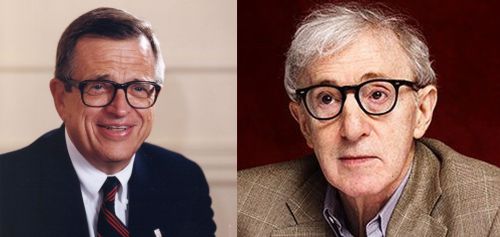
Chuck Colson: Teshuvah and Woody Allen


Chuck Colson (1931-2012) died this past weekend. His ruthless loyalty to Richard Nixon led to his central role in the Watergate scandal and to time in prison. That experience in turn led to his rebirth as an Evangelical Christian and to a lifetime of writing books (23 of them) and of helping the least among us—prisoners and others—to achieve fuller and better lives, at least by Colson’s religious lights.

If many were turned off by Colson’s politics before his conversion, it was not always easier after. Some questioned his sincerity. Others wondered whether any amount of transformation, however sincere, could balance his responsibility for helping to bring our democracy to its knees. Others saw the politics of his Christianity to be as socially destructive as the politics of his pre-Christian ruthlessness.

Two notes about Chuck Colson.

His first book Born Again (1976) is distinguished from all other books by participants in Watergate, from Nixon down through all his men. Most readers with particular political or religious inclinations didn’t read the book then, and even fewer do now. It is a compelling, candid, sincere confession of malfeasance and faith. Whether Colson’s work of the past forty years is to your liking or loathing, if you believe in the possibility of turning—in Hebrew, teshuvah—then you should believe in this. Personal transformation is not limited to those we approve of.

The second note is that Chuck Colson was a big Woody Allen fan. This was revealed last fall in an article  by Washington Post religion writer Michele Boorstein. Theories of humor and religion aside, this really isn’t hard to understand. Funny and smart is funny and smart, and this is probably something Colson appreciated. There’s no evidence that Colson and Allen ever met (though Boorstein did uncover a tape of Allen interviewing Billy Graham!). If they had, maybe they would have shared their experiences and views about the power of turning and confession for everyone, including artists and political operatives.