Bob Schwartz

Category: Religion

Days of Holocaust Remembrance: Different Trains

Holocaust Train Car
Monday was Yom HaShoah, the Day of Remembrance for victims and heroes of the Holocaust. In the United States, the entire week marks the National Days of Remembrance.

The phenomenon of the Holocaust has demanded the work of historians and others to record and chronicle. That mission moves ahead, and every year—more than seventy years later—adds new dimensions to the story. It has also demanded the work of activists, whose mission is transform the basest experiences into a brighter and more humane future.

But the artists are different kinds of workers and alchemists. They know that when we read or hear the details, or see the photos, we are apt put up a psychic wall, because we can take only so much. Enough: we are human, as were the victims and the masters of madness. Artists approach us, and the Holocaust, differently. Even if our psyches want to put up a wall, to give us some rest from the onslaught, we don’t know where to build it. So we are tricked into watching, listening, and learning in a different way with different senses.

Steve Reich is one of the masters of modern music. He composed a suite, Different Trains, inspired by the Holocaust. Each of the three movements represents the experience before, during and after the War.

Here is a YouTube video of a performance of the second movement, Different Trains – Europe-During the War. The composition features the recorded voices of Holocaust survivors.

If you are a Spotify user, you can listen to Different Trains.

At the U.S. Holocaust Memorial Museum in Washington, D.C., there is an actual train car used to transport Jews (above). This extraordinary museum contains artifacts and educational displays, the cumulative effect of which can be overwhelming. You might feel your spirit broken, tears in your eyes, and then, miraculously, your spirit begins to be healed, a little.

That’s why we have the historians, the activists and the artists. They are the doctors dedicated to healing the soul of a badly wounded world and trying to make sure it doesn’t get so sick, ever again.

Moses on Krypton, Superman in Egypt

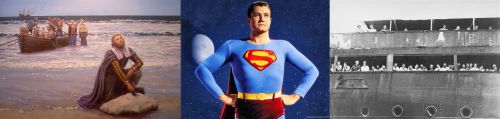
Mose & Superman
The story of the Exodus and Passover is a story of freedom, faith and return from exile. It is also a story about the universal question of identity: who am I?

According to the story told in the Book of Exodus, Moses is born a lowly Hebrew, a child of slaves. Set afloat by his mother to avoid Pharaoh’s slaying of the first born, he is found and given the Egyptian name Moses. He is raised as Egyptian royalty, though as a baby he is fed at the breast of his Hebrew mother.

It is never clear in the text when or how he first finds out about his heritage. We only know that he does discover that he is a Jew. He flees to Midian and marries Zipporah, who bears him a son. The name chosen for their son tells a story, the story of Moses and of the Jewish people. The name is Gershom, meaning “I have been a stranger in a foreign land.” (Exodus 2:22)

This famous phrase leads to a question: exactly which land is Moses a stranger in? Is he a Hebrew who has been a stranger in Egypt, despite living his entire adult life as a great Egyptian? Or is he an Egyptian suddenly identified with a people he never knew as his own?

A clue is found in the stories about Moses as a speaker. Twice Moses tries to tell God that he is speech challenged. When directed to address the Jews, Moses claims to be “slow of tongue” and “heavy of mouth.” When told to speak to Pharaoh, Moses describes himself cryptically as having “uncircumcised lips.” Some interpreters attribute this to an actual speech impediment, perhaps stuttering. But a different view is that Moses is trying to tell God something sensible: Moses does not speak Hebrew very well. And why should he speak Hebrew, when he has spent his life as an Egyptian?

At this point, we leave Egypt for a trip to Cleveland in the 1930s. Jerry Siegel and Joe Shuster are a couple of nerdy Jewish teenagers with a love of science fiction and a talent for comic book art. They had grown up with the stories of the Bible, including the tales of Moses. Consciously or not, they mixed these together into a comic book creation that would become a modern cultural icon: Superman.

In the Siegel and Shuster version, there is no infant floated off in a basket to avoid his death, and no Egyptian princess to find and adopt him. Instead, the Kryptonian infant Kal-el (a version of the Hebrew phrase Kol El, “the voice of God” or “all of God”) is rocketed off in a space capsule to avoid the planet’s destruction. The capsule crashes on Earth, and he is found and adopted by the Midwestern couple, Ma and Pa Kent.

The biblical infant is raised as an Egyptian and given the Egyptian name Moses; Kal-el is raised as an earthling and given the Midwestern name Clark Kent. The time will come for both of them, Moses and Clark Kent, to reclaim their true identities in order to tap into great power, to become super-men.

But this reclaiming of identity is not without difficulties. The man born Kal-el struggles with his disguises: Is he Superman pretending to be Clark Kent, or is he Clark Kent who has a second identity as Superman?

These particular stories of exile and identity are only two of many such stories in history and in popular culture. It is a story that repeats itself again and again, not only among the Jewish people in ancient and modern times, but among all people in all times and circumstances.

Think of the Jews in the midst of their Exodus, chronically uncertain about who they were and where they belonged. As much as they wanted to follow their faith and their leader to a promised place, their adopted home for generations—even if not by choice, even under the oppressor’s thumb—had been Egypt.

Think of Moses, caught between two worlds. Yet the struggle for identity turns out to be a source of strength for him. All that he accomplished could never have happened if he had been only an Egyptian or only a Hebrew. It was through his being both, and through his trying to resolve that seeming contradiction, that the events of the Exodus transpired.

Think of ourselves. We may believe that by staying in one place and simply holding tight to an unchanging way, we can maintain an identity free of questions, and we can avoid being strangers in a foreign land. But that is impossible. Those around us are constantly changing and the world around us is constantly changing. The land we think of as familiar becomes foreign to us, and we find ourselves strangers in it.

Being a stranger is unavoidable, and it can be a good thing. Like Moses, we discover who we are only when we question who we are in the particular place and time we inhabit. Along with the divine direction that he heard, it is this burning question of identity that drove Moses to do great things. It is a valuable lesson for all of us as we retell the story of the Exodus this Passover.

Actor Is Typecast As Satan

Satan
The media is all atwitter over the observation that the actor who plays Satan in a new Bible series looks a lot or something like President Obama.

The Associated Press got a response from the producers:

Mark Burnett and Roma Burnett said Monday the Moroccan actor who played Satan in the History channel series has played Satanic characters in other Biblical programs long before Obama was elected president.

First, separate from any questions about motives or about whether Mohamen Mehdi Ouazanni does look like Obama, let’s quickly get past a gap in this reply. If an actor looks like the President, and you have some creative notion that this helps make it a good casting choice (for artistic, political or publicity reasons), his having played Satan before just might be a bonus. Or if his experience as Satan is the driving reason, then the look-alike feature might be a bonus. The earlier Satan experience doesn’t fully dismiss any possibilities.

Beneath all this is a commentary on the craft and business of acting. From the producers’ comments, it appears that Mohamen Mehdi Ouazanni is, or is on his way to, being typecast as Satan. He played the part before, he is playing it now (and getting lots of attention for it), and may then be asked to play it again. If Charlton Heston had done a few more Moses movies after The Ten Commandments, what would his later career have looked like? Would he have been waiting around for the next Moses movie, instead of giving us Ben Hur, Planet of the Apes, Soylent Green, etc.? No major actor has ever reprised the role of Jesus, either, because besides the fact that there is no sequel to the story, it is the kind of part that is hard to shake.

There is a silver lining, though. Whether or not there are other Satan parts in this actor’s future, there is no doubt that in years to come, we will be seeing all kinds of films about Barack Obama. Some will even cast Obama as a metaphorical devil—a part he already plays in lots of political punditry. When those films are finally made, there will be a call for actors, and maybe having played Satan will be a real qualification.

The Saints Francis

St. Francis of Assisi
Right now, there are millions of words being written and spoken about who Pope Francis is and what kind of Pope he will be. Read and listen with care and a bit of skepticism, knowing that some (but not all) have an agenda or a bit of rosy vision, and knowing that almost all of the “experts” got this papal selection wrong. The fact is that predictions are all we have at the moment, but they will fade in the shadow of what the Pope actually does or doesn’t do and accomplish.

Instead or in addition, spend some time with the saints, particularly the various Saints Francis. Even for us non-Catholics and non-Christians, the saints are an enormously interesting, educational and in some cases enlightening phenomenon. If you don’t have some appreciation for the saints, whether or not you believe the intrinsic or underlying theology, you cannot understand the Catholic Church. Besides that, in the world of religion, not just Catholicism, the lives of the saints are just plain entertaining and their teachings often edifying and inspiring.

Here is the list of Saint Francis variations, taken from the SPQN site, a go-to location for summary saint information and references:

Francis Gil de Frederich
Francis Isidore Gagelin
Francis Jaccard
Francis Jerome
Francis Johnson
Francis Man
Francis Mary Paul Libermann
Francis Page
Francis Palau y Quer
Francis Patrizzi
Francis Pontillo
Francis Possenti
Francis Regis Clet
Francis Rogaczewski
Francis Seelos
Francis Solano
Francis Solanus
Francis Trung Von Tran
Francis Webb
Francis Xavier
Francis Xavier Bianchi
Francis Xavier Can Nguyen
Francis Xavier Mau
Francis Xavier Seelos
Francis de Capillas
Francis de Geronimo
Francis de Hieronymo
Francis de Montmorency Laval
Francis de Sales
Francis di Girolamo
Francis of Assisi
Francis of Girolamo
Francis of Nagasaki
Francis of Paola
Francis of Saint Michael
Francis of Sales
Francis, Caius
Francis, Gaius
Francisca Aviat
Francisca de Ambrosia
Francisca Salesia
Francisca Salesia Aviat
Francisco Castells Brenuy
Francisco Ferro, Ambrosio
Francisco José López-Caamaño García-Pérez
Francisco Marto
Francisco of the Child Jesus
Francisco Palau y Quer
Francisco Pascual Sánchez
Francisco Shoyemon
Franciscus de Hieronymo

The most-discussed and obvious of the lives behind Cardinal Bergoglio’s groundbreaking choice of name (he is the first Pope Francis) is Francis of Assisi. His turning from a worldly life to a mission of simplicity, service, peace and, of course, living with nature led to his founding of one of the Church’s most significant orders (the Franciscans) and indirectly to the founding of another by his star student (the Poor Clares). He is also a patron saint of dozens of occupations, causes and places, including

against dying alone
against fire
animal welfare societies
animals
birds
ecologists
ecology
environment
environmentalism
environmentalists
families
lace makers
lace workers
merchants
needle workers
peace
tapestry workers
zoos
Italy
Colorado
Ahuacatlán, Mexico
Assisi, Italy
Freising, Germany
Massa, Italy
Nambe Indian Pueblo
Quibdo, Choco, Colombia
San Pawl il-Bahar, Malta
Sante Fe, New Mexico
Sorbo, Italy
Denver, Colorado, archdiocese of
Kottapuram, India, diocese of
Lancaster, England, diocese of
Metuchen, New Jersey, diocese of
Salina, Kansas, diocese of
San Francisco, California, archdiocese of
Sante Fe, New Mexico, archdiocese of
Viana, Angola, diocese of

But he is not the only Saint Francis with a substantial presence in the Church. Saint Francis de Sales, for example, is the namesake of schools worldwide, founder of his own order (the Salesians), and in 1923 was named patron saint of writers and journalists (and presumably bloggers) by Pope Pius XI.

However you are celebrating the upcoming St. Patrick’s Day—if you are—you might start your study of the saints with him.  But don’t stop there. Take this opportunity of a new Pope to learn about the Saints Francis, from the big names to the lesser known but still worthy ones. You’ll find it a special experience, no matter what your spiritual perspective, and maybe much more fun and useful than listening to the earnest babble of certain media talking heads.

The Pope and the H-Bomb

Richard Chaberlain in The Thorn Birds
From The Guardian

The Vatican has attacked reports in the Italian media linking Pope Benedict XVI’s resignation to the alleged discovery of a network of gay prelates as attempts to influence the cardinals in their choice of a new pontiff.

The Vatican secretariat of state said in a statement: “It is deplorable that as we draw closer to the time of the beginning of the conclave … that there be a widespread distribution of often unverified, unverifiable or completely false news stories that cause serious damage to persons and institutions.”

Whether or not that statement was written by Church lawyers (and even for lawyers, they serve the cause of language and reasoning with uncommon precision and conscientiousness), the denial is carefully constructed. The stories are described as one of three things: unverified, unverifiable or completely false. Note bene that two of these categories do not necessarily include or even imply falsity. Just verification. The reason for this care is that there is a top ten directive about false witness—which includes labeling as false that which is not.

Almost everyone willing to talk openly about the workings of the Church, and particularly its seminaries, will admit that there is a homosexual element of the enterprise. To say “everybody knows” is a ridiculous overstatement. But to say “nobody knows” or “not true” are equally ridiculous. Many know, some talk, most don’t.

The speculation that Pope Benedict resigned because the H-Bomb was about to drop will remain unverified and unverifiable, if the Vatican firewall holds, and it may. But whether you call it a code or a conspiracy of silence, speculation calls for and ultimately begs for verification.

Both law enforcement and the Church depend on the urge to confess. That urge is rooted in the complex and inchoate thing called conscience. In the case of the police, suspects are torn between punishment and a clean(er) heart. This is exactly the same tension for Catholics in the booth. But at this much higher level, the stakes and the choice to tell are much more momentous.

Metta New Year

Enso 1

The Metta Sutta—the Buddha’s Discourse on Loving Kindness

This is what should be accomplished by the one who is wise,
Who seeks the good, and has obtained peace.

Let one be strenuous, upright, and sincere,
Without pride, easily contented, and joyous.
Let one not be submerged by the things of the world.
Let one not take upon oneself the burden of riches.
Let one’s senses be controlled.
Let one be wise but not puffed up and
Let one not desire great possessions even for one’s family.
Let one do nothing that is mean or that the wise would reprove.

May all beings be happy.
May they be joyous and live in safety,
All living beings, whether weak or strong,
In high or middle or low realms of existence.
Small or great, visible or invisible,
Near or far, born or to be born,
May all beings be happy.

Let no one deceive another nor despise any being in any state.
Let none by anger or hatred wish harm to another.
Even as a mother at the risk of her life
Watches over and protects her only child,
So with a boundless mind should one cherish all living things.
Suffusing love over the entire world,
Above, below, and all around, without limit,
So let one cultivate an infinite good will toward the whole world.

Standing or walking, sitting or lying down,
During all one’s waking hours,
Let one practice the way with gratitude.

Not holding to fixed views,
Endowed with insight,
Freed from sense appetites,
One who achieves the way
Will be freed from the duality of birth and death.

God Does Not Like Guns

William Strutt - Peace
God does not like guns. God is also not crazy about nuclear weapons, and about all the easy to use and widely available tools of destruction in between.

This isn’t obvious. As scholars of religion and violence point out, the Old Testament is a compendium of both divine and divine-inspired and endorsed human mayhem. In the continuing battle against moral evil, which often has a religious component or context, the imperative to take up arms goes unquestioned among some, but not all. Finally, an entire eschatological theology is based on a battle that ends and transcends history as we know it, leading once and for all to the heaven on earth we have all been awaiting.

Let us pull back to the now and here, particularly last night in Newtown, Connecticut, where clergy of all faiths talked about God, if not for God.

The events in Newtown opened up a door to a new world. It was not Armageddon in an epic sense, but it was the end of the world for some, and everyone felt that. The door is a passage to the place where we leave the theology of the Second Amendment behind, where we stop listening to the priests of the National Rifle Association and their interpretations of what the founding gods meant.

This is the time to extend last night in Newtown to every congregation in America. There, leaders will explain to congregants whether God loves guns, and particularly whether God loves guns in such massive quantities and destructiveness.

The leaders can then cite Isaiah 11, and explain how “a child will lead them” is not merely some hermeneutic puzzle pointing to a messiah. Instead, it is reflected in the instruction by Jesus: “Let the little children come to me, and do not stop them; for it is to such as these that the kingdom of heaven belongs.”

The leaders will close by acknowledging that the faithful congregants will hear and themselves espouse practical arguments that stand in the way. Leaders will then patiently explain that all faith is ultimately impractical and heedless of impossibility. God does not like guns, but as his instruments, we are bound to do the worldly work of reducing their number and universal availability. If we claim to be faithful, that is more than just a good deed. It is a divine mission. God, it appears, will be more disappointed than ever if we fail.

Happy Hanukkah from Matisyahu

Matisyahu
Matisyahu is a Hanukkah miracle.

Not because suburban native Matthew Miller named himself after Mattathias, head of the family that took back the Temple in Jerusalem from the Assyrians, giving us the holiday. Not because he became a Chassidic reggae superstar. Not because last Hanukkah he shaved his beard and announced: “No more Chassidic reggae superstar.” Not because this Hanukkah his latest album Spark Seeker is Number 1 on the Billboard Reggae chart, a position it has held for weeks. Not even because his single Happy Hanukkah  is a joyous and irresistible rap reggae celebration about all that is good about the holiday, from which all proceeds go to Hurricane Sandy relief:

Happy Hanukkah
I wanna give a gift to you
Light up the night, my love shine through
From Mount Zion, this is what we do
Bring love to you

Matisyahu is a miracle because he did and is doing what we are supposed to do. Follow your light where it takes you, wherever it takes you. Wherever that is, when you get there, if you get there, shine a light of your own. It is a chance to make yourself happy and to make other people happy. And even if you are not sure you are there, or even sure where you are, celebrate anyway. It’s Hanukkah.

Black Friday

The shopping day after Thanksgiving, Black Friday is so named because for retailers, it can mean the difference between loss and profit–being in the black.

Like it or not, the Christmas shopping season is an important contributor to this consumer economy. But the term is an overwhelmingly bleak one, particularly in relation to Christmas. In all other contexts, Black Friday is historically associated with financial crises, weather disasters, fires, military attacks and massacres. Rather than concerning Christmas and the birth of Jesus, the death of Jesus is marked by what is called Good Friday–also known as Black Friday.

And then there is the 1940 horror movie (see above)…

The Rubicon and the Pillar: If We Pass This Little Bridge


The Lives of the Twelve Caesars
By Suetonius

XXXI.

…The lights going out, he [Julius Caesar] lost his way, and wandered about a long time, until at length, by the help of a guide, whom he found towards daybreak, he proceeded on foot through some narrow paths, and again reached the road. Coming up with his troops on the banks of the Rubicon, which was the boundary of his province, he halted for a while, and, revolving in his mind the importance of the step he was on the point of taking, he turned to those about him, and said: “We may still retreat; but if we pass this little bridge, nothing is left for us but to fight it out in arms.”

XXXII.

While he was thus hesitating, the following incident occurred. A person remarkable for his noble mien and graceful aspect, appeared close at hand, sitting and playing upon a pipe. When, not only the shepherds, but a number of soldiers also flocked from their posts to listen to him, and some trumpeters among them, he snatched a trumpet from one of them, ran to the river with it, and sounding the advance with a piercing blast, crossed to the other side. Upon this, Caesar exclaimed, “Let us go whither the omens of the Gods and the iniquity of our enemies call us. The die is now cast.”