Bob Schwartz

Category: Religion

Thank You Mask Man

Thank You Mask Man
The release of the new Lone Ranger movie is an opportunity to introduce some readers to Lenny Bruce, very nearly the most significant comic of the modern comedy era.

In the 1950s and early sixties, there was nothing that Bruce wouldn’t talk about—in language that you could hear anywhere except on stage or screen, in attitude that was mercilessly satirical and uncomfortable for a lot of people. Most of all, it was funny. It wasn’t that he didn’t care and was only doing it to be sensational. He did it because he cared painfully about hypocrisy and self-righteousness that ended up hurting people deeply (just like today). He held up a mirror, and if what people saw looked ridiculous and less than complimentary, he was just the observer.

He has been called the Elvis of stand up, and that applies in a few ways. First, he was a groundbreaking talent who did what others had not done before and made it wildly popular. Second, his work was controversial and resulted in reaction. In the case of Bruce, it was not only social or media reaction; it was legal. Elvis was never busted for his hip shaking. Third, each of them had certain personal demons that contributed to a sad and untimely demise.

Lenny Bruce continued the long tradition of telling truth to power in a funny way. In his later years, after numerous busts for obscenity, a certain bitterness colored his attempts at comedy, “attempts” because to be honest much of it wasn’t funny. But at his height, there was a sweet honesty that made his arguments hard to resist.

Thank You Mask Man is a comedy bit about the Lone Ranger. In 1968, it was made into an animated short, with Bruce’s routine as the soundtrack. The premise of the bit is that the Lone Ranger never stops to accept “thank yous” from the people he helps. When he finally does agree to enjoy appreciation, it turns out to be something the townspeople don’t expect. Be aware and warned: Bruce manages to work small-mindedness, homosexuality, and even religion into the goofy mix (i.e., we won’t need the Lone Ranger after the Messiah returns).

Enjoy Lenny Bruce and a Lone Ranger you’ve never seen before.

Immigration: The Right People and the Wrong People

Pilgrims - Superman - Jews
Today brings another high-profile politician talking about immigration policy that lets “the right people” in (those who will create the next Google) and keeps “the wrong people” out (vaguely defined, but you’ll know them when you see them).

A reminder that except for continental natives, all Americans are immigrants. Even the Mayflower people. Even Superman, an undocumented immigrant who for years was hidden by a seemingly kind and gentle Midwestern couple—of outlaws; why weren’t Ma and Pa Kent ever put in jail?

In the lead up to World War II, America could not find a place for thousands of Jews fleeing Hitler. These were apparently the wrong people, or the right people at the wrong time, or something. Any country is apt to make mistakes; America is no exception. Still, it is ironic that some of the people who were turned away might have started hundreds of Googles, or the 1930s equivalents. As it is, we can only imagine.

We can’t let everybody in, or so we say, but we don’t really talk about why not and what that means. Instead, we have immigrants who are “the wrong people”, but we also have “the right people” to serve particular national or individual interests (see also involuntary immigrants who were cheaper and more versatile than machines).

Not everybody is Superman. Not everybody is a bunch of unwanted people who will become the cliché of founding stock (Pilgrims) or unwanted people who never make it to shore (Jews). Not everybody is an entrepreneur. Not everybody is willing to take the worst jobs that few others want. Immigrants are people, not “right” or “wrong”. We can and should have a conversation without forgetting that.

DNA and the Supreme Court Reading Program

DNA Court
Today’s Supreme Court decision on the patentability of genetic material, Association for Molecular Pathology v. Myriad Genetics, Inc.  is another example of just how informative and fun these opinions can be, as opposed to just hearing the media summaries. This leads to a suggestion for a Supreme Court Reading Program.

Earlier posts have covered the value—in knowledge and entertainment—of reading current Supreme Court opinions, even if you are not a lawyer. This also includes reading the briefs in support of various positions, from a range of people and organizations. When the marriage equality cases were argued back in March, a post was devoted to The Briefs on Marriage Equality.

In this complex and significant gene case, the unanimous opinion of the Court (Justice Scalia concurred in a very short comment of his own) is that particular genetic material that isolated and identified (here, the site of mutations leading to breast and ovarian cancer) is not patentable, but that a new synthesized version of that same material, with the deletion of some parts, is.

Among the things that makes the opinion so interesting is its cogent explanation of a technical area. Genetics isn’t easy, and the opinion is really an understandable primer on a difficult topic.

Even more interesting are the array of briefs submitted in the case. Along with companies that want to be able to hold lucrative proprietary interest in genes, there are scientists and health care advocates who want nothing to stand in the way of free and open development and application. (The Humane Genome Project, for example, from the first offered all the work on the mapping the human genome to humanity.) Lawyers and intellectual property activists also chimed in, with intense interest in how patent law is a mess in these hyper-advancing times, having fallen so far behind the realities of digital and bio innovation. Also interesting is a brief from the Southern Baptist Convention, which taken from their church perspective makes a pretty good argument that, to put it bluntly, you can’t patent God.

So when you hear mention of an interesting Supreme Court case, either when it is argued or decided, step away from the media reports, even when those are reliable from experts you trust. Instead, visit the Supreme Court site to read or download the opinion (the opinion is published on the site almost immediately). Then visit the American Bar Association site that collects all the amicus briefs for each case that is argued. There will be a lot of those briefs—more than a hundred in the case of marriage equality—so you will want to pick and choose. Sometimes the name of the person or organization submitting the brief will catch your interest, just by who or what they are.

That certainly applies to the gene patent case. There among the many briefs is one identified as Brief for James D. Watson, Ph.D. in Support of Neither Party. Just in case the name isn’t familiar, James Watson, Ph.D. is the co-discoverer of the double helix structure of DNA, for which he and Frances Crick were awarded the Nobel Prize in Physiology in 1963. Even if he wasn’t one of the most important scientists in history, his delightful and erudite 26-page brief would be worth reading. It’s just one more example of how a Supreme Court Reading Program can be an enlightening and surprising addition to whatever else you’re currently paying attention to.

The Next Civil War: Religion

Lincoln Penny
A few years ago, I proposed that the American divide over abortion might one day reach the dangerous depths of a much earlier conflict over slavery. Not since slavery—not even with still-festering questions about racial and other inequalities—has an issue had such a basic and visceral impact.

The poll numbers on abortion have shifted, the judicial context may be stable (for the moment), but the legislative activity is still a battlefield: among the initiatives, just today Pennsylvania Governor Tom Corbett signed a law prohibiting insurers that offer abortion coverage from participating in the state’s exchange under the Affordable Care Act.

Yet even with that, abortion will not be the biggest issue that cleaves America in the next few years. It will be, much more than it is now, religion.

Not one religion against another, or one religion-based position against another. We are approaching the point where half of America has an explicit or implicit affinity with some organized religious denomination or belief, and half does not. The not includes a wide range from atheists, agnostics, areligionists or anti-religionists to those who are “spiritual but not religious.”

America is not a theocracy or, officially, a theocratic democracy. But “theocratic democracy” (see Israel) is the way a number of Americans see it approvingly. Our conventions, traditions and even our money support this, and when they didn’t support it sufficiently, it was enhanced—as when during the Cold War against godless Communism, “under God” was added to the Pledge of Allegiance.

The dynamic between religious and secular has long played out in America in just about every official sphere. But in the past, those who fought for the secular and even succeeded (prayer in schools) were considered an aberrant and weird fringe. The fringe is now a minority, but still in some eyes, aberrant and weird. What happens when that fringe turned minority becomes an equal partner in American civics, citizens who are guided by bright moral lights, just not those that emanate from lamps they don’t believe in and refuse to support—or allow to rule their lives? What then?

Abraham Lincoln said we could not survive half-slave and half-free. The nineteenth century would not have hinted at it. but the American twenty-first may be half-God, half-not. What might Lincoln say then?

Moral Mondays

Moral Mondays

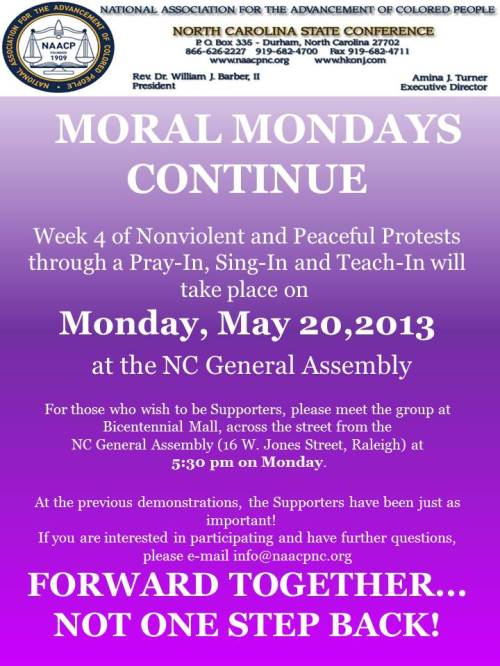
Today, Monday, June 3, is another Moral Monday in North Carolina. A Mega Moral Monday. Small and local right now, Moral Mondays have the potential to be the kind of broad movement that in recent years progressives have wanted but so far been unable to achieve.

In May, the North Carolina NAACP began peaceful protests each Monday at the General Assembly. The civil disobedience is meant to bring attention to legislative curbs on Medicaid expansion, workers’ rights and voting rights, and to the lack of legislative progress on gun control and public education funding. There have been an increasing number of arrests of activists, 153 so far. This week, the protests are expanding across the state.

All movements are more likely to fall flat than catch fire. The Occupy movement reflected real dissatisfaction and outrage, but never sufficiently articulated the underlying principles that would galvanize people to commit and to connect with each other in big numbers.

Moral Monday is built on a foundation that is at the heart of what bothers so many Americans. As is apparent from many of our political controversies, some of those who claim the moral high ground sometimes seem to ignore possible moral shortcomings in their policies, e.g., a Christian imperative to lift the poor and heal the damaged may be at odds with extreme cuts in government support and programs. (In this regard, see questions about Ayn Rand that arose in the most recent election.)

Moral Monday simplifies what is admittedly a set of very complex issues to a very basic baseline: If you claim, by the light of faith or by a sense of enlightened humanity, to believe in moral action, then your idea of morality must be your primary guide. You are free to choose that morality; no constitution, no set of laws, nothing can or should move it. But once you have chosen, and especially after you say it loudly every Friday, Saturday, or Sunday, or on whatever days you proclaim your core beliefs, your duty is to act on it. If you don’t act morally, or if you try to rationalize around that morality for some supposed greater cause, you are only human, but should investigate and consider your action, and even your possible hypocrisy.

Moral Mondays may not make it beyond North Carolina. But it is possible that in a little while, all around the country, more and more people will start the week by taking a stand and, if necessary, getting arrested for it. There is a global and historic tradition for this sort of action, and great change has been made.

Thank you North Carolina NAACP. Mondays will never be the same.

Shavuot and Ruth

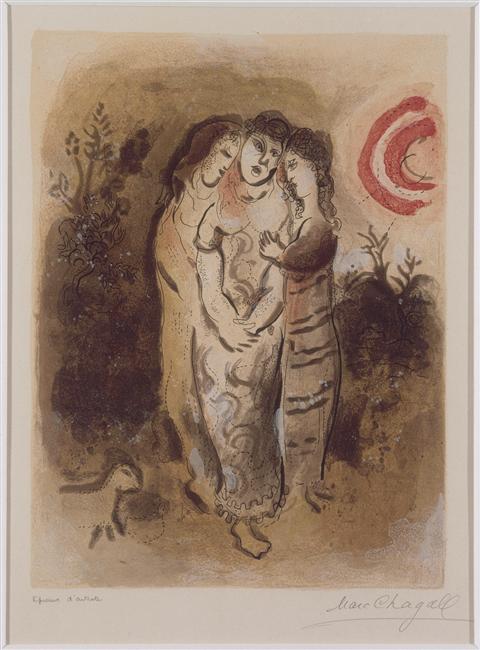
Chagall - Naomi and Her Beautiful Daughters

Today is the Jewish holiday of Shavuot. It is said so often that Shavuot is “lesser known” that maybe it is now better known for being lesser known.

Its low profile outside the Jewish communities doesn’t mean it is insignificant, or that a host of meanings and traditions aren’t attached.

Shavuot began as an agricultural celebration. The name literally means Festival of Weeks, one of the three pilgrimage holidays, along with Passover and Sukkot. The Bible commands the counting of the omer, the days from the second day of Passover. After seven weeks, on the fiftieth day, a grain offering is to be made at the Temple. As a harvest celebration, Shavuot is also known as the Day of the First Fruits. If you’re into borrowing food traditions, Shavuot is a dairy holiday, and cheese blintzes and cheesecake are always appropriate.

Shavuot also celebrates the giving of the Ten Commandments and the Torah, the central event in Jewish life. Some make the case that dating this event on Shavuot is biblical. But attaching this event to the holiday seems more a matter of tradition than biblical precision. After the destruction of the Temple, agricultural pilgrimages ended.  This new tradition arose, a tradition that remains at the heart of the modern Shavuot celebration. Among the observances, some people gather and stay up all night reading the Torah, along with other scripture and literature.

There is a holiday calendar mashup surrounding Shavuot. Shavuot and Christian Pentecost often fall within a few days of each other—this year Shavuot starting on the evening of May 14 and Pentecost on Sunday May 19.

There are some holidays on the Jewish and Christian calendars that based on history and theology have a real and important relationship, such as Passover and Easter. There are holidays that may coincide on the calendar but have little to do with one another. And then there are Shavuot and Pentecost, which have an usual relationship.

To begin with, the holidays share the same name, sort of. As a festival marking seven weeks, Shavuot became known as Pentecost among Greek-speaking Jews, because it marks the “fiftieth” day from the second day of Passover.

Pentecost is a major feast on the Christian liturgical calendar. It represents the descent of the Holy Spirit on the apostles and others, on the fiftieth day (Pentecost) after Easter. It is often considered the birthday of the Church.

It is relatively straightforward to deal with the nexus between the events of Holy Week and Passover. There is evidence in the Gospels, and the weight of opinion is that the Last Supper was indeed a Passover meal. But the dueling Pentecosts, and the attempts to harmonize them, have caused nothing but confusion.

It is certain that the Jews of Jesus’ time would have celebrated the agricultural holiday of Shavuot. But beyond this, we have Christians who try to make the case that Christian Pentecost is “historically and symbolically” related to Shavuot, though it isn’t clear exactly how. On the other side, there are a few Jewish writers who claim that the name Pentecost was unknown to Jews, even Greek speakers, and that the name was given to Shavuot by Christians.

Finally, there is this coincidence. In Reform Judaism, youth confirmation is often held on Shavuot, in recognition of the giving of the Torah. In many Christian denominations, youth confirmation is held on Pentecost, in recognition of the work of the Holy Spirit.

If you take a big picture view, you can probably connect the dots and come up with a relationship between Shavuot (Pentecost) and Pentecost. This is especially tempting when the two holidays coincide so closely. But they are two distinct holiday, and harmonizing is a stretch.

As far as Shavuot traditions, maybe the most heart-lifting is reading the Book of Ruth. Separate from its religious meaning, this is a great piece of literature, a short story about unyielding devotion, commitment and loyalty to family—and one of the first and most famous to affirm the family of women. It is the touching antidote to every caustic mother-in-law joke that has ever been told.

In Ruth, the mother-in-law Naomi loses her husband, as her daughters-in-law lose theirs (above, Chagall’s Naomi and Her Beautiful Daughters). Seeming to have little else in common than her sons, Naomi urges them to leave and get married again. One does leave, but Ruth refuses, in words that are sometimes used to signify the power of Ruth’s conversion of faith, but that are a much more universal expression of devotion as solid as that of any marriage:

She then decided to come back from the Plains of Moab with her daughters-in-law, having heard in the Plains of Moab that God had visited his people and given them food. So, with her daughters-in-law, she left the place where she was living and they took the road back to Judah.

Naomi said to her two daughters-in-law, ‘Go back, each of you to your mother’s house. May God show you faithful love, as you have done to those who have died and to me. God grant that you may each find happiness with a husband!’ She then kissed them, but they began weeping loudly, and said, ‘No, we shall go back with you to your people.’

‘Go home, daughters,’ Naomi replied. ‘Why come with me? Have I any more sons in my womb to make husbands for you? Go home, daughters, go, for I am now too old to marry again. Even if I said, “I still have a hope: I shall take a husband this very night and shall bear more sons,” would you be prepared to wait for them until they were grown up? Would you refuse to marry for their sake? No, daughters, I am bitterly sorry for your sakes that the hand of God should have been raised against me.’

They started weeping loudly all over again; Orpah then kissed her mother-in-law and went back to her people. But Ruth stayed with her. Naomi then said, ‘Look, your sister-in-law has gone back to her people and to her god. Go home, too; follow your sister-in-law.’

But Ruth said, ‘Do not press me to leave you and to stop going with you, for wherever you go, I shall go, wherever you live, I shall live. Your people will be my people, and your God will be my God. Where you die, I shall die and there I shall be buried. Let God bring unnameable ills on me and worse ills, too, if anything but death should part me from you!’

(Ruth 1:6-17)

Barna: You Don’t Have to Be Christian

Spiritually Homeless
If you have any interest in the state of American religion—or of American society—you must pay attention to the Barna Group. Founded by George Barna in 1984, for decades jit has been analyzing American attitudes towards and participation in religion, from the perspective of informing Christian churches. By its nature, though, this is not necessarily a denominational narrow view. Consider, by analogy, market research by General Motors. That research is not entirely, or even primarily, about consumers and GM cars. It is about consumers and all car companies and cars and transportation in general. Just so, state-of-the-art quality research on religion is valuable to anyone in the field.

Beyond this, it is valuable for anyone interested in America. For example, our public discussion includes the terms Christian, evangelical, born again, etc., being thrown around casually as if everyone knows and agrees on what they mean—except that everyone doesn’t. That lack of rigor isn’t a luxury that Barna has. It has defined these and other terms with surgical precision, so that the research itself can be precise and informative.

The just-released report on Three Spiritual Journeys of Millennials is only the latest example of how fascinating and useful the Barna research can be. When numbers of people flee from organized religion, only the most shortsighted think that this is a just a problem for Christianity or for any other religious institution. A social sea change is a sea change, and not trying to seriously assess its meaning and implications is simply foolish. Those who applaud the phenomenon as a sign of long overdue enlightenment—of people finally coming to their senses—are not thinking it through. Jew, Muslim, Buddhist, atheist, areligionist, anti-religionist, this report—and all that Barna does—can help you with that thinking.

Days of Holocaust Remembrance: Different Trains

Holocaust Train Car
Monday was Yom HaShoah, the Day of Remembrance for victims and heroes of the Holocaust. In the United States, the entire week marks the National Days of Remembrance.

The phenomenon of the Holocaust has demanded the work of historians and others to record and chronicle. That mission moves ahead, and every year—more than seventy years later—adds new dimensions to the story. It has also demanded the work of activists, whose mission is transform the basest experiences into a brighter and more humane future.

But the artists are different kinds of workers and alchemists. They know that when we read or hear the details, or see the photos, we are apt put up a psychic wall, because we can take only so much. Enough: we are human, as were the victims and the masters of madness. Artists approach us, and the Holocaust, differently. Even if our psyches want to put up a wall, to give us some rest from the onslaught, we don’t know where to build it. So we are tricked into watching, listening, and learning in a different way with different senses.

Steve Reich is one of the masters of modern music. He composed a suite, Different Trains, inspired by the Holocaust. Each of the three movements represents the experience before, during and after the War.

Here is a YouTube video of a performance of the second movement, Different Trains – Europe-During the War. The composition features the recorded voices of Holocaust survivors.

If you are a Spotify user, you can listen to Different Trains.

At the U.S. Holocaust Memorial Museum in Washington, D.C., there is an actual train car used to transport Jews (above). This extraordinary museum contains artifacts and educational displays, the cumulative effect of which can be overwhelming. You might feel your spirit broken, tears in your eyes, and then, miraculously, your spirit begins to be healed, a little.

That’s why we have the historians, the activists and the artists. They are the doctors dedicated to healing the soul of a badly wounded world and trying to make sure it doesn’t get so sick, ever again.

Moses on Krypton, Superman in Egypt

Mose & Superman
The story of the Exodus and Passover is a story of freedom, faith and return from exile. It is also a story about the universal question of identity: who am I?

According to the story told in the Book of Exodus, Moses is born a lowly Hebrew, a child of slaves. Set afloat by his mother to avoid Pharaoh’s slaying of the first born, he is found and given the Egyptian name Moses. He is raised as Egyptian royalty, though as a baby he is fed at the breast of his Hebrew mother.

It is never clear in the text when or how he first finds out about his heritage. We only know that he does discover that he is a Jew. He flees to Midian and marries Zipporah, who bears him a son. The name chosen for their son tells a story, the story of Moses and of the Jewish people. The name is Gershom, meaning “I have been a stranger in a foreign land.” (Exodus 2:22)

This famous phrase leads to a question: exactly which land is Moses a stranger in? Is he a Hebrew who has been a stranger in Egypt, despite living his entire adult life as a great Egyptian? Or is he an Egyptian suddenly identified with a people he never knew as his own?

A clue is found in the stories about Moses as a speaker. Twice Moses tries to tell God that he is speech challenged. When directed to address the Jews, Moses claims to be “slow of tongue” and “heavy of mouth.” When told to speak to Pharaoh, Moses describes himself cryptically as having “uncircumcised lips.” Some interpreters attribute this to an actual speech impediment, perhaps stuttering. But a different view is that Moses is trying to tell God something sensible: Moses does not speak Hebrew very well. And why should he speak Hebrew, when he has spent his life as an Egyptian?

At this point, we leave Egypt for a trip to Cleveland in the 1930s. Jerry Siegel and Joe Shuster are a couple of nerdy Jewish teenagers with a love of science fiction and a talent for comic book art. They had grown up with the stories of the Bible, including the tales of Moses. Consciously or not, they mixed these together into a comic book creation that would become a modern cultural icon: Superman.

In the Siegel and Shuster version, there is no infant floated off in a basket to avoid his death, and no Egyptian princess to find and adopt him. Instead, the Kryptonian infant Kal-el (a version of the Hebrew phrase Kol El, “the voice of God” or “all of God”) is rocketed off in a space capsule to avoid the planet’s destruction. The capsule crashes on Earth, and he is found and adopted by the Midwestern couple, Ma and Pa Kent.

The biblical infant is raised as an Egyptian and given the Egyptian name Moses; Kal-el is raised as an earthling and given the Midwestern name Clark Kent. The time will come for both of them, Moses and Clark Kent, to reclaim their true identities in order to tap into great power, to become super-men.

But this reclaiming of identity is not without difficulties. The man born Kal-el struggles with his disguises: Is he Superman pretending to be Clark Kent, or is he Clark Kent who has a second identity as Superman?

These particular stories of exile and identity are only two of many such stories in history and in popular culture. It is a story that repeats itself again and again, not only among the Jewish people in ancient and modern times, but among all people in all times and circumstances.

Think of the Jews in the midst of their Exodus, chronically uncertain about who they were and where they belonged. As much as they wanted to follow their faith and their leader to a promised place, their adopted home for generations—even if not by choice, even under the oppressor’s thumb—had been Egypt.

Think of Moses, caught between two worlds. Yet the struggle for identity turns out to be a source of strength for him. All that he accomplished could never have happened if he had been only an Egyptian or only a Hebrew. It was through his being both, and through his trying to resolve that seeming contradiction, that the events of the Exodus transpired.

Think of ourselves. We may believe that by staying in one place and simply holding tight to an unchanging way, we can maintain an identity free of questions, and we can avoid being strangers in a foreign land. But that is impossible. Those around us are constantly changing and the world around us is constantly changing. The land we think of as familiar becomes foreign to us, and we find ourselves strangers in it.

Being a stranger is unavoidable, and it can be a good thing. Like Moses, we discover who we are only when we question who we are in the particular place and time we inhabit. Along with the divine direction that he heard, it is this burning question of identity that drove Moses to do great things. It is a valuable lesson for all of us as we retell the story of the Exodus this Passover.

Actor Is Typecast As Satan

Satan
The media is all atwitter over the observation that the actor who plays Satan in a new Bible series looks a lot or something like President Obama.

The Associated Press got a response from the producers:

Mark Burnett and Roma Burnett said Monday the Moroccan actor who played Satan in the History channel series has played Satanic characters in other Biblical programs long before Obama was elected president.

First, separate from any questions about motives or about whether Mohamen Mehdi Ouazanni does look like Obama, let’s quickly get past a gap in this reply. If an actor looks like the President, and you have some creative notion that this helps make it a good casting choice (for artistic, political or publicity reasons), his having played Satan before just might be a bonus. Or if his experience as Satan is the driving reason, then the look-alike feature might be a bonus. The earlier Satan experience doesn’t fully dismiss any possibilities.

Beneath all this is a commentary on the craft and business of acting. From the producers’ comments, it appears that Mohamen Mehdi Ouazanni is, or is on his way to, being typecast as Satan. He played the part before, he is playing it now (and getting lots of attention for it), and may then be asked to play it again. If Charlton Heston had done a few more Moses movies after The Ten Commandments, what would his later career have looked like? Would he have been waiting around for the next Moses movie, instead of giving us Ben Hur, Planet of the Apes, Soylent Green, etc.? No major actor has ever reprised the role of Jesus, either, because besides the fact that there is no sequel to the story, it is the kind of part that is hard to shake.

There is a silver lining, though. Whether or not there are other Satan parts in this actor’s future, there is no doubt that in years to come, we will be seeing all kinds of films about Barack Obama. Some will even cast Obama as a metaphorical devil—a part he already plays in lots of political punditry. When those films are finally made, there will be a call for actors, and maybe having played Satan will be a real qualification.