Bob Schwartz

Category: Religion

Thanksgiving and Hanukkah in America: A History
Hanukkah in America
Hanukkah is getting lots more attention this year than it usually does, because it starts on Thanksgiving, rather than on or about Christmas.

This is nearly unprecedented. Of course there’s lots of controversy about just how rare it is, partly because Thanksgiving has officially moved from the last Thursday in November to the fourth Thursday, partly because the Jewish calendar is a lunar calendar, partly because of some esoterica of interest to extreme calendar freaks. Some say it won’t happen again for 70,000 years, others say it will never, ever happen again. If you happen to be around when it does, if it does, please e-mail, post, tweet, or whatever sort of advanced messaging will be used then to communicate with the curious but departed.

Thanksgivingukkah, or whatever other ridiculous and ear-hurting names people are coming up with, is second only to Black Friday as a cultural meme this week. We will be seeing lots of turkeys with Hanukkah candles stuck in them—actual ones, not just Photoshopped ones, at actual Thanksgiving tables, with plenty of videos to prove it. Might even see some turkey selfies. On the food front, we will have combined cuisines, where things not usually seen on the Thanksgiving table make an appearance, such as latkes and sour cream. (Note: I am promoting latke stuffing as the best of all possible hybrids.)

There’s a lot to talk about when Hanukkah and Christmas collide and coincide, theologically, historically and socially. Both involve charismatic Jewish religious leaders taking on tyranny—though one battles on the military and political front, while the other wields an entirely different set of weapons. As a central theme, both at some point take on the profaning of the Temple, in one case made unholy by soldiers, in the other made unholy by turning sacred space into a commercial enterprise. Both involve miracles and miraculous lights challenging the darkness. Not to mention that at the time of Jesus, Jews knew and marked the events of the Maccabee revolution, which had taken place less than two hundred years earlier.

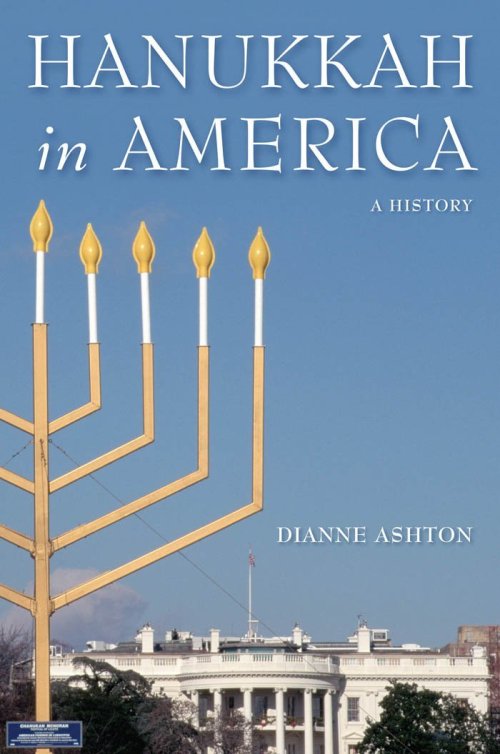
Whether you are Jewish, or just newly fascinated by Hanukkah because it is for once not getting lost in the Christmas mishegas (“craziness” in Yiddish), have I got a book for you. Hanukkah in America: A History by Dianne Ashton is more than just a review of how American Jews regarded and celebrated this once-minor holiday. It is the definitive and delightful book about how Hanukkah evolved to become a laboratory for what it means to be a Jew in America, and for that matter what it means to be Americans of any kind.

Here’s something Ashton writes about Thanksgiving and the “deluxe Hanukkah turkey dinner”:

Many Jews combined food products available in America with recipes they deemed appropriate for Hanukkah meals. Even with a simple meal at home, immigrants could imagine a different Hanukkah past than the one in Eastern Europe. They could envision a personal bond with Judah Maccabee by selecting Carmel wine, which claimed to be “what the Maccabees drank.” Local food shops such as Goldman’s Tea and Coffee Store held special sales in honor of Sabbath Hanukkah. Jewish restaurateurs sometimes targeted immigrants’ desires for American foods at special occasions. Perhaps no food is so identified with America as the turkey, an animal native to North America and the featured dish of the Thanksgiving dinners that take place across the country only a few weeks before Hanukkah. When Gorfein’s, a kosher restaurant, advertised a deluxe Hanukkah turkey dinner in the Forverts, it apologized in print the next day to “hundreds [who had to be] turned away” because the restaurant “had no space or food left for them.” Gorfein’s offered the same dinner a second night.

My usual Hanukkah post, sometime around Christmas, ends with a mention of a wonderful Comedy Central special, A Colbert Christmas: The Greatest Gift of All. Our comic saviors Jon Stewart and Stephen Colbert perform the song Can I Interest You In Hanukkah? with Stewart making the case for the Jewish holiday:

Jon: Can I interest you in Hanukkah? Maybe something in a Festival of Lights. It’s a sensible alternative to Christmas. And it lasts for seven – for you – eight nights.
Stephen: Hanukkah huh? I’ve never really thought about it.
Jon: Well, you could do worse.
Stephen: Is it merry?
Jon: It’s kind of merry.
Stephen: Is it cheery?
Jon: It’s got some cheer.
Stephen: Is it jolly?
Jon: Look, I wouldn’t know from jolly. But it’s not my least unfavorite time of year.
Stephen: When’s it start?
Jon: The 25th.
Stephen: Of December?
Jon: Kislev.
Stephen: Which is when exactly?
Jon: I will check
Stephen: Are there presents?
Jon: Yes, indeed eight days of presents. Which means one nice one, then a week of dreck.
Stephen: Does Hanukkah commemorate events profound and holy? A king who came to save the world?
Jon: No, oil that burned quite slowly.
Stephen: Well, it sounds fantastic!
Jon: There’s more. We have latkes.
Stephen: What are they?
Jon: Potato pancakes. We have dreidels.
Stephen: What are they?
Jon: Wooden tops. We have candles.
Stephen: What are they?
Jon: THEY ARE CANDLES! And when we light them, oh the fun it never stops. What do you say, Stephen, do you want to give Hanukkah a try?
Stephen: I’m trying see me as a Jew. I’m trying even harder. But I believe in Jesus Christ
So it’s a real non-starter.
Jon: I can’t interest you in Hanukkah? Just a little bit?
Stephen: No thanks I’ll pass. I’ll keep Jesus, you keep your potato pancakes. But I hope that you enjoy ‘em on behalf of all of the goyim.
Jon: Be sure to tell the Pontiff, my people say “good yontif”.
Stephen: That’s exactly what I’ll do.
Both: Happy holidays, you
Jon: too!
Stephen: Jew!
Jon: Too?

That’s it for this holiday mashup. Read the book; it’s great. Celebrate religious freedom by eating too much food. Spin the turkey. Light the candles. But whatever you do, don’t smoke the turkey, because it is impossible to keep that thing lit.

Happy holidays. Be safe.

Saints for All

Catherine Wheel
It is All Saints’ Day, and you don’t have to be Catholic, Christian or a believer of any kind to appreciate it.

Observed in the Western Christian church on November 1, it is the day that makes All Hallows’ (Saints’) Eve, aka Halloween, possible. Many denominations, including Anglicans, Lutherans and others, find a place and meaning for the holiday. But it is most associated with the Catholic Church, where it is a celebration of all saints known and unknown.

Saints are most specifically and tightly defined in the Catholic context. Saints are those whose lives allow them a special theological position and a special relationship with the divine after death, so that they may intercede on behalf of the faithful. You’ve no doubt heard reports about the two-step process of being designated a saint by the Pope: beatification (with the title “Blessed”), followed by canonization, based on the investigation and proof of intercessory miracles. It is usually a long road, though it appears that the very popular Pope John Paul II is on the fast track to sainthood.

The Catholic Church has had an historic problem with saints, one that continues to the moment. Two related problems really. The first is that from the beginning, people had a way of venerating those who inspired and who they admired, essentially developing cults around them, whether or not it was “official.” The related problem is that this enthusiasm was often based more on legend and even on superstition, rather than on actual biography or theological fine points. Early on the Church took control of saint making, though sometimes to little avail. As for saints whose life stories were questionable or constructed out of whole cloth, in recent years the Church has begun cleaning up the database, literally demoting some and stripping them of their sainthood.

Many religions, including Judaism, Islam and Buddhism, hold special regard for those we might call saints, ones whose holiness goes above and beyond those of regular mortal people. In Judaism, for example, a tzadik is one whose righteousness sets him apart and allows him to serve as a channel flowing between the earthly and the divine, or better yet, serving as a model for the divine in the earthly.

Even if you don’t like religion but love good stories, saints are for you. Take Saint Catherine of Alexandria. In the early 4th century, this pious Christian scholar attempted to convince the Roman Emperor Maxentius not to persecute Christians. He arranged for Catherine to debate great pagan philosophers, but she won the argument. He tortured her. He proposed marriage, but she claimed her only marriage was to Jesus Christ. He condemned her to die on a spiked wheel that was to break her body apart. Instead, the wheel was destroyed at her touch. Maxentius then beheaded her; she became a martyr and a saint. (The wheel had its own life. Now known as a Catherine Wheel, it is used to this day as a spectacular spinning fireworks display.)

Or so the story goes. Despite her importance as one of the most revered of saints in the Middle Ages, this is now regarded as legend, with no evidence of the events or even of Catherine’s existence. Though she still has a place in Church tradition, her feast day was removed from the official Church calendar in 1969, only to have her day restored to the list in 2002 as optional.

Besides good stories, and besides the miraculous aspects that some find outside the circle of their own tradition, rationality or belief, the saints often provide some inspiring modeling in their lives. It isn’t necessarily the difference between the sacred and the profane, although there’s plenty of that in cases such as Augustine, where the base and worldly give way to something greater. It is the difference between the ordinary and the extraordinary—no more or less than we might admire athletes, artists or anyone who excels in ways that make the impossible seem possible for us too.

In a way, it is a back door path to redefining exactly what miracles are. We might not be martyrs, we might not make a deadly instrument of torture disappear at a touch, we might not heal the incurably sick. Saints reach beyond grasp, and besides asking them for help when no help seems available, that is why people are excited by them. We have arms, we can reach too. We can help, even if it isn’t the kind that gets us listed in some official church roster.

Good stories. Some fireworks. Plenty of inspiration. Maybe every day can be All Saints’ Day.

Which Comes First: Evolution or Revolution?

Tea Party
The 20th century gave us two world wars and an atomic bomb, but the most interesting of the Big Events of the century may be the Russian Revolution. An inequitable and unbalanced way of life gave bloody way to abstract enlightened visions of a better world. The particular inequities ended, Russia moved into modern times, but competition for the “right” vision and ineradicable baser human natures seeking power and control led to decades of national and global troubles. “Meet the new boss, same as the old boss,” the Who said.

The Russian Revolution was grounded in a Marxist vision, which was in turn a Christian vision: a community on earth as it is in heaven, a brotherhood of people in which suffering and want would be softened, if not alleviated, by those who have a surplus of comfort and resource. It was Lennon, not Marx, who said, “You can say I’m a dreamer, but I’m not the only one. I hope someday you’ll join us, and the world will live as one.”

What went wrong?

What almost always goes wrong is that evolution and revolution are out of sync. It is easy to say that people and society should first evolve for a while, and then at some critical moment, all that’s needed is that next faster-than-evolution event to take it to the next level.

That turns out rarely to be the case.

Evolution is slow, erratic, and always engenders resistance and reaction. The cliché is that people and society fear change, but that is too easy. They fear the unknown. The expression “better the devil you know than the one you don’t” sums it up. It takes a substantial leap—you might say a leap of faith—the walk into a vision rather than remain in a lesser but familiar reality.

Revolution is both an attempt to make evolution more real and to create conditions where that evolution can continue more broadly and forcefully. But, as pointed out with the Russian experience, it doesn’t always work that way. Revolution is conflict, and conflict creates its own set of conditions sometimes antithetical to evolution. “Fighting for peace” is oxymoronic (some would say just plain moronic), but we have had to live through that. (Note the moment in Stanley Kubrick’s brilliant film Dr. Strangelove where the President scolds his arguing advisers, “Stop it. There’s no fighting in the War Room.”)

One of the exceptional examples of evolution and revolution working together is the American Revolution. It is one of the reasons it worked so well. The founders may have been the fathers of our country, but they were the children of the Enlightenment. That multi-faceted evolution—philosophical, political, economic, spiritual—had gone as far as it could go when it hit a wall. They believed that if they could break through, which did mean war, they could establish an enlightened nation. And, to an extent greater or lesser than some might like or expect, they did.

Evolution, or lack of it, is at the heart of some current American problems.

America is heir to two great evolutions, sometimes unrecognized, often distorted. Some of those obstructionists who fight today hark back to the patriots who were mad as hell and wouldn’t take it any more, and so upended a cargo of British tea. Others who claim this is a Christian nation have the idea that if alive today, Jesus would certainly choose to be an American.

Every American in these dynamic times is free to pick the evolution they aspire to. There are plenty to choose from. We do have two very big ones on the menu. If a rabid revolutionary patriot, you might choose to follow the path of a 21st century version of Enlightenment; you might even study the work of those founding Enlightenists—Jefferson, Madison, Monroe, et al.—for guidance. If a committed Christian it’s even easier. No slogging through the Federalist Papers, or even the whole Bible. Just read and read again the words of Jesus—the ones in red type—and consider just how much evolution he was asking for and expecting. Then again, maybe it’s not evolution he was talking about at all.

A Chilly Breeze of Hate, a Hungarian Conductor and the Prospects for American Anti-Semitism

Ivan Fischer
Those of us who grew up Jewish in late 20th century America had a pretty good experience of tolerance, certainly compared to even our parents’ generation. The Holocaust had an immunizing effect, not so much because people saw where such ugly expressions of hatred might lead, but because it was harder to hold those views—at least publicly. There was not an immediate spillover effect, so common prejudices against blacks, women, gays, and other intolerance “classics” continued, while new groups such as Muslims were added all the time. Hate takes no holiday.

The news was not without stories of anti-Semitism. And if we lived in certain parts of the country, we might be more likely to feel like a stranger, and even to hear somebody we liked talk about bargaining as “Jewing” someone down. Oh well, that was ignorance talking, and overall those folks often had a good heart. Maybe the greatest deterrent to taking it too seriously was the Jewish cohort who daily found an anti-Semite around every corner. It wasn’t that there weren’t and aren’t anti-Semites everywhere, including some positions of high profile and power, it’s just that the progress Jews have made in acceptance and mainstreaming made these anomalies. There were other groups still having a much tougher time.

A story from this weekend’s New York Times prodded that complacency, just a little. It comes not from America at all. It is from Hungary. There, anti-Semitism and nationalism are on the rise, to the point where the country’s most celebrated conductor, Ivan Fischer, has written and staged an opera about it. Called The Red Heifer, it is about a 19th century incident in which Jews were blamed for the murder of a peasant girl. But contemporary elements make clear that this is not a story about historical artifacts. The whole world context of the opera is not just Hungary; much of Europe, particularly but not entirely those in the former Soviet empire, are trying to establish new identities in these trying times. That insurgent identity frequently involves a broad menu of nationalistic intolerance. See, for example, the treatment of gays in Russia and the rise of neo-Francoism in Spain. And where there’s a list, Jews are on it. That doesn’t make sense, but not making sense is precisely the hallmark of all this.

It is no secret that certain kinds of intolerance are a little more obviously a part of American life today. There can, for example, be argument about whether the unprecedented disrespect and vitriol for the President is purely political. It isn’t, and most know, or should, that race is near the heart of the hate. Americans too are having hard times that may continue for a while. Even if the current crop of demagogues seems penny-ante compared to “real” American demagogues of the 20th century—the Huey Longs, the Father Coughlins, the Joe McCarthys, the George Wallaces—demagoguery it is. And if we hope and do transcend history, it may be that some things don’t or can’t change: where there’s a list, Jews are on it.

One of the saddest phenomena of recent years is the ultra-ironic sight of a Jewish vigilance about anti-Semitism bizarrely combining with near-paranoid anti-Islamism. E-mails have circulated praising Dutch nationalist politician Geert Wilders, who advocates keeping Muslims out of the Netherlands and out of all (supposedly) white and Western Europe, lest those white and Western values be despoiled, or worse. Why this appeals to some Jews may not be a mystery, but it is moral madness.

And yet. These are stressful times around the world; outside of war, the most stressful in generations. Distrust and fear of “the other” is bred in the human bone. We must work to rise above and to mutate it out. If you have any sense of history—and all of us should study to be amateur historians—you may at certain moments get a little instinct, a buzz, a foreboding that you hope is way off, one that might be as much about you as about the state of things, and thus should be shaken off. On the other hand, there is the cliché: just because you’re paranoid doesn’t mean that somebody isn’t out to get you.

Two truths co-exist in America. Public anti-Semitism has never been at a lower ebb, and will not return to earlier levels. Privately, the truth is that the vast majority of Americans have never met a Jew, and know little about Judaism except the occasional news story or that it is the primitive religious precursor to Christianity. That unknowing is not pernicious, even if it’s not ideal. But seeing what is going on in the rest of the world is a reminder that vacuums can be filled by suspicion, perplexing troubles need someone to blame, and this “other” or that “other” is just too convenient not to accuse.

For American Jews, it is overstatement to call this a chilly breeze. There is not much in the air at the moment. But intolerance is a funny thing. It has a life of its own, and it doesn’t always take the same course. Over-vigilance and paranoia can be counter-constructive and debilitating. This doesn’t mean that closing your eyes works either. What’s happening thousands of miles away is not happening here. But who’s to say who’s next, once the dogs of hate are let loose.

There are never enough occasions to repeat the famous words of Martin Niemöller, the Protestant pastor who was a public foe of Adolf Hitler and who spent years in concentration camps. In a sense it is his translation of Christian (and Buddhist) non-judgmentalism and non-dualism. If you think you are not different but/or are “the right kind” of different, you are mistaken.

First they came for the Socialists, and I did not speak out—
Because I was not a Socialist.

Then they came for the Trade Unionists, and I did not speak out—
Because I was not a Trade Unionist.

Then they came for the Jews, and I did not speak out—
Because I was not a Jew.

Then they came for me—and there was no one left to speak for me.

What the GOP Can Learn from Pope Francis

Pope Francis
Pope Francis has turned out to be everything his most idealistic supporters hoped for, and then some. For a bonus trick, he may be able to save the Republican Party—politically speaking.

If you’ve only seen the top-line coverage of his interview with the magazine America, or read some quotes, do read the whole thing. It is a multi-dimensional view of a simultaneously simple and complex leader of an enormous—and enormously controversial—enterprise. We are apparently just beginning to see his skills.

For one thing, he is trying to navigate a sea of reformist and conservative elements, a dynamic that has left the Church in turmoil. He is doing this by something outrageously unlike most of what we see in the “sophisticated” twenty-first century. He is leading by staying true to a bedrock of belief, in word and action, but doing it in a way that is learned, thoughtful, humble and realistic. He is stripping away an accretion of institutional and self-interest extras, genuinely trying to get back to the core that made him a priest and a Pope, that brought so many to the Church, and that so many now see forgotten and hypocritized away.

This is a near miracle, and he may be on his way to doing just that. As a bonus, if the Republican Party is paying attention, it can learn something too. It turns out that unalloyed, unconditioned ideals can be both appealing and moral, including love, compassion, humility, tolerance (see the Beatitudes for a complete list). It isn’t easy to make this work in the real world, and it will be controversial and unpleasing to some, particularly those with extreme views.

The Republican Party is in the same position as the Church. There are some core beliefs that are eminently worthy but are being lost and forgotten in layers of maneuvering, narrow-mindedness, arrogance and hypocrisy. Catholics didn’t like that in the Church, and citizens, including some Republicans, don’t like it in the party.

Right at this moment, there is no Pope Francis on the horizon for the Republicans. This may become more apparent in the next few weeks, as some Republicans continue to exhibit a thoughtless, heartless and unproductive stubbornness that flies in the face of everything the party once stood for. Then again, nobody saw Pope Francis coming either. Let’s hope, for the sake of the nation as an economic, political and moral enterprise, that the Republican Pope Francis comes along very soon.

Yom Kippur: Beyond the Self

Shofar - Chagall
No sin is so light that it may be overlooked; no sin is so heavy that it may not be repented.
Moses ibn Ezra

A person cannot find redemption until he sees the flaws in his soul, and tries to efface them. Nor can a people be redeemed until it sees the flaws in its soul and tries to efface them. But whether it be a person or a people, whoever shuts out the realization of his flaws is shutting out redemption. We can be redeemed only to the extent which we see ourselves.
Martin Buber

Should we despair of our being unable to retain perfect purity? We should, if perfection were our goal. However, we are not obliged to be perfect once and for all, but only to rise again and again beyond the level of the self.
Abraham Joshua Heschel

Bear in mind that life is short, and that with every passing day you are nearer to the end of your life. Therefore, how can you waste your time on petty quarrels and discords? Restrain your anger, hold your temper in check, and enjoy peace with everyone.
Rabbi Nachman of Breslov

Al Cheit (For Our Sins) is a central prayer of Yom Kippur. It is traditionally recited while beating our hearts for each item on the list.

It is a long list. Few will have committed all of them. Few have escaped committing any. It is just a list of examples. Your experience may vary, and there may be others you might add.

The tradition says that the Book of Life is open during the Ten Days of Awe. When the holy days end with Yom Kippur, the Day of Atonement, when the shofar sounds, the book closes and our lives will have been written for the next year. But the book is always open. This isn’t an inventory of recriminations. It is an opportunity to reflect and, if needed, to make amends. That is how, as Heschel says, “to rise again and again beyond the level of the self.” That is how we write the book.

Al Cheit
For Our Sins

For the sins we have committed through arrogance and selfishness:
For being obsessed with our own concerns,
For choosing rudeness over common courtesy,
For loving our egos.

For the sins we have committed by defrauding others:
For using people in pursuit of our ambitions,
For manipulating the love of others,
For gossiping.

For the sins we have committed through denial and deceit:
For creating theories to rationalize our behavior,
For faking emotions for our own benefit,
For using the sins of others to excuse our own,
For claiming that ends justify the means.

For the sins we have committed through greed and overindulgence:
For using force to maintain our power,
For poisoning our planet,
For remembering the price of things but forgetting their value.

For the sins we have committed through hardening our hearts:
For accepting poverty as inevitable,
For staying silent when we should speak out,
For resenting the young and ignoring the elderly,
For abandoning proper outrage.

For the sins we have committed through hypocrisy:
For condemning in our children the faults we tolerate in ourselves,
For condemning in our parents the faults we tolerate in ourselves,
For neglecting our promises.

For the sins we have committed by narrow-mindedness:
For passing judgment without knowledge,
For denying our baseless hatreds.

For the sins we have committed against You through sex and love:
For confusing love with lust,
For pursuing fleeting pleasure while disregarding lasting hurt,
For withholding affection to control the ones we love.

For all these sins, forgive us, pardon us, grant us atonement.

Yom Kippur: A Serious Day for a Serious Man

A Serious Man
This evening begins Yom Kippur, the Jewish Day of Atonement, the last of the ten Days of Awe that starts a new year. The mood is somber. It is the most serious day on the calendar, a day of fasting and reflection, a day to contemplate the actions and inactions of the year past, and to commit to a better year ahead.

Which is why it is a day to recommend a darkly comic movie.

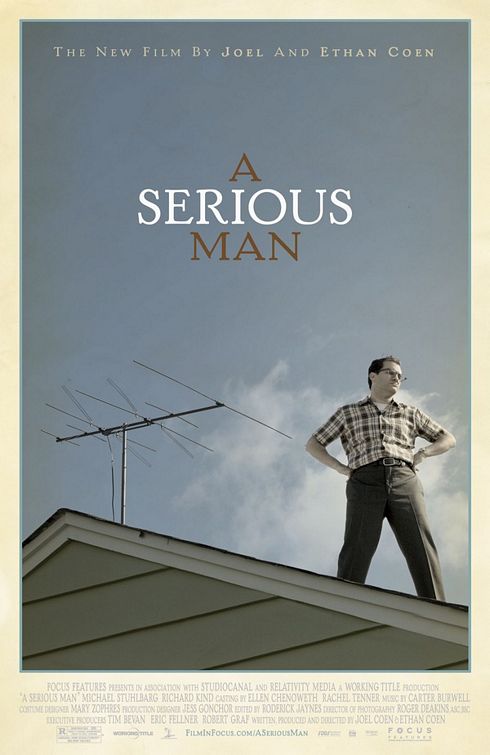
A Serious Man (2009) from Joel and Ethan Coen has never been taken seriously enough (playlist of clips). It was nominated for two major Academy Awards, Best Picture and Best Original Screenplay, but none of the cast members were invited to the festivities until the last week before the event. That is an ironic nod to the movie itself.

Scholars have spent papers—entire careers—explaining why Jews try to be funny and why so many succeed. One of the stock rationales is that Jews are an historically beleaguered people, and the humor is a natural response. Another related thought is that Jewish attempts to make sense of it all have come to nothing, and so absurdity is the only possible answer.

A Serious Man is grounded in those ideas and more. Larry Gopnick is a physics professor in the 1960s. In his academic life, he is up for tenure, a student is trying to bribe him, and even as he lectures on Heisenberg’s Uncertainty Principle, there is a sense that he really doesn’t understand uncertainty at all. Things are worse in his personal life, much worse. As his son prepares for bar mitzvah, Larry discovers that his wife is having an affair with his friend, his brother is caught in a gay bar, his dentist espouses weird mystical tooth theories, and there is a question whether Larry may have a serious health problem.

Larry looks for answers in faith, but the mysterious Rabbi Marshak, the older spiritual head of the congregation, is impossible to see. At the bar mitzvah. Larry’s son Danny, who at the start of the movie had his transistor radio taken away at Hebrew School, goes off to see this rabbi. He finds him in an inner sanctum, where Rabbi Marshak explains it all through the Jefferson Airplane and with a powerfully simple piece of advice:

Marshak is an old man staring at him from behind a bare desktop. His look, eyes magnified by thick glasses, is impossible to read.

Danny creeps to the chair facing the desk. He gingerly sits on the squeaking leather upholstery, self-conscious under Marshak’s stare.

Marshak’s slow, regular, phlegmy mouth-breathing is the only sound in the room. The two stare at each other.

Marshak smacks his lips a couple of times, wetting surfaces in preparation for speech.

Finally:

MARSHAK
When the truth is found. To be lies.

He pauses. He clears his throat.

. . . And all the hope. Within you dies.

Another beat. Danny waits. Marshak stares. He smacks his lips again. He thinks.

. . . Then what?

Danny doesn’t answer. It is unclear whether answer is expected. Quiet.

Marshak clears his throat with a loud and thorough hawking. The hawking abates. Marshak sniffs.

. . . Grace Slick. Marty Balin. Paul Kanta. Jorma. . .somethin.
These are the members of the Airplane.

He nods a couple of times.

. . . Interesting.

He reaches up and slowly opens his desk drawer. He withdraws something. He lays it on the bare desk and pushes it across.

. . . Here.

It is Danny’s radio.

. . . Be a good boy.

The movie closes with a note taken straight from the Book of Job. A tornado approaches. Will it be the voice of God out of the whirlwind? Or will it just be one more inexplicable disaster, one more serious touch of uncertainty?

Who knows? Yom Kippur and every day, listen to Rabbi Marshak: Be a good girl or boy.

Rosh Hashanah and Syria

UNHRC

Politics and prayer. There will be plenty of both during these Jewish High Holy Days.

Rosh Hashanah, the New Year, begins this evening. Please consider a donation to the UN Refugee Agency (UNHCR) to help the more than two million refugees who have so far fled Syria.

Ktivah v’chatima tova. May you be inscribed and sealed for a good year.


Bandon by the Sea and Living Forever

Continuum Center
This is about a beach town and the possibility of living forever.

Bandon is a small beach town (about 3,000 people) on the southern coast of Oregon. It is special because of its beauty and spirit, including extraordinary rock outcroppings and stacks of bleached drift logs that hover in the sun and occasional fog. It is also special because few know about it. It is far enough from anywhere—248 miles south of Portland, 465 north of San Francisco—that there are other tourist stops better known and, to some, more exciting.

Bandon 4

The New Age is an ignored topic that deserves more than this brief discussion. In the 1970s, the movement toward a new consciousness coalesced around the concept of a New Age, a new era of human enlightenment and evolution that would move us forward, leaving some of the darkest aspects of our sometimes-sorry history behind. This included not only spirituality and religion, but psychology, art, music, mythology, earth, food, sex—anything that could help transform us and the way we live. By name, “New Age” has fallen into disuse; but as a matter of fact, many of the ideas and expressions are now part of our cultural fabric.

In 1979, philanthropist Hugh Harrison visited the Continuum Exhibit at JFK University in California. The exhibit showcased the Immortality Principle, the possibility of consciousness continuing after death. He was impressed and put the exhibit on tour, and also established a home for it in Bandon, in a building on Main Street called the Continuum Center. It was a splendid multimedia exhibit, state of the art for its time.

Continuum Book
One of faces of the New Age movement that is powerful though sometimes mocked is its music. New Age music was once a common category, though it has fallen into disuse. No good cultural development goes untortured. New Age music at its start and at its best is an attempt to coax, drag, push, pull and otherwise move your consciousness by the ear. In less talented hands it has been oversimplified and underpowered, but no different than with any other musical genre.

When I walked into the Continuum Center in Bandon years ago, I saw the oversized graphics and read about a vision of consciousness. But the very first thing I noticed was the music playing. It was, it turned out, the sublime Angel’s Flight by Shadowfax, and it was the first New Age music I had ever heard. The pictures and text of that visit are a little indistinct in memory, but that song isn’t, maybe because I’ve listened to it a few hundred times since.

A recent visit to Bandon, for the first time in a long time, revealed that not much had changed, a good thing. Maybe it was not a surprise that the Continuum Center as an exhibit is gone. But the building is still there, transformed into a small shopping plaza, but as you’ll see above, the name remains. Spirit abides.

So if any of this is interesting, here’s what to do. Listen to Angel’ Flight and other transportive music by Shadowfax and other worthy New Age artists. Learn a little more about the possibilities of consciousness and change, if you aren’t already doing so. Does consciousness survive death? Who knows, but what a beautiful question.

Last but not least, if your travels take you to the Pacific coast, visit Bandon. Unlike the Continuum Center exhibit, which lasted a few years, the beach and rocks and waves go on and on and on, waiting for you. They will wait forever.

Notes for a George Zimmerman Sermon

Pulpit
This is Sunday, the day after the night before when the George Zimmerman verdict was reached and announced.

There will be countless sermons preached in churches today about the meaning of the crime, the trial and the verdict. The quick take of the media has focused on black churches for obvious reasons. In a case easily seen as having a racial component, the anger and frustration has been color-blind, but members of the black communities have reason to have special interest, if not to take it personally.

That still leaves a large number of churches that are not predominantly black. or more broadly, not non-white, or more plainly, white churches. This isn’t a monolith, nor is this an easy case and verdict to digest. There will be pastors who openly question how well justice was done, others who distance themselves from judgment, and maybe others who find a vindication of something in the verdict. Many more will not touch it at all, either because it has nothing to do with what goes on in church or because even if it does, the right words aren’t yet found to be spoken.

Whatever the identity of those in the pulpits or the pews, here are a few points that might belong in a George Zimmerman sermon.

The laws written by people and the higher laws (whether you call them the laws of God or something else) are two different things. Human imperfection extends to our inability to do perfect justice. Not only is it impossible to do perfectly, it is impossible for people to conceive of how it would be done perfectly in some other “better” realm. If there is a heaven or heaven/hell combination, exactly what are those trials like and what do the statures and rules of evidence look like? Whether you picture the 10 laws, or the 613 laws, or however many laws and interpretive regulations being litigated against you or those you love or despise, how does that case go?

There are some suggested solutions that are widely preached but, let’s say, inconstantly practiced. If we admit we don’t know everything, can’t build everything, can’t “correctly” judge everything, then we might be stuck with just some one-size-fits-all answer: forgive. This doesn’t mean, in the case of George Zimmerman, giving up on changing the laws, or not pursuing further legal tactics such as a federal civil rights suit or a civil wrongful death suit, or being friendly to George Zimmerman if you see him on your street or on your tv screen. Those are the worldly things we should feel free to pursue if that is what’s in our hearts. But in our hearts, where those higher laws are supposed to find a home, we are better off working on the compassion and forgiveness stuff. Especially with a tragic death, when we are the living, still capable of making things better.

Imperfection. Compassion. Forgiveness. Especially in light of this case. Oh God, that is so hard to take.