Bob Schwartz

Category: Politics

The Presidential Campaign: How Do They Get Away With This Stuff?


The refrain of this Presidential campaign, in the face of the breathtakingly nonsensical and mendacious, should be “How do they get away with this stuff?”

Consider these two related items.

1. In the view of most political scientists and pundits, the single most significant impact of being elected President of the United States is the power to appoint Supreme Court justices.

2. A recent FindLaw.com survey found that only 34 percent of Americans can name any member of the Supreme Court. Only 1 percent could name the entire Court. The percentage who can name any particular justice:

John Roberts – 20%
Antonin Scalia – 16%
Clarence Thomas – 16%
Ruth Bader Ginsburg – 13%
Sonia Sotomayor – 13%
Anthony Kennedy – 10%
Samuel Alito – 5%
Elena Kagan – 4%

Presumably, a number of the people paying attention to the campaign and voting for President are the same people who don’t know the name of a single Supreme Court justice.

That’s how.

The Book On Lying


“Truthfulness can be required even where full truth is out of reach.”

In a season of seeming lies, there is only one book to read.

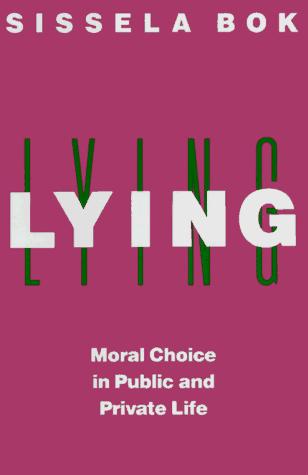
Sissela Bok’s classic Lying: Moral Choice in Public and Private Life (1978) is the essential work on the topic. At the time of its publication, no philosopher had tried to create such a brief, readable and accessible analysis. It has not been done better since.

This book was widely read and debated when it was published in 1978. That’s not surprising. Watergate was still a fresh presence in our public life. Before that crisis, people suspected—even expected—that some politicians were engaged in lying. Discovering the President and his inner circle all engaged in high-level big-scale deception confirmed the worst suspicions.

Bok begins with some fundamentals:

“I shall define as a lie any intentionally deceptive message that is stated….The moral question of whether you are lying or not is not settled by establishing the truth or falsity of what you say. In order to settle this question, we need to know whether you intend your statement to mislead.”

“As dupes we know what as liars we tend to blur—that information can be more or less adequate; that even where no clear lines are drawn, rules and distinction may, in fact, be made; and that truthfulness can be required even where full truth is out of reach.”

“When we undertake to deceive others intentionally, we communicate messages meant to mislead them, meant to make them believe what we ourselves do not believe.”

She analyzes some of the justifications that arise in special circumstances, as when we believe we are justified in lying to liars or lying to enemies:

“Enemies, through their own unfairness, their aggressive acts, or intentions, have forfeited the ordinary right of being dealt with fairly.”

“For the harm from lies to enemies is peculiarly likely to spread because of this very casual way in which enemy-hood is so often bestowed. Most claims that lies to enemies are justified would not then stand up in the face of reasonable scrutiny.”

Bok makes it clear that even when seemingly justified, all lies of all kinds have moral consequences:

“Because lines are so hard to draw, the indiscriminate use of such lies can lead to other deceptive practices. The aggregate harm from a large number of marginally harmful instances may, therefore, be highly undesirable in the end—for liars, those deceived, and honesty and trust more generally. One can’t dismiss lies merely by explaining that they don’t matter. More often than not they do matter, even when looked at in the simple terms of harm and benefit.”

What Must Todd Akin Think of Sarah Palin?


What must Todd Akin think of Sarah Palin?

Todd Akin has lots of opinions about the ladies, inside and out. As for the inside, he has apparently been graced with some sort of revelation—dare we call him a prophet?—about a previously undiscovered physiological process whereby a woman’s body “knows” whether a rape is the kind that should or should not allow a resulting pregnancy. He has been asked to write a monograph about this process, profusely illustrated, but he has been otherwise occupied with his race against Senator Claire McCaskill in Missouri. It is a loss for medical science, but maybe he will have lots more time after the election. Citizens and gynecologists can only hope.

His views about the outside of women came clear after his debate with Sen. McCaskill, when he said:

“I think we have a very clear path to victory, and apparently Claire McCaskill thinks we do, too, because she was very aggressive at the debate, which was quite different than it was when she ran against Jim Talent,” Akin said. “She had a confidence and was much more ladylike, but in the debate on Friday she came out swinging, and I think that’s because she feels threatened.”

A review of Sen. McCaskill’s debate performance shows that she was thoughtful, firm, politely aggressive, and unrelenting—which is exactly what you would expect and hope for from a former prosecutor and current United States Senator.

When it comes to men dealing with women in politics—as candidates and voters—there are two ways of looking at it. One is external and pragmatic. Whether those men are saintly idealists or craven devils, women can play a role in their obtaining and maintaining power—given that women have had the vote for almost a century, and have held public office even longer.

The second and more fascinating view involves what’s going on inside—inside the heads of those men. This political season, something that got touched on in the 2008 campaign is now even clearer. It’s something that can be said about some small number of men who have been complicit, as actors or fellow travelers, in what for a while this cycle was called the “war on women”:

They don’t understand women.
They can’t control women, at least not easily.
They fear women, because they don’t understand them and can’t control them.

Keep these in mind and much will make sense.

What doesn’t make sense is what Todd Akin must think of Sarah Palin.

There are a thousand things to say about Sarah Palin, and particularly about her controversial role in the 2008 election. One thing is certain: she does not fit Todd Akin’s idea of “ladylike.” She is happy to be the pitbull with lipstick. Think of a political woman who is ambitious, confident, outspoken, and likely to dismember the man or moose who crosses her. Quick: Is that Sarah Palin or Hillary Clinton? Exactly.

In America, women have failed to reach their deserved heights and presence in many fields. Elective politics, particularly at the national level, is one of them. By definition, the U.S. Senate can’t be the world’s greatest deliberative body, overstuffed as it is with men. And it certainly won’t be enhanced by Todd Akin’s membership; just ask most Republicans who nearly killed him over his “legitimate rape” remarks.

Conservatives worship Margaret Thatcher. Some of them no doubt hold out hope for the love that dared not speak its name, the hope that the obvious affection between Thatcher and Ronald Reagan went all the way, and that one day, not long from now, the offspring of that union will arrive in our political life as a savior.

If it’s a son, that is. If it’s a daughter, we might still have a problem.

While we are playing with ridiculous fantasies, here’s another one. Suppose that instead of Claire McCaskill on an open stage, Todd Akin had to face Maggie Thatcher, Hillary Clinton and Sarah Palin behind closed doors to explain his visionary, man-centric thinking.

It wouldn’t be ladylike, and it would be worth paying to see.

Soylent Green, My Friend, Is People


Mother Jones has already changed the trajectory of the Presidential campaign with the “47%” video. It’s latest video find may not have the same effect, but it is still revealing.

It comes from a promotional Bain Capital CD-ROM from 1998. Along with other artifacts of the Bain culture at the time, it includes a video of Mitt Romney from 1985 explaining the Bain business model:

Bain Capital is an investment partnership which was formed to invest in startup companies and ongoing companies, then to take an active hand in managing them and hopefully, five to eight years later, to harvest them at a significant profit…The fund was formed on September 30th of last year. It’s been about 10 months then. It was formed with $37 million in invested cash. An additional $50 million or so of what I’ll call a call pool, which is money that we can call upon if the deals are large enough that they require more than a $2 or $3 million dollar initial investment. Why in the world did Bain and Company get involved in this kind of a business? We’re not particularly noted for having years and years of experience in financing. Three reasons. We recognized that we had the potential to develop a significant and proprietary flow of business opportunities. Secondly, we had concepts and experience which would allow us to identify potential value and hidden value in a particular investment candidate. And third, we had the consulting resources and management skills and management resources to become actively involved in the companies we invested in to help them realize their potential value.

It’s the “harvest” line that is getting the most attention, presumably because it suggests to some that the companies are viewed primarily as abstract opportunities that are optimized for profit, rather than enterprises that make particular things and where particular people work and build their lives.

Fans of sci-fi movies are burdened by seeing the “real” world through the lens of those films. So this line flashed two iconic and unforgettable scenes.

One is from The Matrix (1999), when we first see the humans being used as living batteries to power the world of the Matrix.

The other is from Soylent Green (1973). In 2022, the desperate population of overcrowded New York City is being kept alive by the nutritional drink Soylent Green. At the end, we learn the dark secret of Soylent Corporation, as screamed by Charlton Heston (spoiler alert): “Soylent Green is people!” Yes, it is processed from the oversupply of corpses.

All this probably has nothing to do with Bain Capital harvesting companies. Somehow, though, “Corporations, my friend, are people!” just got mixed up with “Soylent Green is people!”, Charleston Heston got mixed up with Clint Eastwood and Mitt Romney.

As noted in a post a few days ago, this campaign may not just be threatening to drive us—candidates and voters—mad. It may have done that already.

Victims of the Federalist Laboratories


This morning, a pundit again tried to square the circle by explaining how Mitt Romney can be both the heroic father of Romneycare in Massachusetts and the sworn enemy of Obamacare in the U.S. It goes like this: the states are political/social/economic “laboratories” in which 50 different experiments can produce 50 different solutions. (It isn’t clear why the District of Columbia, Puerto Rico, etc., are not capable of conducting these experiments too.)

This is nonsense. Not as political theory or as Constitutional interpretation. It is nonsense because it makes no sense, or at best, tragic sense.

America’s most notorious state-by-state experiment was slavery. And if an experiment is judged by its results, slavery was in some ways an excellent economic solution for the states that tried it. No matter how much other states tried to convince them that it was flawed, those slavery laboratories kept on operating—right until the time that they were forced to close them down in a bloody war.

This is how experimental laboratories work. Different scientists race to solve essential problems. When one comes up with an effective solution, that doesn’t necessarily stop the others from continuing their work on better answers, or from criticizing competitors. But in the meantime, if the problem is critical, the solution is rolled out widely to relieve the situation, at least until something better comes along.

Let’s say that the Massachusetts laboratory developed a cure for cancer. After some clinical trials, it was deemed worthy to be given to the whole state. The benefit was positive and obvious. One of the developers went out of his way to make a high-profile public case for its success and his role in it.

But the other 49 states said: not so fast. They believed that there was a better solution to cancer, if not right around the corner, then soon. All they needed was more time, and in the meantime, they didn’t want the people of their state subjected to these wild experimental solutions.

That is a much more apt metaphor than merely talking about laboratories in general. Call it what you want—Heritagefoundationcare, Romneycare, Obamacare, Affordable Care Act—we have a proven solution. Standing in the way of it, promising to repeal it, simultaneously owning and disowning it, is unconscionable in the face of knowing that with it, people who are well can be kept well and that people who are sick can get better.

Anyone, from a Presidential candidate on down, who can look at people and tell them that they will just have to suffer a little longer while the political scientists of the 49 states tinker in their laboratories needs to look elsewhere. They need to look at themselves, and see where the real problem is.

Mitt Romney Doesn’t Really Want To Be President


Mitt Romney doesn’t want to be President. This has been apparent for a while, but it seemed so unlikely—so strange for a person who is actually a nominee—that it defied saying. But it is the clearest explanation of everything that is happening.

Why would Romney run if he doesn’t want the office? The clichéd but useful explanation goes to a father-son dynamic.

In at least one objective respect, Mitt has spectacularly surpassed George Romney. Mitt Romney is a very, very rich man, wealthier than his father ever was.

As a businessman, it is a little more complicated. George Romney was, as the saying used to go, a captain of industry. He worked his way up to become head of one of the largest automakers, back when that mattered much more than it does now. Even if American Motors wasn’t one of the Big Three, it was a notable, forward-looking player in the field.

Mitt Romney’s success is different. Even treating the financial world as a discrete industry, which it of course is, the term “captain of industry” doesn’t seem to apply to Mitt. In the annals of financial history, no one will be talking about the creativity of Bain Capital the way business historians still do about the ahead-of-its-time thinking that marked American Motors—the company that believed the oversized car era was over, and that consumers would be buying compact and efficient automobiles. Eventually they would.

Politics is where the distinction is sharpest. George Romney was elected Republican Governor of Michigan three times—a state that was then decidedly Democratic. He had substantial political appeal and support, but his dream of being President was scuttled in part by the infamous “brainwashing” incident. He had visited Vietnam, and was told by the generals how well the war was going—in spite of evidence to the contrary. When he spoke about his opposition to the war, he said he had been “brainwashed” by the generals. George Romney’s political career never recovered.

As a politician, Mitt Romney has run for office just twice, and won only once. He was defeated for U.S. Senate from Massachusetts in 1994, and then was elected Governor in 2002. He chose not to run for re-election in 2006. Indications were that he would have a difficult race, and he instead began his run for the Presidency the day before he left office.

This father-son analysis—that Mitt Romney is trying, at all costs and for whatever reasons, to do what his father never could—may sound too easy. But the story of fathers and sons is just about the oldest story ever told. The patriarchal sagas of the Old Testament begin there, and great stories derive their greatness from the fact that some things never change.

Mitt Romney is following a program that he may not see or understand but that he has little or no choice about. It is a program, this running for President, that normally requires some combination of skill and desire. A surplus of one can balance out a deficit in the other. But trying to run without either—which we have never seen in a Presidential race—is bound to produce some anomalous results.

In the case of Mitt Romney, we can set aside the issue of how much political skill he has, though many have their doubts. The real question is how much desire he has. The answer, strangely, is little or none.

The outcome of the election is far from written. In case Mitt Romney loses, there is reason to believe that he will suffer some nagging psychic pain. But given the possibility that it is not something he really wants. there is also reason to believe he will go back to an extraordinarily comfortable life, and secretly be relieved.

Too Much of Nothing


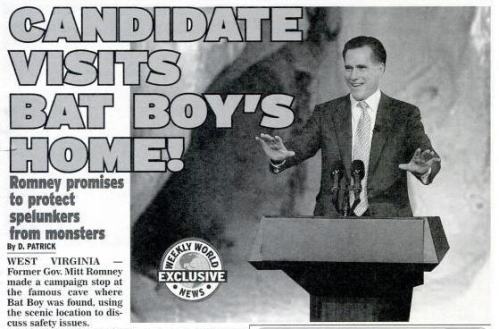
The last post was called a political break, with the prospect of returning immediately to earnest observations about the current campaign. For those who didn’t read it, that post included a Marx Brothers movie and a Weekly World News exclusive about Mitt Romney and Bat Boy. Now that’s a break.

If it’s possible for political junkies to overdose, this may be it. There are already a bunch of posts drafted and ready, political and otherwise (this is a blog about everything, not just politics). But just for a moment, the will to post seems to have gotten a little lost.

So the political break continues. In the same spirit of free association that gave rise to the guest appearance of Bat Boy, here is some commentary from Bob Dylan. “But when there’s too much of nothing, nobody should look.”:

Now, too much of nothing
Can make a man feel ill at ease
One man’s temper might rise
While another man’s temper might freeze
In the day of confession
We cannot mock a soul
Oh, when there’s too much of nothing
No one has control

Too much of nothing
Can make a man abuse a king
He can walk the streets and boast like most
But he wouldn’t know a thing
Now, it’s all been done before
It’s all been written in the book
But when there’s too much of nothing
Nobody should look

Too much of nothing
Can turn a man into a liar
It can cause one man to sleep on nails
And another man to eat fire
Ev’rybody’s doin’ somethin’
I heard it in a dream
But when there’s too much of nothing
It just makes a fella mean

Political Break: Mitt Romney and Bat Boy


“Sometimes I think I must go mad.”

That’s a quote from the Marx Brothers movie Horse Feathers (1932). And that’s how a lot of us feel right about now, after months of campaign craziness and days of political bombshells. There will be plenty of time for insightful analysis and cogent commentary. But just for a moment, a break.

Here’s something from the movie:

Retiring President of Huxley College: I am sure the students would appreciate a brief outline of your plans for the future.

Professor Quincy Adams Wagstaff (Groucho Marx): What?

President: I said the students would appreciate a brief outline of your plans for the future.

Wagstaff: You just said that! That’s the trouble around here: talk, talk, talk! Oh, sometimes I think I must go mad. Where will it all end? What is it getting you? Why don’t you go home to your wife? I’ll tell you what, I’ll go home to your wife and, outside of the improvement, she’ll never know the difference. Pull over to the side of the road there and let me see your marriage license.

President: President Wagstaff, now that you’ve stepped into my shoes…

Wagstaff: Oh, is that what I stepped in? I wondered what it was. If these are your shoes, the least you could do was have them cleaned.

And here’s something from the Weekly World News in March of 2007, during Mitt Romney’s first unsuccessful run for the Presidency:

Mitt Romney Doesn’t Believe He Is Running Against A President

A political conundrum has been solved, and the solution is a startling answer to what has been going wrong so far for the Romney-Ryan ticket.

Both candidates spent the first 24 hours of the current foreign crisis injudiciously and recklessly criticizing the President, in the face of being chastised by both Democrats and Republicans for their amateurish efforts.

The obvious question to ask both of them is what foreign policy expertise or experience informs their criticism. This would be their likely answer: well, what foreign policy expertise or experience did Barack Obama have when he took office in 2009?

Exactly. Precisely. Except for one thing. This isn’t candidate Obama they are running against. This is a man who has for four years been negotiating the wild waters of global politics, and in the view of many, though clearly not all, he isn’t doing a bad job.

That’s where the revelation came in. In a nearly literal sense, they don’t believe Barack Obama has been President for these four years. They may not subscribe to “birther” notions that would legally disqualify Obama from holding the office, though we aren’t sure of that. But functionally, they seem to believe that the smart but shallow and inexperienced young Senator who took office in 2009 is the same man they face now.

They believe they are running against young Senator Obama—or maybe even younger community organizer Obama, law student Obama, pot-smoking college student Obama. The only thing they have to do is run a better campaign than the unsuccessful John McCain did. Maybe this isn’t a clinical break from reality, enough to put their mental stability in doubt, but the effect has been to raise real questions about their political stability.

The President has tried to help them. In his speech at the Democratic National Convention, he announced loudly, plainly and unequivocally, “I am the President.” Mitt Romney and Paul Ryan apparently weren’t listening, and even if they heard, they still don’t believe.

The Politics of Economics: Fix the Broken and Ease the Pain

The great political lesson of the Great Depression was to fix the broken economy and ease the people’s pain. More than politics, this was a moral lesson too. Anything less—one and not the other—would have simply been wrong, politically and morally.

In many situations—the medical is one of them—it may not be possible to fix what’s broken without causing more pain in the process. But that doesn’t relieve you of the responsibility to do everything possible to at least diminish that pain, both the original and whatever has been added.

In some ways, this is precisely where the politics of this election sits right now.

Even with the complex metrics of how bad things have been and how much or how fast they may be improving, neither party is unaware that there are problems to be fixed.

The Republican party wants us to believe that they are the ones to better fix these problems. Maybe they are, maybe not.

But the real distinction concerns the pain.

The Republicans seem to say that the pain already being felt and the pain that the fixes may inflict are a necessary and unavoidable phenomenon. Easing the pain will only make things worse and extend the problems, something we cannot afford. In response, some have pointed out that a number of the Republican policy makers are themselves feeling little or no pain.

The Democrats, in a position that is somehow ridiculed, seem to believe that while pain can never be eliminated, there is every reason to ease it whenever possible. That won’t always be possible, but at least it is worth exploring and trying.

In the medical context, there are still people who refuse to take painkillers, believing that it somehow makes you weak or that you are subject to becoming an addict. But medicine also recognizes that pain itself is tremendously stressful on the body, and the healing itself can be compromised by deep, chronic, unrelieved pain.

The same thing goes for the body politic. For those of us who were not there for the Great Depression, we have only family stories or history books. While our current woes are thankfully not that severe, there is plenty of pain to go around, and some of will it stay around for a while. Easing that pain is every bit as important as fixing problems. Mercy is never weakness, whatever some politicians may say.