Bob Schwartz

Category: Politics

The Gates Book and the Gates Speeches
Duty
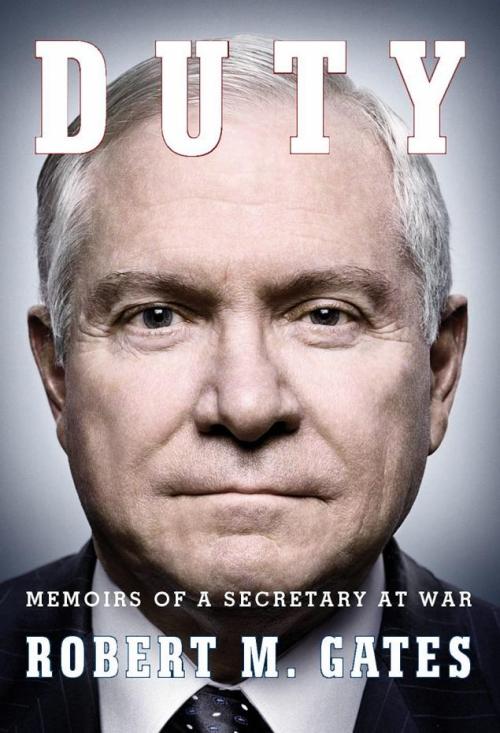
Former Secretary of Defense Robert M. Gates is about to release a memoir of his tenure under Presidents Bush and Obama. Provocative advance excerpts from Duty are now being released, and these explosive devices are anything but improvised.

Every news outlet, pundit and politician is already busy making points about President Obama, Vice President Biden, former Secretary of State Hillary Clinton and others, based on comments clipped from these excerpts, rather than having read the whole book. Even out of context, it is clear that Gates has formed some definite opinions based on working for and with these American leaders. That is anyone’s privilege, but particularly that of a man who spent forty-five years in laudable public service, much of it at the highest levels of government.

As always, though, opinion and criticism is a matter of perspective, that is, where the critic stands underlies what a critic sees and says.

You can read all the speeches that Gates delivered as Secretary of Defense. This is guaranteed not to be as titillating as reading or hearing about the “best parts” of Duty, but it might give you additional insight that will make the context of the book clearer.

Here, for example, are excerpts from remarks he made to the Heritage Foundation on May 13, 2008, when he was serving under President George W. Bush. (You can read the entire speech here) At that point, the Iraq war was five years old, only halfway to its conclusion. At that point, he had been Secretary of Defense for two years, and from that point, he would remain in that position under President Obama until July 2011.

But there is a more fundamental point that I will close with – and again, historical perspective is important. It is impossible to separate discussions of the “broken” Army following Vietnam – a conscription army – from the ultimate result of that conflict. At a congressional hearing last year, General Jack Keane, former Vice Chief of Staff of the Army, recounted the profound damage done to the Service’s “fiber and soul” by the reality of defeat in that war.

The risk of overextending the Army is real. But I believe the risk is far greater – to that institution, as well as to our country – if we were to fail in Iraq. That is the war we are in. That is the war we must win.

There it is, the context: Iraq was “the war we must win.” Gates’ insights into military matters is often brilliant and sensible, informed by his intelligence, experience and education. But on this point he candidly reveals a premise that for some colors everything else he offers. We must win Iraq because the failure to win would “break” the military the way that Vietnam did.

We did not win in Iraq, but technically, we did not lose. That current events in Iraq point to some devolution doesn’t really settle the question. That some U.S. Senators are calling for us to return to Iraq to avoid that loss or at least to avoid the appearance of futility is a partial reflection of exactly what Gates said.

We know that Gates’ personal critiques are based on close working relationships and observations. We also know, or should recognize, that those critiques are grounded in a worldview that others may not, very legitimately, share. If for Gates one of the measuring sticks is whether someone believes that Iraq had to be won, that measure may be skewed by genuine differences in informed opinion. One opinion is that as valorous as the service and sacrifice was, Iraq was a mistake, to be abandoned as prudently as possible; others might now say the same about Afghanistan. What Gates has to say about our leaders is certainly worth listening to, provided we pay equal attention to the mindset of the speaker.

The Other Poverty: The Poverty of Ideas

mining_lg
The other poverty is the poverty of ideas.

Let us ask each of our leaders and politicians for just one relatively new and interesting idea to solve a pressing problem. Just one. It doesn’t have to be an idea that has won substantial support or that has achieved broad consensus. In fact it can’t be that. Instead it should be something that is just a little bit out there, the kind that might elicit a “you must be kidding” or “that will never pass” or “that will never work.”

What we mostly have is problem solving that borders on archival monomania, the single idea with ancient lineage that fits a particular purpose or ideology—but has not really demonstrated an ability to solve particular problems.

This morning Sen. Dean Heller of Nevada explained why he is one of the few Republicans supporting an extension of unemployment benefits. In the course of the interview, he said that the biggest problem was jobs. He then ticked off the number one conservative solution—tax reform—but when he got to the second idea, it came out sounding like “something else” without a single detail. That’s because leaders and politicians on both sides of the aisle are stumped, which they admittedly should be by the unique and unprecedented economic moment we are living through.

During the 2012 presidential campaign, Newt Gingrich was roundly derided for his suggestion that we mine the Moon and colonize Mars. There are plenty of reasons that Newt wasn’t and isn’t a good choice for President, but that isn’t one of them. Sure it’s a bit science fictionish, but then so is practically all of the current tech that is one of the only bright spots in the global economy. Can you imagine a U.S. Senator in the 1950s coming to the floor of the Senate brandishing a copy of that weekend’s Sunday funnies, pointing to Dick Tracy and saying “That wrist radio, gentlemen, is where we should be heading.”? China and India are racing to the Moon, and it is not for the view.

Politics and political leadership are inherently conservative, in the sense that maintaining the institution and its support seems to demand modest, slow, incremental change—if any change at all. That’s where party lines and sticking to scripts come from. An intolerance for innovation and fringe philosophy go with that. We shouldn’t be asking parties or politicians to give up core principles and precepts. But if we actually want to solve problems, and not just hear tired old nostrums that won’t do any good, then we have to make a safe place for innovation, one where thinkers who happen to be in office are not committing political suicide by offering something interesting and maybe even eccentric. Because until we ask our politicians to enrich us with new ideas and not empty platitudes and happy talk, more of us will be unhappy with increasingly empty pockets.

All Politicians Are Progressives

Horse Carriage - Lincoln
Either you embrace innovation or you don’t. And so all politicians who use an iPhone or love the NFL are progressives.

Innovation has two faces. One is the innovation that solves problems. The other is innovation that just does stuff—even if you didn’t ask for it, even if you never knew you wanted it or needed it. Moving from horse transport to self-contained mechanical carriages solved a basic problem, but over time added features some of which are useful and practical for the central function, others of which are just enjoyment that becomes essential. Because times change, as do human expectations and aspirations. Innovation feeds that.

So unless you are a politician who doesn’t have a smartphone, or who doesn’t use a phone or computer at all, or doesn’t drive a tricked-out luxury car (it counts even if you have a driver), you are the beneficiary and tacit endorser of innovation. Which is why when some politicians hearken back to the comprehensive goodness of 18th century America—or 19th or 20th, depending on the issue—it is dangerously silly. This economic Drecession requires an embrace of 360 degree innovation, not just untaxing and unburdening ourselves to prosperity. Not just churning out a generation of STEMers to magically bring us back to former glory. And not just putting digital devices in the hands of every school child either.

This is not the exclusive purview of any political party. There is a tendency, even among the most well-meaning, to take pages from a beloved playbook that are no longer viable. When the legendary coach Sid Gillman changed pro football forever in the 1950s by making the forward pass the centerpiece of the game, it was scoffed at—until he started winning championships and opponents had to permanently rethink the defensive game.

If politicians want to ride around in fancy horse-drawn carriages and send their messages by horse-carried post (if they haven’t made the Post Office disappear), that’s okay. But chances are they’ve embraced innovation in practically every minute of their lives (they love their Twitter!) because, well, it is 2013. It is 2013, everywhere, in every facet, and pretending otherwise is just horse-and-buggy policy. Or maybe just a convenient way to get elected.

Online Gambling and Real Life Guns: It’s About The Children

sheldon-adelson-615cs013012
A team of highly-paid ex-politico lobbyists are out there arguing against proposed bills in Congress to allow Internet gambling. Under one of these bills, a 12% tax would be shared between the federal and state governments, 4% and 8% respectively. That would be a lot of revenue in these hard times.

Gambling is an American and ancient tradition. Lotteries helped fund the American Revolution, which makes them practically sacred. In this case, the main opponents of digital gaming for money are the wealthy owners of real-world casinos and establishments, most visibly billionaire Sheldon Adelson, who helped bankroll Mitt Romney’s quest for the Presidency. No surprise there. The practice of online gaming, which already goes on with offshore sites, would expand dramatically, leaving bricks, mortar and showgirl spots with a severely reduced market.

Some of the arguments against the bills are, on their own terms, not entirely unpersuasive. Gambling does support hospitality and tourism, and if the already declining dollars drop further, there are going to be folks who lose their jobs in this challenged economy. It’s not clear that the entrepreneurs getting rich off this have the will and creativity to come up with substitute businesses that would replace those jobs. Gambling is also already a social problem, damaging lives and families, and what is bad gets worse with increased volume. The final big argument is, naturally, about “the children.” No matter what we try to do, the online environment is notoriously freewheeling, and there is no question that underage players would find a way to play, just as they get cigarettes and alcohol.

On the tourism question, cultural and social trends have always left some forms of entertainment and diversion behind while other new or more appealing ones prospered. Either you believe overall in the free market or not. People who say that government shouldn’t be picking winners and losers shouldn’t be telling the government to pick winners and losers.

Out of control gambling can be pernicious, no doubt about it. But the argument, one actually made, that the poorest in society would be unfairly burdened by the attraction of online gambling is under current realities absurd. First, because it is not clear that all the opponents of online gambling care so very much for the lower tiers of American society. Second, because government already endorses, promotes and profits from easy-access gambling that does weigh on the most vulnerable—the lotteries. With all the strains on government budgets, it is unimaginable what state some states would be in without those gaming dollars.

Then there is the ultimate trump card: the children. That score is easy to answer. On the scale of things kids shouldn’t be allowed to do, alcohol is number 2, tobacco is a close number 3, and then comes gambling. Number 1 is easy. Children should not have guns, should not live in an environment where guns are widely available and acceptable, and where guns are regularly used to shoot, injure and kill innocent people—including children.

So if you happen to see or hear any of those lobbyists shilling for Sheldon Adelson and his ilk, talking about how it is about “the children” and how we must protect them from the evils of playing online poker or placing a digital bet on an NFL game, ask them if guns aren’t a tad more dangerous, and ask them what they’ve done to seriously reduce the ubiquity of those guns and to eliminate the personal and social costs that those guns have inflicted on all of us.

There likely won’t be a good answer, at least not one that isn’t laced with equivocation, hypocrisy and protests of irrelevancy. It is relevant. Ask them to put the two side by side, the harm to children from online gambling and from guns, and tell them that the billionaires are free to make billions more on their casinos—just as soon as the guns get put away.

Veterans Day and Busby Berkeley

Gold Diggers of 1933
Gold Diggers of 1933 may be the strangest of all classic movies—and the one that has the most to say about Veterans Day 2013.

It is classic because it is still entertaining: snappy, cynical dialogue; singing and dancing that may be a little out of style, but Busby Berkeley production numbers that are still wonders of the world, in part because they were actually performed and filmed on sound stages—no special effects or shortcuts. Your jaw will drop in astonishment and delight.

The strangeness is that framing this jollity is a movie about the Depression—not as a backdrop but about it, head on. Nowhere is this incongruity more obvious than the close of the movie. There is a penultimate mega-happy ending, where the three down-on-their-luck showgirls marry the three rich Boston bluebloods. But just then, there is one last song and production number: Remember My Forgotten Man.

In 1932, most veterans of World War I were out of work, as were so many others. In 1924 the government had authorized a longstanding practice of offering bonuses to those who served in war. This took the form of Certificates of Service, which matured over 20 years, and were to be paid in annual installments. But in the midst of the Depression, the veterans didn’t need that money down the road—they needed it right now. A movement for immediate redemption of the certificates gained momentum (the amount was tens of billions of dollars in today’s money). So in 1932, 43,000 marchers—veterans, their families and their supporters—gathered in Washington in what came to be called the Bonus Army, to demand cash payment. This was rebuffed. President Hoover and Republicans in Congress believed that this would require a tax increase, and that a tax increase would delay the recovery of the economy.

These were the Forgotten Men. As the tragic climax of a musical comedy, we watch a sordid street scene, narrated in song by Gingers Rogers. She is now surviving as a prostitute, married to a war veteran abandoned by the government and the nation. On stage we see the troops marching off in glory to cheers and flag-waving, only to return broken and injured, with no one to greet or comfort them—or even to remember them.

Remember My Forgotten Man

I don’t know if he deserves a bit of sympathy,
Forget your sympathy, that’s all right with me.
I was satisfied to drift along from day to day,
Till they came and took my man away.

Remember my forgotten man,
You put a rifle in his hand;
You sent him far away,
You shouted, “Hip, hooray!”
But look at him today!

Remember my forgotten man,
You had him cultivate the land;
He walked behind the plow,
The sweat fell from his brow,
But look at him right now!

And once, he used to love me,
I was happy then;
He used to take care of me,
Won’t you bring him back again?
‘Cause ever since the world began,
A woman’s got to have a man;
Forgetting him, you see,
Means you’re forgetting me
Like my forgotten man.

Maybe the musicals of the 1930s are old-fashioned and for a lot of people unwatchable. Maybe Busby Berkeley is just some campy choreographer whose over-the-top numbers are funny but incomparable to today’s digital masterpieces. Then again, maybe ending a popular entertainment with a bleak and uncompromising plea to our national conscience isn’t a bad idea—and never goes out of style. Remember Our Forgotten People, circa 2013.

Republicans Miss Another Opportunity to Be a Popular National Party

Goat
The shortcomings of the ACA website during its high-profile first weeks could have been a gift to the struggling Republicans. A softball to hit out of the park. While Democrats are understandably busy trying to make the best, to explain how complex systems are frequently troubled when they go live (true), to be, in essence, apologists, the Republicans could have been that thing that Americans of all stripes ache for: problem solvers.

Instead they heard the fire bell/dog whistle (or is it an elephant call?) and marched fiercely into battle mode. The current House hearings on the website seem more like a trial: at one point, one Republican member asked all the testifying contractors whether they had discussed their testimony with anyone from the government team beforehand. (Answer: no.)

What a missed opportunity. If the Republicans as a single voice had said that this is, from their perspective, still an awful program, but that we are all Americans, and if we are going to do something, we don’t do it half-assed, and let us today find a way to solve the problem. In earnest. That would have made any defensive positions by the Democrats more glaringly apologist, and would have made the Republicans not just heroes but responsible, reasonable heroes who don’t deserve to be despised by large parts of America, including some people in their own party.

But to some, this would have made these problem-solving heroes EINO—Elephants in Name Only—that is, goats. Watching this kangaroo court, some others might think that goats might be an improvement.

Which Comes First: Evolution or Revolution?

Tea Party
The 20th century gave us two world wars and an atomic bomb, but the most interesting of the Big Events of the century may be the Russian Revolution. An inequitable and unbalanced way of life gave bloody way to abstract enlightened visions of a better world. The particular inequities ended, Russia moved into modern times, but competition for the “right” vision and ineradicable baser human natures seeking power and control led to decades of national and global troubles. “Meet the new boss, same as the old boss,” the Who said.

The Russian Revolution was grounded in a Marxist vision, which was in turn a Christian vision: a community on earth as it is in heaven, a brotherhood of people in which suffering and want would be softened, if not alleviated, by those who have a surplus of comfort and resource. It was Lennon, not Marx, who said, “You can say I’m a dreamer, but I’m not the only one. I hope someday you’ll join us, and the world will live as one.”

What went wrong?

What almost always goes wrong is that evolution and revolution are out of sync. It is easy to say that people and society should first evolve for a while, and then at some critical moment, all that’s needed is that next faster-than-evolution event to take it to the next level.

That turns out rarely to be the case.

Evolution is slow, erratic, and always engenders resistance and reaction. The cliché is that people and society fear change, but that is too easy. They fear the unknown. The expression “better the devil you know than the one you don’t” sums it up. It takes a substantial leap—you might say a leap of faith—the walk into a vision rather than remain in a lesser but familiar reality.

Revolution is both an attempt to make evolution more real and to create conditions where that evolution can continue more broadly and forcefully. But, as pointed out with the Russian experience, it doesn’t always work that way. Revolution is conflict, and conflict creates its own set of conditions sometimes antithetical to evolution. “Fighting for peace” is oxymoronic (some would say just plain moronic), but we have had to live through that. (Note the moment in Stanley Kubrick’s brilliant film Dr. Strangelove where the President scolds his arguing advisers, “Stop it. There’s no fighting in the War Room.”)

One of the exceptional examples of evolution and revolution working together is the American Revolution. It is one of the reasons it worked so well. The founders may have been the fathers of our country, but they were the children of the Enlightenment. That multi-faceted evolution—philosophical, political, economic, spiritual—had gone as far as it could go when it hit a wall. They believed that if they could break through, which did mean war, they could establish an enlightened nation. And, to an extent greater or lesser than some might like or expect, they did.

Evolution, or lack of it, is at the heart of some current American problems.

America is heir to two great evolutions, sometimes unrecognized, often distorted. Some of those obstructionists who fight today hark back to the patriots who were mad as hell and wouldn’t take it any more, and so upended a cargo of British tea. Others who claim this is a Christian nation have the idea that if alive today, Jesus would certainly choose to be an American.

Every American in these dynamic times is free to pick the evolution they aspire to. There are plenty to choose from. We do have two very big ones on the menu. If a rabid revolutionary patriot, you might choose to follow the path of a 21st century version of Enlightenment; you might even study the work of those founding Enlightenists—Jefferson, Madison, Monroe, et al.—for guidance. If a committed Christian it’s even easier. No slogging through the Federalist Papers, or even the whole Bible. Just read and read again the words of Jesus—the ones in red type—and consider just how much evolution he was asking for and expecting. Then again, maybe it’s not evolution he was talking about at all.

The Marijuana Dilemma: It’s About Age

Marijuana
This was going to be a note about the Gallup poll showing that 58% of Americans think that the use of marijuana should be legal, and that 38% have tried it. It would include arguments about how pot stands in relation to other legal intoxicants—alcohol, tobacco, firearms (sorry, that’s the federal law enforcement agency)—and about how our justice system is distorted and how lives are ruined by reflexive, thoughtless, moralistic public policy.

But no. This is about a simple solution. It won’t make everybody happy, particularly those hypocritical it’s-all-bad-for-you-and-society Puritans who apparently missed the Sunday School class where Jesus mentioned getting the log out of your own eye before criticizing someone else’s splinter. But this might work.

Add marijuana to the list of acceptable American intoxicants. Then take the three biggies—alcohol, tobacco and marijuana—and make their distribution to children, particularly younger children, an even bigger deal than it is, so that the jail cells currently filled with marijuana-guilty adults could then be filled by real bad guys. Draconian punishment. Because while adult use of these intoxicants may be equivocal, childhood use of them is not.

We did not need American alcohol prohibition to learn that nothing will stop people using intoxicants. (Another hint: sex, at least if you’re doing it right, is also an intoxicant, the world’s most popular and, yes, one that the Puritans have also tried to circumscribe.) In another missed Sunday School lesson, Jesus did not smash the jars at the wedding at Cana, as he did the moneylender tables at the Temple; he actually made more wine for the celebrants. The poor we have with us always; so too the wine drinkers.

It is widely agreed that none of the three intoxicants are perfect: all of them are abused, all of them have real potential for ruining life and health. (America’s other big intoxicant, coffee, is excepted from this discussion, in part because any regulation of coffee would start a national revolt that really would prompt a new party, the Coffee Party, and in part because it is coffee that makes posts like this possible.) But as much as adolescents want to indulge, and as much as they already find a way to do it, if there’s a beneficial bargain to be made, this may be it. Let the grownups smoke/drink/smoke, let them explain to their kids why it isn’t a good idea for the younger set.

If you are currently a pre-teen or teenager yourself, or you once were, and you indulge in weed or once did, this may seem silly, arbitrary and unworkable. Here’s the news: all social policy is ultimately unworkable, or at least challenging and perplexing. The truth is that marijuana abuse by adolescents, just like alcohol and tobacco abuse by them, really is a bad thing, and really can cause irreversible damage. Adults should be free to get blissed out or ruin their lives (with minimal harm to others); kids shouldn’t be. If we are going to have some sort of marijuana policy, it ought to be a lot more sensible than the one we have now, even if the solution isn’t perfect.
10:39 AM 10/23/2013

A Chilly Breeze of Hate, a Hungarian Conductor and the Prospects for American Anti-Semitism

Ivan Fischer
Those of us who grew up Jewish in late 20th century America had a pretty good experience of tolerance, certainly compared to even our parents’ generation. The Holocaust had an immunizing effect, not so much because people saw where such ugly expressions of hatred might lead, but because it was harder to hold those views—at least publicly. There was not an immediate spillover effect, so common prejudices against blacks, women, gays, and other intolerance “classics” continued, while new groups such as Muslims were added all the time. Hate takes no holiday.

The news was not without stories of anti-Semitism. And if we lived in certain parts of the country, we might be more likely to feel like a stranger, and even to hear somebody we liked talk about bargaining as “Jewing” someone down. Oh well, that was ignorance talking, and overall those folks often had a good heart. Maybe the greatest deterrent to taking it too seriously was the Jewish cohort who daily found an anti-Semite around every corner. It wasn’t that there weren’t and aren’t anti-Semites everywhere, including some positions of high profile and power, it’s just that the progress Jews have made in acceptance and mainstreaming made these anomalies. There were other groups still having a much tougher time.

A story from this weekend’s New York Times prodded that complacency, just a little. It comes not from America at all. It is from Hungary. There, anti-Semitism and nationalism are on the rise, to the point where the country’s most celebrated conductor, Ivan Fischer, has written and staged an opera about it. Called The Red Heifer, it is about a 19th century incident in which Jews were blamed for the murder of a peasant girl. But contemporary elements make clear that this is not a story about historical artifacts. The whole world context of the opera is not just Hungary; much of Europe, particularly but not entirely those in the former Soviet empire, are trying to establish new identities in these trying times. That insurgent identity frequently involves a broad menu of nationalistic intolerance. See, for example, the treatment of gays in Russia and the rise of neo-Francoism in Spain. And where there’s a list, Jews are on it. That doesn’t make sense, but not making sense is precisely the hallmark of all this.

It is no secret that certain kinds of intolerance are a little more obviously a part of American life today. There can, for example, be argument about whether the unprecedented disrespect and vitriol for the President is purely political. It isn’t, and most know, or should, that race is near the heart of the hate. Americans too are having hard times that may continue for a while. Even if the current crop of demagogues seems penny-ante compared to “real” American demagogues of the 20th century—the Huey Longs, the Father Coughlins, the Joe McCarthys, the George Wallaces—demagoguery it is. And if we hope and do transcend history, it may be that some things don’t or can’t change: where there’s a list, Jews are on it.

One of the saddest phenomena of recent years is the ultra-ironic sight of a Jewish vigilance about anti-Semitism bizarrely combining with near-paranoid anti-Islamism. E-mails have circulated praising Dutch nationalist politician Geert Wilders, who advocates keeping Muslims out of the Netherlands and out of all (supposedly) white and Western Europe, lest those white and Western values be despoiled, or worse. Why this appeals to some Jews may not be a mystery, but it is moral madness.

And yet. These are stressful times around the world; outside of war, the most stressful in generations. Distrust and fear of “the other” is bred in the human bone. We must work to rise above and to mutate it out. If you have any sense of history—and all of us should study to be amateur historians—you may at certain moments get a little instinct, a buzz, a foreboding that you hope is way off, one that might be as much about you as about the state of things, and thus should be shaken off. On the other hand, there is the cliché: just because you’re paranoid doesn’t mean that somebody isn’t out to get you.

Two truths co-exist in America. Public anti-Semitism has never been at a lower ebb, and will not return to earlier levels. Privately, the truth is that the vast majority of Americans have never met a Jew, and know little about Judaism except the occasional news story or that it is the primitive religious precursor to Christianity. That unknowing is not pernicious, even if it’s not ideal. But seeing what is going on in the rest of the world is a reminder that vacuums can be filled by suspicion, perplexing troubles need someone to blame, and this “other” or that “other” is just too convenient not to accuse.

For American Jews, it is overstatement to call this a chilly breeze. There is not much in the air at the moment. But intolerance is a funny thing. It has a life of its own, and it doesn’t always take the same course. Over-vigilance and paranoia can be counter-constructive and debilitating. This doesn’t mean that closing your eyes works either. What’s happening thousands of miles away is not happening here. But who’s to say who’s next, once the dogs of hate are let loose.

There are never enough occasions to repeat the famous words of Martin Niemöller, the Protestant pastor who was a public foe of Adolf Hitler and who spent years in concentration camps. In a sense it is his translation of Christian (and Buddhist) non-judgmentalism and non-dualism. If you think you are not different but/or are “the right kind” of different, you are mistaken.

First they came for the Socialists, and I did not speak out—
Because I was not a Socialist.

Then they came for the Trade Unionists, and I did not speak out—
Because I was not a Trade Unionist.

Then they came for the Jews, and I did not speak out—
Because I was not a Jew.

Then they came for me—and there was no one left to speak for me.

This Modern World by Tom Tomorrow

This Modern World
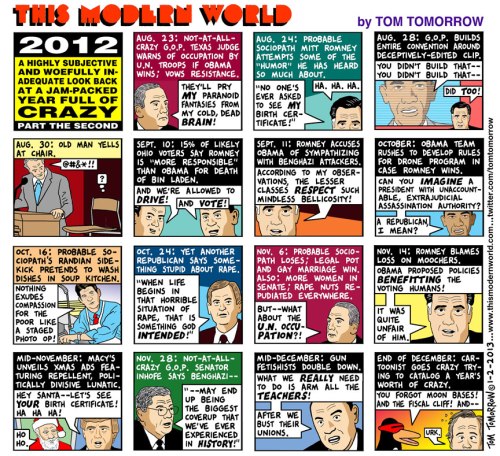
Tom Tomorrow (Dan Perkins) is just about the best editorial cartoonist in America. He won this year’s Herblock Prize, named for the dean of modern editorial cartoonists.

Here is the current edition of This Modern World

TMW Current

If you would like to be delighted by a collection of all from this past year or so, visit The Nation.

It’s hard to pick out just one more to show off. This is Tom Tomorrow’s review of 2012
TMW 2012 1TMW 2012 2